Is NoCode the Future? What the 2026 Data Says

NoCode will not replace all software development, but it is on track to become the default assembly method for most business applications. According to Gartner forecasts, over 75% of new enterprise applications will be built with low-code or no-code technologies by 2026, up from under 25% in 2020.
Table of Contents:
- Key Takeaways
- Introduction
- Is NoCode the Future, or Did the Category Already Peak?
- Why Did Airtable Sell for 2.7x Its Recurring Revenue?
- Does AI Replace NoCode, or Does It Need NoCode to Ship Safely?
- What Is Actually Running Under a Drag-and-Drop Editor?
- Who Is Actually Building With These Tools in 2026?
- Is NoCode the Future for Small Agencies and Lean Ops Teams?
- Honest Tradeoffs
- FAQ
Key Takeaways
- Airtable's roughly 89% valuation drop was not a product failure. It was a repricing of something every software buyer should now understand.
- The security evidence against raw AI-generated code is far stronger than most builders assume, and it quietly strengthens the case for visual platforms.
- Every serious NoCode limitation clusters in one predictable place, and it is not the place non-technical builders usually check before committing.
Introduction
Airtable peaked at an $11.7 billion valuation in December 2021 and agreed to sell for $1.285 billion in August 2026. That gap is exactly why agency operators and ops leads keep asking the same question: is NoCode the future, or a category that already had its moment? The adoption data and the valuation data point in opposite directions, which is what makes the question genuinely hard to answer.
I have watched both narratives get oversold. One camp says AI made visual builders irrelevant. The other says visual building is eating enterprise IT. The evidence supports a stranger third answer.
Here is what the 2026 numbers, the acquisitions, and the security research actually show about where visual development is heading.
Is NoCode the Future, or Did the Category Already Peak?
Adoption is accelerating while valuations compress, and both facts are true at once. Analyst forecasts put the visual development market on a steep multi-year climb, driven by enterprise IT backlogs rather than hobbyist demand. The category is expanding into infrastructure, even as individual platforms lose pricing power.
The forecasts vary widely depending on how each firm draws the category boundary:
- NextMSC: the low-code application platform market reached $36.81 billion in 2024 and $49.43 billion in 2025, projected to hit $215.97 billion by 2030 at a 34.3% CAGR.
- Fortune Business Insights: values the same market at $32.0 billion in 2024, forecasting $264.40 billion by 2032.
- Kissflow and Gartner: report a more conservative $30.1 billion in 2024, reaching $101.7 billion by 2030.
- Dataintelo: sizes the narrower no-code builder segment at $24.8 billion in 2025, with North America accounting for 38.2% of global sales.
That spread of $30 billion to $37 billion for the same year tells you the category has no agreed perimeter yet. Everyone is measuring a different animal. A market where credible analysts disagree by 20% on its current size is a market still deciding what it actually is.
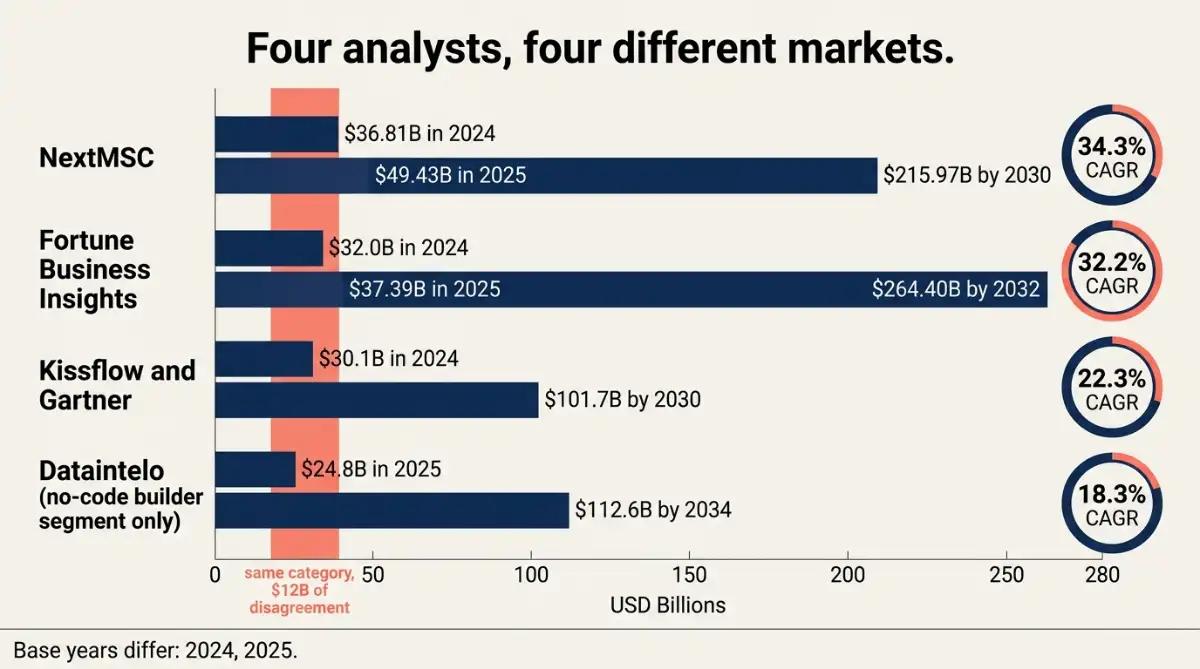
What the estimates agree on is direction. Every major firm models double-digit compound growth through 2030 at minimum, and Dataintelo's narrower reading still projects $112.6 billion by 2034. For a fuller breakdown of the competing forecasts, the no-code market size data for 2026 lays out each methodology side by side.
Why Did Airtable Sell for 2.7x Its Recurring Revenue?
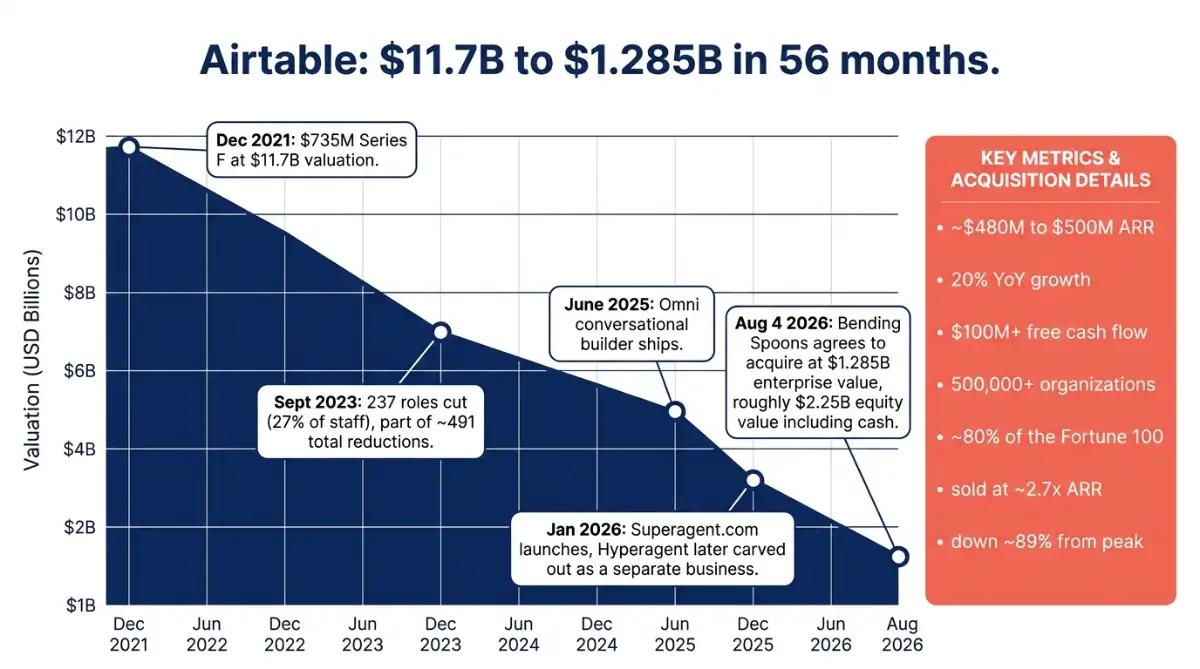
The Airtable sale is the clearest financial signal in the category. After raising $735 million in December 2021 at an $11.7 billion valuation, the company agreed on August 4, 2026 to be acquired by Milan-based Bending Spoons for an enterprise value of $1.285 billion in cash, roughly $2.25 billion in equity value once cash balances are included.
The operating business was not struggling in any conventional sense:
| Metric | Airtable at acquisition (2026) |
|---|---|
| ARR | ~$480M to $500M |
| YoY growth | 20% |
| Free cash flow | $100M+ |
| Customers | 500,000+ organizations, ~80% of the Fortune 100 |
| Operating multiple | ~2.7x ARR |
Profitable, growing, deeply embedded, and still repriced at roughly 89% below peak. The path there included two workforce reductions totaling around 491 employees, including 237 cuts (27% of staff) in September 2023.
"It's a sickening feeling. I made the decisions that got us here." Howie Liu, CEO of Airtable, September 2023
One detail matters more than the headline number. Airtable's autonomous AI division, Hyperagent, was carved out into an independent business before the deal closed. The AI assets were worth separating; the visual database was worth 2.7 times its recurring revenue. That is the whole lesson in one transaction, and the full Airtable story from spreadsheet to relational database fills in how the product got there. If you are evaluating it as a working database today rather than as a cautionary tale, the Airtable pricing and use case breakdown is the more useful page.
Does AI Replace NoCode, or Does It Need NoCode to Ship Safely?
Generative AI removed the effort premium that justified expensive software, but it did not remove the need for governed execution. Prompt-driven building produces working prototypes fast and insecure production code just as fast. The security research on this is not ambiguous.
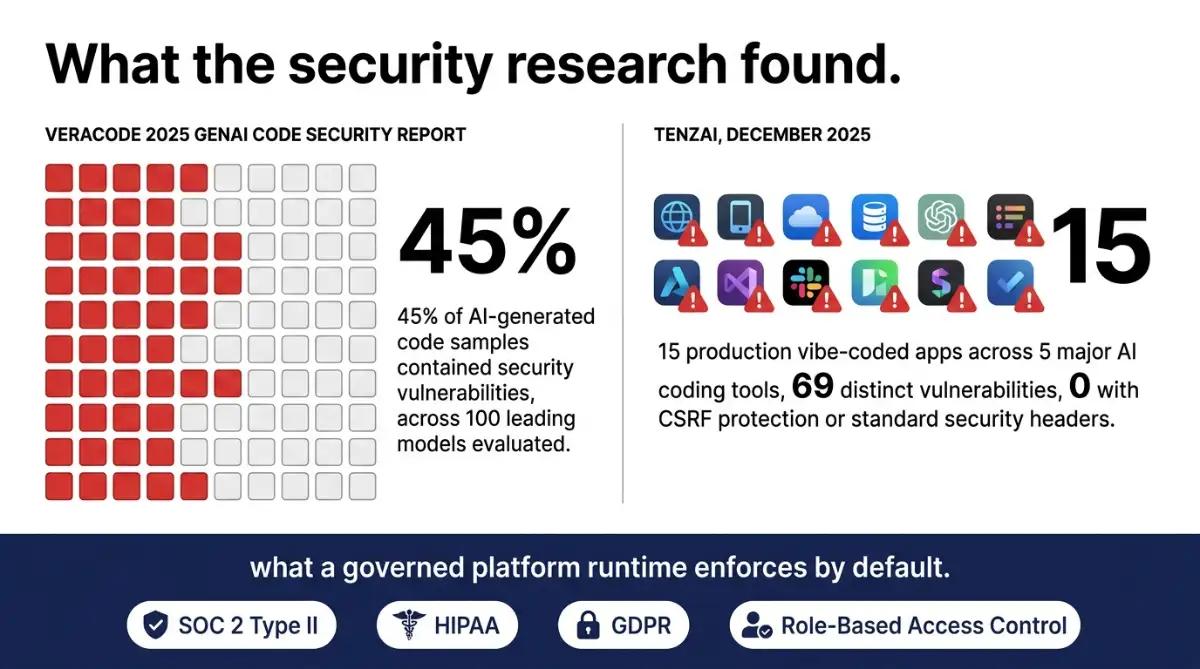
The findings that should reframe the debate:
- According to Veracode's 2025 GenAI Code Security Report, evaluating 100 leading models, AI-generated source code contains security vulnerabilities 45% of the time.
- A December 2025 Tenzai study tested 15 production applications built across five major AI coding tools and found 69 distinct vulnerabilities.
- Every single application in that Tenzai sample lacked Cross-Site Request Forgery protections and standard security headers.
Not most of them. All of them.
"Anyone can use generative AI as a partner at work, even if they don't have a traditional education." Satya Nadella, CEO of Microsoft, TIME Magazine, May 2023
Nadella is right about access, and that is precisely the problem. Access without guardrails is how you get 15 out of 15 apps missing CSRF protection. So the plausible future is not AI versus visual builders, it is AI agents writing into visual platforms that enforce authentication, role-based access control, and SOC 2 compliant runtimes by default. Capgemini reaches a similar conclusion in its analysis of scalable delivery beyond vibe coding. The distinction between these two approaches is covered properly in no-code versus vibe code, and the platform-side risk picture in this 2026 no-code security reality check.
How Has the Vibe Coding Boom Actually Changed No-Code in 2026?
The boom did not kill visual building. It split the category in two. AI-native generators now write real React and TypeScript from a prompt, while established platforms bolted conversational agents onto their existing editors. Capital flowed overwhelmingly toward the first group, and the incumbents responded by buying their way in.
The speed of the money is the part worth sitting with:
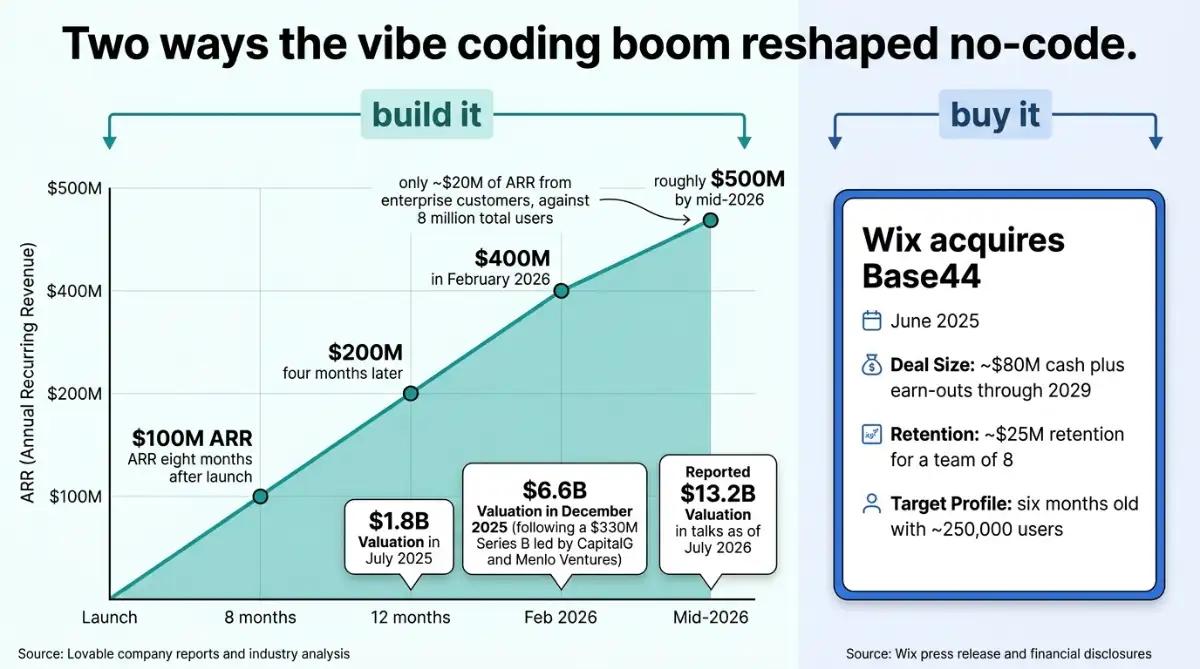
- Lovable hit $100 million ARR within eight months of launch, then doubled it four months later, according to TechCrunch's reporting on its $330 million Series B at a $6.6 billion valuation in December 2025.
- By February 2026 that figure had crossed $400 million ARR with roughly 8 million users, per Forbes, and TechCrunch reported in July 2026 that the company was in talks to raise at $13.2 billion.
- Wix acquired six-month-old Base44 in June 2025 for around $80 million in cash plus earn-outs running through 2029, adding roughly $25 million in retention payments for a team of eight. Buried in the Forbes reporting is the detail that complicates the story. Enterprise customers accounted for only about $20 million of Lovable's ARR. The explosive growth is prosumer growth, which is a different business from the one Airtable and Webflow built. A category can grow faster than anything in software history and still be selling mostly to people who were never going to buy enterprise seats.
Meanwhile the incumbents converged on the same playbook. Bubble shipped an in-editor AI agent that builds visual structures from natural language prompts. Webflow added AI credits across Workspace tiers and Answer Engine Optimization agents in May 2026. Framer introduced an AI assistant for generating on-brand components. The output is the tell: those agents produce proprietary visual configuration, while Lovable, Bolt, and v0 hand back a codebase you can take elsewhere. A side-by-side of the AI-native side sits in this comparison of Lovable, Bolt, and v0.
What Is Actually Running Under a Drag-and-Drop Editor?
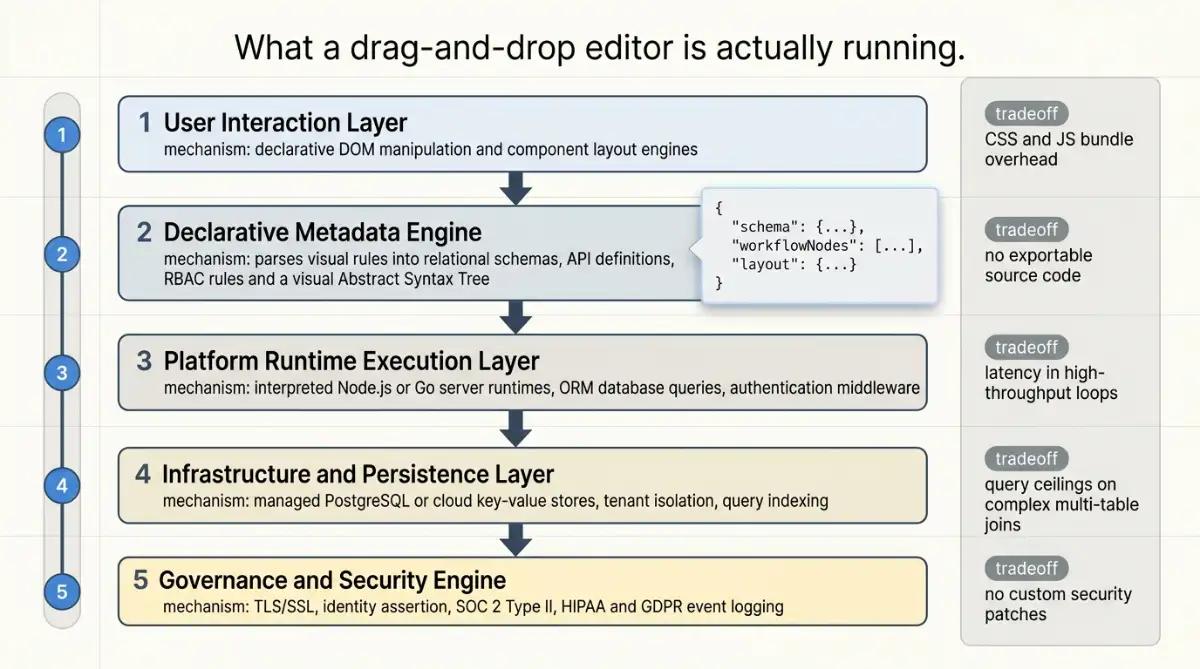
Modern NoCode platforms are not code generators. They are interpreted, declarative metadata engines: your visual edits are recorded as structured JSON or XML representing an Abstract Syntax Tree, a database schema map, workflow nodes, and layout definitions. Nothing compiles. Everything is interpreted at runtime.
That architecture explains both the speed and the ceiling:
| Layer | Mechanism | Advantage | Tradeoff |
|---|---|---|---|
| Visual front-end | Declarative DOM manipulation | Instant updates, no build step | CSS/JS bundle overhead |
| Workflow engine | Async event queues, execution graphs | No uncaught syntax exceptions | Latency in high-throughput loops |
| Data abstraction | Dynamic relational mapping | Auto-indexing and migrations | Query ceilings on complex joins |
| API integration | Webhook listeners, OAuth wrappers | Fast third-party connections | Exposed to rate limits and schema breaks |
| Governance engine | Tenant sandboxing, encryption | SOC 2, HIPAA, GDPR out of the box | No custom security patches |
Webflow sits slightly apart here, generating W3C-compliant semantic HTML5, CSS, and JavaScript directly from its browser-based design engine, which is a large part of why designers took it seriously. The story of how Webflow made no-code respectable covers how that engineering decision changed the tool's reputation, and the Webflow features and pricing overview covers where it currently sits.
This also settles a question people ask constantly. The reason visual apps rarely export to clean source code is structural, not commercial: there was never any source code in the first place, only interpreted configuration.
Who Is Actually Building With These Tools in 2026?
The growth is not coming from hobbyists. It is coming from business units that got tired of waiting for engineering capacity, and from IT departments that decided supervised building beats shadow IT. That shift created a job function that barely existed five years ago.
The backlog numbers explain the pressure. According to enterprise surveys published by Gartner, 73% of CIOs identify application backlogs as a primary barrier to digital execution, with average development queues reaching 14 months. Broader low-code adoption and ROI statistics point the same way. Fourteen months is long enough for the original business case to expire.
So the work moved sideways:
- Citizen developers: Gartner reports that 41% of enterprise organizations now run formal citizen development programs.
- Distribution shift: analysts expect 80% of low-code tool users to sit outside central IT departments by 2026.
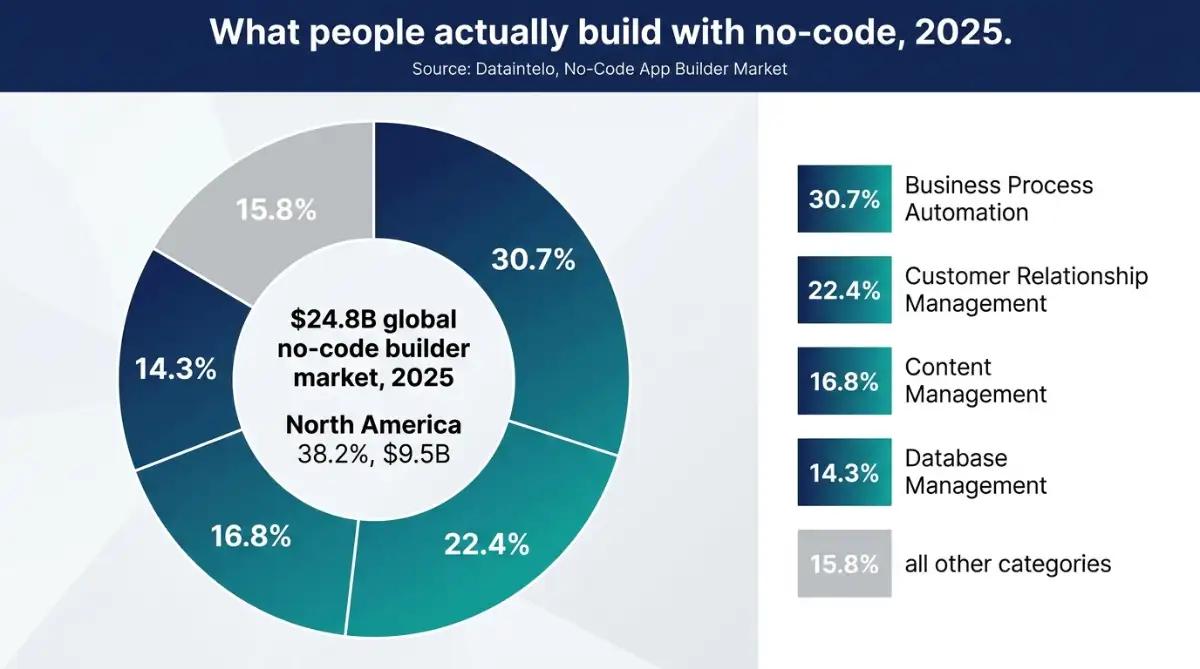
- What they build: Dataintelo's 2025 application breakdown puts business process automation at 30.7%, CRM at 22.4%, content management at 16.8%, and database management at 14.3%.
Notice what is missing from that list. Almost nobody is using these platforms to build the flagship product. They are automating approvals, portals, trackers, and internal reporting, which is unglamorous work that quietly consumes enormous engineering time. That is the seam where no-code ops has become a real career path.
Client portals are the clearest example. Tools like Softr grew by sitting on top of a database a team already maintains instead of asking them to migrate, and the Softr review and use cases show what that pattern looks like in practice.
Is NoCode the Future for Small Agencies and Lean Ops Teams?
For agency operators and ops leads, the answer depends almost entirely on what you are building, not on how technical your team is. Internal tools, client portals, content platforms, and validation MVPs are where visual development consistently wins. Anything latency-sensitive or hardware-adjacent is a category error.
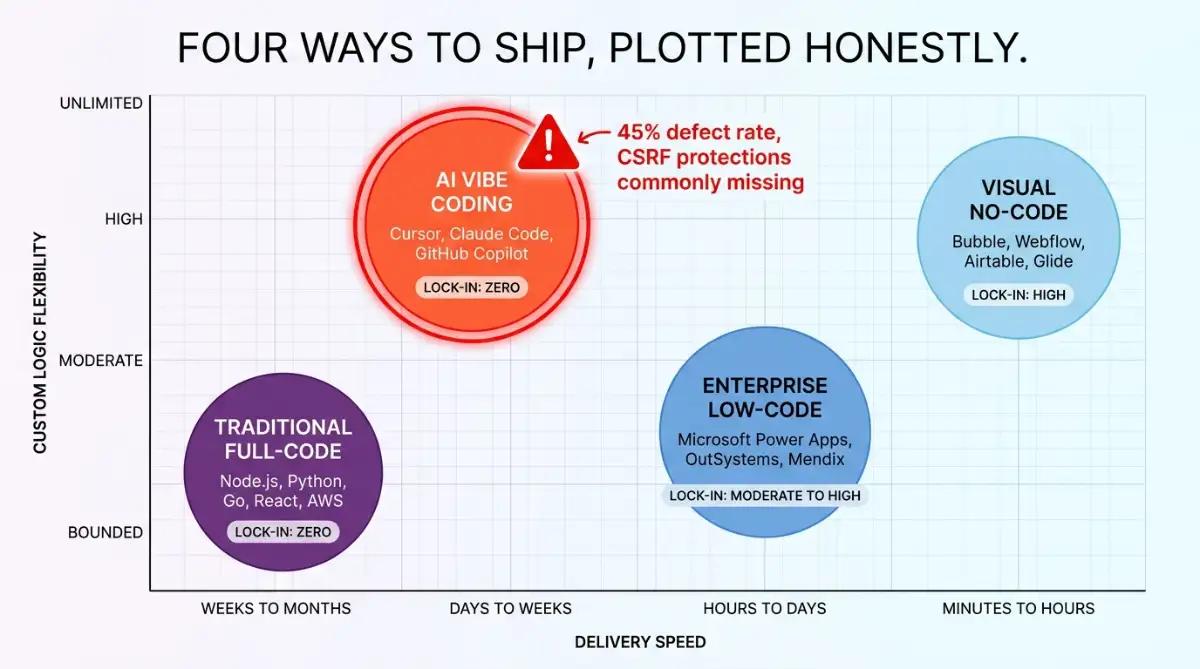
Here is how the four approaches actually compare:
| Factor | Visual NoCode | Enterprise Low-Code | AI Vibe Coding | Full-Code |
|---|---|---|---|---|
| Speed | Hours to days | Days to weeks | Minutes to hours | Weeks to months |
| Custom logic | Bounded by visual blocks | Custom code extensions | Bounded by hallucinations | Unlimited |
| Security | Platform-managed | Enterprise governance | 45% defect rate | Depends on discipline |
| Lock-in | High | Moderate to high | Zero | Zero |
Matching the build type to the right tool category saves more time than any individual platform choice:
- Marketing sites, portfolios, and content pages: website builders
- Client portals, dashboards, and internal tools: web app builders
- Native or cross-platform products with device features: mobile app builders
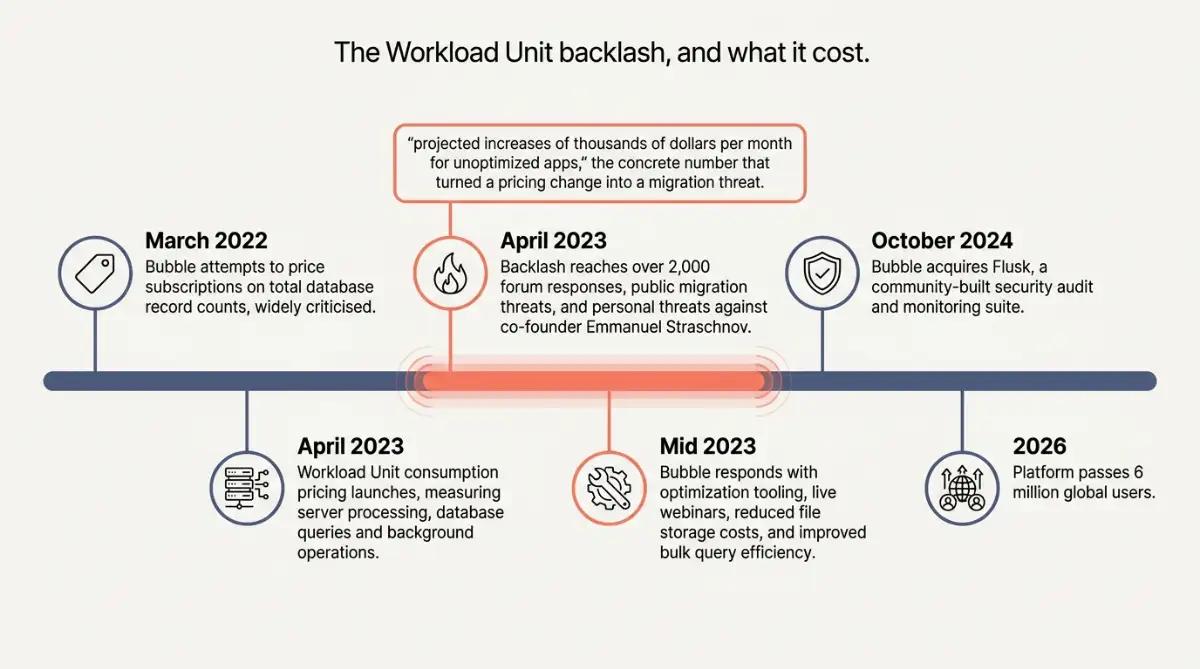
The ecosystem numbers back the practical case. Zapier now connects over 7,000 application endpoints and has executed more than 81 billion tasks, and its origin as the birth of no-code automation in 2012 explains why integrations became the category's real moat. Bubble has passed 6 million global users and acquired security auditing suite Flusk in October 2024. Webflow consolidated its CMS and Business plans into a single Premium tier at $25 per month in May 2026, adding AI credits across Workspace tiers.
"The frontier model leap handed every knowledge worker an engineer." Wade Foster, CEO of Zapier, 2026
For teams weighing subscription costs against engineering salaries, the real 2026 cost and scaling guide runs the comparison properly. Plan-level detail sits on the individual profiles, including Zapier's tiers and automation limits and the wider no-code tool directory.
Honest Tradeoffs
The strongest argument against NoCode is not capability, it is unit economics. In April 2023 Bubble replaced its pricing with a Workload Unit model measuring computing consumption, following a criticized 2022 attempt to price on database record counts. Applications running unoptimized searches or frequent API calls faced projected increases of thousands of dollars monthly. The response ran past 2,000 forum replies, public migration threats, and personal threats against co-founder Emmanuel Straschnov.
"Most apps will have a sufficient amount of workload included in their plan." Emmanuel Straschnov, co-founder of Bubble, April 2023
Bubble did respond with optimization tooling, lower storage costs, and better bulk query efficiency, and the current structure is documented on the Bubble pricing and features page. But the incident exposed the structural risk: on proprietary platforms, your cost curve is set by someone else's metering decisions, and success is what triggers the bill.
Vendor risk compounds it. Private equity acquisitions can restructure pricing and roadmaps, which is exactly the concern the Bending Spoons deal raised across Airtable's customer base. There are also hard technical walls. Sub-millisecond execution, heavy algorithmic math, device drivers, and OS-level file operations sit outside what interpreted runtimes can do, and no amount of AI assistance changes that.
The mitigation is boring but effective: verify before you commit that your relational data can be extracted continuously via automated backups or REST APIs, even if your interface stays locked to the editor. Own the data, rent the interface.
Start exploring launch-ready no-code templates here!
FAQ
What does NoCode actually mean?
NoCode describes platforms that let people build functional software through visual interfaces instead of writing syntax. Your configurations are stored as structured metadata and interpreted at runtime, rather than compiled into source files you own or edit directly.
Is NoCode the same thing as low-code?
No. NoCode targets business analysts, ops managers, and non-coders working entirely within visual abstractions. Low-code platforms like OutSystems, Mendix, and Microsoft Power Apps are built for hybrid teams, allowing professional developers to inject custom code snippets and API extensions.
How much do NoCode platforms cost?
Entry pricing is low, with Webflow's consolidated Premium tier at $25 per month as a typical example. The real variable is usage-based scaling: workload units, query volumes, and record limits can push costs up sharply as traffic grows.
Can NoCode apps handle real production traffic?
Yes, for most business applications. Airtable serves over 500,000 organizations including roughly 80% of the Fortune 100. Constraints appear with high-frequency transaction processing, complex multi-table joins, and workloads requiring sub-millisecond response times.
Do you own the code from a NoCode app?
Usually not, because there is rarely conventional source code to own. Webflow is the notable exception, generating standards-compliant HTML5, CSS, and JavaScript. Most platforms store visual metadata that does not export cleanly, so plan your data extraction path early.
Start building without code
Browse thousands of no-code templates for Webflow, Framer, Bubble, Lovable, Replit and more.
Explore Templates