What Is Airtable? The Spreadsheet That Became a Database
Airtable is a cloud-based relational database platform that combines the visual grid interface of a spreadsheet with the structured logic of a true database. Founded in San Francisco in 2012 by Howie Liu, Andrew Ofstad, and Emmett Nicholas, it lets non-technical teams build linked tables, typed fields, and custom internal apps without writing SQL.
Table of Contents:
- Key Takeaways
- Introduction
- What Makes Airtable Different from a Spreadsheet?
- Who Founded Airtable and Why Did They Stay in Stealth for Two Years?
- How Does Airtable's Backend Actually Work Under the Hood?
- How Did Airtable Reach an $11.7 Billion Valuation and Then Lose Two-Thirds of It?
- Why Did Airtable Cut a Third of Its Workforce in Nine Months?
- What Is HyperAgent and Why Did Airtable Bet the Company on AI Agents?
- Honest Tradeoffs
- FAQ
Key Takeaways
- Airtable's two-year stealth phase ended with an on-set Ashton Kutcher cheque, but the real story is what those two years bought the engineering team.
- The 75x revenue multiple Airtable hit in 2021 hid a structural growth problem that two rounds of layoffs, a doubled subscription price, and a 66% valuation cut would eventually expose.
- HyperAgent's 2026 launch reframes Airtable as an "agent system of record," and the implications for existing prosumer customers are stranger than the marketing suggests.
Introduction
Ask any operations lead at a 20-person company where the real work lives, and the honest answer is usually a Google Sheet with 14 tabs and three conditional formats. That is the audience Airtable was built for: small operations and design teams running multi-step workflows on spreadsheets they have outgrown. So what is Airtable, and why did it become the default upgrade when the sheet hit its limits?
The answer is a structured database wearing the friendly grid interface of a spreadsheet, founded in 2012, peaked at an $11.7 billion valuation, and now pivoting into autonomous AI agents. This piece walks through the engineering, the financial whiplash, and the agent bet that launched in early 2026.
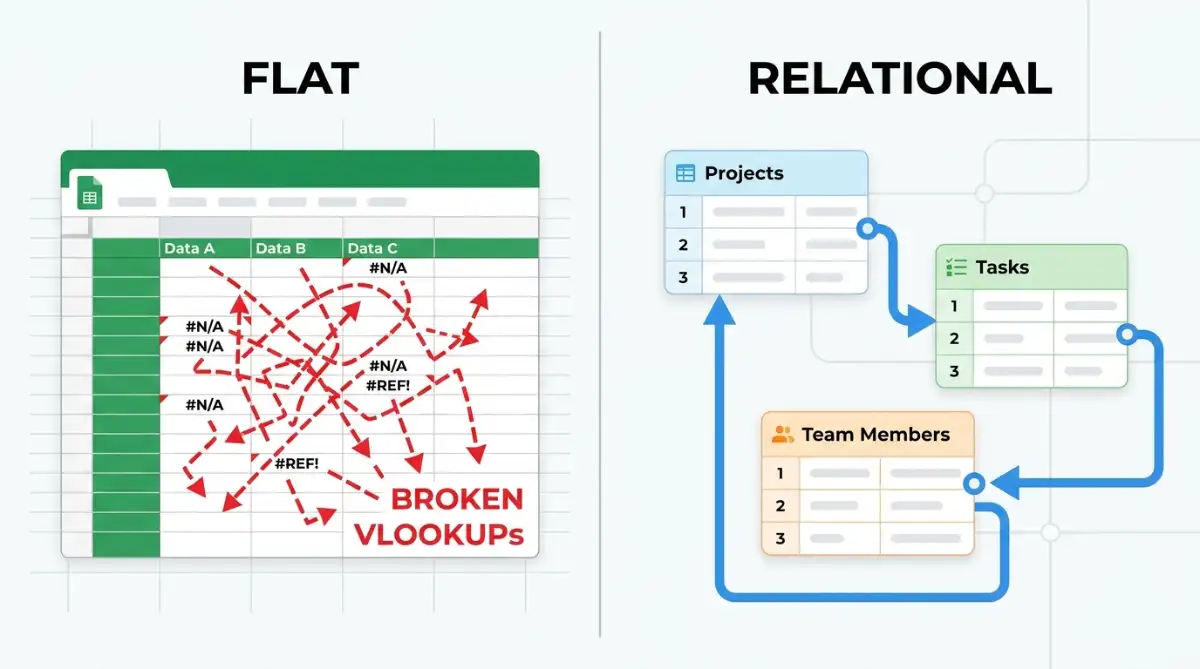
What is Airtable and what makes it Different from a Spreadsheet?
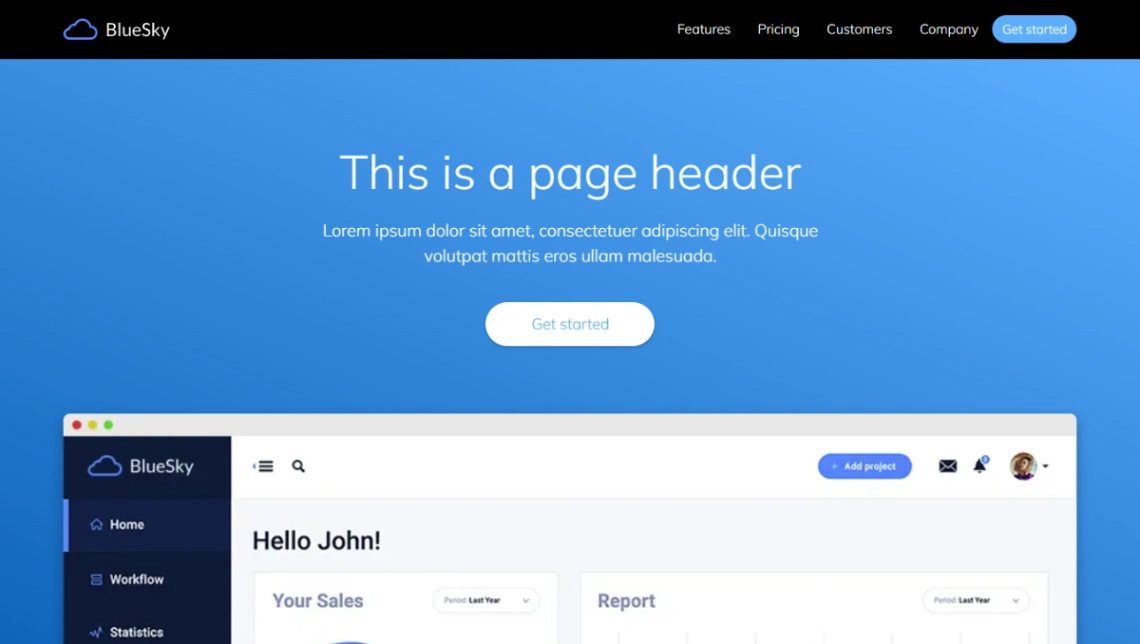
Airtable is a true relational database with a visual interface, not a prettier spreadsheet. While Google Sheets stores isolated text and number strings across grids that break the moment a formula gets copy-pasted into the wrong row, Airtable enforces typed fields, primary keys, and linked-record relationships without asking users to write a single line of SQL.
The mechanical difference matters more than the UI. In a spreadsheet, "5" can be a number, a string, or a date depending on which neighbour cell formats it. In an Airtable base, a field is locked to one type: number, attachment, single-select, barcode, linked record. Tables connect via a leftmost primary field, which functions exactly like a primary key in PostgreSQL.
Asked another way, what is Airtable doing that a spreadsheet is not? Enforcing structure at the field level, so multi-team workflows do not degrade into the entropy every non-technical builder eventually hits.
| Behaviour | Spreadsheet | Airtable |
|---|---|---|
| Field typing | None (every cell free-form) | Strict per-column type |
| Record links | Copy-paste references | True relational joins |
| Many-to-many | Manual junction sheets | Native via linked records |
| Real-time edits | Locking conflicts common | Sequential worker process |
Airtable's bet was that a database with the social ergonomics of a Google Sheet would beat a database with the rigour of a DBA console, and so far it has been right.
This shift sits at the centre of the broader low-code movement, where non-engineers build production tooling that used to require IT tickets.
Who Founded Airtable and Why Did They Stay in Stealth for Two Years?
Airtable was incorporated as Formagrid, Inc. in San Francisco in 2012. The two-year stealth phase that followed was not vanity. It was the structural work required to make a relational engine feel like a spreadsheet without lying to anyone. The founders brought three complementary backgrounds:
- Howie Liu (CEO): previously sold relationship-management startup Etacts to Salesforce in 2010; observed the spreadsheet-as-database misuse while a Salesforce PM.
- Andrew Ofstad: former Google product manager who led the Google Maps redesign.
- Emmett Nicholas: founding engineer at Stack Overflow.
The funding origin story is genuinely odd. According to Airtable's founding history, the team pitched investor Ashton Kutcher on the set of Two and a Half Men, where he reportedly committed on the spot. Airtable then raised a $3 million seed round in February 2015 from Caffeinated Capital, Freestyle Capital, Data Collective, and CrunchFund, followed by the public web and iOS launch in March 2015.
The 2012 cohort matters here. Bubble launched the same year, and so did Zapier, making 2012 the closest thing the no-code era has to a founding vintage.
How Does Airtable's Backend Actually Work Under the Hood?
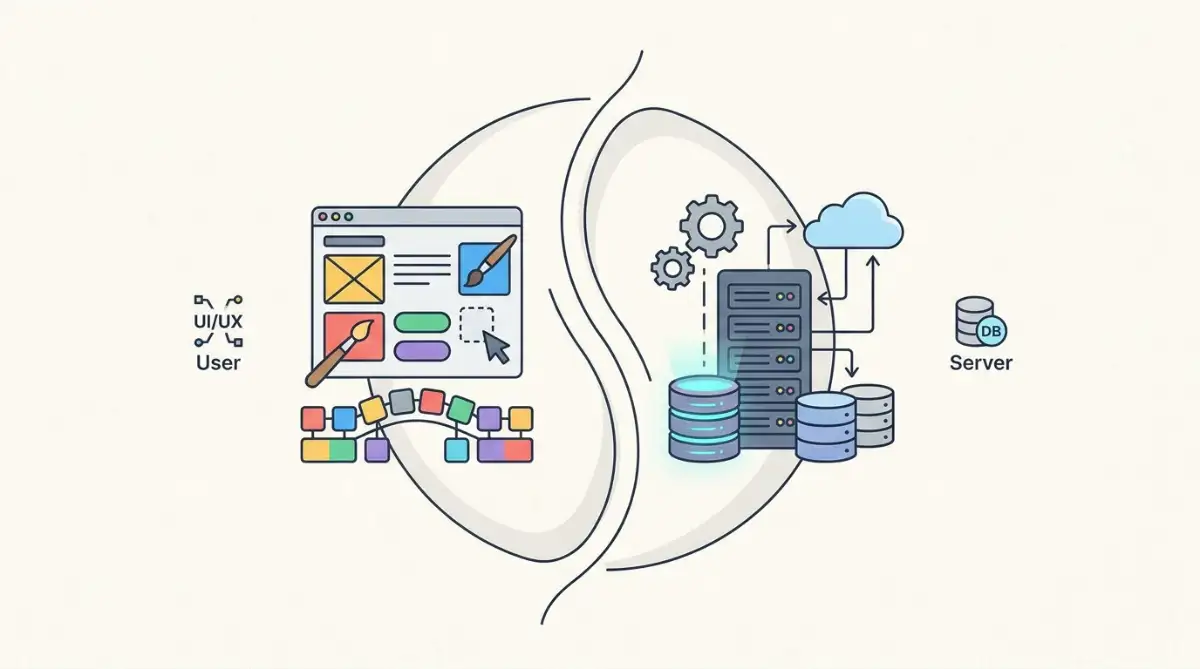
Underneath the friendly grid is an architecture engineered for write-heavy, multi-tenant collaboration at scale. Airtable does not route edits through a standard REST API. Each active base gets a dedicated worker process that executes operations sequentially, while a realtime service holds persistent WebSocket connections open to every collaborator on that base.
Sequential execution sounds boring. It is also why two operations leads editing the same record at 4:59pm on a Friday do not trigger a race condition. The architecture trades raw parallelism for transactional correctness, which is the right call for the kind of workflows non-technical builders actually run.
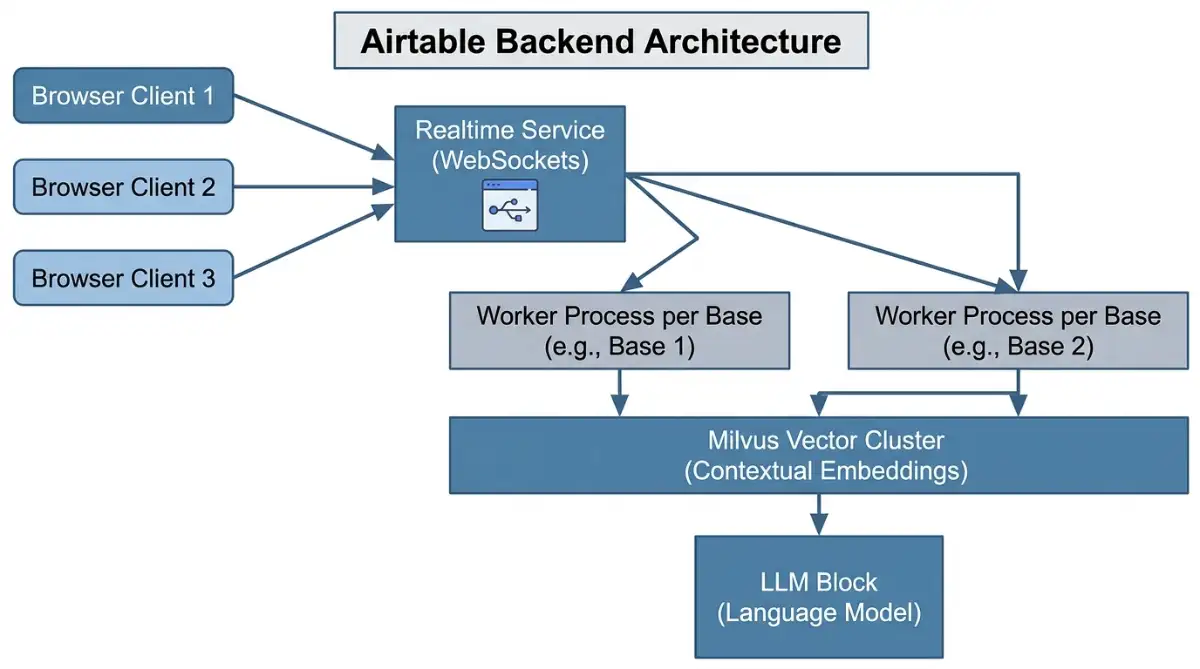
The four components below are the load-bearing pieces:
- Worker Process: one backend process per base, executing concurrent edits in sequence to prevent collisions.
- Realtime Service: persistent WebSocket layer that pushes micro-updates to every active client without page reloads.
- Recovery Engine: detects reconnections and backfills the diff a disconnected user missed.
- View Projection: loads only the cell slice visible on screen, not the entire table.
For its semantic-search and AI features, Airtable maps each base to a dedicated partition inside a Milvus vector cluster, using Hierarchical Navigable Small World (HNSW) indexing for 99% to 100% recall. According to Airtable's own engineering writeup published on Milvus.io, the system hits sub-500ms latency when feeding contextual data to LLMs. This puts Airtable closer to a true no-code application platform than to a glorified spreadsheet host.
The decision to give every base its own worker process is the kind of choice that looks expensive on paper and is invisible when it works.
How Did Airtable Reach an $11.7 Billion Valuation and Then Lose Two-Thirds of It?
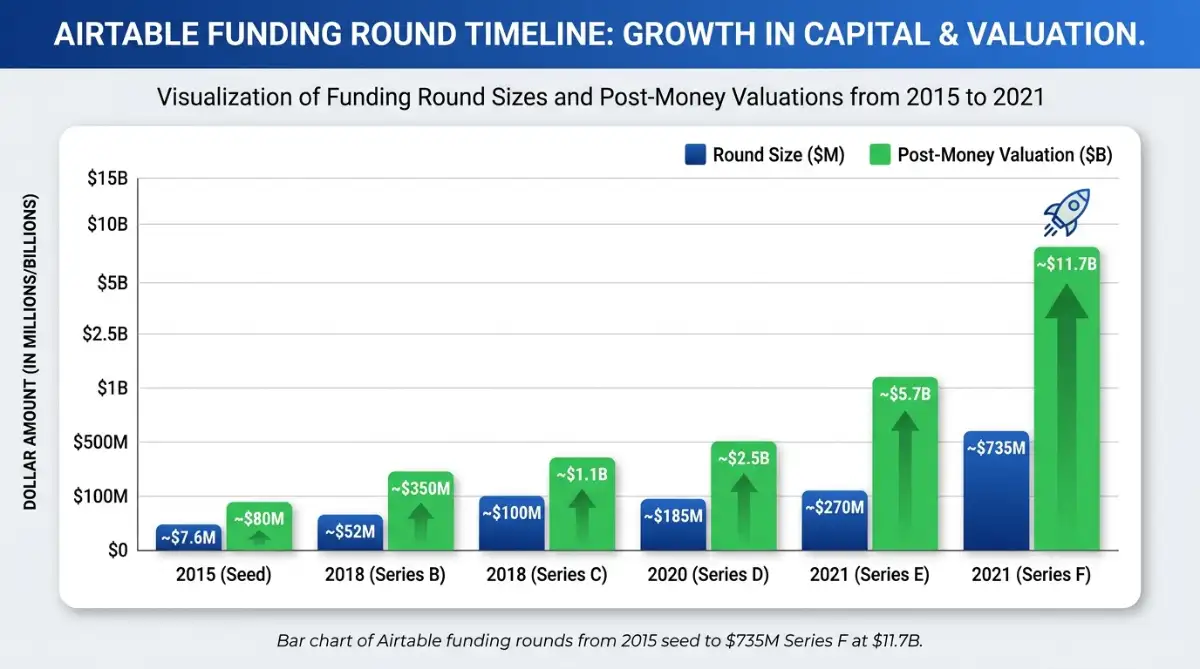
Airtable's valuation history is a textbook case of the 2021 zero-interest-rate peak followed by the 2022–2026 correction. The Series F closed in December 2021 at $735 million, valuing the company at $11.7 billion, led by Salesforce Ventures and Franklin Resources. On 2021 revenue of $156 million, that priced Airtable at roughly a 75x revenue multiple.
By early 2026, the same equity was trading on secondary markets at approximately $4 billion. That is a 66% decline from peak. According to TSG Invest's secondary-market reporting, the contraction tracked the broader SaaS reset rather than any single Airtable-specific event.
ARR climbed steadily even as the paper value fell:
| Metric | 2022 | 2023 | 2024 |
|---|---|---|---|
| ARR | $160M | $375M | $478M |
| YoY Growth | – | ~134% | 27.5% |
| Cash Flow | Negative | Negative | Positive |
Airtable's 170% enterprise net dollar retention, per its own disclosed metrics, outpaces Monday.com (120%) and Asana (130%). Valuation is a story investors tell each other. NDR is a story customers tell with their cheques.
Why Did Airtable Cut a Third of Its Workforce in Nine Months?
Airtable executed two large rounds of layoffs in roughly nine months, both tied to the same strategic shift: away from bottoms-up prosumer growth and toward top-down enterprise sales. In December 2022, the company laid off 254 employees, around 20% of its workforce. According to Computerworld's December 2022 coverage and Medium, the round coincided with the exit of the Chief Revenue Officer, Chief Product Officer, and Chief People Officer.
The optics got worse. Reports surfaced that CEO Howie Liu had purchased a $31 million estate in Los Angeles shortly before the layoffs, and the discourse was, predictably, brutal. I would argue the timing was indefensible regardless of intent.
Nine months later, in September 2023, Airtable cut another 237 positions, roughly 27% of remaining headcount. Self-serve support and marketing teams took the heaviest hit, signalling exactly where the company's revenue priorities now sat.
The pricing changes landed at the same time:
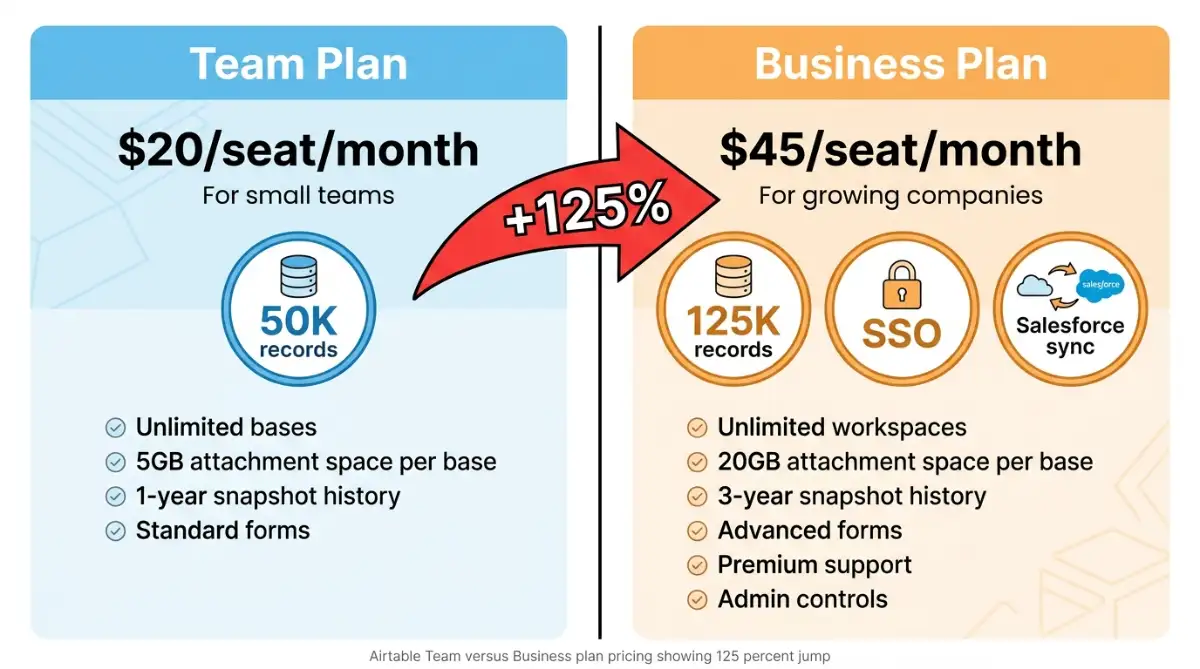
- Team plan: $10 to $20 per editor per month, a 100% increase.
- Business plan: $20 to $45 per editor per month, a 125% increase.
- Workspace-wide upgrades: one base hitting limits triggers a workspace-level tier change.
- Prorated refunds: abolished in October 2025 for mid-cycle seat removals.
For a 20-person operations team running on the Team plan, a single prototype base exceeding 50,000 records can force a workspace-wide upgrade to Business, adding roughly $6,000 in annual licensing. That cost lands squarely on the original customer base.
What Is HyperAgent and Why Did Airtable Bet the Company on AI Agents?
If the original question was what is Airtable, my read is the 2026 answer is no longer just "a relational database." In June 2025, the company relaunched as an "AI-native" platform, embedding generative AI directly into the relational schema. Two native features anchor the strategy. Omni is a conversational AI assistant that builds applications, designs interfaces, and runs analyses from plain-language prompts. Field Agents are AI agents embedded inside structured tables that classify records, draft localised marketing copy, run web research, and parse uploaded PDF invoices.
On October 13, 2025, David Azose joined as CTO from OpenAI, where he led engineering for ChatGPT's Business Products division. The same day, Airtable acquired DeepSky (formerly Gradient), a startup that had raised roughly $40 million in venture funding. Founders Chris Chang, Forrest Moret, and Mark Huang joined with twelve engineers to work on long-context models and multi-agent orchestration.
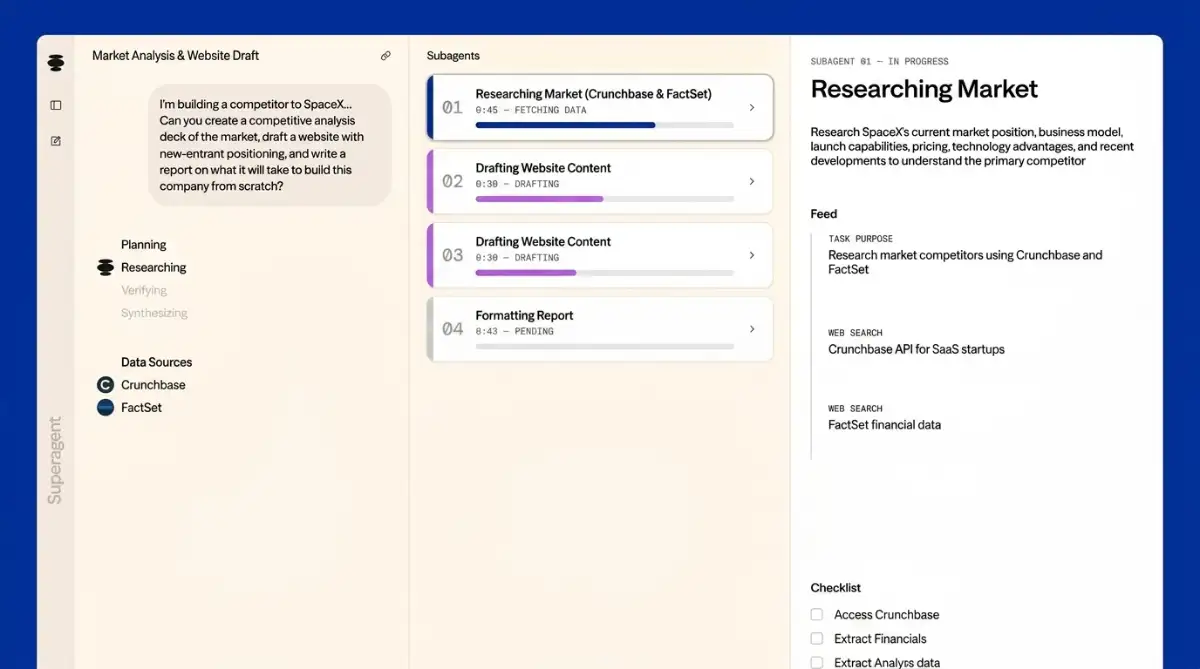
The product launch followed on January 27, 2026, when Airtable shipped Superagent, its first standalone product in over a decade. It was rebranded and expanded into HyperAgent in April 2026. Unlike linear chat tools, HyperAgent acts as a multi-agent orchestrator that assigns sub-tasks to specialised agents running in parallel, pulling data from Crunchbase and FactSet, and exporting structured presentation-ready files.
By positioning the relational base as an "agent system of record," Airtable is arguing that autonomous AI needs structured context the way enterprises need a CRM, and not a chat log.
On May 22, 2026, CEO Howie Liu announced the Founding 500 program, a $10 million infrastructure subsidy giving 500 agent-first founders $20,000 each in inference credits. The pitch: build on Airtable, and Airtable subsidises the compute. Whether prosumer customers, the audience Airtable raised prices on twice, follow into this new identity is the open question.
Honest Tradeoffs
Airtable's structural strengths come with structural limits that anyone betting infrastructure on it should know.
The 125% price jump from Team to Business penalises exactly the kind of growing teams that drove Airtable's early adoption. A single prototype base exceeding the 50,000-record cap pushes the entire workspace into the Business tier, even if 90% of the team only needs Team features. According to user complaints on the r/Airtable subreddit and pricing analysis from SaaS Price Pulse, this triggers a great deal of forced upgrades.
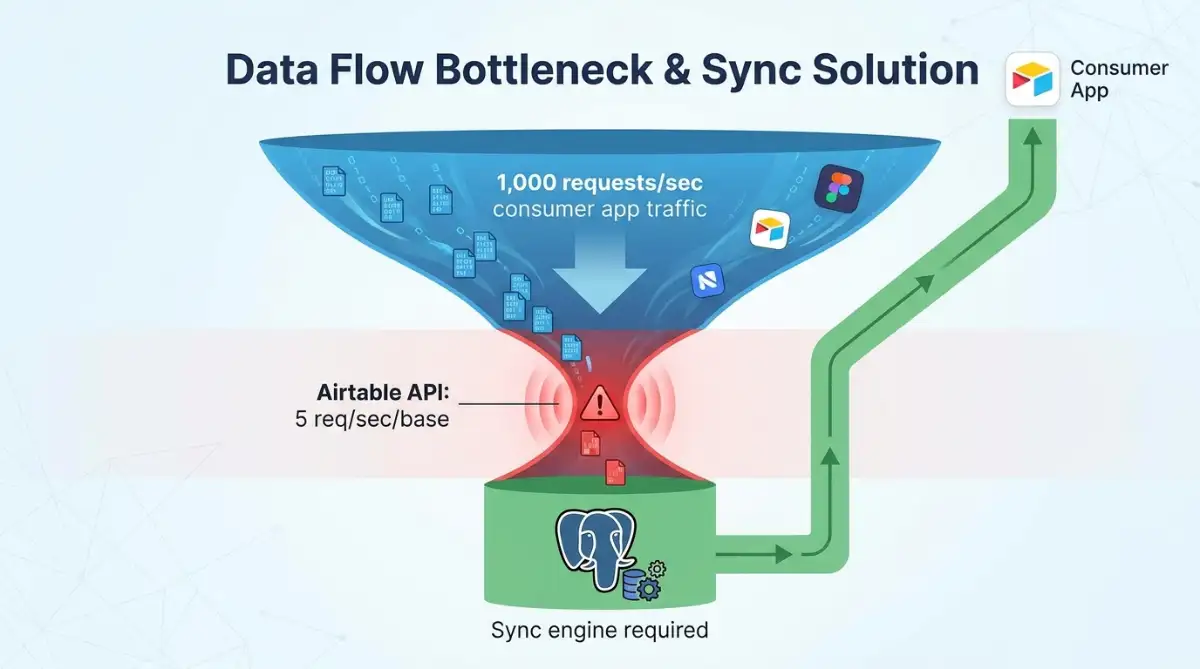
The API rate limit of 5 requests per second per base is universal across all plans, including Enterprise. For any consumer-facing application with meaningful traffic, that ceiling is hit in minutes. According to Whalesync's documentation on Airtable record limits, teams routinely build external sync engines to PostgreSQL or Supabase just to work around it, adding architectural cost most operations leads will never want to own.
The vendor lock-in is real and underdiscussed. Airtable exports individual tables as CSVs but cannot export a full base with its schema, linked-record relationships, and interface views intact. Migrating off Airtable means rebuilding the relational model from scratch. There are no native staging environments either, so testing schema changes requires manually cloning a base, which changes every record and field ID and breaks live integrations.
Start exploring launch-ready no-code templates here!
FAQ
Is Airtable free to use? Yes, the Free tier costs $0 and supports up to 5 editors, 1,000 records per base, and 1 GB of attachment storage. According to Airtable's pricing page, viewers and form submitters never count against the seat limit on any plan, which keeps shared bases genuinely free for external collaborators.
Is Airtable better than Google Sheets for small teams? It depends on whether your data is relational. Google Sheets wins for free-form numerical modelling and one-off calculations. Airtable wins the moment you have two or more linked datasets, since native record links and typed fields prevent the spreadsheet entropy that destroys multi-team workflows.
Can Airtable replace PostgreSQL as a real database? Not for high-traffic transactional workloads. According to Airtable's documentation, the 5-requests-per-second API ceiling and the 500,000-record-per-base cap make it unsuitable as a primary backend for consumer applications. Teams typically sync Airtable to PostgreSQL or Supabase for production workloads.
Who owns Airtable in 2026? Airtable is still a private company led by co-founder Howie Liu as CEO. Major institutional investors from the Series F round include Salesforce Ventures and Franklin Resources, alongside earlier backers Caffeinated Capital, Charles River Ventures, and CrunchFund. According to Sacra's company profile, secondary-market valuation sat near $4 billion in early 2026.
What's the difference between Airtable and Notion? Notion is document-first, with databases bolted onto a page hierarchy. Airtable is database-first, with documents and interfaces built on top of structured tables. For workflows that depend on linked records, typed fields, and views over the same underlying data, Airtable's relational engine is structurally more rigorous.
Start building without code
Browse thousands of no-code templates for Webflow, Framer, Bubble, Lovable, Replit and more.
Explore Templates