What Is SaaS? The Modern Business Model Explained (2026)
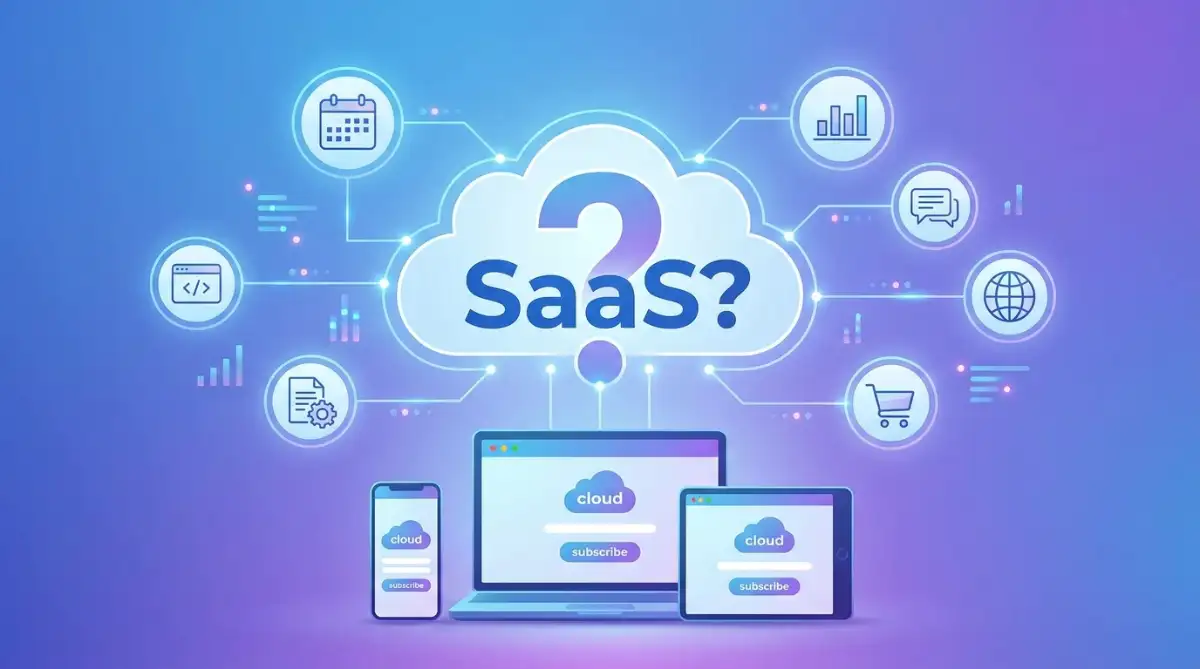
SaaS (Software as a Service) is a cloud delivery model where an application runs on the vendor's servers and customers access it through a browser for a recurring subscription fee. The vendor handles hosting, security patches, and updates, while customers pay per seat or per usage instead of buying licenses and hardware upfront.
Table of Contents:
- Key Takeaways
- Introduction
- What Is SaaS and How Does the Model Actually Work?
- Where Did SaaS Come From? A 60-Year Origin Story
- How Does Multi-Tenancy Keep Thousands of Customers on One App?
- How Big Is the SaaS Market in 2026?
- What Does SaaS Cost a Small Agency Compared to On-Premises Software?
- Is SaaS Being Replaced by AI Agents?
- FAQ
Key Takeaways
- Salesforce cut hosting costs from up to $18,000 per customer to under $2,000 with one architectural decision, and that decision still defines every subscription tool you use today.
- The research firms sizing the SaaS market disagree by almost $100 billion for 2025, and the reason why says a lot about what actually counts as SaaS.
- Gartner has flagged $234 billion in software spend as exposed to "agentic arbitrage," a shift that could quietly end the per-seat pricing model most vendors depend on.
Introduction
If you run a small agency or a one-person business, you probably pay for eight to fifteen subscription tools without ever asking what is SaaS, exactly, or why it took over. Understanding what is SaaS matters more in 2026 than it did a decade ago, because the model itself is mutating under pressure from AI agents.
According to Gartner's February 2026 forecast, worldwide IT spending will hit $6.15 trillion in 2026, and SaaS captures roughly 54% of all public cloud revenue. That's your invoices, multiplied by every business on the planet. I've watched solopreneurs treat these tools as background noise, then get blindsided by an 8% to 12% annual price hike. This guide explains where the model came from, how it works under the hood, and where it's headed next.
What Is SaaS and How Does the Model Actually Work?
Software as a Service means the vendor runs the application on its own cloud infrastructure and rents you access, typically through a browser, for a monthly or annual fee. You never install anything, never patch anything, and never own the software. The vendor ships updates automatically, and your cost scales with seats or usage.
The economic trade is the interesting part. Traditional software was a capital expense (CapEx): a big upfront license, plus servers, plus IT staff. SaaS converts all of that into an operating expense (OpEx) you can cancel. That's why a two-person design studio can run the same CRM stack as a Fortune 500 company on day one.
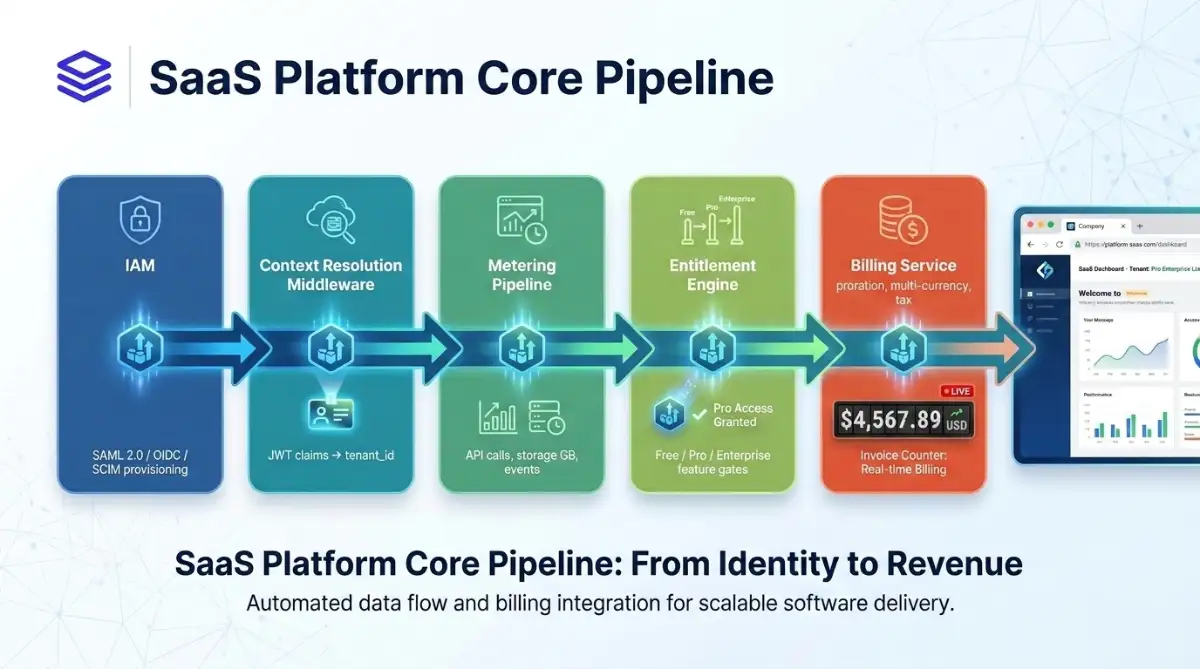
A typical SaaS platform is held together by five modules working in concert:
- Identity & Access Management (IAM): login and user lifecycle via protocols like SAML 2.0 and SCIM
- Context resolution middleware: figures out which customer a request belongs to
- Metering pipeline: counts API calls, storage, or events for billing
- Entitlement engine: unlocks features based on your subscription tier
- Billing service: handles proration, currencies, and tax
You never own SaaS software. You rent access to an outcome, and that single fact explains both its low entry price and its long-term cost creep.
If you're exploring what a no-code builder is, you're already looking at SaaS: nearly every visual builder on the market runs on this exact model.
Where Did SaaS Come From? A 60-Year Origin Story
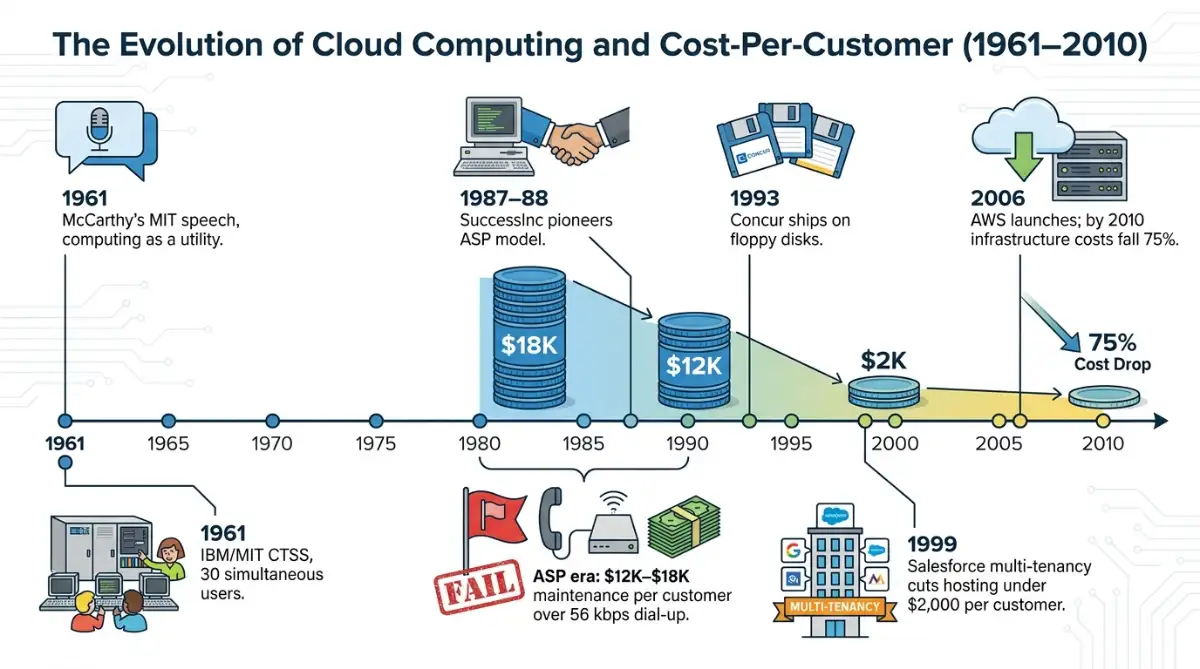
The idea predates the web by three decades. Computer scientist John McCarthy proposed in a 1961 MIT speech that computing should be sold like a public utility, the way you pay for electricity or water. Mainframe time-sharing systems like IBM and MIT's CTSS (1961) made that real for up to 30 simultaneous users, before cheap PCs killed the model in the 1980s.
The 1990s revival came through Application Service Providers (ASPs), and it mostly failed. ASPs ran each customer on separate hardware, which pushed maintenance costs to $12,000 to $18,000 per customer per year, all delivered over 56 kbps dial-up. Networks like USI and Futurelink couldn't scale.
Three companies cracked it:
- Concur (1993): started selling expense software on floppy disks, migrated to browser-native subscriptions, and sold to SAP for $8.3 billion in 2014
- NetSuite (1998): launched as NetLedger, a web-based accounting tool for SMBs; Oracle acquired it in 2016 for $9.3 billion
- Salesforce (1999): Marc Benioff's "End of Software" pitch, and the first true multi-tenant architecture
Then AWS arrived in 2006 and handed every startup rentable infrastructure. By 2010, cloud infrastructure costs had fallen 75% compared to 2006, and the subscription model became the default. For the fuller Salesforce story, see the OG SaaS builder that changed the web.
How Does Multi-Tenancy Keep Thousands of Customers on One App?
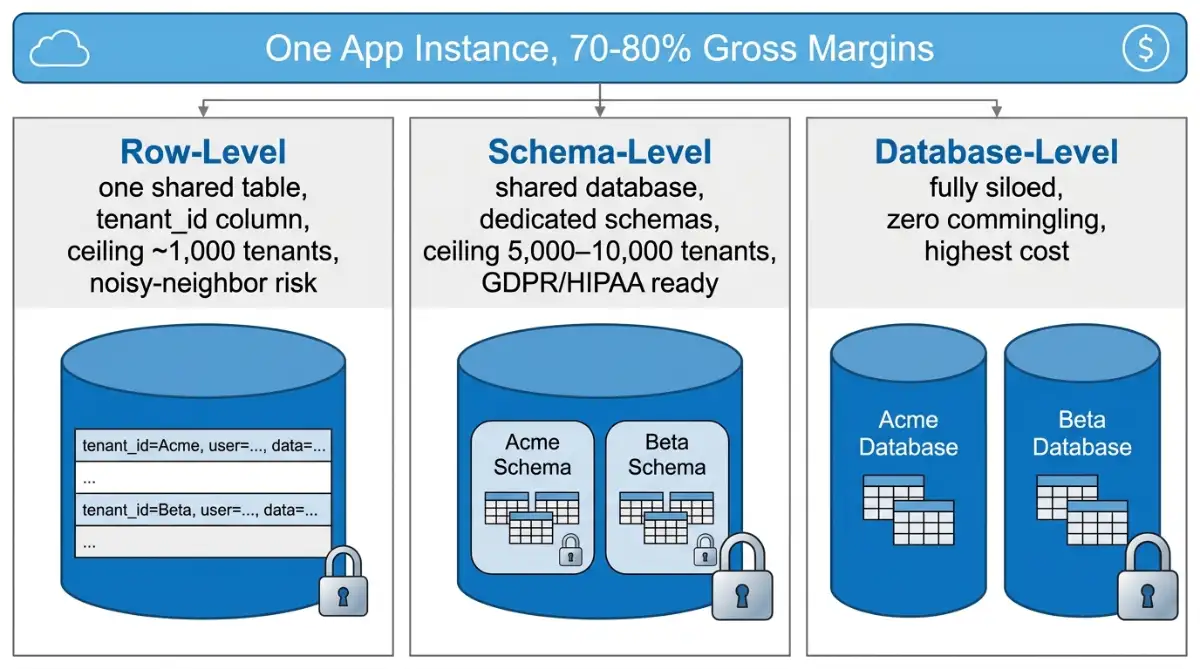
Multi-tenancy is the architecture that made SaaS economics work: a single application instance serves many isolated customer accounts (tenants) on shared infrastructure. Salesforce proved the payoff, hosting all customers on one codebase with database-level logical separation, cutting hosting costs to under $2,000 per customer annually and reaching 70% to 80% gross margins.
The design question is how strictly to separate tenant data. There are three standard models:
| Isolation Model | How It Works | Practical Ceiling | Best For |
|---|---|---|---|
| Row-level (shared everything) | All tenants in one database, separated by a tenant_id column | ~1,000 tenants before performance degrades | Early-stage, price-sensitive products |
| Schema-level | Shared database, dedicated schema per tenant | 5,000 to 10,000 schemas per instance | Growth-stage B2B with GDPR or HIPAA needs |
| Database-level (siloed) | Entirely separate database per tenant | Capped by infrastructure cost and ops overhead | Finance, healthcare, large enterprise |
Row-level isolation is cheapest but risks the "noisy neighbor" problem, where one heavy tenant degrades everyone's performance. Siloed databases eliminate that entirely, at the highest cost.
Multi-tenancy is a bet that thousands of strangers can safely share one application, and the entire subscription economy rests on winning that bet.
The shared model has a dark side, though. In the May 2024 Snowflake incident documented by BlackFog, the ShinyHunters group used malware-harvested credentials to enter 165+ customer accounts lacking MFA, exfiltrating 560 million Ticketmaster records and 109 million AT&T call logs. Vendors secure the platform; you're still responsible for your own credentials, permissions, and backups. That split is called the shared responsibility model, and it's worth reading alongside whether no-code is secure.
How Big Is the SaaS Market in 2026?
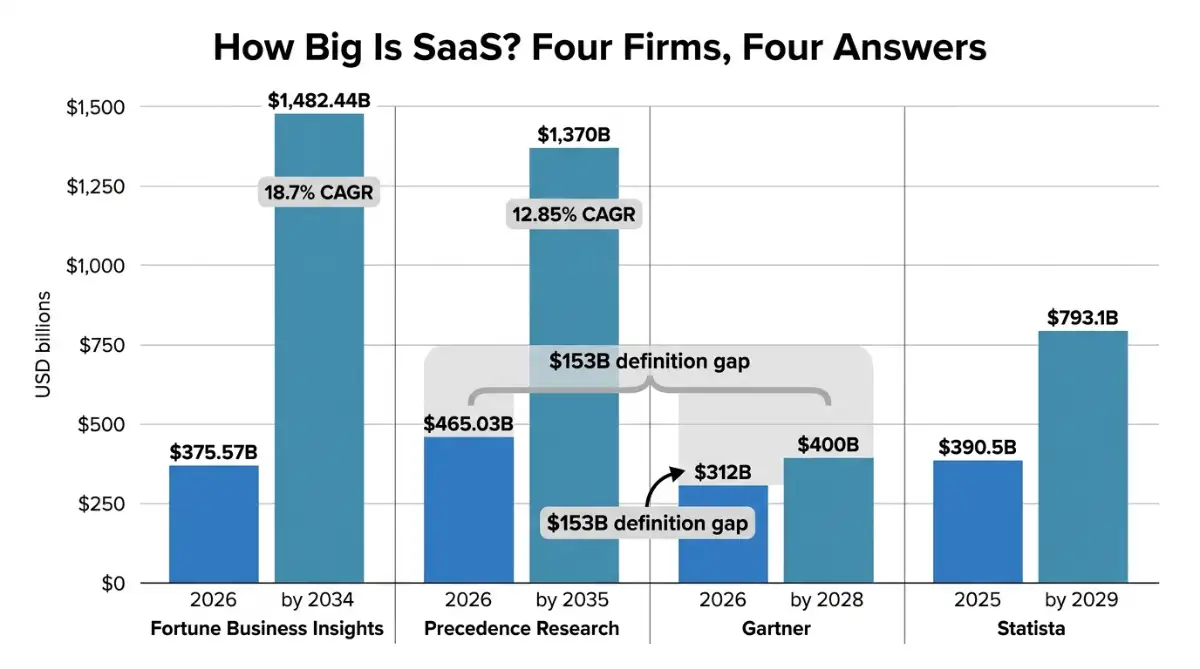
Enormous, but the exact number depends on who's counting. Fortune Business Insights puts the 2026 market at $375.57 billion, growing at 18.7% annually toward $1.48 trillion by 2034. Precedence Research says $465.03 billion for 2026, while Gartner's narrower baseline sits at $312 billion. The spread exists because each firm draws different boundaries around what counts as SaaS.
Here's how the estimates compare:
| Research Firm | 2026 Estimate | Long-Range Forecast | Scope |
|---|---|---|---|
| Fortune Business Insights | $375.57B | $1,482.44B by 2034 | Business application suites only |
| Precedence Research | $465.03B | $1,370B by 2035 | Includes cloud databases, APIs, dev tools |
| Gartner | $312B | $400B by 2028 | End-user public cloud SaaS spend |
| Statista | N/A (2025: $390.5B) | $793.1B by 2029 | Consumer plus B2B aggregated |
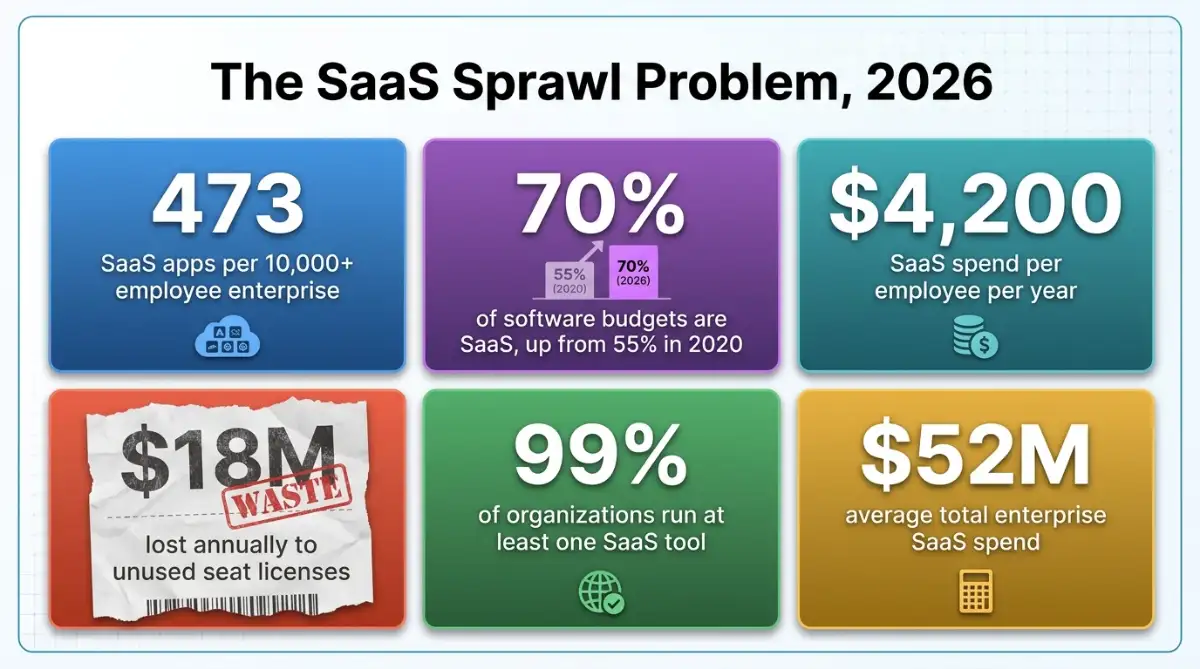
The spend side is just as striking. According to enterprise procurement research in the field, SaaS now consumes 70% of total software budgets, up from 55% in 2020, and large enterprises with over 10,000 employees maintain an average of 473 distinct SaaS applications. The waste is real too: the average enterprise loses roughly $18 million per year on unused seat licenses. Small operators aren't immune; the mechanics are identical at $4,200 per employee per year, just with fewer zeros. For deeper adjacent numbers, see no-code market size and forecasts.
What Does SaaS Cost a Small Agency Compared to On-Premises Software?
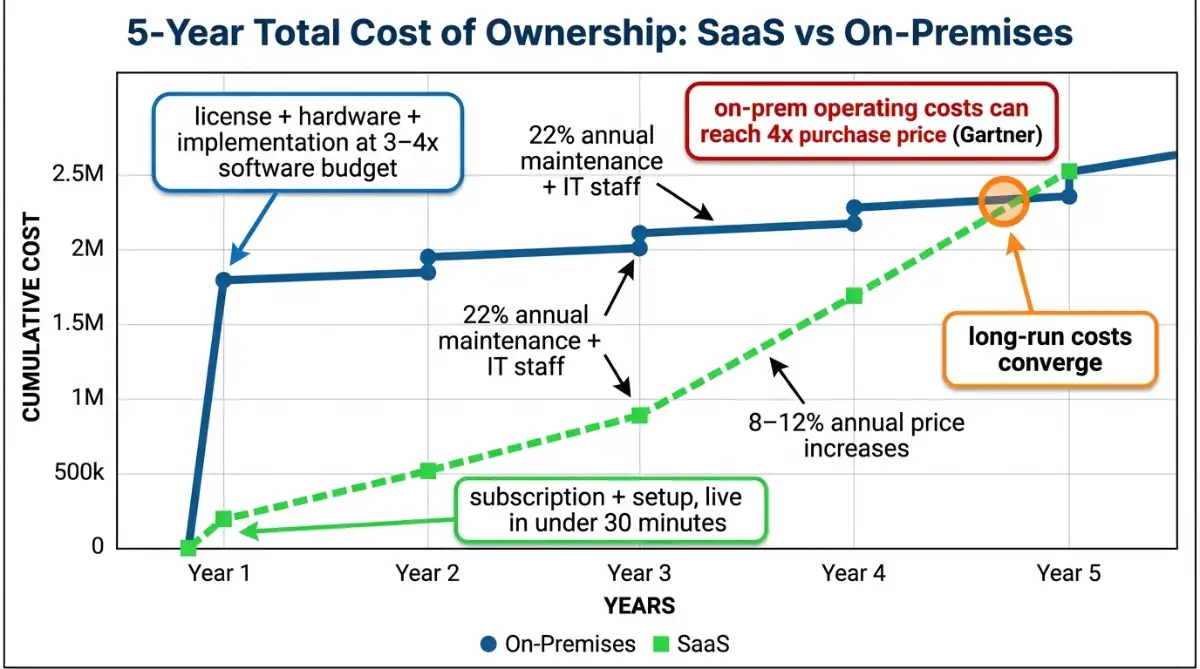
Over five years, SaaS wins on predictability, not always on total spend. On-premises software front-loads cost into year one (license, hardware, implementation), then bleeds annual maintenance averaging 22% of the license price. Gartner finds annual operating costs for on-prem software can reach four times the initial purchase price once you count power, space, and staff.
The contrast in practice:
- Deployment: SaaS activates in under 30 minutes; on-prem takes 6 to 12 months of procurement and tuning
- Implementation: on-prem implementation often runs three to four times the original software budget
- Innovation drag: Deloitte reports legacy on-prem systems eat 64% of enterprise IT budgets, leaving 36% for anything new
- Staffing: SaaS needs almost no internal IT; on-prem needs database admins, network engineers, and security teams
For a five-person agency, that math is decisive. You don't have a server room, and you shouldn't want one.
The honest caveat: subscriptions compound. Vendors commonly push 8% to 12% automatic annual increases, sometimes 15% to 25%, and per-seat pricing punishes you for hiring. My contrarian take is that SaaS isn't cheaper, it's smoother: you trade a possible long-run discount for zero surprises and zero maintenance weekends. Whether that trade holds for your build-vs-buy decisions is the same question tackled in is no-code worth it.
Is SaaS Being Replaced by AI Agents?
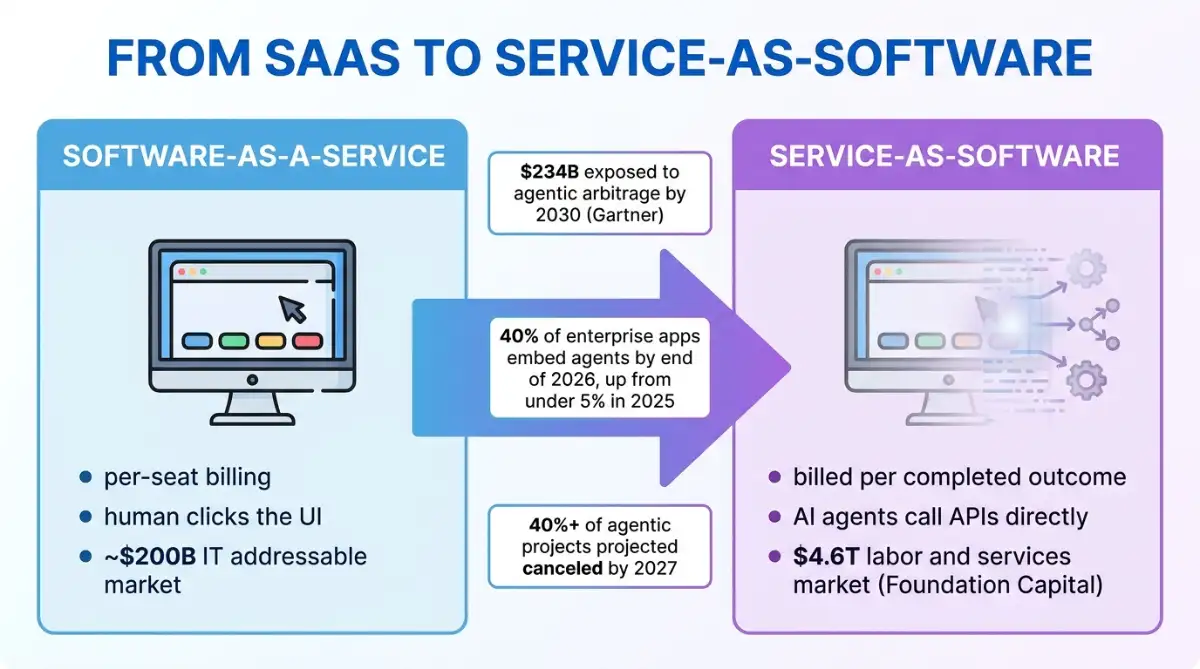
Not replaced, but restructured. The industry phrase is "Service-as-Software": instead of renting a tool for humans to click through, businesses buy completed outcomes executed by autonomous AI agents. Gartner projects that by the end of 2026, 40% of enterprise applications will embed task-specific agents, up from under 5% in 2025, and flags $234 billion in application spend as exposed to agentic arbitrage through 2030.
Microsoft CEO Satya Nadella put it bluntly on the BG2 Podcast in December 2024:
"SaaS is dead."
Gartner's George Brocklehurst was more precise in July 2026, arguing that agentic systems bypass UX-heavy applications entirely:
"This breaks the link between user growth and revenue growth for many enterprise software vendors."
The evidence is already visible. Salesforce's Agentforce hit $800 million in ARR (up 169% year over year) with 2.4 billion agentic work units delivered, per its fiscal 2026 fourth-quarter results. Meanwhile Foundation Capital sizes the outcome-based opportunity at $4.6 trillion, because agents compete for labor budgets, not just IT budgets.
But the transition is messy:
- Gartner projects over 40% of agentic AI projects will be canceled by end of 2027 over cost and unclear ROI
- AI-native companies run gross margins of 65% to 70%, below the 77% SaaS median, thanks to GPU and inference costs
- Public SaaS multiples compressed to 3.8x revenue in early 2026 as buyers chased AI-native architectures
The interface is becoming invisible. The subscription, in some form, survives. If you want the builder's-eye view of this shift, no-code vs vibe code covers how AI is changing who gets to build software at all.
Start exploring launch-ready no-code SaaS templates here!
FAQ
What does SaaS stand for? SaaS stands for Software as a Service, a delivery model where applications run on the vendor's cloud servers and users access them through a browser via subscription. It's one of three core cloud layers, alongside IaaS (infrastructure) and PaaS (platform), and it's the layer most non-technical users touch daily.
What are common examples of SaaS? Salesforce (CRM), ServiceNow (workflow), Workday (HR), Snowflake (data), and everyday tools like Gmail, Slack, Notion, and Shopify are all SaaS. If you log in through a browser, pay a subscription, and never install updates yourself, you're using SaaS, whatever the vendor calls it.
Is SaaS the same as cloud computing? No, SaaS is one layer of cloud computing. Cloud computing includes IaaS (raw servers, like AWS), PaaS (development platforms), and SaaS (finished applications). SaaS is the largest slice, capturing roughly 54% of public cloud end-user spend according to industry analyses.
How much does SaaS typically cost per user? Enterprise benchmarks put average spend at $4,200 per employee per year across all SaaS tools combined, though individual apps range from free tiers to hundreds per seat monthly. Watch for automatic annual increases of 8% to 12%, which vendors frequently build into renewal terms.
What's the difference between SaaS and a web app? A web app is any application running in a browser; SaaS is a business model for delivering one. Every SaaS product is a web app (or has one), but a free browser game with no subscription is a web app without being SaaS. The distinction is commercial, not technical.
Start building without code
Browse thousands of no-code templates for Webflow, Framer, Bubble, Lovable, Replit and more.
Explore Templates