No-Code Ops: The Career Path Quietly Taking Over Tech
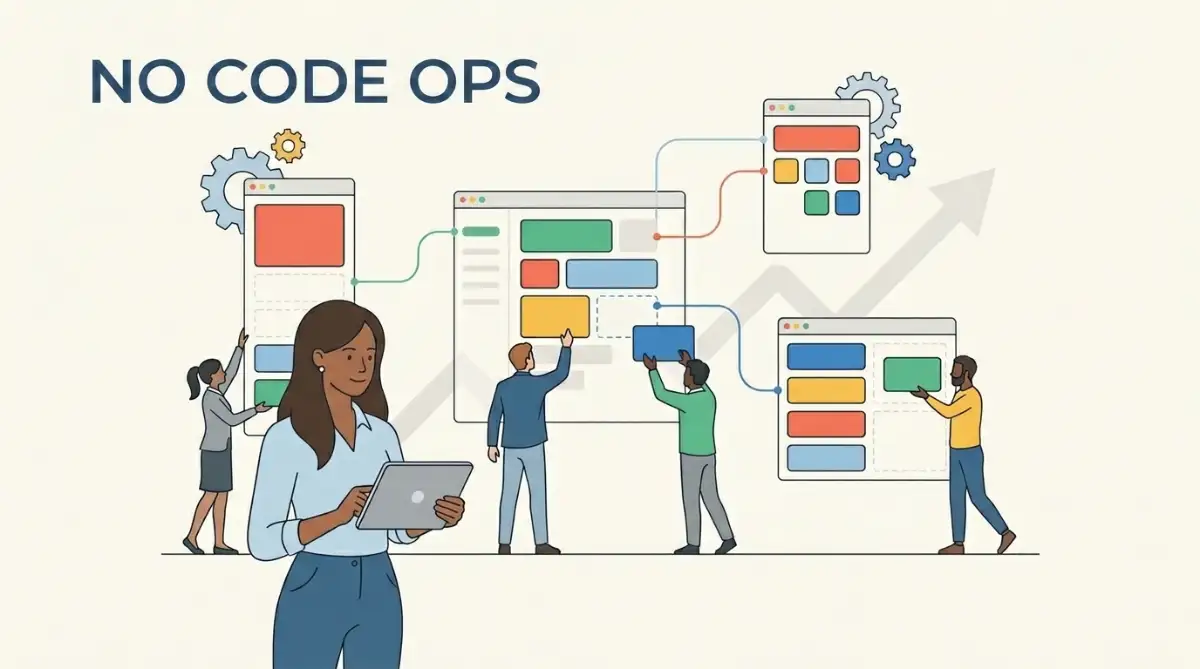
No-Code Ops is a corporate discipline where non-technical employees design, automate, and maintain internal software using visual platforms and AI instead of waiting on central IT. The role formalized in 2021 with the Atlanta startup NoCodeOps, which Zapier acquired in July 2024.
Table of Contents
- Key Takeaways
- Introduction
- What Exactly Is No-Code Ops, and Why Is It Now a Job Title?
- Who Built NoCodeOps, and Why Did Zapier Buy It?
- How Does a No-Code Ops Stack Actually Work?
- What Does a No-Code Ops Career Actually Pay in 2026?
- What Is the "Zapier Cliff," and When Should You Self-Host?
- Where Does No-Code Ops Quietly Break?
- FAQ
Key Takeaways
- No-Code Ops went from a pandemic-era Twitter friendship to a full Zapier acquisition in roughly three years, and the reason has surprisingly little to do with the tools themselves.
- Salaries in the field run from $50 an hour to $147,000 a year, but one add-on skill quietly separates the top earners from everyone else.
- The "Zapier Cliff" is the moment cloud automation pricing turns brutal, and most teams sail right past it until a five-figure invoice arrives.
Introduction
If you're the operations manager who somehow became your team's unofficial automation builder, congratulations: you have a job title now. According to Forrester's 2026 Citizen Developer Census, operations managers make up 24% of the people quietly building corporate software inside visual tools, the single largest group. That quiet army has a name, a salary band, and at least one startup that sold to Zapier.
No-Code Ops is what happens when the person who understands a broken workflow stops filing a ticket and starts building the fix. This piece traces how a discipline born on Twitter became the operating layer of a market Gartner pegs at $44.5 billion for 2026, what it pays, and exactly where it falls apart.
What Exactly Is No-Code Ops, and Why Is It Now a Job Title?
It's the shift from filing an IT ticket to building the fix yourself. No-Code Ops describes operators who own internal systems end to end: configuring relational databases, wiring automations, and shipping dashboards entirely in visual tools. The person who understands a workflow's exceptions is now the same person who automates them.
The discipline exists because software talent has always been the bottleneck. By 2021, roughly 26.8 million people worldwide could write code, under 1% of the planet, all expected to clear the entire technical backlog. Meanwhile, non-technical knowledge workers outnumber engineers heavily. Laela Sturdy, General Partner at CapitalG, pegs that gap at ten to one, more than 268 million people who understand a business process but never learned syntax.
When the people who understand a workflow's exceptions are the same people who automate it, the translation layer between business and engineering disappears.
No-Code Ops hands those workers the keys. Erwan Kezzar of Contournement frames these platforms as the next-generation Office suite, arguing they now structure data and run operations, not just spin up websites. A No-Code Operator typically owns three things:
- The data model, built in tools like Airtable instead of raw SQL
- The automations, wired through platforms born in the early Zapier era
- The interface, where colleagues actually click buttons and submit forms
This is the maker movement grown up and put on payroll. For the plumbing-level version, our no-code builder guide covers how visual building works underneath.
Who Built NoCodeOps, and Why Did Zapier Buy It?
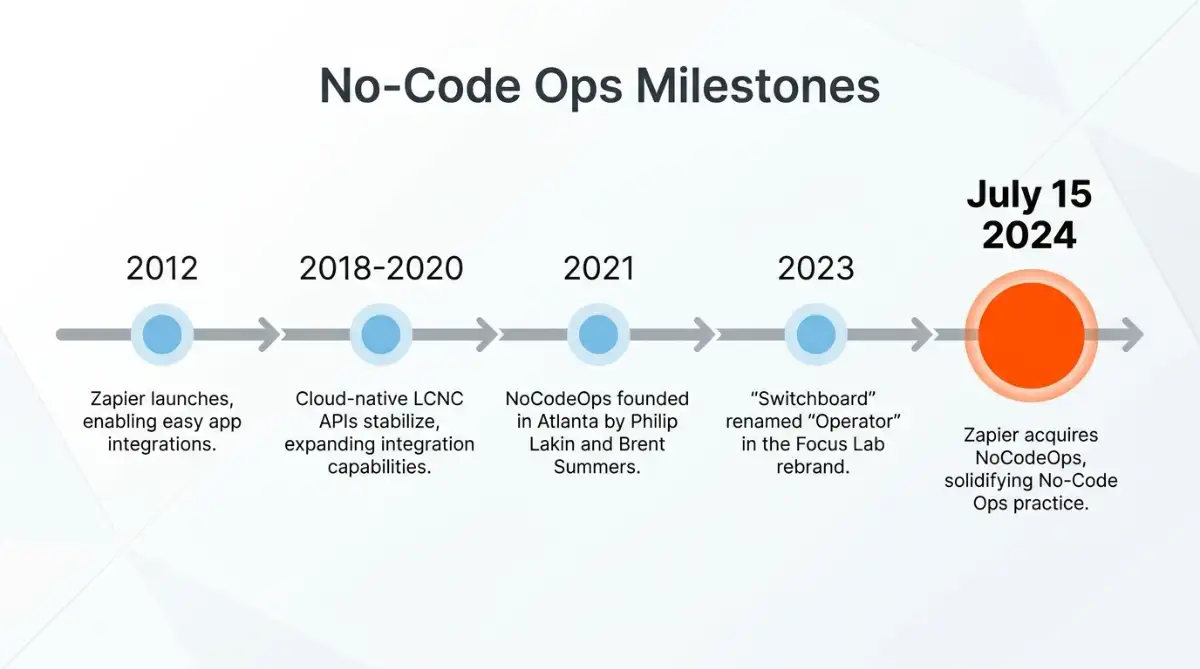
Two builders, Philip Lakin and Brent Summers, founded NoCodeOps in Atlanta in 2021 after meeting on Twitter during the pandemic. They never met in person until six months in. Three years later, on July 15, 2024, Zapier acquired the company outright.
Lakin's background is the tell. Before NoCodeOps, he was Solutions Architect for National Operations at Compass, where he rolled out visual software onboarding to 15,000 real estate agents. He had already lived the core problem: non-technical teams needed software, and central IT could not ship it fast enough.
The company's first product, "Switchboard," tracked integration errors across Zapier and Make so operators could see when automations silently failed. In 2023, design agency Focus Lab advised a rebrand. Because NoCodeOps held the search authority and "Switchboard" was a generic name, they made NoCodeOps the parent brand and renamed the product "Operator."

Wade Foster, Zapier's co-founder and CEO, had backed the seed round, and that relationship matured into a deal.
Brent and I believe that with Zapier, we can accelerate the adoption of no-code solutions in larger companies, making automation accessible to all.
After the transaction, Lakin became Head of Enterprise Innovation at Zapier, Summers joined the product team, and community manager Claudia Cafeo moved into marketing.
| Milestone | Date | Detail |
|---|---|---|
| NoCodeOps founded | 2021 | Atlanta; Lakin and Summers, met on Twitter |
| Product rebrand | 2023 | Focus Lab; "Switchboard" becomes "Operator" |
| Zapier acquisition | July 15, 2024 | Undisclosed sum |
How Does a No-Code Ops Stack Actually Work?
Every No-Code Ops system splits into three cloud layers: storage, orchestration, and interface, with monitoring on top. Decoupling them lets an operator assemble secure internal software without compiled code. Each layer has its own go-to tools, and most teams run several at once.
The storage layer is a visual relational database, something like Airtable, Notion, or Coda, that enforces a schema and auto-exposes API endpoints. The orchestration layer is the middleware: Zapier, Make.com, or n8n listening on webhooks and running conditional logic. The interface layer (Stacker, Softr, Glide) puts a polished portal on top, with role-based access control deciding who sees which records.
Decoupling storage, logic, and interface is what turns a tangle of spreadsheets into something that behaves like real internal software.
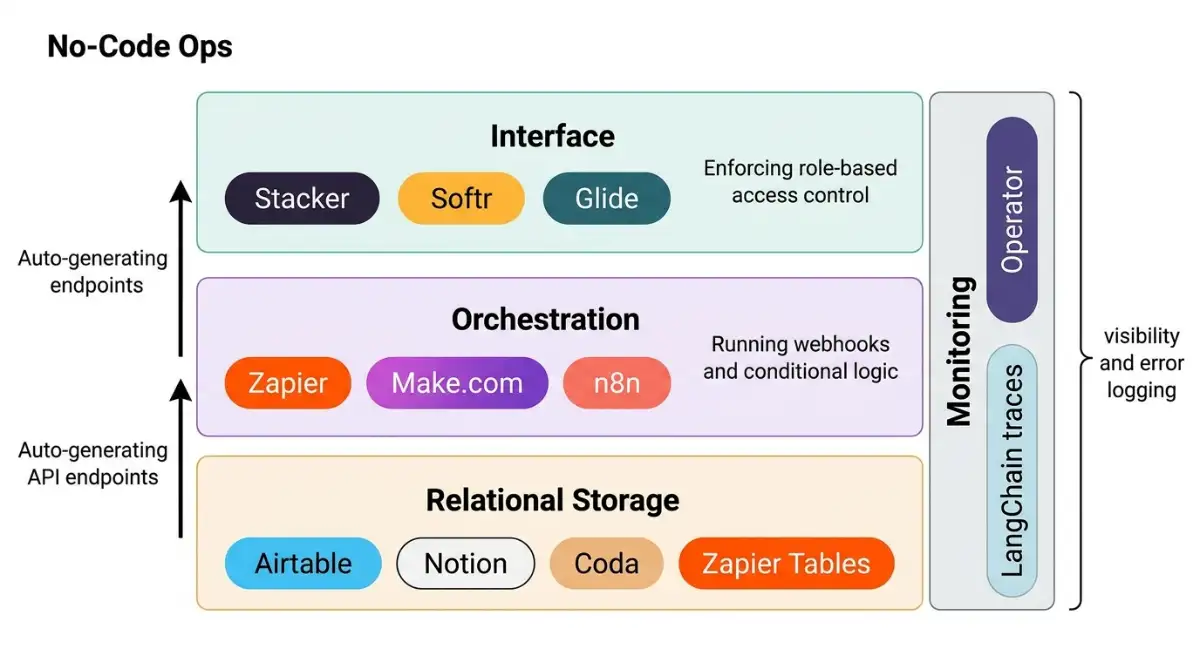
| Layer | Go-to tools | What the operator does |
|---|---|---|
| Relational storage | Airtable, Notion, Coda | Map schemas, define fields, link records |
| Orchestration | Zapier, Make.com, n8n | Build multi-step logic, handle webhooks |
| Interface | Stacker, Softr, Glide | Ship dashboards and portals with RBAC |
| Monitoring | Operator, LangChain traces | Track errors, latency, dependencies |
Teams usually grow into this in three phases: first automating high-volume manual tasks, then layering conversational analysis on top of the database, and finally wiring AI-driven logic into a CRM for predictive outreach. If I had to bet on one layer to learn first, it would be the data model, not the automation, because a clean schema forgives a lot of sloppy logic later.
What Does a No-Code Ops Career Actually Pay in 2026?
Better than most non-technical operators expect, and rising fast with AI skills. Full-time roles range from project-manager bands into six figures for senior automation directors, while freelancers bill by the hour or by the sprint. The exact ranges sit in the table below, and one variable moves them more than any other.
That variable is AI fluency. According to PwC's Global AI Jobs Barometer 2025, workers who add AI and advanced automation skills command 56% higher wages on average. Upwork's Research Institute reports that AI freelancers earn 40% higher hourly rates than their non-AI peers, with total AI and machine-learning projects on the platform up 70% year over year.
The single biggest raise in No-Code Ops isn't a promotion, it's learning to wire AI into the automations you already build.
| Role | Model | Earnings |
|---|---|---|
| No-Code Project Manager | Full-time | $70,000 to $105,000 |
| Senior Automation Director | Full-time | $113,000 to $147,000 |
| No-Code Consultant | Freelance | $50 to $75 per hour |
| AI Automation Specialist | Per sprint | $2,000 to $10,000 |
| Operations Lead (UK startup) | Full-time | £35,000 to £45,000 |
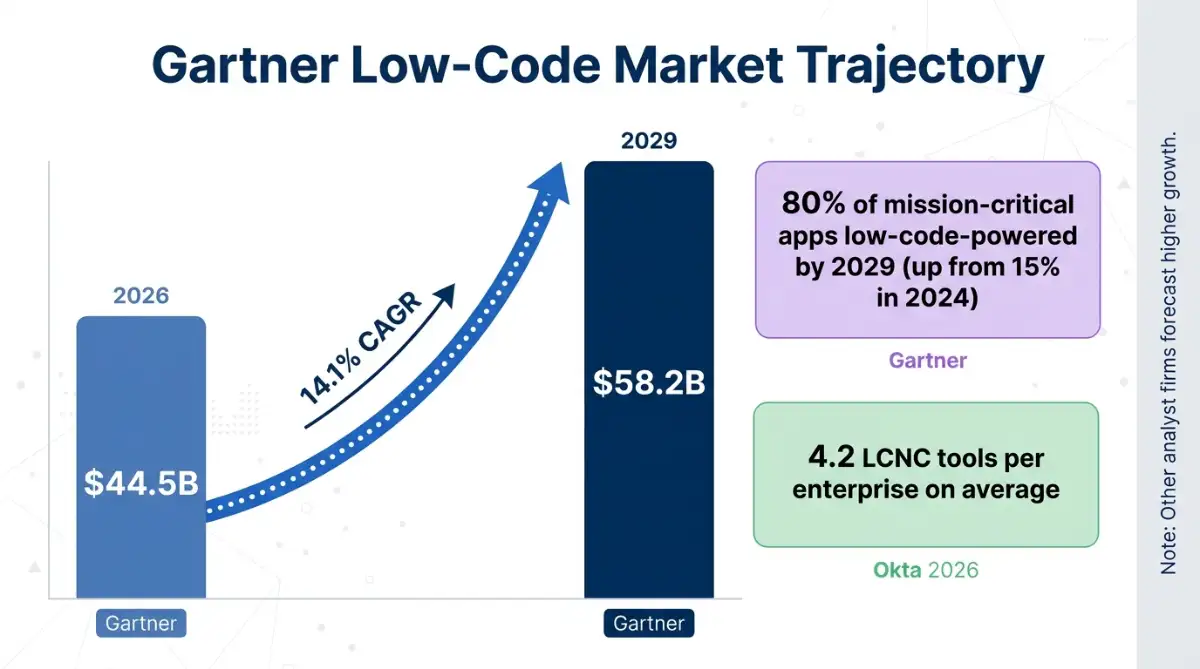
The demand behind those numbers is broad. Operations managers lead adoption at 24%, followed by marketing managers (19%) and sales managers (16%), per Forrester. By industry, Financial Services tops the list at 82%, then Healthcare at 74%. Gartner puts the low-code market at $44.5 billion for 2026, on track for $58.2 billion by 2029, and the wider no-code market data shows why those budgets keep flowing toward visual tooling.
What Is the "Zapier Cliff," and When Should You Self-Host?
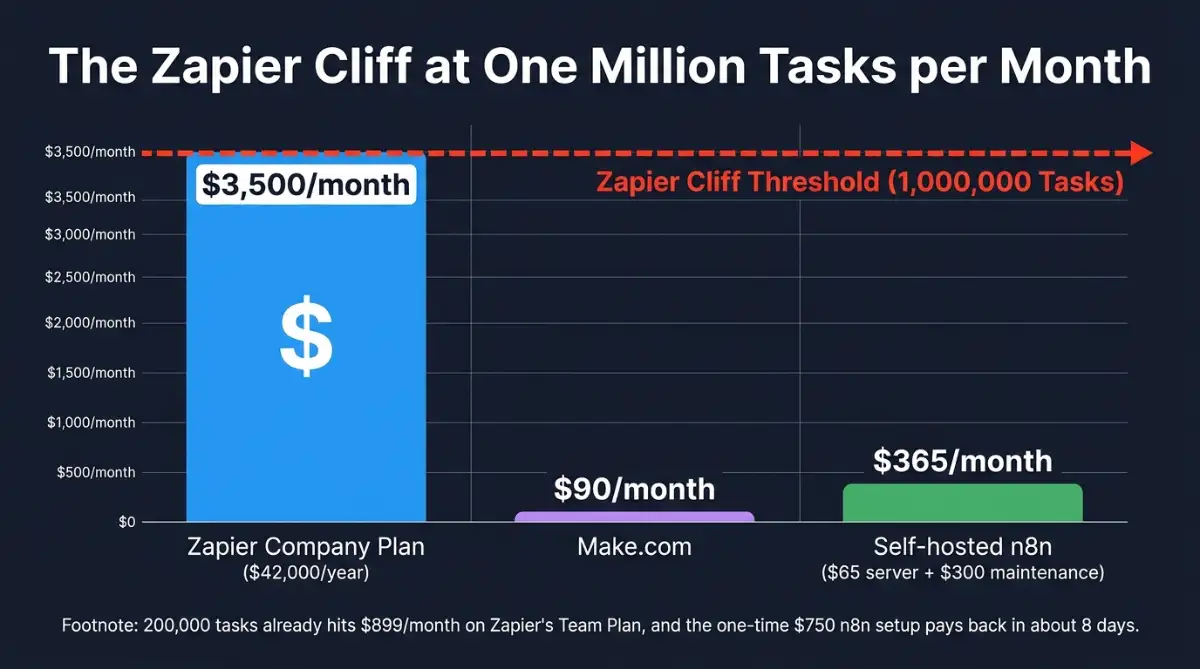
The Zapier Cliff is the point where task-based cloud pricing stops making sense. Because Zapier bills per task, a busy workflow can climb from a few hundred dollars to roughly $3,500 a month. Self-hosting n8n flattens that to a fixed server fee, no matter the volume.
The math is what stings. Picture a lead-routing agent processing 10,000 leads a month, each running a 20-step sequence (CRM check, email verification, routing, Slack alerts). That is 200,000 tasks, about $899 a month on Zapier's Team Plan. Scale to a million tasks and Zapier's Company Plan reaches roughly $3,500 a month, or $42,000 a year.
A self-hosted n8n instance on a Hetzner AX102 server costs a flat $65 a month whether it runs 10,000 tasks or 10 million. Add a one-time $750 setup (about five engineering hours) and roughly $300 a month in maintenance labor, and total cost lands near $365 a month. The setup tax pays for itself in just over eight days.
The Zapier Cliff isn't a pricing bug, it's the moment your automation volume outgrows the convenience you paid for.
| Criteria | Zapier Pro | Make.com Core | n8n Self-Hosted |
|---|---|---|---|
| Best for | Fast SaaS connectivity | Visual pipelines | Sovereign AI agents |
| Ease of use | Very high | High | Moderate (VPS setup) |
| 1M tasks/month | ~$3,500 | ~$90 | ~$65 server |
| Data sovereignty | None | None | Complete |
| Edge | 9,000+ integrations | Granular routing | Local LLMs, agent memory |
So should you self-host? It depends, and usually the answer is no until your task volume says otherwise. The two clear triggers are regulated data (GDPR Article 44, HIPAA), where records legally cannot touch a third-party cloud, and persistent AI memory. n8n 2.0 ships 70-plus AI nodes and native LangChain integration, with local model execution through Ollama, which is where the low-code middle ground starts to matter for technical operators.
Where Does No-Code Ops Quietly Break?
In the gaps between confidence and correctness. The worst failures here are not crashes but silent ones: an automation that returns "success" while routing records to the wrong account. OWASP, accessibility audits, and schema drift each expose where visual tooling hides its mistakes.
OWASP maintains a "Citizen Development Top 10," and three risks come up constantly:
- Blind Trust (CD-SEC-01): operators install marketplace templates with hidden scripts that harvest credentials or mine crypto behind a clean interface.
- Account Impersonation (CD-SEC-02): integrations run on a builder's personal OAuth credentials, so they break or leak the moment that person leaves.
- Sensitive Data Leakage (CD-SEC-04): the 2021 Microsoft Power Apps Portals leak exposed 38 million records across 47 organizations through default permission settings.
Then there's the failure mode I find genuinely scary: schema drift. If an internal tool renames an API field from customer_id to account_id, compiled code throws a loud error. A visual platform may silently coerce or drop the value, return a green "success," and quietly corrupt the database. I've watched a single renamed field poison records for weeks before anyone noticed.
The symptom of a failure and the cause of the failure are never in the same layer.
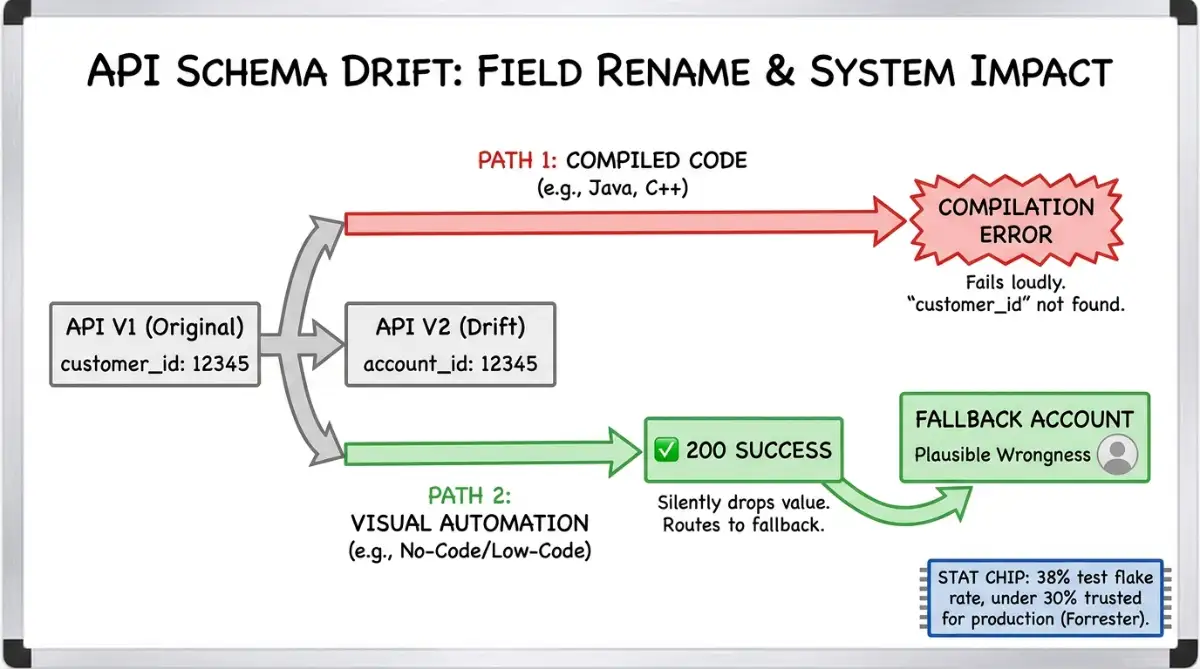
The reliability data backs up the caution. A 2024 WebAIM analysis of one million home pages found 95.9% had detectable WCAG 2 failures, averaging 56.8 errors per page. Forrester reports that under 30% of enterprises trust visual automation for production-critical test suites, partly due to a 38% test flake rate when front-end structures shift. The fixes are governance, not magic: monitoring tools like Operator, and keeping your data in a portable engine like Postgres so a price hike never traps you. Our deeper read on whether no-code is secure enough walks through the guardrails.
Start exploring launch-ready no-code templates here!
FAQ
Is No-Code Ops the same as low-code development? Not quite. No-Code Ops is an operational discipline (building and running internal systems with visual tools), while low-code is a broader category that still expects some hand-written code. Most operators blend both, pairing no-code platforms like Airtable and Zapier with the occasional low-code script.
Do you need to know how to code to get a No-Code Ops job? No, but logical fluency matters more than a tidy visual editor. The strongest operators understand data normalization, API parameters, and conditional routing even without writing syntax. You are configuring systems rather than avoiding them, so database thinking carries you much further than memorized code.
Which tools should a beginner learn first? Start with one tool per layer: Airtable for relational data, Zapier or Make for orchestration, and Softr or Glide for the interface. According to Okta's 2026 figures, enterprises run an average of 4.2 of these tools, so cross-platform fluency beats deep single-tool mastery.
Is no-code secure enough for sensitive business data? It can be, with governance. The bigger risks are human: unvetted marketplace templates, personal OAuth credentials powering company integrations, and oversharing inside visual databases. Regulated teams handling clinical or financial data often self-host on n8n to keep records off third-party cloud servers entirely.
How much does Zapier cost compared to n8n? At small scale they are close, but the gap explodes with volume. A million-task-per-month workflow runs roughly $3,500 a month on Zapier's Company Plan versus about $65 a month for a self-hosted n8n server. Factoring in maintenance labor, n8n still lands near $365 a month total.
Start building without code
Browse thousands of no-code templates for Webflow, Framer, Bubble, Lovable, Replit and more.
Explore Templates