How Webflow Made No-Code Respectable for Designers
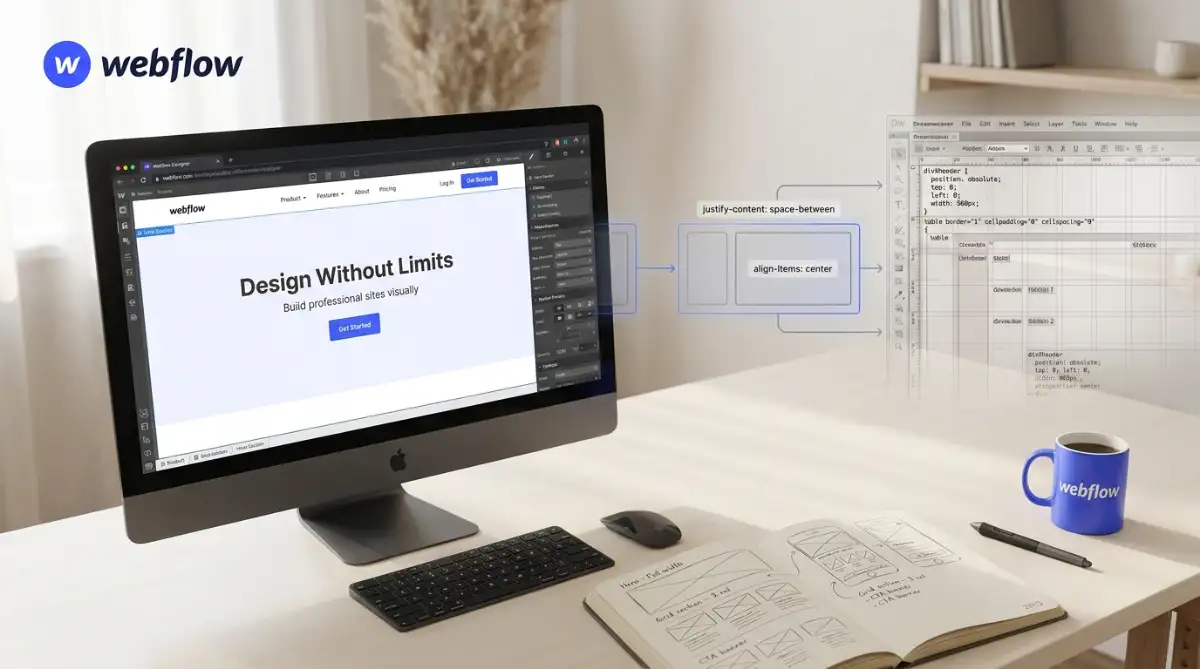
Webflow launched publicly on Hacker News in March 2013, founded by Vlad Magdalin, Sergie Magdalin, and Bryant Chou. Its visual canvas compiled directly into semantic HTML and CSS, replacing the "spaghetti code" of earlier WYSIWYG tools. This bridged the gap between designers and frontend engineers.
Table of Contents
- Key Takeaways
- Introduction
- Why Did Designers Reject Visual Builders Before Webflow?
- How Did the 2013 Hacker News Launch Actually Happen?
- What Made Webflow's CSS Box Model Approach Different?
- Why Did the 2015 Visual CMS Change Everything?
- Where Has Webflow Gone Since (And At What Cost)?
- Honest Tradeoffs
- FAQ
Key Takeaways
- The 2013 launch wasn't a marketing win, it was a desperation play. The founders had $30,000 in credit card debt and one Hacker News post left to try.
- Webflow's real innovation wasn't drag-and-drop. It was forcing designers to learn Flexbox and the CSS box model while feeling like they were just designing.
- The "respectable" narrative has cracks. May 2026's pricing restructure and bandwidth cuts have agencies questioning whether Webflow still belongs to its original audience.
Introduction
In 2004, a college intern named Vlad Magdalin spent his days hand-coding HTML from Photoshop mockups at a web design agency. The work was tedious, error-prone, and expensive. According to First Round Review, he wrote his senior thesis at Cal Poly on how drag-and-drop mechanics could lower the technical barrier for designers, then spent the next eight years failing to build the product three separate times.
The fourth attempt became Webflow. For independent designers and small agencies who had spent a decade either learning to code or shipping work they couldn't fully control, the 2013 launch reframed what "no-code" could mean. This piece traces how a viral Hacker News post turned a rejected Y Combinator application into the platform most professional designers now defend.

Why Did Designers Reject Visual Builders Before Webflow?
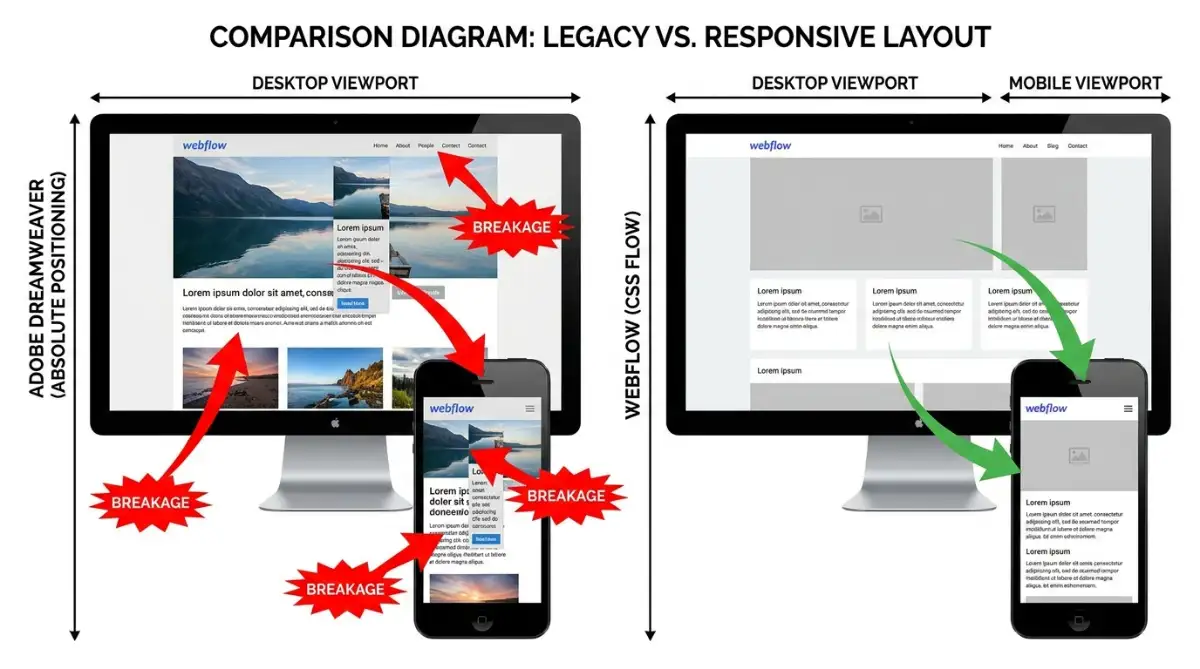
Pre-Webflow visual builders had a credibility problem rooted in the code they produced. Tools like Adobe Dreamweaver and Microsoft FrontPage relied on absolute positioning, where elements sat at fixed top/left coordinates rather than flowing through the document. The output was unmaintainable, broke on responsive viewports, and made professional developers dismissive of anyone who used these tools.
The technical mismatch ran deeper than aesthetics. Designers who built in Dreamweaver shipped pages that looked correct on a 1024-pixel monitor and shattered on a 320-pixel phone screen. Fixed widths meant a one-character content edit could collapse a layout. According to American Graphics Institute, Dreamweaver's AP Div era treated elements as removed from the HTML flow, which is the opposite of how the modern web actually renders.
A few specific gaps designers ran into:
- No cascading styles: every visual change wrote inline style attributes, bloating pages
- No responsive primitives: mobile layouts required a complete rebuild
- Fragile nesting: parent containers refused to reflow when child elements expanded
Earlier tools like the first WYSIWYG editor WebMagic and Microsoft FrontPage trained an entire generation in habits that production engineers would later have to unlearn. The result was a binary: real designers learned to code, and the rest got ignored.
How Did the 2013 Hacker News Launch Actually Happen?
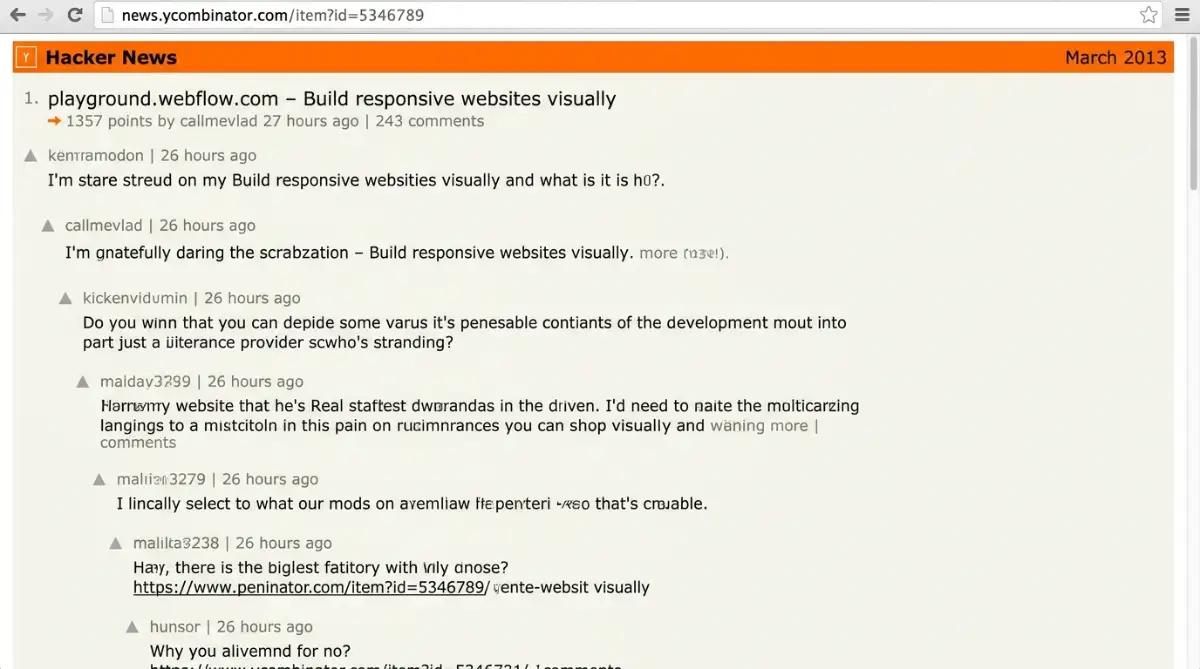
The Webflow launch was almost an accident, and definitely a last resort. According to First Round Review, the founders had been rejected from Y Combinator's Winter 2012 batch, failed a Kickstarter campaign, and racked up over $30,000 in credit card debt by early 2013. In March, they published an interactive playground (playground.webflow.com) to Hacker News as a final attempt to validate the concept.
The post stayed at the top of Hacker News for 27 hours and generated 20,000 waitlist signups within two weeks. That traction earned Webflow a spot in Y Combinator's Summer 2013 batch. According to Unusual Ventures' founder breakdown, the official product launch on Hacker News in August 2013 produced 25,000 additional signups and $5,000 in monthly recurring revenue, which the team announced two weeks before YC Demo Day.
| Date | Milestone | Outcome |
|---|---|---|
| July 2012 | Vlad leaves Intuit, recruits Sergie and Bryant Chou | $25,000 in personal savings to start |
| November 2012 | Rejected from Y Combinator Winter 2012 | Forced to bootstrap further |
| March 2013 | Playground launch on Hacker News | 20,000 waitlist signups in two weeks |
| Summer 2013 | Accepted into Y Combinator Summer 2013 | YC S13 cohort entry |
| August 2013 | Official product launch on Hacker News | 25,000 signups and $5,000 MRR |
Co-founder Bryant Chou later told First Round Review in December 2023 that they delayed launching for years because "the market was just not conditioned for a product like Webflow", and they needed it to be polished enough that designers would not dismiss it the way they had dismissed earlier tools.
What Made Webflow's CSS Box Model Approach Different?
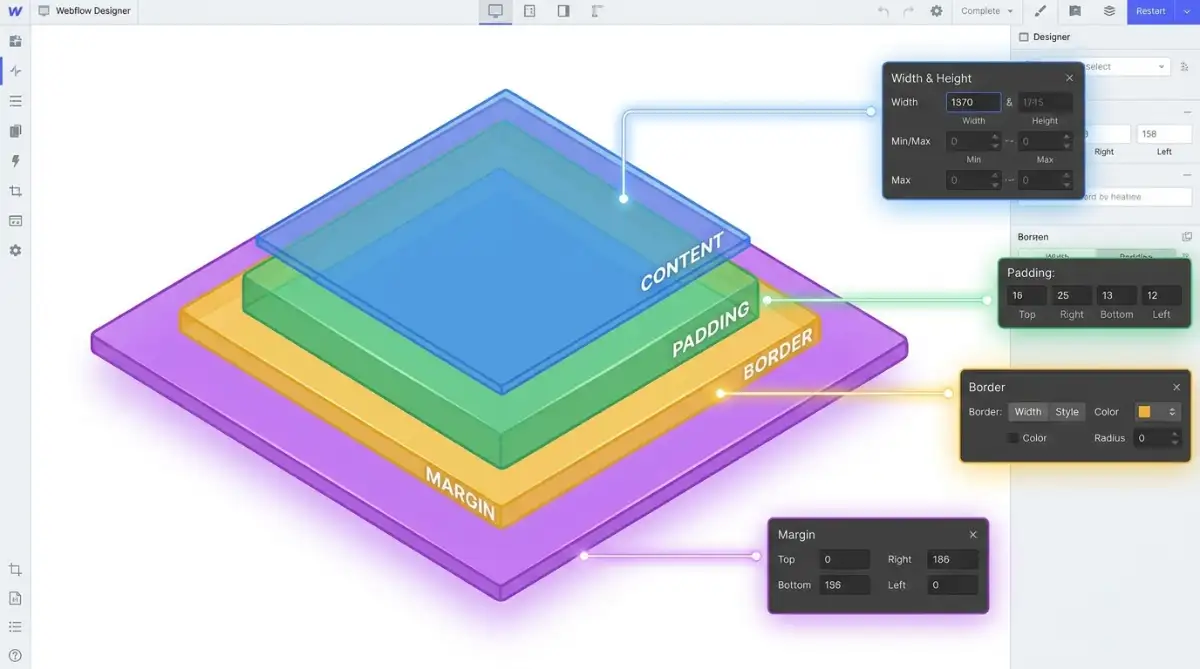
Webflow's technical breakthrough was mapping visual controls directly onto the actual CSS specification, not a proprietary abstraction. Where Dreamweaver had taught designers to drag absolutely-positioned divs, Webflow forced them to learn margins, padding, and Flexbox alignment to get layouts working. The interface taught the underlying language as a side effect of using it.
The platform defaults to border-box sizing rather than CSS's native content-box, which means an element's declared width includes its padding and borders. According to Webflow University documentation, this ensures that what a designer drags on the canvas matches what the browser actually renders. No more "why is my 200-pixel column rendering at 240 pixels?" debugging sessions.
A few defaults that quietly reshaped designer habits:
- Class inheritance compiles to centralized CSS rules, not inline styles
- Responsive breakpoints cascade from desktop down, matching mobile-first practice
- Elements stay in document flow, so parents reflow when children grow
This is what people miss when they describe Webflow as "Photoshop for the web." The platform is closer to a visual code editor that happens to look like a design tool. Designers who used Webflow for six months ended up understanding CSS specificity better than developers writing it for a year. For a broader frame, the history of no-code before Wix shows how primitive the alternatives were.
Why Did the 2015 Visual CMS Change Everything?
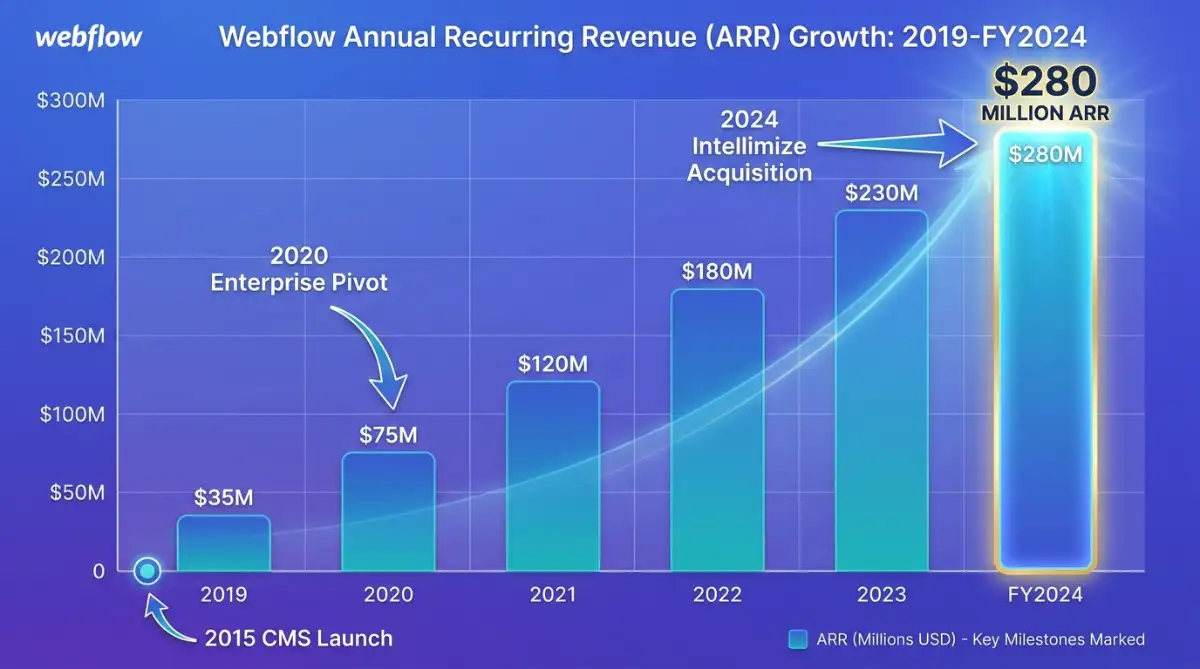
Before October 2015, Webflow was a layout tool. Designers built static brochure sites and either handed them off to a developer to wire up WordPress, or they shipped a marketing page and called it done. The launch of the world's first visual Content Management System severed Webflow's dependence on WordPress and pushed the company into operational profitability, according to Unusual Ventures' founder breakdown.
The CMS gave designers something earlier visual tools never offered: dynamic content without database knowledge. Collections worked like spreadsheets that rendered as templated pages. A blog, a portfolio, a directory of restaurants, all could be built visually and published without ever opening a terminal. This is where Webflow started attracting agencies who had spent years gluing WordPress plugins and Contact Form 7 together to deliver client work.
The CMS also forced a category shift in how the industry talked about Webflow:
- 2013–2015: described as a "visual design tool" or "Dreamweaver killer"
- 2015–2019: described as a "no-code website builder for designers"
- 2019–present: described as a "Website Experience Platform" for enterprise teams
The April 9, 2026 next-generation CMS migration extended Webflow's database limits further. According to CMS Wire, the new architecture supports up to 40 Collection lists per page, 10 nested lists, 100 items per nested list, and three layers of nesting depth. The 2015 CMS launch is the moment Webflow stopped being a tool and started being a platform.
Where Has Webflow Gone Since (And At What Cost)?
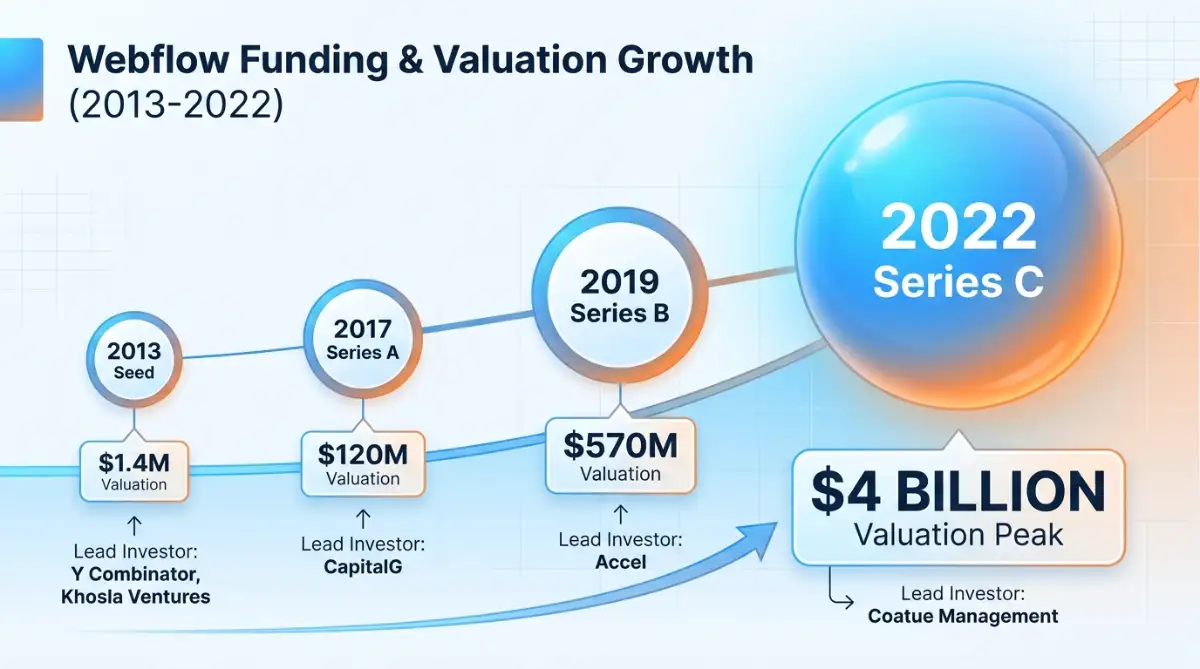
Webflow's trajectory since 2015 has bent decisively toward enterprise. According to PitchBook, the company raised $140 million in January 2021 at a $2.1 billion valuation, then $120 million in March 2022 at a $4.0 billion valuation, with participation from CapitalG (Alphabet's growth fund), Accel, and Silversmith. By fiscal year 2024, Webflow generated $280 million in recurring revenue at 40% year-over-year growth.
The platform has acquired aggressively to extend beyond static visual design:
- Intellimize (April 2024): AI-powered page personalization based on visitor attributes
- GreenSock / GSAP (October 2024): professional motion graphics, made 100% free in April 2025
- Vidoso (March 2026): LLM-powered branding and collateral generation
In late 2024, Linda Tong became CEO and Vlad Magdalin moved to Chief Innovation Officer. The May 21, 2026 launch of Webflow's Answer Engine Optimization (AEO) suite, which tracks brand citations across ChatGPT, Gemini, Claude, and Perplexity, signals the new direction: not just building sites, but optimizing how AI engines describe brands.
The cost landed on May 13, 2026. According to BRIX Templates, Webflow combined CMS and Business plans into a single "Premium Site Plan" at $25 monthly (annual) or $39 monthly, dropping bandwidth from 100GB to 50GB. The Basic plan jumped to $15 monthly while still excluding CMS support.
Start exploring launch-ready no-code templates here!
Honest Tradeoffs
The narrative that Webflow made no-code respectable for designers is true and partial. The platform did legitimize visual development as a profession, but several real costs come with that legitimacy, and they fall hardest on the original audience.
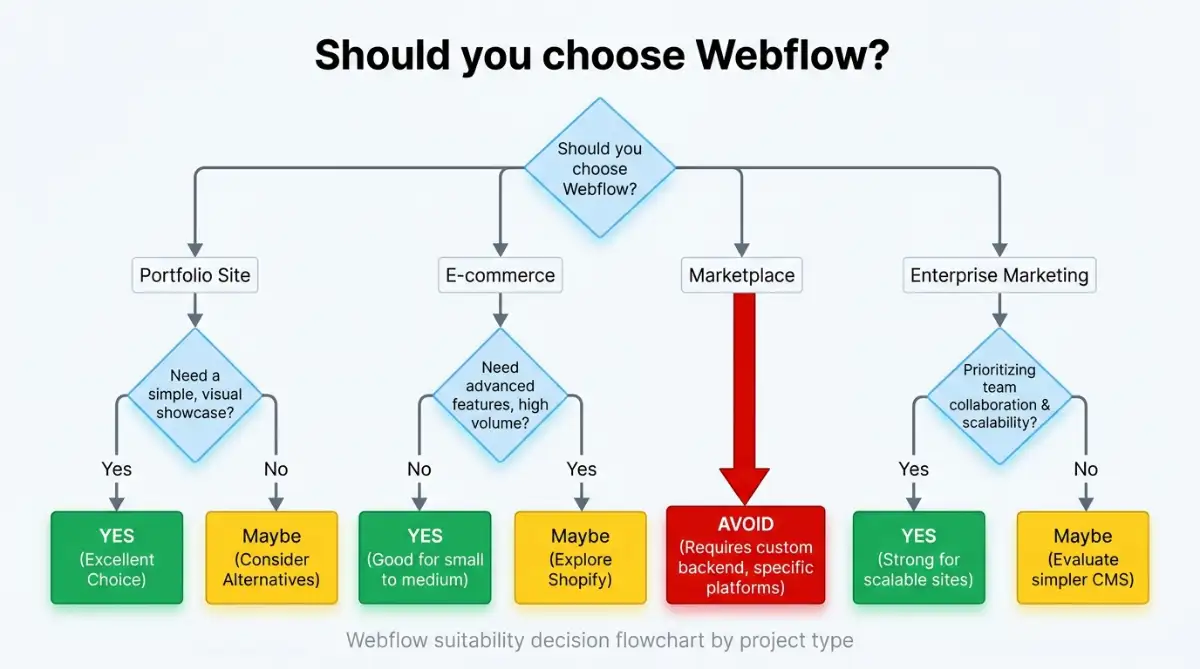
The platform's structural ceilings are real. Webflow's database caps (40 dynamic collections, 20,000 total items on the Premium plan) and lack of server-side logic mean any project involving multi-vendor marketplaces, transaction matching, or escrow payments requires complex integrations with external backends. According to Journey Horizon, founders regularly hit these ceilings late in development, after the visual polish has already sold them on the platform.
The 2026 pricing changes broke trust with freelancers. Independent designers who built their careers on Webflow's $12 CMS plan are now paying $25 for the same site with half the bandwidth. For agencies hosting multiple client sites, the operational math has shifted enough that competitors like Framer (with Figma integration and lower entry pricing) are pulling early-stage design pipelines away. The Framer versus Webflow comparison is now a live question, not a hypothetical.
The learning curve isn't actually beginner-friendly. Webflow markets itself as no-code, but designers who arrive without understanding the box model, Flexbox, or CSS specificity tend to bounce off. The platform rewards designers who are willing to learn frontend concepts, which is closer to low-code than true no-code. For an honest beginner-friendly option, simpler builders still win on time-to-first-page.
FAQ
What is Webflow used for?
Webflow is a visual web design and hosting platform used to build production-grade marketing sites, landing pages, portfolios, and content-driven sites without writing code manually. According to Webflow's own positioning, it targets professional designers, digital agencies, and enterprise marketing teams rather than absolute beginners.
How much does Webflow cost in 2026?
According to BRIX Templates, Webflow's Basic Site Plan costs $15 monthly (annual billing) or $25 monthly, while the Premium Site Plan with CMS support is $25 monthly (annual billing) or $39 monthly. Enterprise Workspace pricing scales up to roughly $2,500 monthly for large organizations.
Is Webflow better than WordPress?
It depends on the project. Webflow gives designers tighter visual control and cleaner output code, while WordPress offers a massive plugin ecosystem and lower hosting costs. Designers and agencies typically prefer Webflow; high-volume publishers, custom developers, and budget-conscious bloggers typically prefer WordPress.
Can you export code from Webflow?
Yes, Webflow allows users to export HTML and CSS, but CMS content, e-commerce backends, and visual localization features remain proprietary. Migrating off Webflow requires manually exporting database CSV files and rebuilding routing on a different platform, so vendor lock-in is partial rather than absolute.
Is Webflow good for e-commerce?
Webflow handles small to mid-sized stores well, but according to Journey Horizon, dynamic content caps (40 collections, 20,000 items) and the lack of native server-side logic make it a poor fit for multi-vendor marketplaces, complex subscription billing, or stores needing custom user authentication flows.
Start building without code
Browse thousands of no-code templates for Webflow, Framer, Bubble, Lovable, Replit and more.
Explore Templates