Is No-Code Worth It? A Real 2026 Cost & Scaling Guide

No-code is worth it for validating ideas, marketing sites, and internal tools, cutting build costs by roughly 62% and launching 74% faster. It stops paying off once transaction volume, performance demands, or consumption-based fees outgrow the platform's ceilings.
Table of Contents:
- Key Takeaways
- Introduction
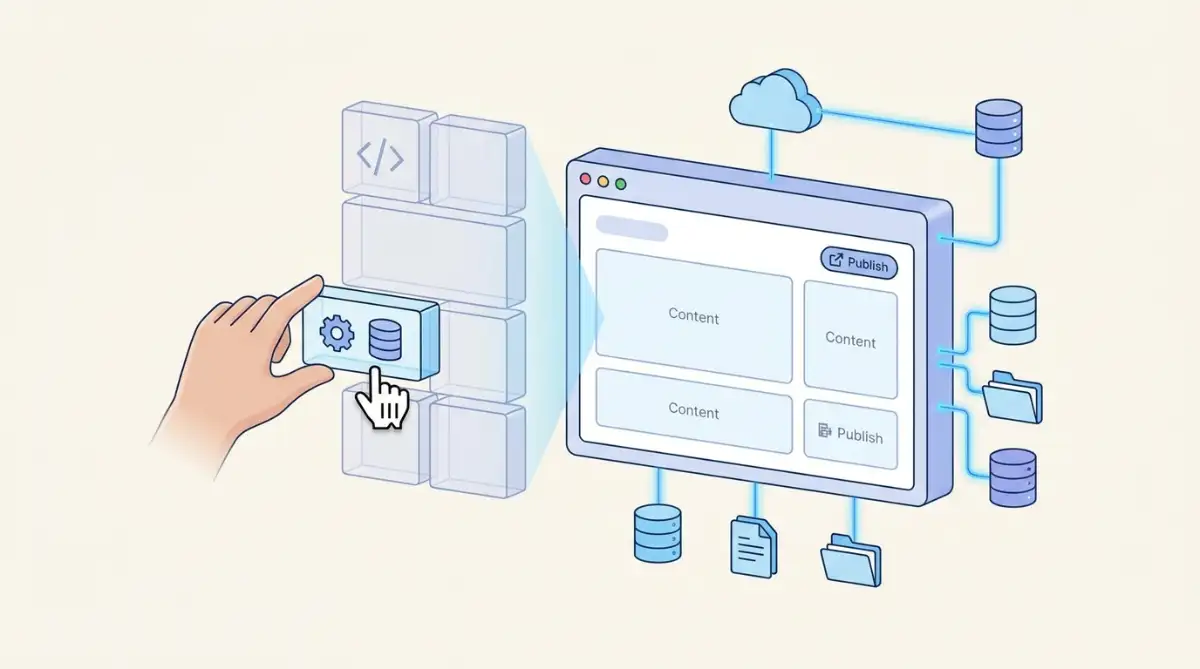
- What Does "No-Code" Actually Mean in 2026?
- Where Does No-Code Actually Save You Money?
- When Do No-Code Apps Hit a Performance Wall?
- Is No-Code Secure Enough to Trust With Real Data?
- Does Vibe Coding Make No-Code Obsolete?
- What Happens When You Outgrow No-Code?
- The Honest Tradeoffs
- FAQ
Key Takeaways
- No-code can cut prototype costs by up to 70% and get you live in weeks, but those savings quietly invert once your app gains real traction.
- Bubble's Workload Unit pricing can turn a $32 plan into a $600 bill, and that math is the hinge most builders miss.
- The "no maintenance" promise holds until compliance, latency, or scale forces a rebuild, and three real companies show exactly where that line sits.
Introduction
If you're a bootstrapped builder staring at a $40,000 quote from a dev shop, the no-code pitch is intoxicating: ship the same thing yourself, in weeks, for the price of a nice dinner out. I've watched lean product teams launch real, revenue-generating apps this way. I've also watched a couple of them open a surprise $600 invoice for something that cost $32 the month before.
So the useful question isn't a flat yes or no. It's "worth it for what, and for how long?" This piece walks through the money, the performance ceilings, the security profile, and the exact moment most people outgrow the tools.
What Does "No-Code" Actually Mean in 2026?
No-code lets you build working software by arranging visual components instead of writing syntax, and in 2026 it's a serious market. According to major technology analysts cited in the research, the global no-code and low-code sector sits at a $65 billion valuation, climbing toward $94 billion at a 26.1% compound annual growth rate. This isn't hobbyist territory anymore.

The real fuel is people, not hype. There's a projected shortfall of 85.2 million software workers by 2030, and businesses have responded by handing building tools to non-engineers. These "citizen developers" (operations managers, marketers, analysts) now number an estimated 16.2 million, up 38% from 11.7 million. Gartner has argued for years that low-code is eating into traditional development, and this headcount shift is the proof.
Up to 70% of new business applications are now built with visual abstractions, which quietly rewrites who gets to make software.
Here's the split worth knowing before you pick a tool:
| Category | What it builds | Example platforms |
|---|---|---|
| Full-stack web | Complex apps and SaaS logic | Bubble, WeWeb, Xano |
| Native mobile | iOS and Android apps | FlutterFlow, GoodBarber, Adalo |
| Data-to-app | Internal portals and dashboards | Glide, Softr |
| Design-first | Marketing sites and landing pages | Webflow, Framer |
If the whole concept still feels fuzzy, this plain-English guide to what a no-code builder actually is is a good grounding, and the full market-size breakdown has the numbers behind the growth.
Where Does No-Code Actually Save You Money?
No-code wins hardest at the start of a project's life. According to the evaluation data, visual builders reduce development costs by an average of 62% and accelerate time-to-market by 74%, which is exactly why a first-time builder with no runway to burn reaches for them. The prototype phase is where the gap is almost embarrassing.
Put the two paths side by side and the early advantage is obvious:
| Metric | No-code (Bubble/Webflow) | Custom (Next.js/React/Postgres) |
|---|---|---|
| Upfront prototype build | $5,000 to $15,000 | $30,000 to $60,000+ |
| Time to launch | 1 to 4 weeks | 8 to 24 weeks |
| Annual maintenance | Low, platform-handled | 15% to 20% of build cost |
| 3-year TCO (low volume) | $5,000 to $12,000 | $45,000 to $100,000+ |

The standout figure is the three-year return on investment, which the research pegs at up to 342% at moderate volume. For a solo operator or a two-person team, that's the difference between testing an idea and never launching it.
At low transaction volume, no-code isn't just cheaper than custom code, it's cheaper by an order of magnitude that changes what a small team can even attempt.
That said, notice the phrase "low volume" doing quiet work in that table. Proof that these apps can actually earn is worth reading in this look at real no-code revenue, because the ceiling matters as much as the floor.
When Do No-Code Apps Hit a Performance Wall?
Visual builders scale beautifully until they don't, and the wall is usually financial before it's technical. The clearest example is Bubble's Workload Unit model, which meters backend activities including page loads, database reads, and API calls. Under that model, inefficient design costs real money instead of just running slowly.
The research is blunt about the swing: an unoptimized app can turn a $32 monthly subscription into a $500 to $600 monthly operational bill. That's not a scaling fee, that's a design tax.
Front-end sites hit a different ceiling. Independent audits found that 73% of Webflow projects showed degraded Lighthouse performance scores after six months, driven by asset bloat and third-party scripts. By contrast, Next.js sites regularly land Lighthouse scores of 95 to 100, while visually built sites often top out between 70 and 85.

Common triggers for the wall, in plain terms:
- Consumption billing: every extra database read and workflow adds cost, so sloppy queries compound.
- Nested visual searches: a sub-query per row in a 50-row table fires 50 separate queries per page load.
- Third-party script pileup: each added integration drags Core Web Vitals down over time.
Under fixed pricing a slow filter just annoys users, but under Workload Unit pricing that same filter mails you a bigger invoice every month.
Is No-Code Secure Enough to Trust With Real Data?
Yes, with caveats that depend entirely on what you're storing. The Open Web Application Security Project maintains a dedicated OWASP Low-Code/No-Code Top 10, which exists precisely because business users rarely have training in secure database design, authentication, or access controls. The tools are safe; the untrained hands on them are the risk.
A few of the most common failure modes worth naming:
- Account impersonation: linking a database using personal admin credentials, so every end user inherits elevated rights.
- Data leakage: an automated workflow syncing confidential CRM data into an unmanaged personal spreadsheet.
- Secret handling failures: API keys or user data stored in plaintext inside visual logic.
Compliance is where it gets sharper. Bubble's default hosting is locked to AWS us-east servers in the United States, which can put European citizen data on the wrong continent under GDPR Article 32. For healthcare, building on a standard tier without a signed Business Associate Agreement can expose you to serious HIPAA penalties.

The practical fix is boring but effective: use service accounts, restrict integrations to approved connectors, and pick platforms like WeWeb, Baserow, or Knack that support sovereign or HIPAA-compliant hosting. For a fuller picture, this no-code security and risk reality check is worth the read before you store anything sensitive.
Does Vibe Coding Make No-Code Obsolete?
Not obsolete, but it does complicate the decision. Coined by AI researcher Andrej Karpathy in early 2025, "vibe coding" describes directing AI agents through conversation instead of writing syntax by hand. Tools like Lovable, Bolt.new, and Cursor generate real React and TypeScript codebases you actually own, which is something closed visual builders can't offer.
Adoption is already mainstream. Google Cloud's 2025 DORA report found 90% of professional developers use AI-assisted tools at work, and the Stack Overflow survey put daily AI use at 51%.
Here's the catch, and it's a big one. According to that same Stack Overflow data, only 29% of developers trust AI-generated code, down from 40% the prior year. Veracode reports that 45% of AI-generated code contains vulnerabilities.

| Factor | Visual no-code (Bubble) | AI vibe coding (Lovable) |
|---|---|---|
| Code ownership | None, locked to runtime | High, exportable to GitHub |
| Modification | Drag-and-drop editing | Chat loops or code injection |
| Vulnerability risk | Low, template-based | High, 45% of AI code flagged |
| Who maintains it | The vendor | You do |
Vibe coding hands you the keys to your own codebase, then quietly hands you the maintenance bill and the security review too.
If this path interests you, the guide to vibe code for non-technical builders explains where it fits.

What Happens When You Outgrow No-Code?
You migrate, and the good news is that outgrowing no-code usually means you've already won. The research documents three companies that hit this point, and none of them regret starting visual. They just needed to move once the numbers justified it.
- Comet, a freelancer marketplace, validated its model on Bubble and scaled to $800,000 in monthly revenue before moving performance-critical pieces to custom code.
- Dividend Finance ran its solar lending engine on Bubble, facilitating over $1 billion in loans before being acquired by Fifth Third Bank.
- ProtectUs migrated an RFID hospital system to a French sovereign cloud on OVH, cutting connection latency from 1.2 seconds to 300 milliseconds.

Because closed platforms like Bubble don't export code, migration is a rebuild across four layers, with the frontend alone eating 40% to 50% of the timeline. Smart teams use the Strangler Fig approach, moving components piece by piece while the old app keeps running, which avoids a risky big-bang cutover.
Migrating off no-code isn't an admission of failure, it's the receipt for a bet that paid off faster than a custom build ever could have.
Choosing a starting platform with an eye on this future matters, and this breakdown of the best no-code builders for SaaS weighs portability up front.
The Honest Tradeoffs
No-code is not a permanent replacement for engineering, and pretending otherwise sets builders up for a bad surprise. The clearest break in the marketing narrative is the "zero maintenance" claim: it's true only while your volume stays modest. Once monthly platform fees cross the €500 to €800 range, the research shows custom code on managed cloud usually becomes cheaper, because hosting scales linearly with bandwidth instead of with per-seat and per-read charges.
It's also genuinely wrong for a specific group. If you're building consumer medical software, a high-frequency transactional platform, or anything with strict data-sovereignty rules, standard visual tiers will fight you at every turn. Abstracted databases hide the exact performance levers (indexing, query planning, table statistics) that heavy workloads need.
And experts don't agree on the AI angle. Vibe coding promises code ownership, but with 45% of AI-generated code carrying vulnerabilities per Veracode, handing your backend to an agent without technical review swaps one dependency for a riskier one. My take: no-code remains the safer default for non-technical teams precisely because the vendor, not you, owns the security patching. The tool you can maintain beats the tool that's theoretically more powerful.
Start exploring launch-ready no-code templates here!
FAQ
What does no-code actually mean? No-code means building functional software by arranging visual components in a drag-and-drop editor instead of writing programming syntax. Platforms handle the underlying database, hosting, and logic, letting non-technical people ship apps and websites without an engineering background.
Is no-code cheaper than hiring a developer? Upfront, yes, dramatically. Prototype builds run $5,000 to $15,000 versus $30,000 or more for custom code, according to the evaluation data. The savings shrink at high transaction volume, where consumption fees can exceed the cost of a custom build.
Can no-code apps handle real users and revenue? Absolutely. Comet scaled to $800,000 in monthly revenue on Bubble, and Dividend Finance processed over $1 billion in loans before acquisition. The constraint is efficiency: unoptimized apps get expensive fast under usage-based pricing models.
Is no-code secure enough for sensitive data? It can be, but it depends on configuration and platform. OWASP maintains a Top 10 risk list for these tools, and compliance-heavy data (health or EU citizen records) needs platforms supporting HIPAA agreements or sovereign hosting, not standard default tiers.
How is vibe coding different from no-code? Vibe coding uses AI to generate real, exportable code you own, while no-code keeps your app locked inside a visual runtime. Vibe coding offers portability but shifts security and maintenance back to you, whereas no-code keeps the vendor responsible.
Start building without code
Browse thousands of no-code templates for Webflow, Framer, Bubble, Lovable, Replit and more.
Explore Templates