What Is a Progressive Web App? A Simple Guide 2026
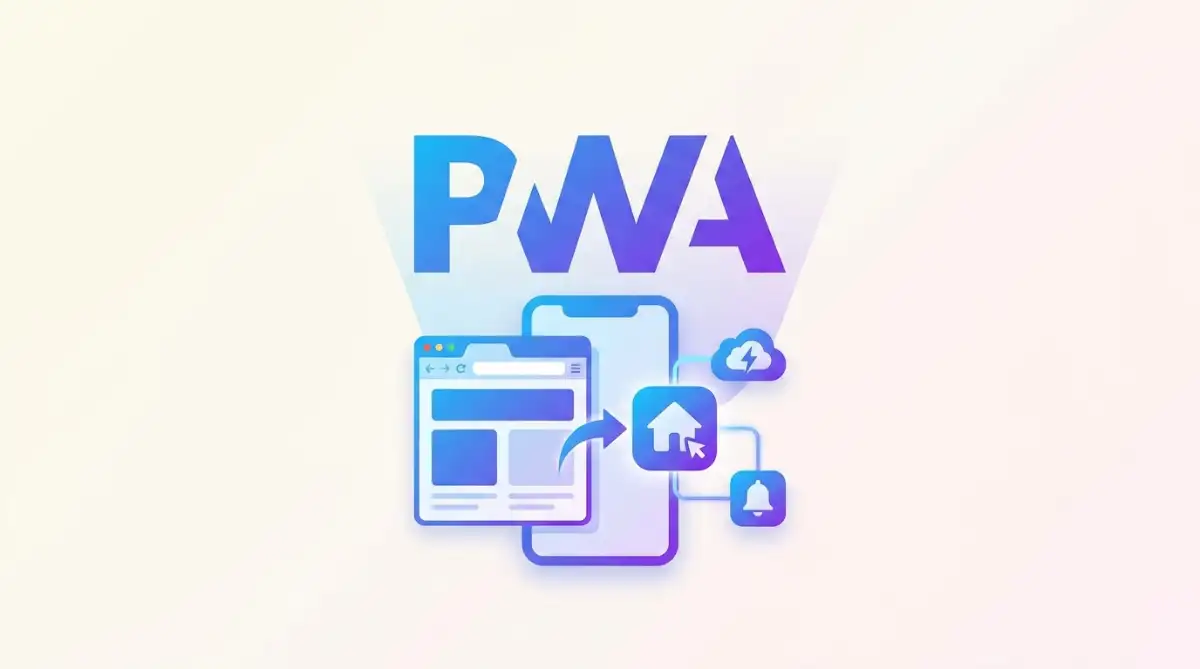
A Progressive Web App is a website built with modern browser features like service workers and a web app manifest, letting it install to a home screen, work offline, and load instantly. PWAs deliver native-style experiences through any compliant browser, skipping the Apple App Store and Google Play entirely. They typically cost 60% to 80% less to build and maintain than separate native iOS and Android apps.
Table of Contents
- Key Takeaways
- Introduction
- What Makes a Progressive Web App Different From a Regular Website?
- How Did Progressive Web Apps Get Their Start?
- What Does a Progressive Web App Cost Compared to a Native App?
- Do Progressive Web Apps Actually Move the Numbers?
- Why Don't Progressive Web Apps Work as Well on iPhones?
- How Big Is the Progressive Web App Market in 2026?
- FAQ
Key Takeaways
- PWAs install straight from a URL and run offline, which is how Starbucks shrank its ordering app to a fraction of the native download size.
- The cost gap is the real headline: a PWA can ship in weeks for far less than a two-codebase native build, before you pay a cent in store fees.
- Apple's WebKit rules quietly cap what a PWA can do on iPhones, and that single asterisk often decides whether a PWA fits your product.
Introduction
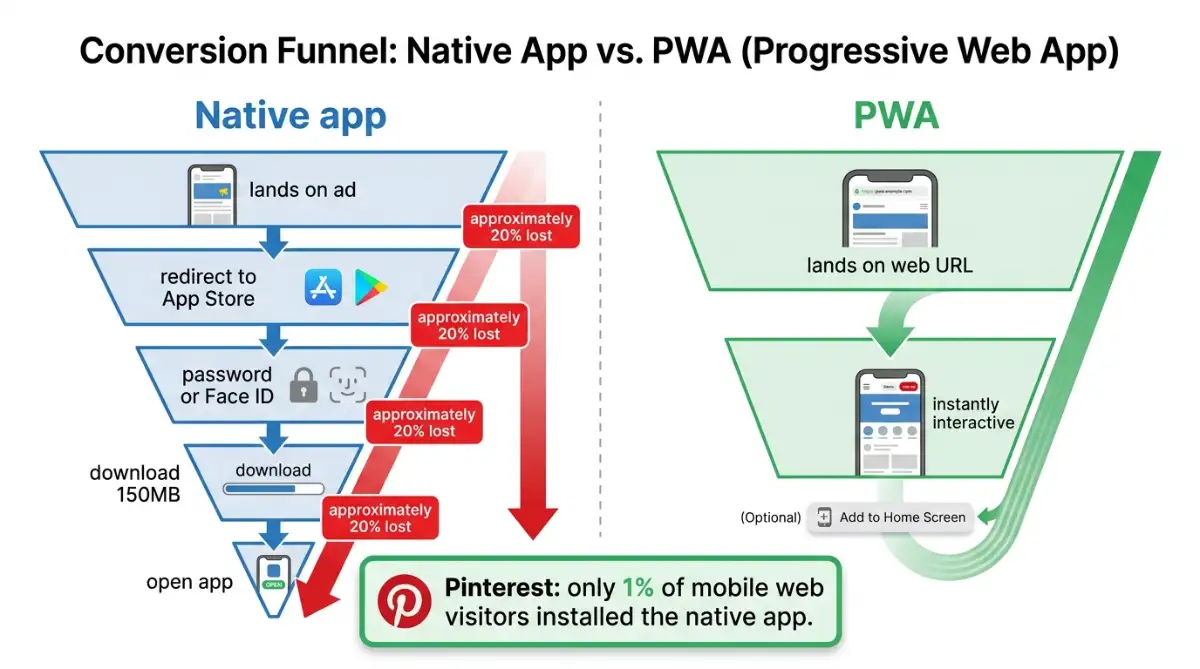
Pinterest discovered that only 1% of its unauthenticated mobile web visitors ever converted into a native app install. For a small e-commerce seller watching shoppers bounce before they reach a download screen, that figure stings. Pinterest's fix was a Progressive Web App, and the rebuilt experience pushed user logins up 370%.
The appeal for online store owners is straightforward: reach mobile buyers without first asking them to detour through an app store. This guide covers how a Progressive Web App works, what one costs, where Apple limits it, and which real case studies show it can move sales. By the end you will know whether a PWA belongs on your roadmap or not.
What Makes a Progressive Web App Different From a Regular Website?
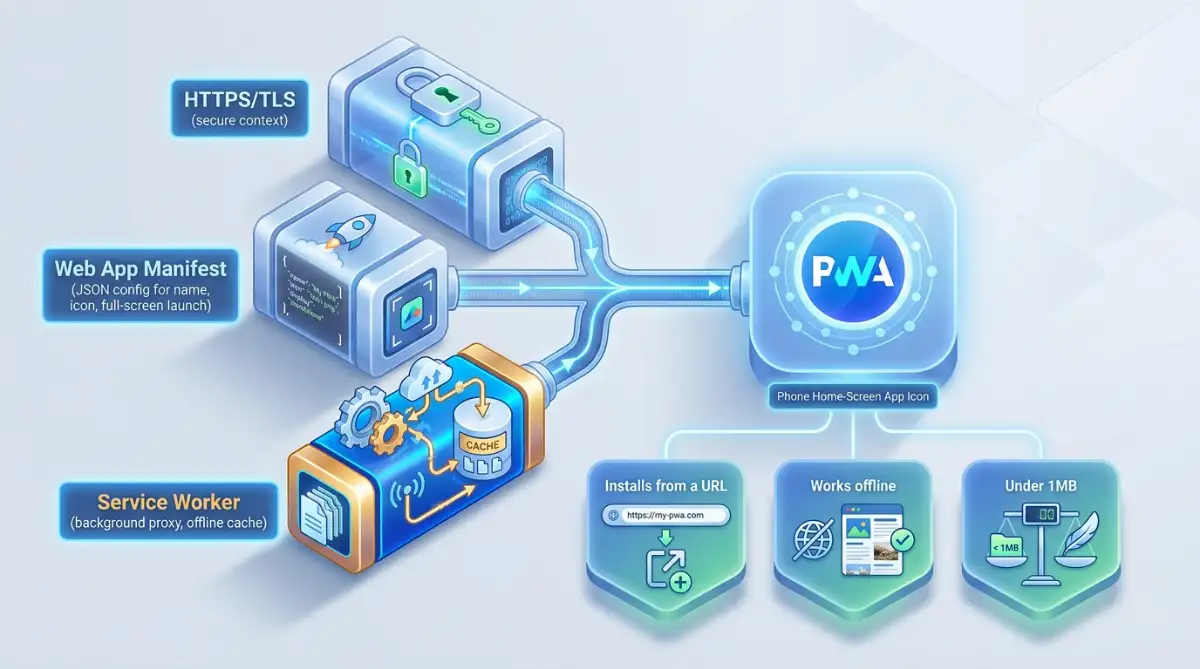
A Progressive Web App is an ordinary website layered with three technical pieces: a secure HTTPS connection, a Web App Manifest, and a registered service worker. Those additions let the site install to a home screen, cache itself for offline use, and behave like installed software inside the browser instead of a tab you keep losing.
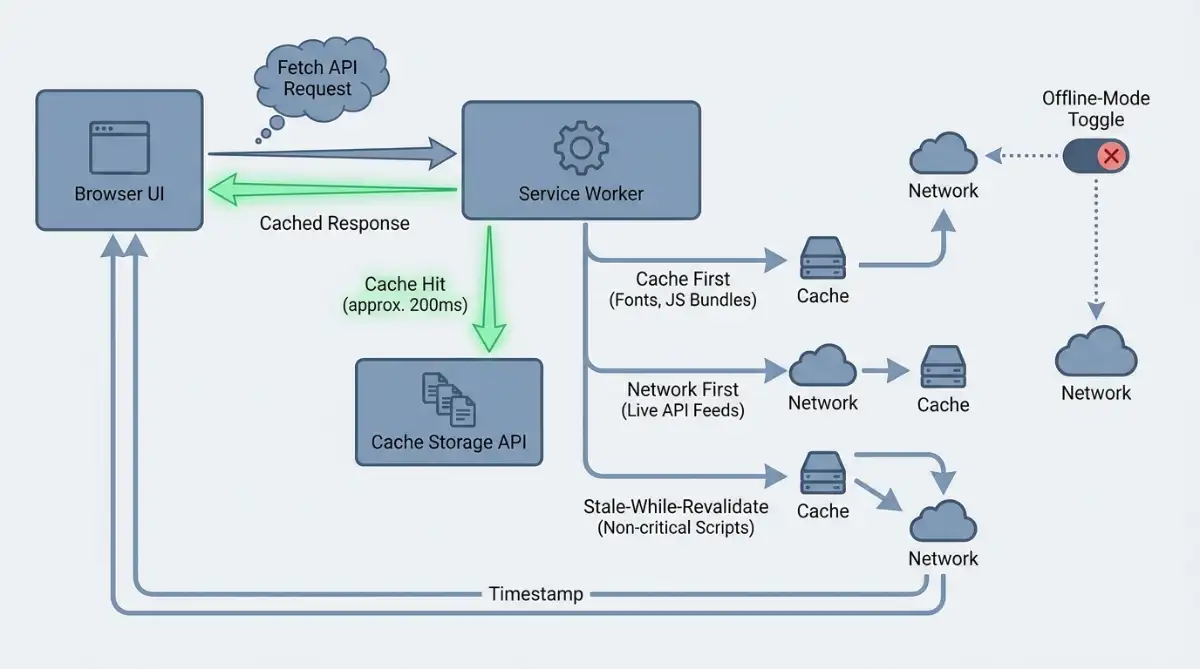
The service worker does the heavy lifting. It runs on a background thread and acts as a programmable proxy that intercepts network requests, so the app can serve cached files first and only hit the network when needed. The Web App Manifest, a small JSON file, tells the operating system the app's name, icon, and how to launch full screen.
Most builders frame a PWA the way Alex Russell originally did.
A Progressive Web App is a website that has taken all the right vitamins.
If you already understand a web app, a PWA is that, plus the offline brain and the install prompt.
The pieces, in plain terms:
- Service worker: the background script that handles caching and offline routing.
- Web App Manifest: the JSON config that controls icons, name, and full-screen launch.
- App Shell: the cached UI skeleton (header, nav, layout) that paints instantly while data loads.
What you actually tune as a builder is the caching strategy. A "cache first" rule serves fonts and scripts instantly from local storage, while "network first" keeps live data like a product feed fresh and only falls back to cache when the shopper goes offline. A third pattern, stale-while-revalidate, shows the cached version immediately and updates it quietly in the background. That mix is why a returning visitor can watch your store paint in well under a second.
How Did Progressive Web Apps Get Their Start?
The idea predates the name. When Steve Jobs unveiled the iPhone at Macworld on January 9, 2007, he initially told developers to build for Safari using web standards rather than a native SDK. The web of 2007 was not fast enough, so Apple launched the native App Store in 2008 and the closed app economy took over.
There's no SDK that you need!
In between sat a messy decade of workarounds. Hybrid packaging frameworks like Cordova, Ionic, and Electron wrapped web code inside a native container so it could ship through stores, but they often carried heavy performance overhead and clunky setup.
The modern term arrived in June 2015, when designer Frances Berriman and Google Chrome engineer Alex Russell coined "Progressive Web Apps" in a now-famous blog post. Google adopted PWAs as a core standard in 2016, Microsoft added support to Windows 10 and Edge in 2018, and Apple finally shipped Web Push on iOS 16.4 in March 2023, closing one of the platform's biggest gaps.
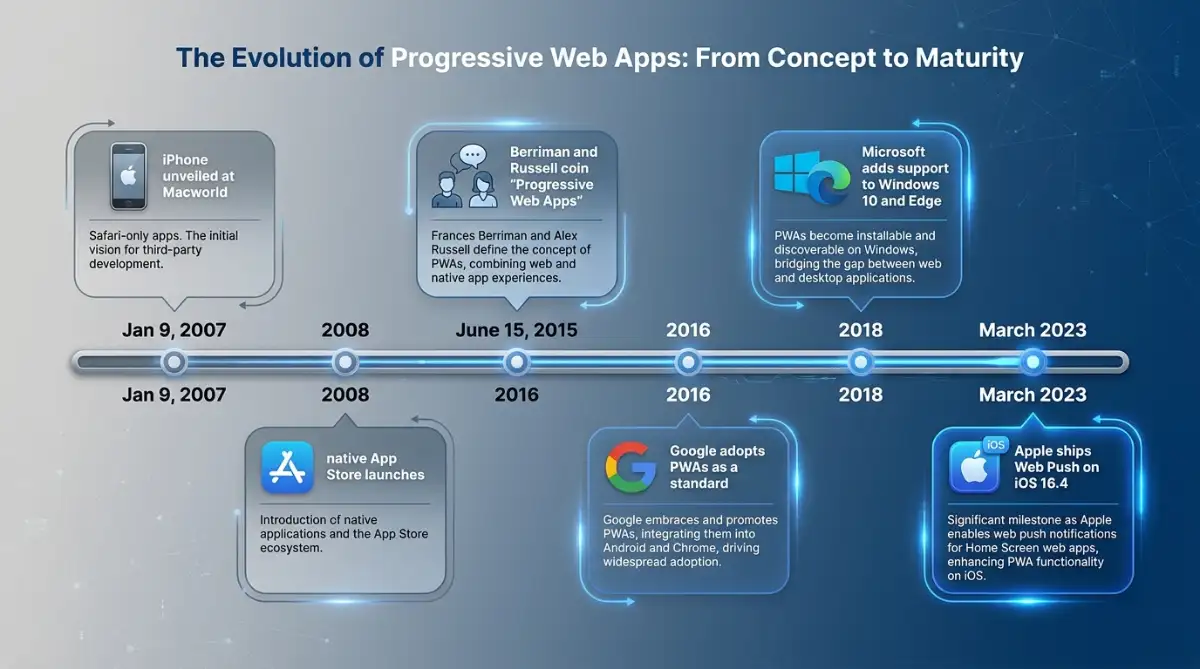
That long arc, from Jobs steering developers to the browser to Apple resisting full PWA parity, is a direct thread out of the same era that killed Flash and reshaped no-code tooling. The web kept circling back to the same promise: an app without the install.
What Does a Progressive Web App Cost Compared to a Native App?
For an online store owner validating an idea, cost is usually the deciding factor. A PWA reaches a working MVP in roughly 4 to 8 weeks for around USD 20,000 to 35,000, versus 14 to 20 weeks and USD 50,000 to 65,000 for a dual native build. It also avoids the 15% to 30% commission that the App Store and Google Play charge on digital goods.
The trade is real performance headroom. A native app still wins on raw frame rate and deep hardware access, and cross-platform frameworks like Flutter sit in between.
| Metric | Native (iOS/Android) | Flutter | React Native | PWA |
|---|---|---|---|---|
| MVP timeline | 14–20 weeks | 12–16 weeks | 14–20 weeks | 4–8 weeks |
| MVP cost (USD) | 50,000–65,000 | 32,000–40,000 | 15,000–40,000 | 20,000–35,000 |
| Download size | 50–200 MB | +4–8 MB | +2–4 MB | < 1 MB |
| App store fees | 15–30% | 15–30% | 15–30% | None |
| Codebases | 2 | 1 | 1 | 1 (web standard) |
The single line that matters most for a lean budget: a PWA ships from one codebase, installs from a link, and never pays a platform a cut of your revenue.
There is a maintenance angle too, and it compounds over time. With a native app, every fix means a new build, a store review, and the wait for users to update. A PWA updates the moment you deploy, so the version a shopper opens tomorrow is always the latest one. Across three years, that single-codebase reality is where the 70% to 80% savings actually accrue, not just on day one.
Do Progressive Web Apps Actually Move the Numbers?
The case studies are the most convincing part of the PWA story, especially for commerce. Starbucks launched its PWA in 2017 at 233 KB over the wire, roughly 99.84% smaller than its 148 MB native iOS app, and saw a 2x increase in daily active users placing orders on the web.
I keep coming back to the Pinterest figure because it reframes the whole pitch: the rebuilt PWA lifted core engagements 60%, logins 370%, and ad revenue per session 44%, all from shoppers who would never have installed an app.
Twitter Lite is now the fastest, least expensive, and most reliable way to use Twitter.
That line from Twitter's engineering lead Nicolas Gallagher tracked the data: Twitter Lite drove a 75% rise in tweets sent and cut bounce rates 20%.
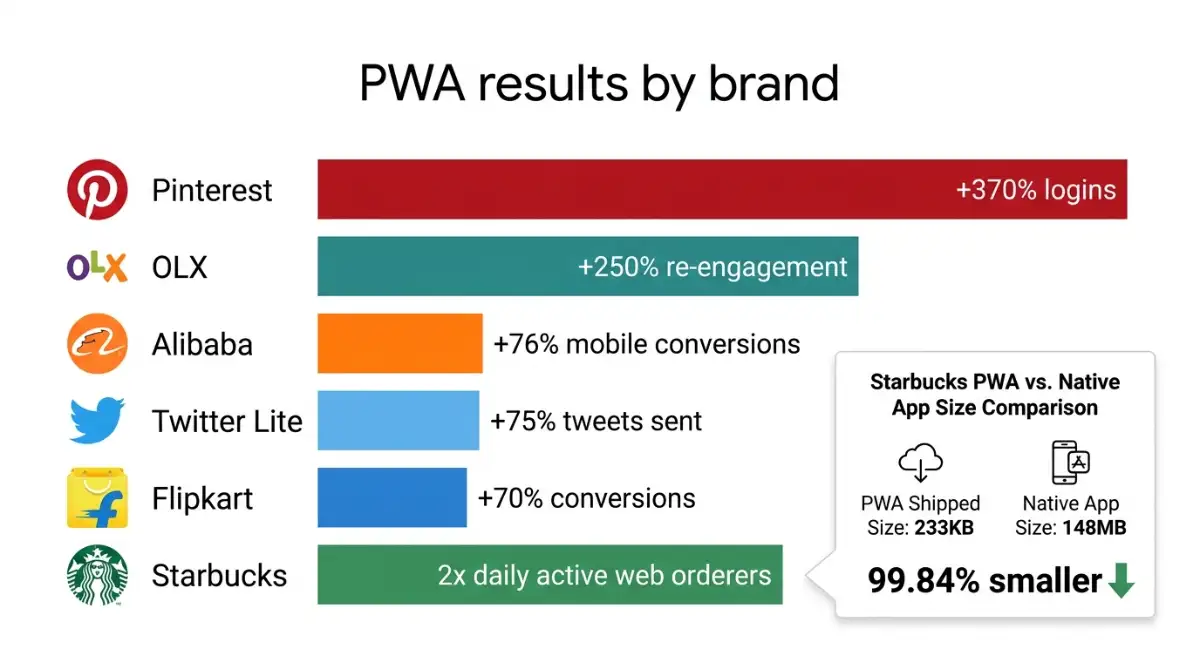
| Company | Headline result | Source |
|---|---|---|
| Flipkart | +70% conversions, 3x time on site | Straits Research |
| Alibaba | +76% mobile conversions | Alibaba case study |
| OLX | -80% bounce, +250% re-engagement | OLX case study |
| Tinder | Load cut 90% (11.91s to 4.69s) | Tinder Online |
For sellers who live on e-commerce platforms like Shopify, these are the numbers that justify the build.
The pattern is sharpest in markets with expensive data and budget phones. Flipkart Lite and Alibaba both leaned on tiny download sizes to reach shoppers who would never sit through a 150MB native install, and Spotify expanded its installable web player partly to sidestep an App Store billing dispute, lifting web monthly active users 30%. When the alternative is a download a buyer abandons, sub-1MB matters more than 120 frames per second.
Why Don't Progressive Web Apps Work as Well on iPhones?
Here is the honest catch. Apple routes every iOS PWA through its WebKit engine and applies limits that Android and desktop Chromium browsers do not. The Cache Storage API is capped at 50MB per partition on iOS, and Intelligent Tracking Prevention deletes all client-side storage after 7 days of inactivity, which can wipe a user's local data and force re-authentication.
Apple's WebKit team also declined in June 2020 to implement 16 advanced web APIs from Project Fugu, citing fingerprinting and security risks. The practical result is a list of things a PWA cannot do on an iPhone.
Blocked on iOS WebKit:
- Web Bluetooth (no pairing with accessories)
- Web NFC (no tag reading)
- Web USB and Web Serial (no local device ports)
- File System Access API (no native local file writes)
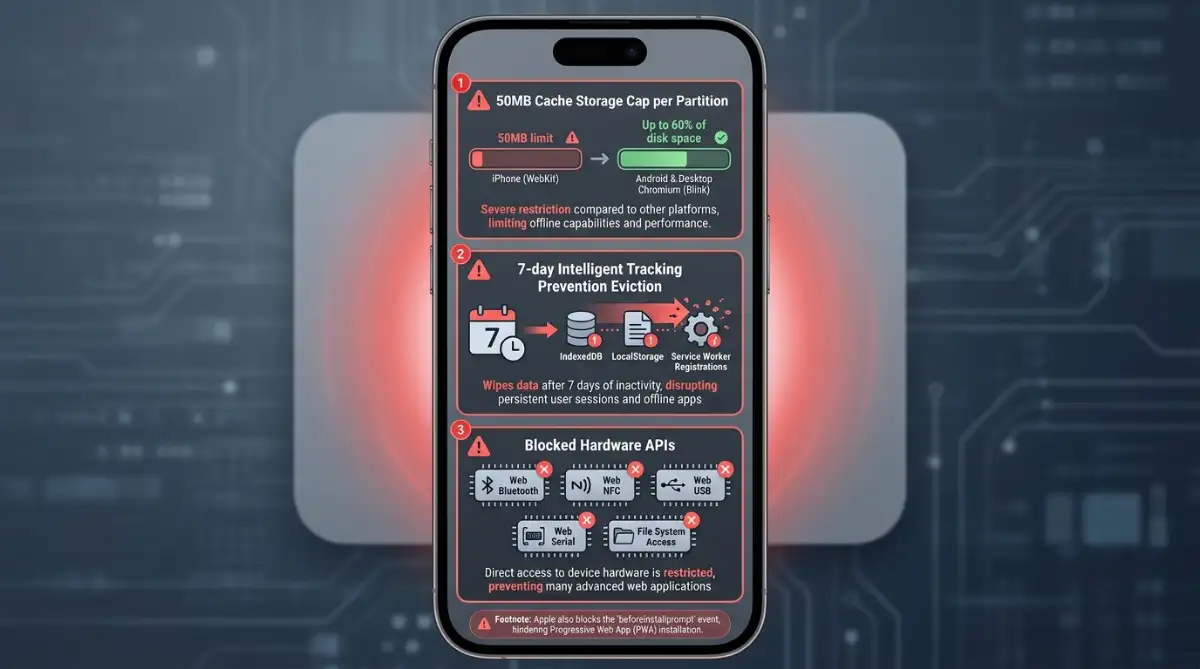
There was also the EU drama: in February 2024, iOS 17.4 betas briefly broke home-screen web apps in Europe, which Apple blamed on Digital Markets Act browser-engine rules, before reversing course on March 1, 2024.
One more iPhone quirk trips up store owners. Android browsers can fire an automatic install prompt, but Apple blocks that event, so iOS users must open the share sheet and tap "Add to Home Screen" themselves. In practice you have to build a small in-app nudge that shows iPhone shoppers exactly how to install, or most of them never will. Whether any of this matters depends entirely on your product. A clothing store's PWA never touches Bluetooth, so the limits are invisible. A smart-home or hardware app is a different conversation, and that is exactly where the native vs web mobile app decision gets sharp.
How Big Is the Progressive Web App Market in 2026?
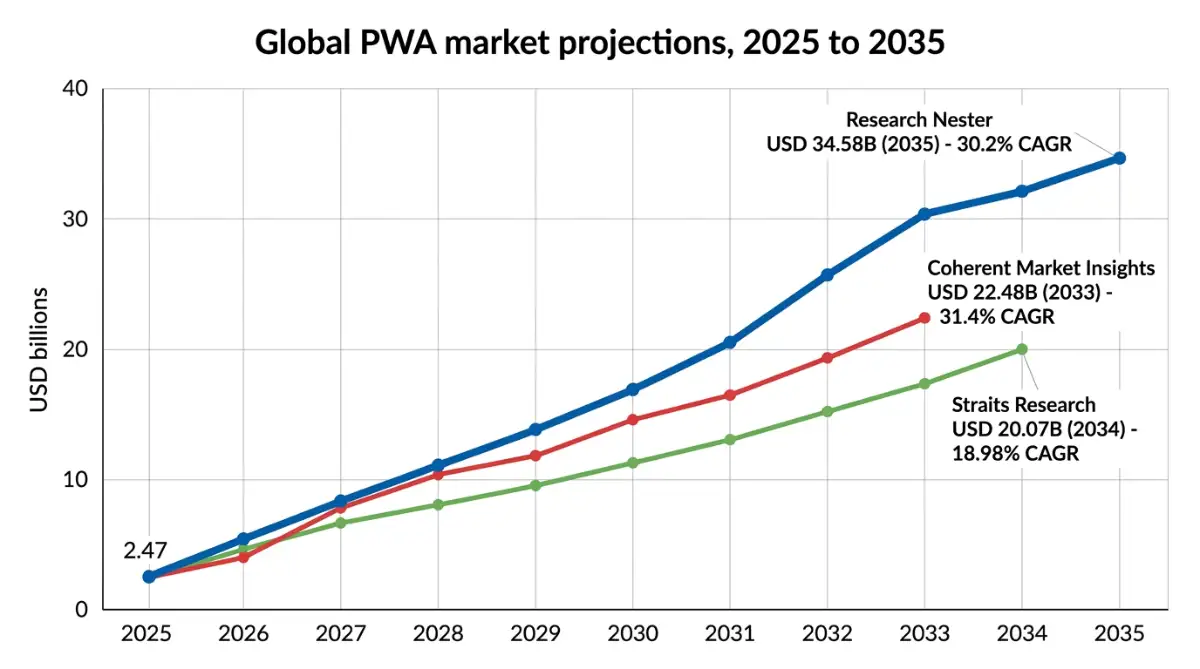
Analysts disagree on the size, but not the direction. Straits Research valued the global Progressive Web App market at USD 4.2 billion in 2025, projecting USD 20.07 billion by 2034 at an 18.98% CAGR. Research Nester is more aggressive, forecasting USD 34.58 billion by 2035 at a 30.2% CAGR.
| Firm | Forecast | CAGR |
|---|---|---|
| Straits Research | $20.07B by 2034 | 18.98% |
| Coherent Market Insights | $22.48B by 2033 | 31.4% |
| Research Nester | $34.58B by 2035 | 30.2% |
| Grand View Research (desktop segment) | $3.08B by 2033 | 27.6% |
According to Global Market Insights, large enterprises held 56% of the market in 2023 and North America led with a 37% regional share. There is also a quieter reason the curve keeps climbing: search. Unlike a native app, whose content sits locked inside an un-crawlable sandbox, every page of a PWA has its own URL that Google can index.
That means the same build that loads fast for shoppers also feeds organic traffic straight to specific product paths, with no download standing in the way. The takeaway for a small online store owner is less about the billions and more about momentum: the tooling, browser support, and case studies are all compounding in the same direction.
Start exploring launch-ready no-code templates here!
FAQ
Do Progressive Web Apps work offline? Yes. The service worker caches the app shell and key data locally, so a PWA can load and function without a connection. On iOS, plan for Apple's 7-day storage eviction by syncing important data to a server rather than relying only on the device.
Can you put a PWA in the App Store? A PWA installs directly from a browser using "Add to Home Screen," so it does not require the App Store at all. You can wrap a PWA for store submission if you want, but the whole point is bypassing store fees and review delays.
Do Progressive Web Apps work on iPhones? They do, with limits. iOS PWAs run on Apple's WebKit engine, support Web Push since iOS 16.4, but cannot use Web Bluetooth, NFC, or USB. For most content and commerce apps that is fine; hardware-heavy apps may need native.
Is a PWA cheaper than building a mobile app? Generally yes. A PWA MVP often costs USD 20,000 to 35,000 from a single codebase, versus USD 50,000 to 65,000 for separate native iOS and Android builds. Over three years, PWAs can save 70% to 80% on development and maintenance.
What is the difference between a PWA and a responsive website? A responsive website only adjusts layout to screen size. A Progressive Web App adds a service worker, a manifest, offline caching, and home-screen install, so it behaves like installed software rather than a page you reopen in a tab.
Start building without code
Browse thousands of no-code templates for Webflow, Framer, Bubble, Lovable, Replit and more.
Explore Templates