How Shopify democratized E-commerce for non devs
Shopify is a hosted e-commerce platform that abstracts server management, payment processing, and security into a single SaaS tool. Over 5.6 million merchants use it to sell across 175+ countries, generating $292.3 billion in GMV in 2024 alone. Its visual editor, AI assistant Sidekick, and 12,320+ app ecosystem let non-developers launch professional stores in hours, not months.
Table of Contents
- From a Snowboard Shop to 5.6 Million Stores
- Why Non-Technical SMB Owners Choose Shopify E-Commerce
- Shopify AI Tools That Replace Your Tech Team in 2026
- Shopify vs Amazon: Who Owns the Customer?
- The Real Cost of Shopify E-Commerce (Apps, Fees, and Fine Print)
- Key Takeaways
- FAQ
According to Shopify's own reporting, its merchants collectively supported five million jobs and drove over $444 billion in global economic activity in 2021. That's not a typo, and it's not from a Fortune 500 conglomerate. It's from a platform built because three guys in Ottawa couldn't find decent software to sell snowboards online. If you're an SMB owner or marketing manager who's been putting off launching a store because you think you need a developer, this breakdown of how Shopify e-commerce works (and what it actually costs) will save you weeks of research.
From a Snowboard Shop to 5.6 Million Stores
Shopify e-commerce exists because the tools available in 2004 were, to put it mildly, terrible. Tobias Lütke, Daniel Weinand, and Scott Lake wanted to sell snowboarding gear through an online store called Snowdevil. The dominant options like Yahoo Store offered rigid templates and almost no design flexibility. Lütke, a programmer, decided to build his own commerce engine using Ruby on Rails instead of wrestling with broken tools. The platform that grew from that frustration went on to raise over $131 million at IPO in 2015 and today generates billions in annual revenue.
The store worked. But here's the twist: other merchants kept asking about the software, not the snowboards. That signal was loud enough for the founders to pivot entirely. They abandoned the retail business and launched Shopify in June 2006. The name itself, a blend of "shop" and "modify," hinted at the core idea: give non-developers the power to customize a professional storefront without writing backend code.
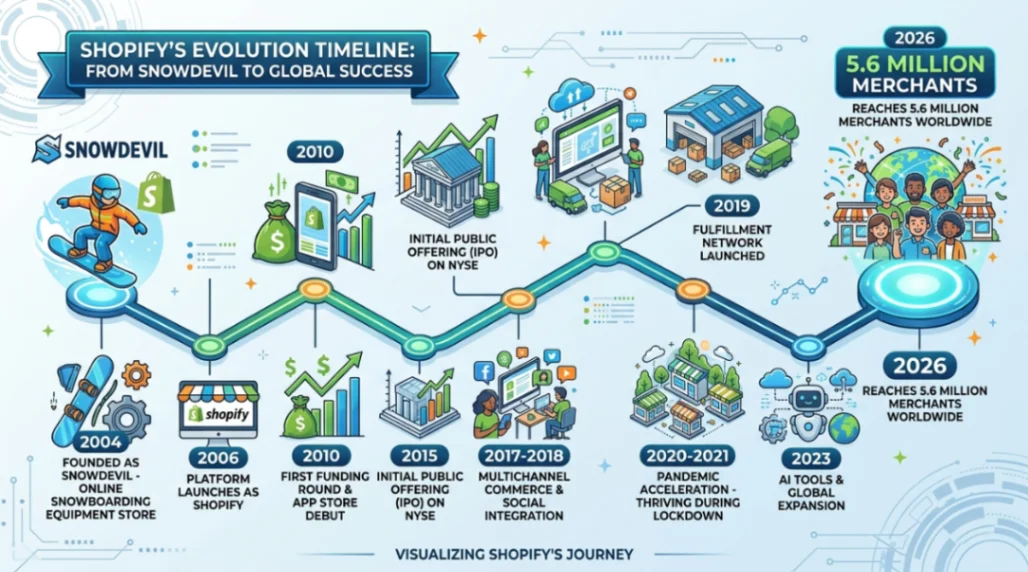
The growth since then has been staggering. According to Backlinko's 2026 merchant statistics, the platform processed $292.3 billion in gross merchandise volume and generated $8.8 billion in revenue in 2024. By early 2026, the merchant count surpassed 5.6 million across 175+ countries. For context, that's more individual stores than the population of New Zealand. The platform's journey from a frustrating era of early web builders to a global commerce operating system happened in under two decades.
Why Non-Technical SMB Owners Choose Shopify E-Commerce
Shopify's biggest selling point for non-developers is that it hides the hard parts. You don't manage servers, install security patches, or configure payment gateways from scratch. Everything runs as a hosted SaaS product, similar to how WordPress changed the CMS landscape in 2003 but purpose-built for selling products.
Two features stand out in 2026:
-
Online Store 2.0 (OS 2.0): Launched in 2021, this update introduced "Sections Everywhere," which lets you drag and drop layout blocks on every page of your store, not just the homepage. Previously, changing a product page layout meant hiring a developer to edit Liquid template files. The default theme, Dawn, also loads 35% faster than its predecessor, helping your store meet Google's Core Web Vitals without any manual optimization.
-
The App Store ecosystem: With over 12,320 apps available, capabilities that once required five-figure custom development budgets (think AI product recommendations, subscription billing, advanced email flows) are available as affordable monthly add-ons. According to Shopify, its developer community earns more than $1 billion annually from app sales alone.
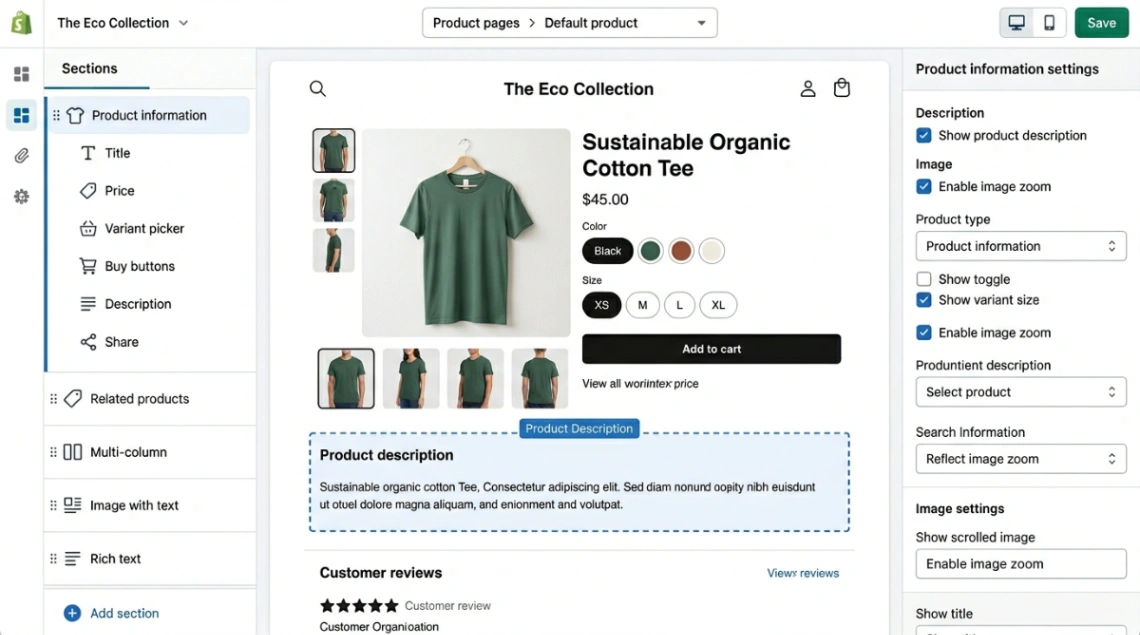
This "Lego-brick" approach to building a store means an SMB owner can launch a basic storefront and bolt on specialized functionality over time, without ever outgrowing the platform. Brands like Gymshark famously migrated to Shopify Plus after their custom-built store crashed on Black Friday, proving that the same infrastructure serves both startups and global DTC brands.
Shopify AI Tools That Replace Your Tech Team in 2026
Shopify Magic and Sidekick are the platform's answer to the content and operations bottleneck that bogs down small teams. If you've ever spent an entire afternoon writing product descriptions or digging through analytics dashboards, these tools were built for you.
Shopify Magic generates product descriptions, blog posts, and email subject lines trained on conversion data from the entire Shopify ecosystem. It adapts to your brand voice and suggests copy that aligns with what's actually driving sales across millions of stores.
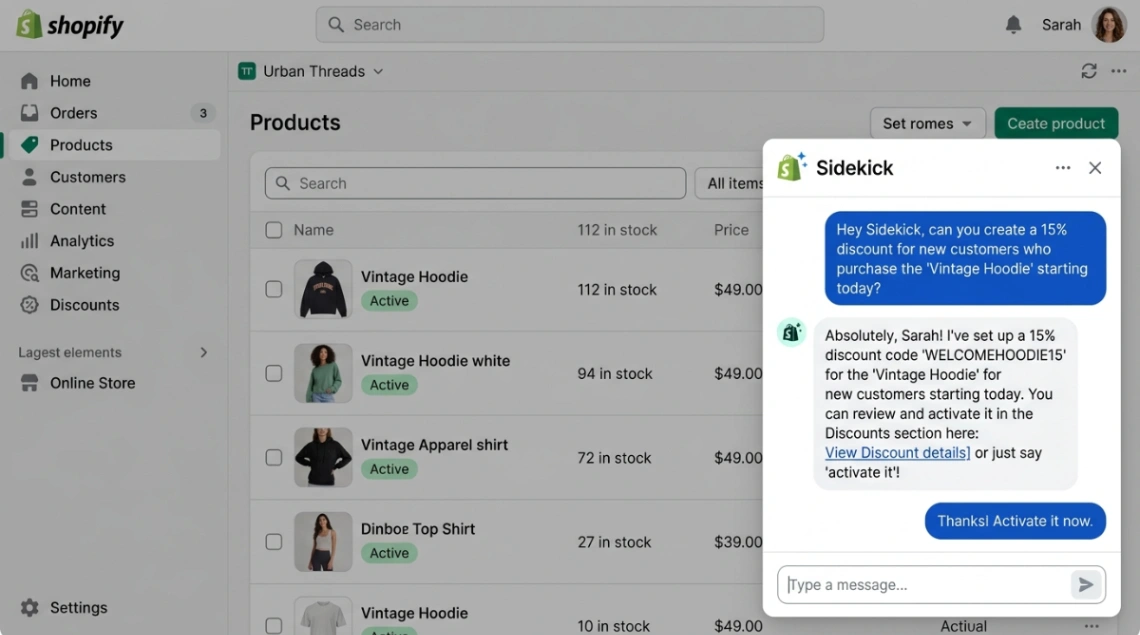
Sidekick goes further. It's an AI assistant embedded directly in your Shopify admin panel. You can ask it plain-language questions like "Which marketing channel drove the most sales this quarter?" or give it commands like "Create a 20% discount for VIP customers and schedule it for Friday." According to Shopify's Winter 2026 Edition release, Sidekick can now build complex workflow automations from a text description, generate store visuals, and even draft custom theme code.
The biggest 2026 development is Agentic Commerce. Shopify's infrastructure now supports "Agentic Storefronts" where AI platforms like ChatGPT, Google Gemini, and Microsoft Copilot can discover and sell your products directly within their conversational interfaces. This rolled out automatically for all 5.6 million stores, making Shopify merchants among the first to sell inside the AI-driven discovery landscape that's rapidly reshaping how consumers find products.
Shopify vs Amazon: Who Owns the Customer?
Shopify gives you the customer relationship. Amazon does not. That's the single most important distinction for any SMB owner weighing both options.
| Factor | Shopify | Amazon |
|---|---|---|
| Customer data ownership | You own email lists, behavior data, and brand identity | Amazon controls the customer relationship and data |
| Branding | Fully customizable storefront with your domain | Standardized listing page alongside competitors |
| Fee structure | Monthly subscription + payment processing (2.4%-2.9%) | Referral fees (8%-45%) + FBA fees + advertising costs |
| Discovery | You drive your own traffic via SEO, ads, social | Built-in marketplace traffic from 300M+ shoppers |
| Scalability | Basic plan to Shopify Plus enterprise tier | Seller tiers with increasing complexity |
According to market data, Shopify powers roughly 30% of the US e-commerce software market, positioning it as the primary independent alternative to the Amazon marketplace. The platform's model means for every $1 Shopify earns, its merchants earn $38. On Amazon, that ratio looks very different because you're paying for access to their audience rather than building your own.
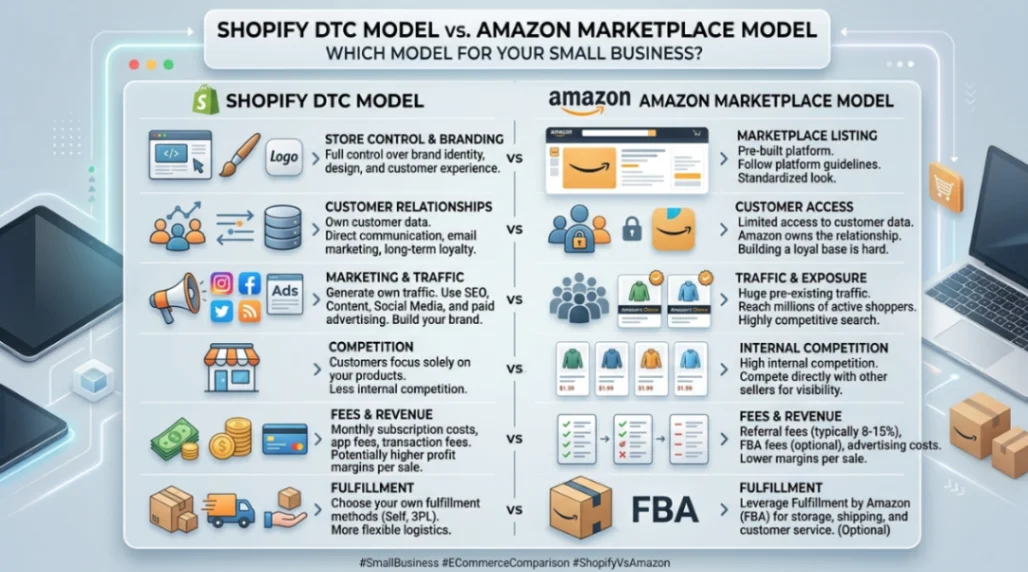
For SMB owners who want to build a brand people remember (not just a product listing buried on page three), Shopify's direct-to-consumer model is the stronger long-term play. That said, many merchants sell on both, using Shopify as their primary storefront and Amazon as an additional sales channel.
The Real Cost of Shopify E-Commerce (Apps, Fees, and Fine Print)
You can launch a Shopify store starting at $39/month on the Basic plan. But the sticker price isn't the whole story, and pretending otherwise would be doing you a disservice.
Payment processing fees through Shopify Payments (powered by Stripe) run between 2.4% and 2.9% per transaction depending on your plan. If you use a third-party payment provider instead, Shopify charges an additional transaction fee of 0.5% to 2% on top of whatever that provider charges. This policy is worth understanding before you commit.
App costs add up. While many essential apps offer free tiers, a typical SMB store running email marketing, reviews, subscription management, and advanced analytics can easily spend $100 to $300/month on app subscriptions. The 12,320+ apps in the Shopify App Store are a strength, but each one is a line item on your monthly budget.
The upside of scale: Shopify negotiates bulk shipping discounts of up to 88% with carriers like USPS, UPS, and DHL. These savings pass directly to you, which is the kind of enterprise-level perk that small businesses can't negotiate on their own. If you're shipping physical products, this alone can offset a meaningful chunk of your app spend.
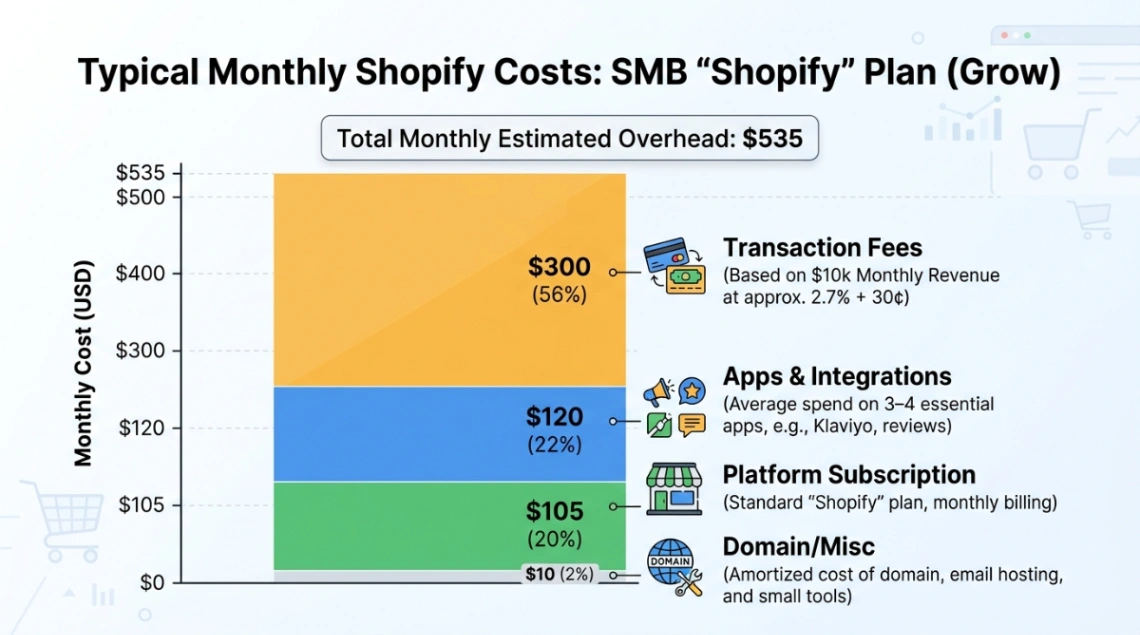
For a deeper look at how no-code builders compare on pricing and flexibility, it's worth evaluating Shopify alongside other platforms to see where your specific budget lands.
Start exploring launch-ready E-commerce templates here!
Key Takeaways
-
Shopify e-commerce removes the technical gatekeeping that kept non-developers out of online retail. With OS 2.0's drag-and-drop editor, AI-powered Sidekick, and 12,320+ apps, SMB owners can build, manage, and scale stores that compete with enterprise brands, no coding required.
-
The platform's economics favor merchants who build their own brand. Unlike Amazon, Shopify lets you own your customer data, email lists, and storefront identity. For every $1 Shopify earns, merchants earn $38, a ratio that reflects a partner model rather than a landlord model.
-
Costs are real but manageable if you plan ahead. The $39/month starting price grows with app subscriptions and payment fees, but bulk shipping discounts of up to 88% and the elimination of custom development costs make the total cost of ownership competitive for most small businesses.
The 5.6 million merchants already on the platform aren't all tech-savvy founders. Most are regular business owners who decided that selling online shouldn't require a computer science degree. In 2026, with AI agents now selling products inside ChatGPT and Gemini on your behalf, the barrier to entry has never been lower, and the ceiling has never been higher.
FAQ
What is Shopify e-commerce and who is it for? Shopify is a hosted SaaS platform that lets anyone build and run an online store without managing servers or writing code. It serves 5.6 million merchants, from solo sellers to enterprise brands.
How much does a Shopify store actually cost per month? Plans start at $39/month, but most SMBs spend $150 to $400/month total when factoring in app subscriptions, payment processing fees (2.4% to 2.9%), and optional third-party tools.
Can I build a professional Shopify store without any coding? Yes. Online Store 2.0 introduced full drag-and-drop editing on every page. The AI assistant Sidekick can also generate theme code and build automations from plain-language commands.
How does Shopify compare to Amazon for small businesses? Shopify lets you own your customer data and brand identity. Amazon offers built-in traffic but controls the customer relationship. Many SMBs use both, with Shopify as the primary DTC storefront.
What are Shopify's AI features in 2026? Shopify Magic generates product copy and marketing emails. Sidekick handles analytics queries, workflow automation, and code drafting. Agentic Storefronts let AI platforms sell your products inside their chat interfaces.
Start building without code
Browse thousands of no-code templates for Webflow, Framer, Bubble, Lovable, Replit and more.
Explore Templates