API No Code: How Tools Talk Without Engineers
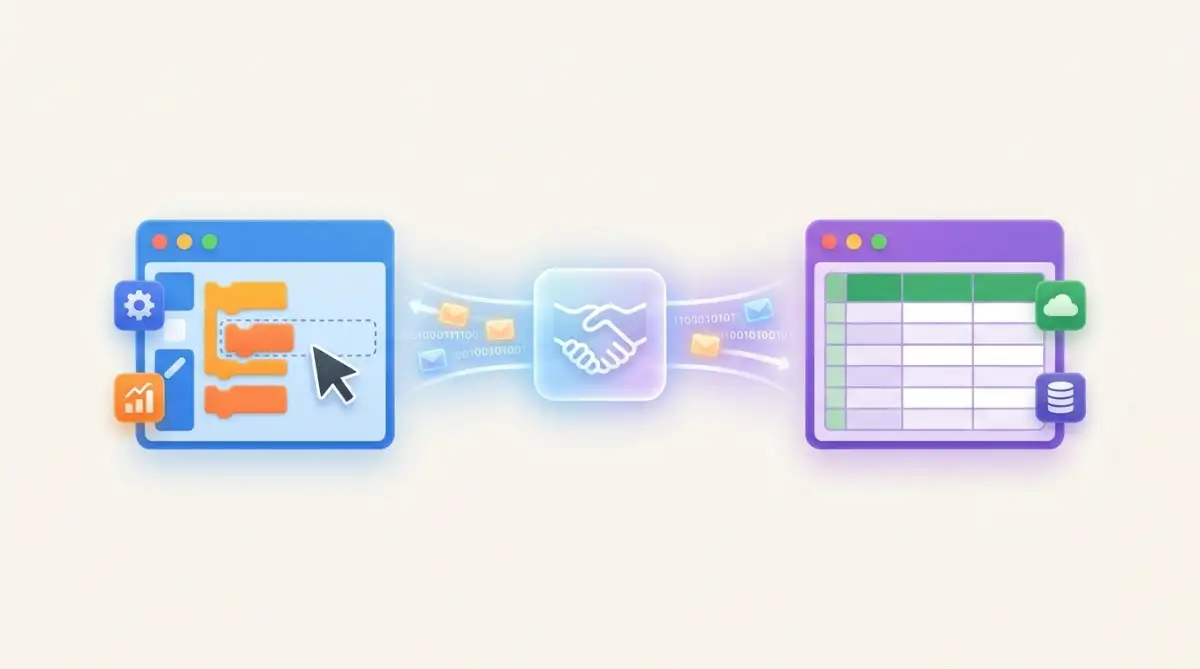
An API is a published HTTPS contract of endpoints, methods, and JSON that lets one program request data or actions from another. No-code middleware such as Zapier, Make, n8n, and Workato acts as a managed client for that contract, handling OAuth, webhooks or polling, and retries. Marketing ops teams use those canvases to move records between SaaS tools without writing fetch calls.
Table of Contents:
- Key Takeaways
- Introduction
- What Does REST Actually Send Between Two Apps?
- How Did Zapier and Make Turn HTTP Into a Canvas?
- How Do API No Code Tools Hide OAuth and Webhooks?
- Which API No Code Platform Fits a Consultant's Stack?
- Why Do Twitter Pricing Shocks Break Overnight Automations?
- What Changes When AI Agents Start Calling These Endpoints?
- FAQ
Key Takeaways
- Zapier's catalog of more than 8,000 apps looks like infinite glue, yet the surprise for marketing ops is still the per-task meter hiding under a friendly canvas.
- Twitter's $42,000 Enterprise API and Reddit's Apollo shutdown proved a Zap is a leased pipe, and the vendor can change the lock without a migration path.
- Postman's 24.3 percent agent-ready figure is the real 2025 split, because most production endpoints still assume a human engineer rather than an MCP client sitting on the other side.
Introduction
I watched a marketing ops specialist wire Typeform to Airtable with an API no code Zap and never open a JSON file. Independent consultants now run the same pattern for invoices, so tools keep talking even when there is no engineer on the retainer.
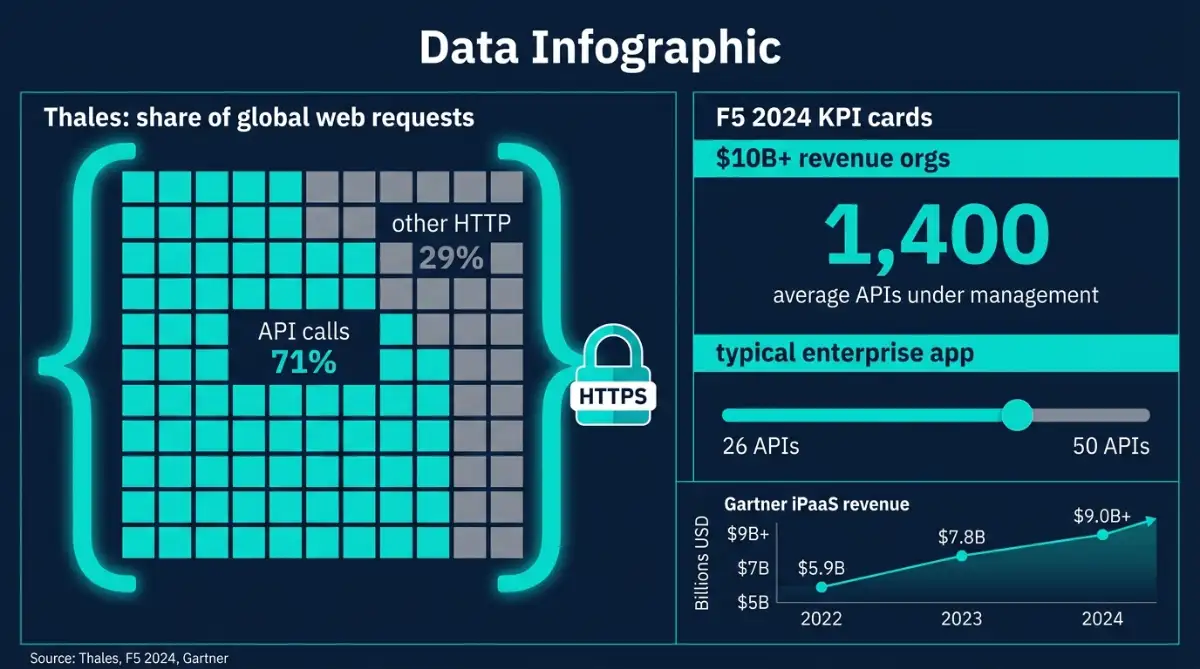
According to Thales, API requests already make up about 71 percent of global web traffic. That is not a developer brag. It is the reason a form, a CRM, and a payment page can agree on a customer record while you sleep.
Get the mapping wrong and you duplicate invoices, drop leads, or write a name into the wrong Stripe metadata field. I will unpack the HTTPS request itself, the Zapier-Make-n8n-Workato layer that hides it, and the Twitter-style price shocks that can kill a workflow overnight.
What Does REST Actually Send Between Two Apps?
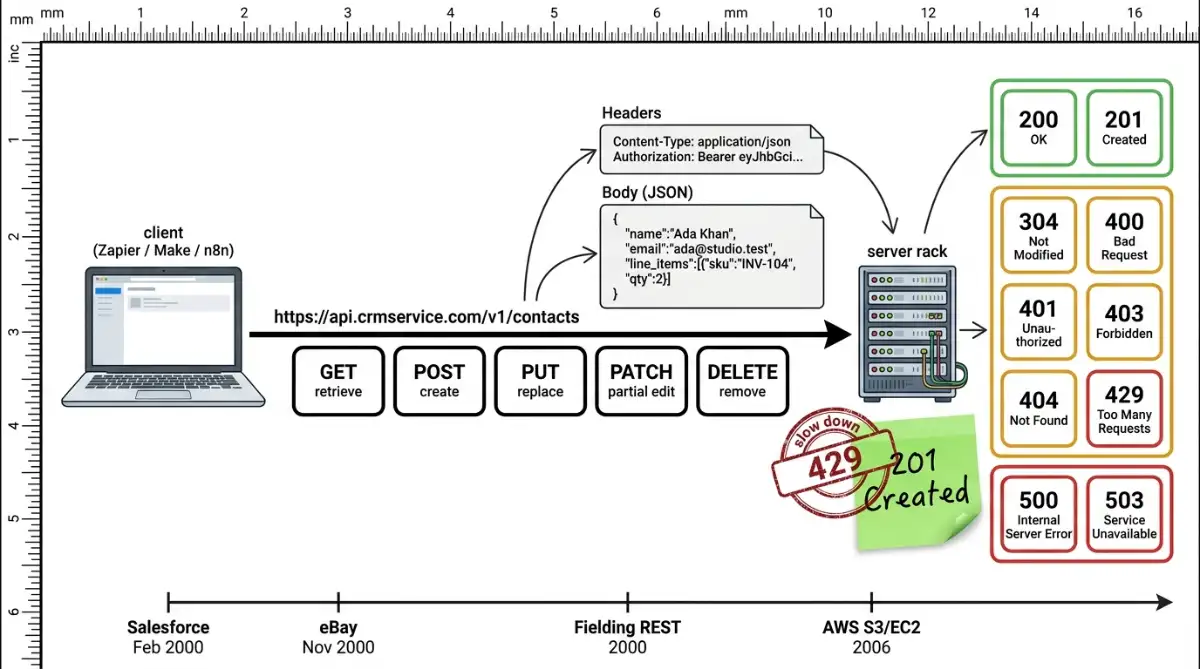
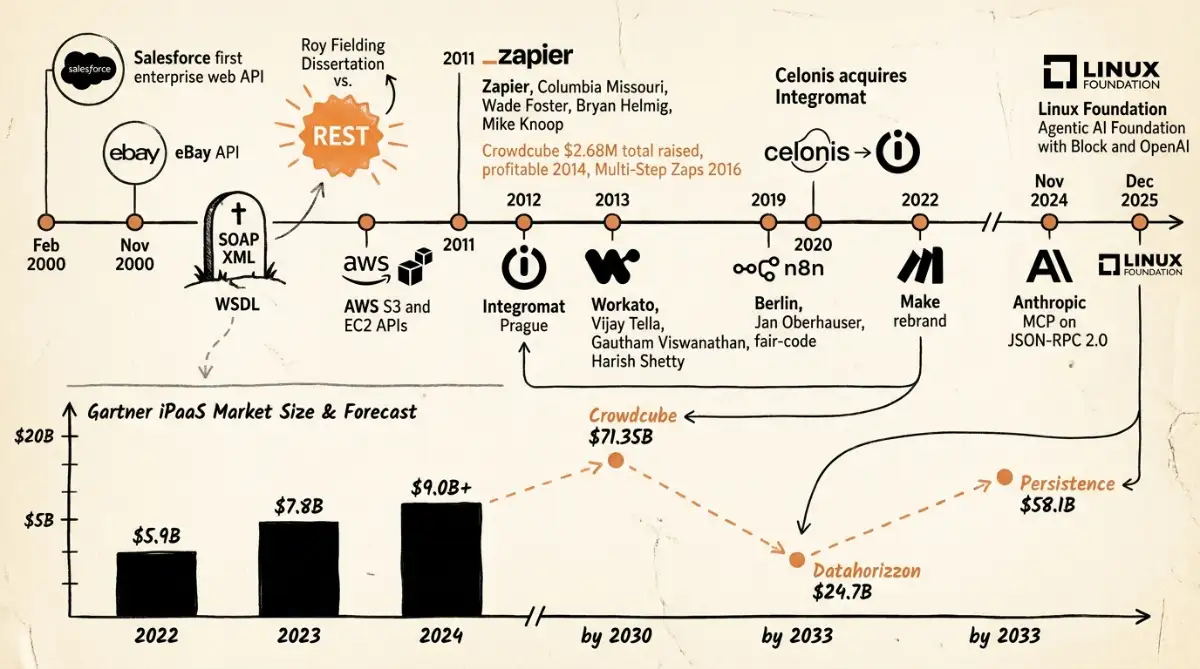
An API call is an HTTPS request to a named URL, with a verb such as GET or POST, optional JSON in the body, and a three-digit status coming back. Salesforce opened this pattern to customers in February 2000. Roy Fielding's REST dissertation the same year told the web to stop wrapping every call in SOAP XML.
According to F5 (2024), organizations with more than $10 billion in annual revenue oversee an average of 1,400 APIs, and a standard enterprise application depends on 26 to 50 distinct APIs to run. That is why a consultant's "simple" stack of forms, CRM, and payments is already a mesh of remote calls.
The handshake has five parts:
- URI / endpoint: the resource address, such as
https://api.crmservice.com/v1/contacts. - HTTP methods: GET reads, POST creates, PUT replaces, PATCH edits one field, DELETE removes the record.
- Headers: content type (almost always
application/json) plusAuthorization: Bearertokens and rate-limit metadata. - JSON payload: the body, a nest of keys, objects, and arrays.
- Status codes: 200 OK, 201 Created, 401 Unauthorized, 404 Not Found, 429 Too Many Requests, 500 or 503 when the server is the problem.
SOAP, from the late 1990s, wrapped the same idea in strict XML and WSDL contracts. Developers hated the compute cost. Fielding's REST style reused the web's own verbs, which is why every no-code HTTP module still looks like a form sitting on GET and POST.
REST won because it reused HTTP instead of inventing a second language on top of the web.
eBay followed Salesforce in November 2000. Amazon Web Services put S3 and EC2 behind callable interfaces in 2006. Once storage and compute answered HTTPS, product companies started selling access itself, not just screens.
How Did Zapier and Make Turn HTTP Into a Canvas?
Middleware appeared after SaaS tools outnumbered the engineers who could stitch them. Zapier started in Columbia, Missouri in 2011, while Integromat launched in Prague in 2012 and later became Make under Celonis. Workato followed in 2013 for ERP-scale recipes. n8n opened in Berlin in 2019 as a self-hosted, fair-code alternative.
According to Gartner, the iPaaS market generated $5.9 billion in 2022, $7.8 billion in 2023, and more than $9.0 billion in 2024. Independent 2030-2033 forecasts then fan out hard: Datahorizzon Research puts the sector at $24.7 billion by 2033, Persistence Market Research at $58.1 billion, and Crowdcube at $71.35 billion by 2030. Treat those ceilings as model disagreement, not a single destiny.
The founding details that still show up in a vendor demo:
- Zapier's 2011 trigger-action model: Wade Foster, Bryan Helmig, and Mike Knoop; Crowdcube lists $2.68 million total raised, profitability in 2014, Multi-Step Zaps in 2016.
- Make's visual, non-linear routing: Prague-born Integromat, acquired by Celonis in 2020, rebranded Make in 2022, with iterators that treat JSON arrays as first-class objects.
- Workato: Vijay Tella, Gautham Viswanathan, and Harish Shetty, former TIBCO and Oracle integration people, selling "recipes" into ERP and HRIS.
- n8n: Jan Oberhauser, fair-code, self-hostable, JavaScript and TypeScript nodes when the visual mapper runs out.
Zapier did not invent remote APIs. It sold a canvas that made someone else's endpoint feel like a light switch.
That canvas is why SaaS stacks could stay specialized instead of collapsing back into one suite. The trade is obvious if you have lived it: you rent the glue, and the glue vendor's catalog becomes part of your architecture.
How Do API No Code Tools Hide OAuth and Webhooks?
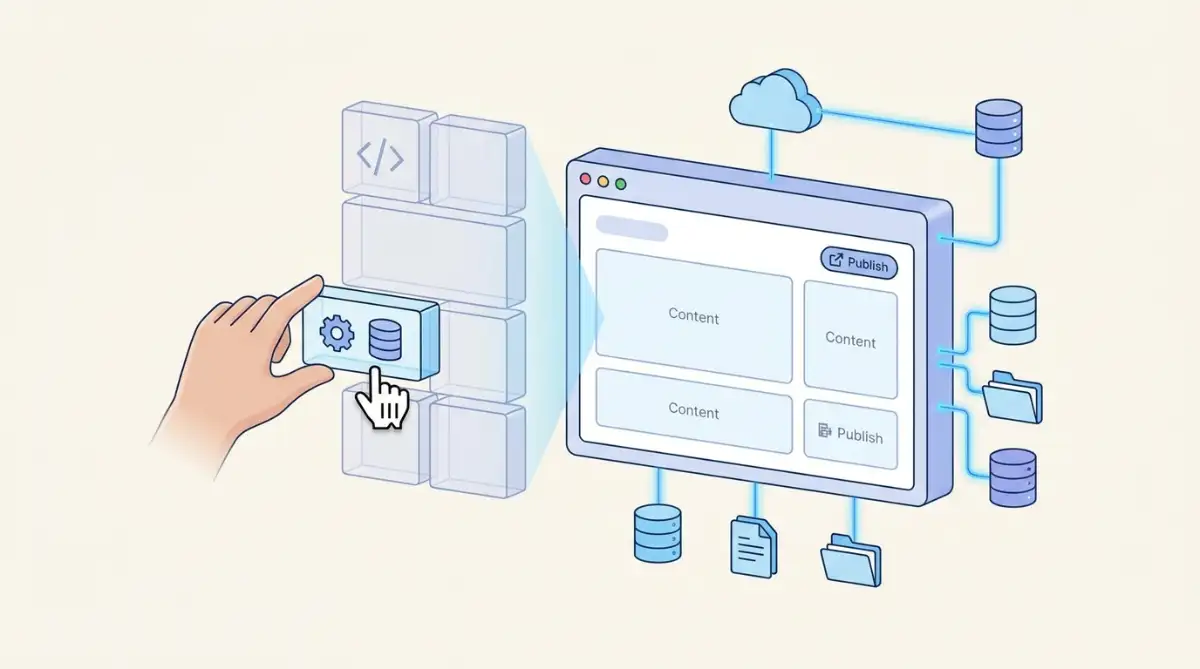
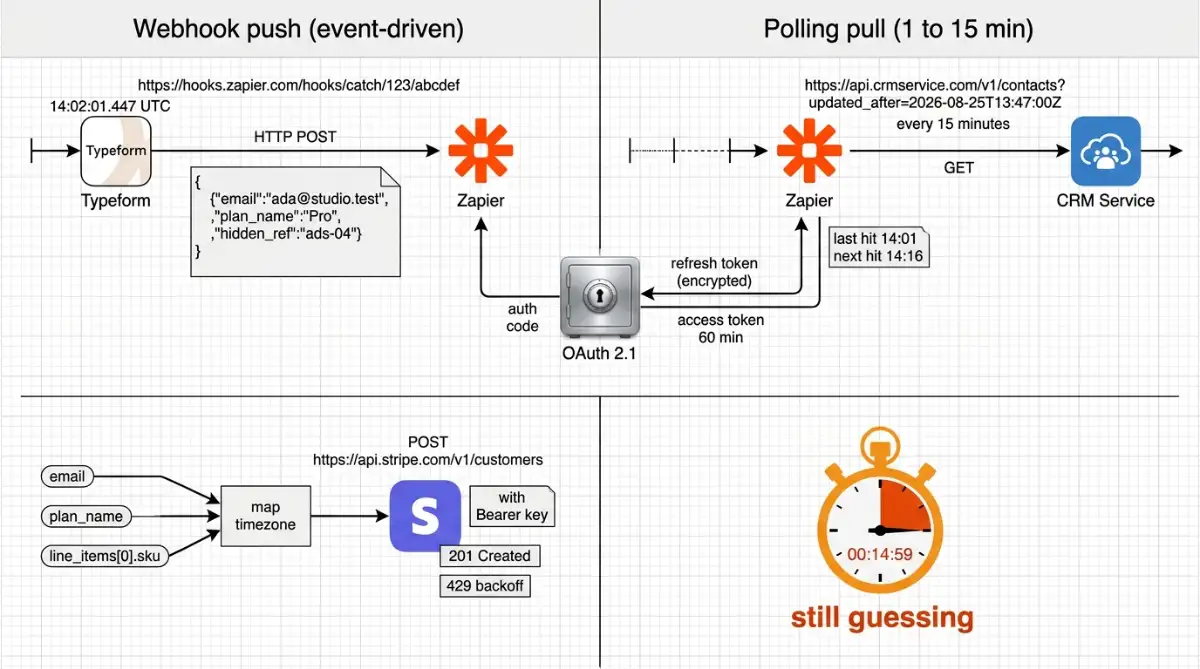
When you drop two apps on a canvas, the vendor is not merging databases. It is a proxy: catch an event, refresh OAuth, parse JSON into field pills, then POST to the destination. Zapier, Make, n8n, and Workato all do this. They differ in how much JSON you are allowed to touch.
I still open the raw JSON on a failed Zap, because the red banner almost never names the field that drifted. Marketing ops specialists learn that habit after the third silent miss, usually when Typeform's form-to-webhook flow adds a hidden field and Airtable rejects the new key.
The proxy walk looks like this:
- Trigger: the source app POSTs a webhook the moment something happens, or the platform polls with GET every 1 to 15 minutes if webhooks do not exist.
- Auth: OAuth 2.0 or 2.1 code exchange with encrypted refresh tokens; you click Allow, the vault keeps the secret.
- Parse: nested JSON becomes clickable pills (name, email, line_items[0].sku).
- Map: dates, timezones, string formats, and arrays flattened for the destination schema.
- Dispatch: a signed HTTPS call to the target, often Stripe's payment API for charges or a CRM create-contact route.
- Recover: exponential backoff on 429 and 503, execution logs, replay buttons.
A webhook is a push. Polling is a scheduled guess. Most broken Zaps are still guessing on a 15-minute clock.
The platform is a hired API client: it stores the refresh token, maps the JSON, and retries the 429.
If the source app has no native connector, the generic HTTP module still speaks REST. You supply the URL, the verb, the headers, and the body. That is the same contract a Node.js script would use, minus the IDE.
Which API No Code Platform Fits a Consultant's Stack?
Pick the platform by data shape and the cost of a miss, not by the logo wall. Zapier fits long-tail SaaS, Make fits nested arrays, and n8n fits private VPCs. Workato is the IT-governed path for SAP-scale recipes. Custom Node.js still wins when you need low-latency microservices.
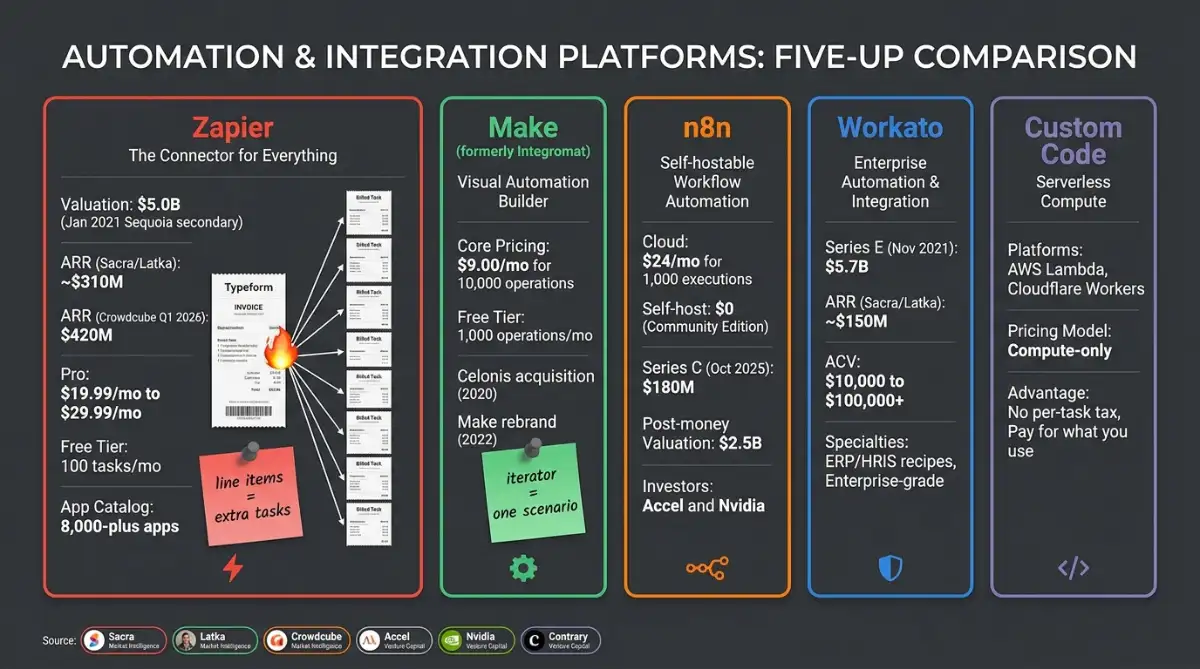
I have paid Zapier task overages on a line-item list that Make would have iterated as one scenario, and that sting taught me to count operations before I count app logos. Independent consultants feel this first on invoice Zaps, where one Typeform submission explodes into ten tasks.
| Platform | Best fit | Listed entry packaging | Scale signal in public filings and research |
|---|---|---|---|
| Zapier | Long-tail SaaS, linear trigger-action | Free 100 tasks/mo; Pro from $19.99 to $29.99/mo | $5.0B valuation (Jan 2021 Sequoia secondary); about $310M ARR (Sacra / Latka); $420M ARR in Q1 2026 (Crowdcube) |
| Make | Nested JSON, routers, iterators | Free 1,000 ops/mo; Core from $9.00/mo for 10,000 operations | Celonis subsidiary after the 2020 Integromat acquisition; rebranded Make in 2022 |
| n8n | Self-host, VPC, JS/Python nodes | Free self-hosted; Cloud $24/mo for 1,000 executions | $2.5B post-money (Oct 2025 Series C, Accel and Nvidia); $180M in that round |
| Workato | ERP/HRIS, staging, IT admin | Annual ACV often $10,000 to $100,000+ | $5.7B (Nov 2021 Series E); about $150M ARR (Sacra / Latka) |
| Custom code | High throughput, proprietary logic | Compute only (AWS Lambda, Cloudflare Workers) | No per-task middleware tax; you own retries and auth |
The catalog size is a trap if your workflow is an array of line items that Zapier bills as a pile of tasks.
It depends: a two-step Typeform-to-Slack Zap belongs on Zapier, while a 40-step finance router with aggregators belongs on Make or n8n. I would rather keep Stripe charges on a dumb, deterministic Zap than let an agent improvise a refund. Wade Foster, co-founder and CEO of Zapier, made that mix of hard rails and fuzzy work the point of a 2025 SaaStr interview.
The people that are getting the most out of AI automation today know how to mix and match determinism with agentic workflows.
Why Do Twitter Pricing Shocks Break Overnight Automations?
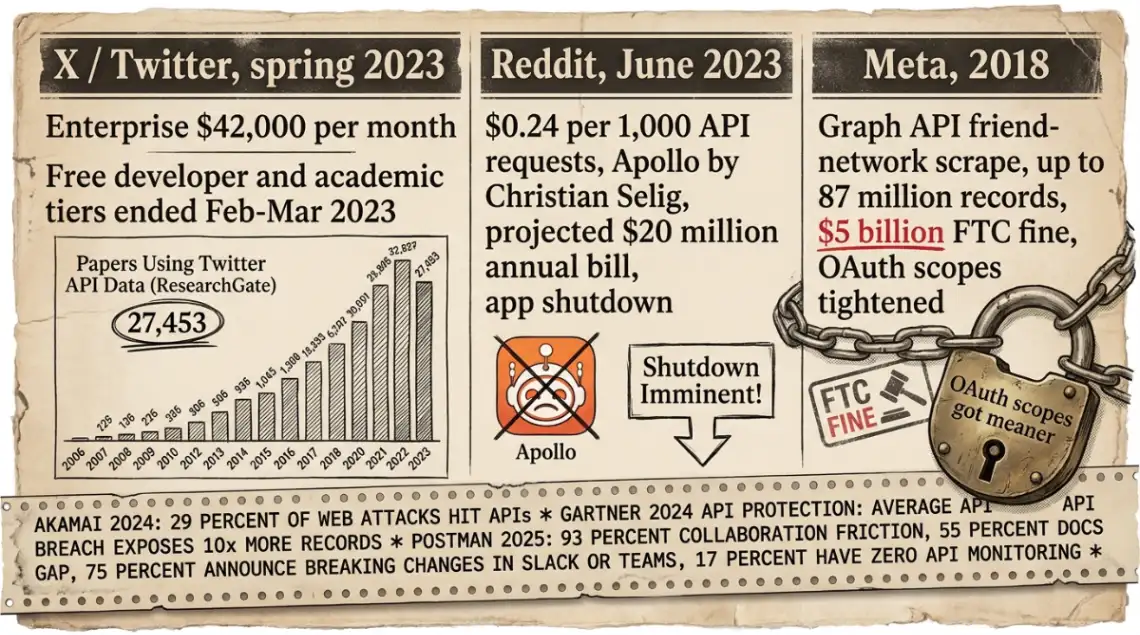
A Zap is only as stable as the vendor's API terms. Twitter ended free developer access in spring 2023 and listed Enterprise at $42,000 per month. Reddit priced calls at about $0.24 per 1,000 requests, a rate that shut down Apollo. Schema drift does the same thing more quietly.
In February and March 2023, Twitter (later X) killed free developer and academic tiers, and a peer-reviewed study counted 27,453 academic papers that had used Twitter API data between 2006 and 2023. Those pipelines, plus thousands of consumer Zaps, went dark with the price list. In June 2023, Reddit set roughly $0.24 per 1,000 requests, and Christian Selig, builder of the Apollo client, showed a bill near $20 million a year and closed the app.
The older wound is still Cambridge Analytica. Over-permissive Graph API scopes let third parties pull profile data from friend networks. Up to 87 million records moved. Meta took a $5 billion FTC fine, and OAuth scopes across the industry got meaner.
Runtime risk is not theoretical either:
- According to Akamai's 2024 State of the Internet report, 29 percent of web-based attacks targeted API infrastructure.
- Gartner's 2024 Market Guide for API Protection said the average API breach exposes at least 10 times more records than a conventional IT breach.
- Postman's 2025 survey found 93 percent of API teams report collaboration friction, 55 percent cite missing or inconsistent docs, and 75 percent still announce breaking changes in Slack or Teams instead of a changelog.
You do not own the endpoint. You rent permission, and the landlord can change the lock overnight.
Shadow APIs, tokens in frontend code, and broken object-level authorization (BOLA) are the boring ways this fails. For a longer read on token hygiene and tenant risk, see the no-code security realities breakdown. Schema drift is the quiet cousin: a renamed JSON key, a Zap that still "succeeds," and a CRM full of empty emails.
What Changes When AI Agents Start Calling These Endpoints?
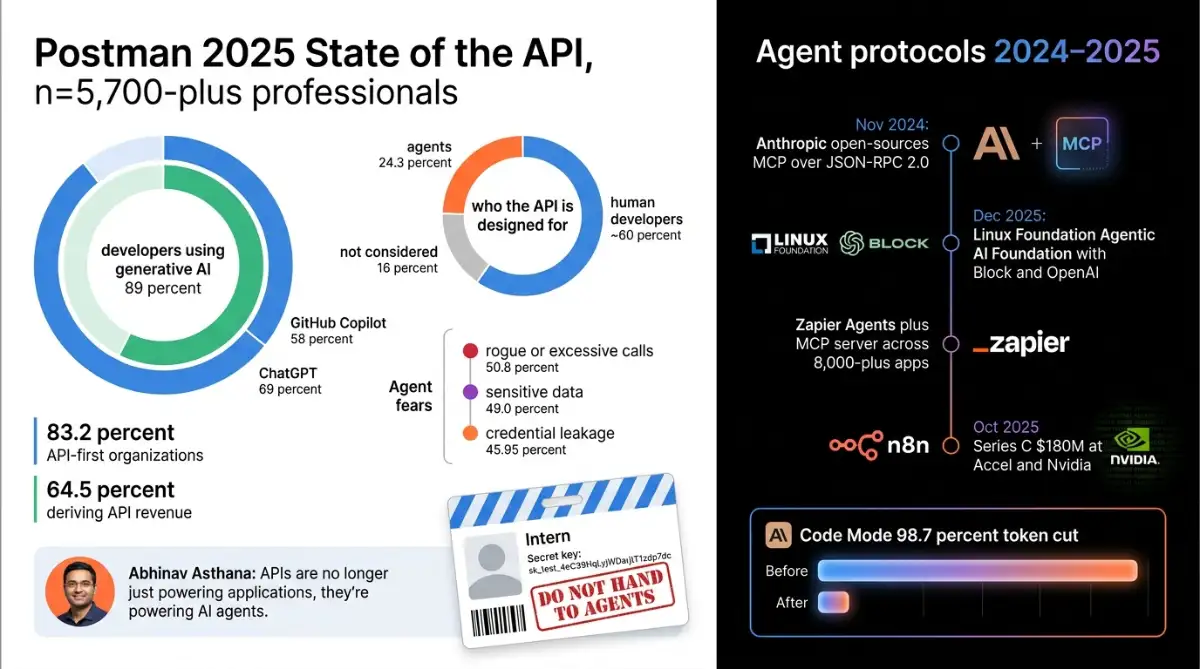
Most APIs were written for human developers, not autonomous agents. According to Postman, 89 percent of developers already use generative AI, yet only 24.3 percent design APIs for agents. Anthropic open-sourced Model Context Protocol in November 2024 so models can discover tools without a new connector for every app.
The 2025 State of the API Report surveyed more than 5,700 engineering professionals. About 60 percent still design APIs strictly for human developers, and 16 percent have not considered agents as consumers at all.
Developers' top fears about non-human traffic, according to Postman:
- 50.8 percent: unauthorized or excessive calls by rogue agents
- 49.0 percent: agents reaching sensitive data
- 45.95 percent: credential sharing or leakage
Abhinav Asthana, co-founder and CEO of Postman, framed the same split in an October 2025 press release:
This year's report shows a clear turning point: APIs are no longer just powering applications, they're powering AI agents.
Anthropic's MCP uses JSON-RPC 2.0 so an agent can list tools and call them. Governance moved to the Linux Foundation's Agentic AI Foundation in December 2025, with Block and OpenAI as co-founders (MCP overview). Zapier answered with Agents and an MCP server across its catalog. n8n raised $180 million in October 2025 (Accel and Nvidia, $2.5 billion post-money) on the back of self-hosted agent plumbing.
An agent that can call Stripe is not a workflow. It is a privileged intern holding production keys.
Anthropic's "Code Mode" research claimed a 98.7 percent cut in token use by having the model write a short script against MCP instead of stuffing whole API schemas into context. That is clever. It does not make a refund policy probabilistic. Keep money movement and CRM writes on deterministic rails, and let agents draft the messy text around them.
Start exploring launch-ready no-code templates here!
FAQ
What is an API in plain language?
An API is a documented way for one program to ask another program for data or to perform an action over the internet. In practice that means a URL, an HTTP method, a JSON body, and a status code such as 200 or 401.
What is the difference between a webhook and polling?
A webhook pushes an HTTP POST to your automation the moment an event happens, which is why Typeform can update Airtable in seconds. Polling is the reverse: the automation issues GET requests on a timer, often every 1 to 15 minutes, to see whether anything new appeared.
How much do Zapier, Make, and n8n cost to start?
Zapier lists 100 free tasks per month and Pro from $19.99 to $29.99, while Make Core starts at $9.00 per month for 10,000 operations. n8n Cloud starts at $24 per month for 1,000 executions, and self-hosting the fair-code editor remains free.
Can I call a REST API that has no native Zapier app?
Yes, Zapier, Make, and n8n all ship a generic HTTP or REST module that accepts a URL, method, headers, and JSON body. You still handle authentication, pagination, and error codes yourself, the same contract a handwritten script would use on day one.
Is pasting an API key into a Zap safe enough?
It works, and it is how many early automations shipped, but OAuth 2.0 is the safer default because the platform stores scoped tokens and can refresh them without exposing a master secret. Treat a leaked key as a production incident, the same way you would treat a leaked password.
Start building without code
Browse thousands of no-code templates for Webflow, Framer, Bubble, Lovable, Replit and more.
Explore Templates