What Is a Native App? Why Performance Matters in 2026
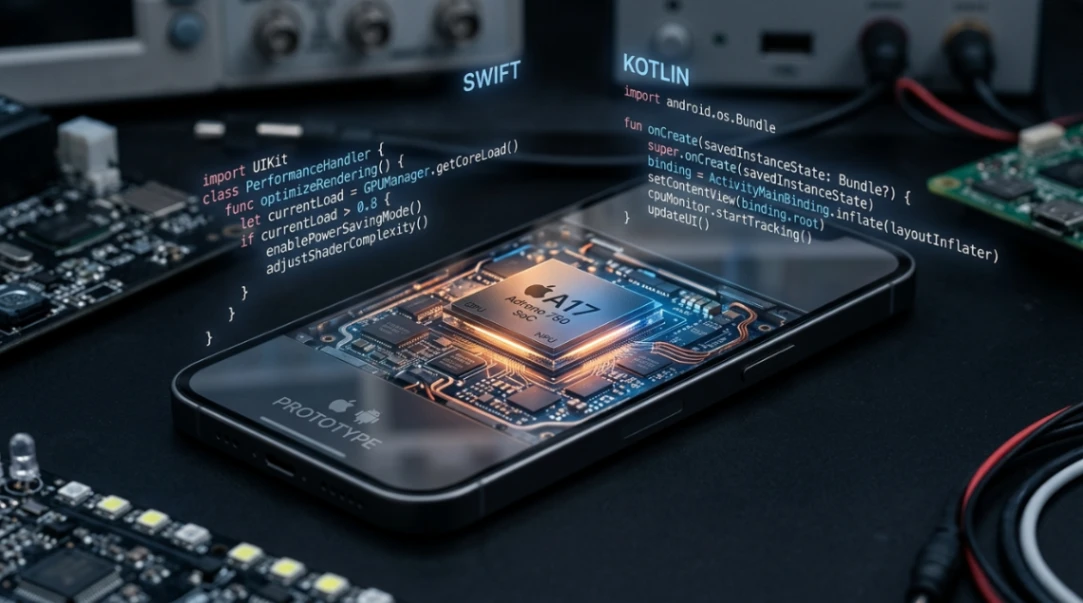
A native app is software built specifically for one operating system (iOS or Android) using platform languages like Swift or Kotlin. It runs directly on the device's CPU and GPU, making it faster and more responsive than web or hybrid alternatives, especially for graphics, sensors, and offline use.
Table of Contents
- What Is a Native App, Exactly?
- Why Native Performance Still Wins in 2026
- Native vs Web vs Hybrid: A Quick Comparison
- The Real Cost of Going Native
- When Native Is Worth It (and When It Isn't)
- Deal-Breaker Questions Founders Actually Ask
- Key Takeaways
- FAQ
Introduction
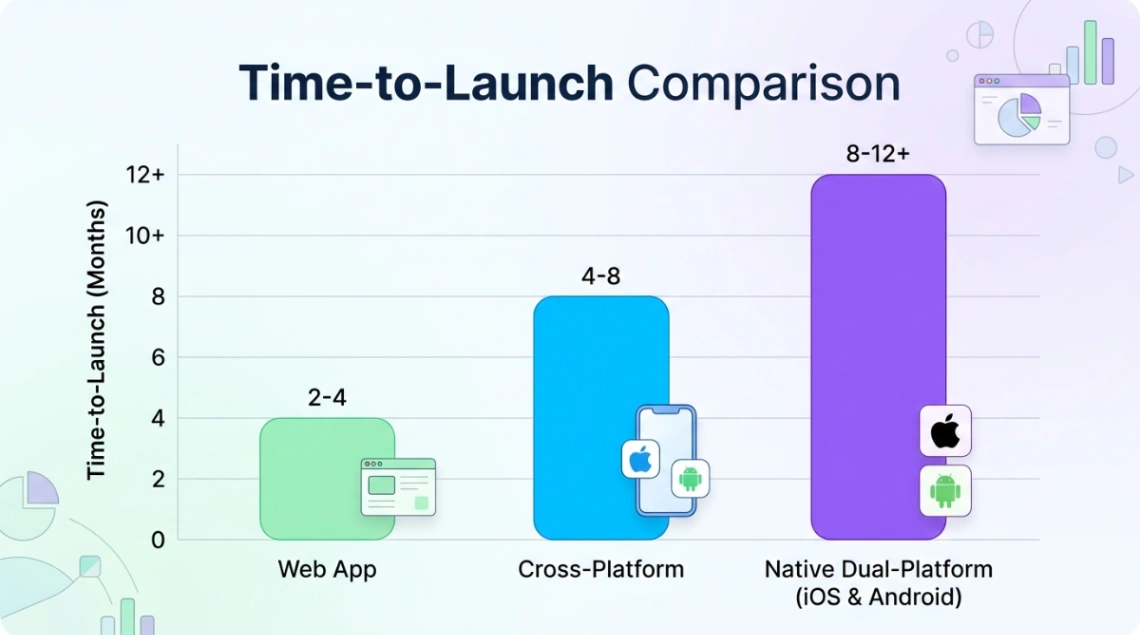
Here's a number that should make any founder pause: building a native app for both iOS and Android typically runs $50,000 to $250,000, and dual-platform projects take 5 to 10 months to ship. Compare that to a web app at 2 to 4 months for roughly 30-70% less, and the question gets serious fast.
If you're a non-technical founder or part of a small product team sizing up your first mobile build, the "should we go native?" decision is one of the most expensive calls you'll make this year. Pick wrong and you've burned six months chasing performance you didn't need, or worse, shipped a sluggish web wrapper to users who expected the real thing.
This guide breaks down what a native app actually is, why performance still matters in 2026, and the specific signals that tell you when native is worth the price tag.
What Is a Native App, Exactly?
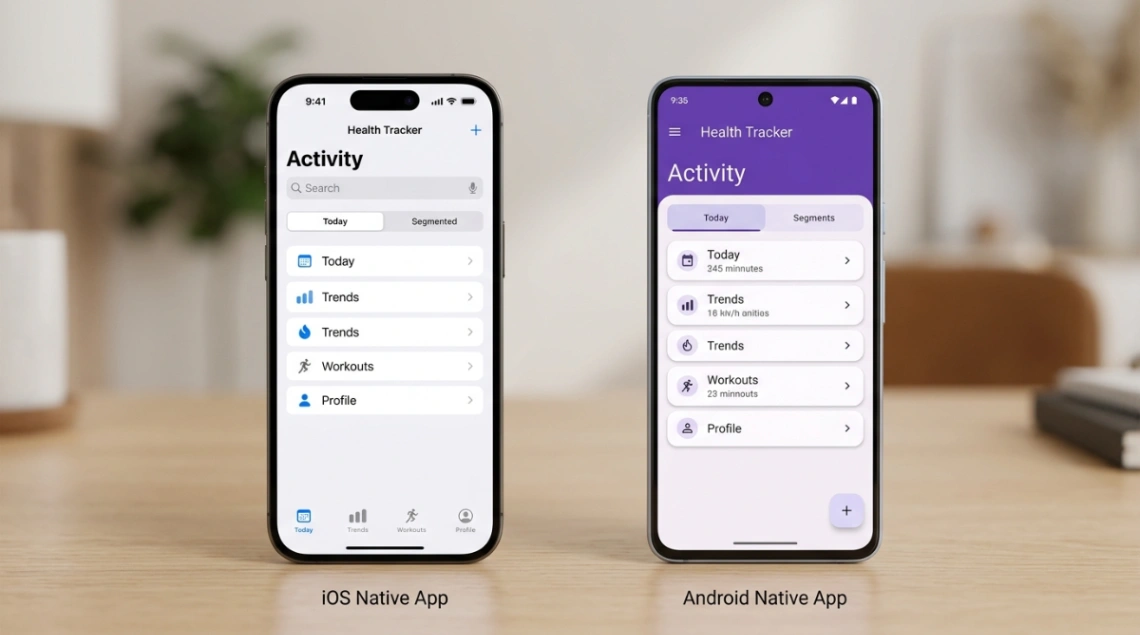
A native app is built for one specific operating system using that platform's official languages and tools. iOS native apps use Swift (sometimes Objective-C) inside Xcode. Android native apps use Kotlin (sometimes Java) inside Android Studio.
The key technical detail: native code compiles directly into machine code for that platform. There's no browser engine in the middle, no JavaScript bridge, no translation layer eating CPU cycles. Your app talks straight to the device's hardware.
That single architectural choice is what unlocks everything else native apps are known for: fast startup, smooth scrolling, deep camera access, biometric login, background GPS, Bluetooth, NFC, and on-device AI through Apple's CoreML or Google's ML Kit.
For a broader look at how native fits alongside web and hybrid options, our mobile app guide covers the full landscape.
Why Native Performance Still Wins in 2026
Native apps cold-start in under 1.5 seconds and respond to taps in roughly 100 milliseconds, according to 2026 mobile performance benchmarks. Web apps add 1 to 3 seconds of browser initialization on top of network latency, with cold starts often hitting 3 to 5 seconds. That gap is the difference between an app that feels "snappy" and one that feels "broken."
The structural reason is simple. Native code runs directly on the CPU and GPU. Web code runs through a browser engine that interprets, renders, and translates every interaction. That extra layer costs you milliseconds on every tap and meaningfully impacts battery life.
For graphics-heavy work (mobile games, AR features, real-time video, complex animations) native isn't a preference, it's a requirement. Native apps tap directly into hardware acceleration and platform-optimized ML frameworks, which is why Apple's Liquid Glass design language and Google's Material You feel instant on native and laggy almost everywhere else.
| Metric | Native | Cross-Platform (2026) | Web/PWA |
|---|---|---|---|
| Cold start | Under 1.5s | 1.8s to 2.5s | 3.0s to 5.0s |
| UI response | ~100ms | ~120-150ms | 200ms+ |
| Animation stability | 120 FPS | 60-120 FPS | Variable |
| Battery impact | Low | Moderate | High |
| Real-time tasks | Baseline | Near-native | Restricted |
Native vs Web vs Hybrid: A Quick Comparison
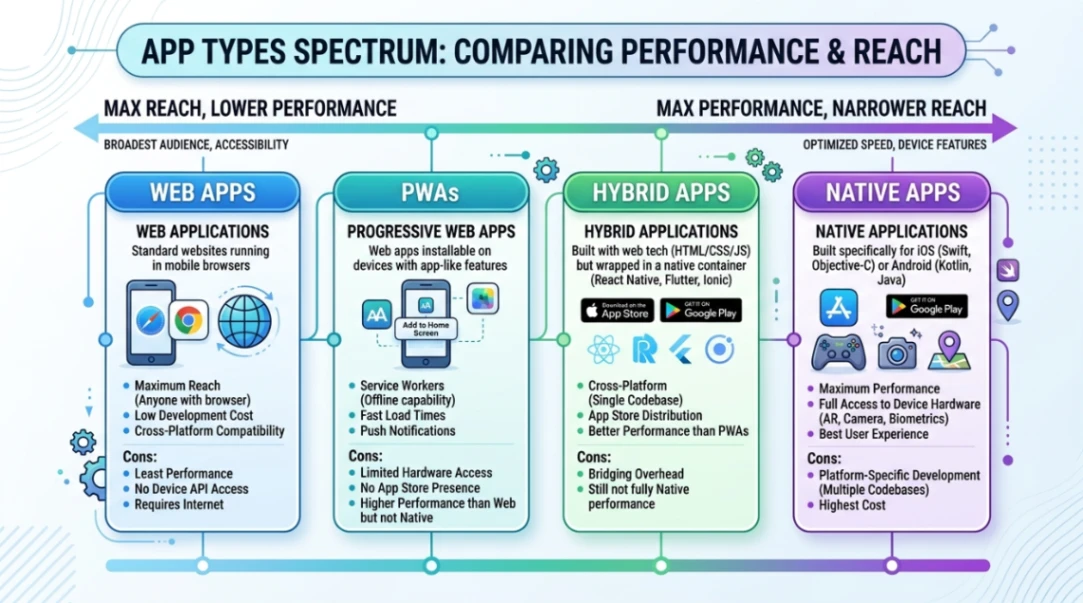
For most founders, the choice isn't really "native or nothing." It's a four-way decision between native, web, hybrid, and Progressive Web Apps (PWAs). Each model trades performance for reach, or cost for capability.
Native gives you peak performance and full hardware access at the price of two codebases. Web apps give you universal reach and instant updates but live inside the browser sandbox. Hybrid apps wrap web code in a native shell to ship to app stores from one codebase. PWAs use service workers to mimic native behavior (offline, push notifications, home-screen install) without app store gatekeeping.
| Aspect | Native | Web App | Hybrid | PWA |
|---|---|---|---|---|
| Language | Swift / Kotlin | HTML / CSS / JS | HTML / CSS / JS | HTML / CSS / JS |
| Hardware access | Full | Restricted | Via plugins | Broad (API limited) |
| Distribution | App stores | URL | App stores | URL / home screen |
| Performance | Optimized | Dependent | Moderate | High (with cache) |
| Codebases | Two | One | One | One |
Worth flagging: cross-platform frameworks like React Native and Flutter have closed most of the gap. Flutter's Impeller engine now hits 120fps on high-refresh displays, and React Native's New Architecture removed the old async bridge bottleneck. Native still holds a 20-30% edge on raw response times, but for most consumer apps, cross-platform is "near-native."
If you're earlier in the journey and still figuring out whether you even need an app, our website guide is a useful starting point.
The Real Cost of Going Native
Native is expensive because you're effectively building two products. iOS and Android use different languages, different IDEs, different design systems (Apple's Human Interface Guidelines vs Google's Material Design 3), and different release processes. That usually means two engineering teams or one team doing the work twice.
Single-platform native builds typically run $50,000 to $250,000. Enterprise projects can hit $500,000 or more. Timeline-wise, expect 5 to 10 months for a dual-platform launch versus 2 to 4 months for a web app or PWA at 30-70% less cost.
Maintenance is the hidden tax. Every update goes through App Store and Google Play review, which can delay critical patches by days. Web apps deploy instantly. For a non-technical founder testing a hypothesis, that release-cycle friction matters as much as the upfront bill.
When Native Is Worth It (and When It Isn't)
Go native when your product depends on:
- Peak performance: games, AR, real-time video or audio processing
- Deep hardware: background GPS, BLE, NFC payments, advanced camera or biometrics
- On-device AI: real-time inference using CoreML or ML Kit, where cloud latency or privacy is a dealbreaker
- App store presence as a trust signal for your category
- System-level features: home screen widgets, Live Activities, Siri or Google Assistant
Skip native (start with web, PWA, or cross-platform) when:
- You're validating an MVP and need to learn fast
- Content and SEO are your acquisition engine
- You need to ship updates weekly without store review delays
- Your features fit comfortably in a browser sandbox
- Your team is small enough that maintaining two codebases would crush velocity
A common 2026 pattern: launch a PWA or web app first to validate, then build native for power users once you have signal. If your validation phase needs a fast front door, our landing page guide covers how to set one up quickly.
Deal-Breaker Questions Founders Actually Ask
Can I get away with a PWA on iOS? Partially. iOS PWAs in 2026 still cap storage at 50MB, expire cached data after 7 days of inactivity, don't support background processing, and lack Bluetooth support entirely (NFC works on Android only). For anything depending on offline reliability or peripherals, native wins.
Will users actually notice the performance difference? Yes, in two places: cold start and animation smoothness. The 1.5s vs 3-5s cold-start gap shapes first impressions, and stuttery scrolling reads as "cheap" even to non-technical users.
What about Apple's 30% commission? It used to be unavoidable. After the EU's Digital Markets Act and recent US court rulings, you can route to web checkout (around 3% in fees) instead of native In-App Purchases. The trade-off: you handle billing, tax, and compliance yourself.
How long before I can ship on both stores? Plan for 5 to 10 months for a dual-platform native build, plus app store review cycles. Apple's 2026 mandate now requires Xcode 26, the iOS 26 SDK, and Privacy Manifests declaring all Required Reason APIs.
Start exploring launch-ready native mobile app no-code templates here!
Key Takeaways
- Native means platform-specific. A native app is built in Swift or Kotlin for one OS, compiled to machine code, and runs directly on the device hardware. That's what produces the sub-1.5-second cold starts and 100ms tap response that define mobile quality.
- Performance is structural, not optional. The gap between native and web isn't a coding skill issue. It's the cost of the browser rendering layer, and it shows up in battery, animation smoothness, and access to sensors like NFC, BLE, and the Neural Engine.
- The decision is economic, not technical. Native costs 2-3x more and ships 2-3x slower than web. That's worth it for graphics-heavy, sensor-heavy, or trust-heavy products, and overkill for content tools, MVPs, and SEO-driven platforms.
The best mobile decision in 2026 isn't "which architecture wins?" It's "which architecture matches the specific friction my users will actually feel?" Answer that honestly, and the build path picks itself.
FAQ
Is a native app the same as a mobile app? No. "Mobile app" is the umbrella. Native, web, hybrid, and PWAs are all mobile apps. Native specifically means built for one OS using its native languages (Swift for iOS, Kotlin for Android).
Can one developer build both iOS and Android natively? Technically yes, but it doubles the workload because the languages, frameworks, and design systems differ. Most teams either hire two specialists or use cross-platform frameworks like Flutter or React Native to share 80-95% of the code.
Are React Native and Flutter considered native? Not strictly. They're cross-platform frameworks that produce near-native performance. Flutter compiles to machine code via Impeller; React Native bridges JavaScript to native UI. Both are "native enough" for most consumer apps in 2026.
Do I need to be in the App Store to be a real app? No. PWAs install to the home screen from a URL and feel app-like without app store approval. The trade-off is reduced trust signals and limited iOS capabilities (no Bluetooth, 50MB storage cap, 7-day cache expiry).
How much does a native iOS app cost in 2026? Single-platform native builds typically run $50,000 to $250,000, with enterprise projects exceeding $500,000. Add roughly the same again for the Android version, since native means maintaining two separate codebases.
Start building without code
Browse thousands of no-code templates for Webflow, Framer, Bubble, Lovable, Replit and more.
Explore Templates