How Steve Jobs Killed Flash and Pushed No Code Forward in 2026
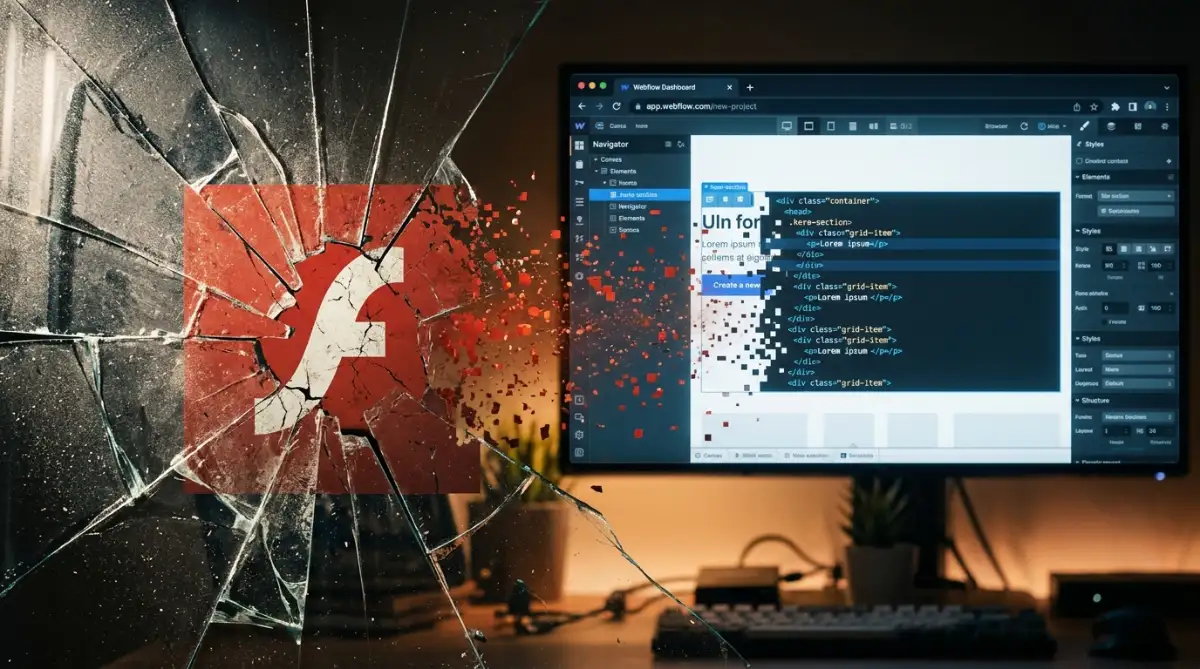
Steve Jobs' 2010 letter "Thoughts on Flash" exposed the technical liabilities of plugin based runtimes on mobile, accelerating Adobe's mobile exit by 2011 and the platform's full end of life in December 2020. The vacuum it left was filled by visual web tools that compile to native HTML, CSS, and JavaScript, the architectural foundation today's no code industry is built on.
Table of Contents
- The 2007 hardware shift that broke Flash
- What Flash actually did for the early web
- How no code builders replaced the plugin with native code
- The market that grew in the vacuum
- Honest tradeoffs in the post Flash no code era
- Key takeaways
- FAQ
Introduction
In April 2010, one open letter wiped out a platform that controlled over 95% of browser multimedia at its peak. One CEO's argument, not a competitor's product, ended a decade of dominance. I still find that wild.
If you're a non technical founder evaluating your first app build, this is your origin story. The reason you can drag a button onto a canvas today, instead of hiring a Flash animator and waiting six weeks, traces back to a hardware decision Apple made in 2007 and a memo Steve Jobs published three years later. Here's what changed, and what no code inherited from the rubble.
The 2007 Hardware Shift That Quietly Killed Flash
The decisive blow against Flash wasn't a software competitor, it was a phone. When Apple shipped the iPhone in June 2007 without Flash support, the platform's mobile future ended before it began.
Adobe argued users were being denied "the full web." Apple argued Flash was too resource heavy for battery powered devices. Both were right, but only one side controlled the device people were starting to live on.
According to Steve Jobs' April 2010 open letter, "the mobile era is about low power devices, touch interfaces and open web standards, all areas where Flash falls short." The letter laid out six technical objections covering openness, full web access, reliability, security, performance, and battery and touch. By November 2011, Adobe ceased Flash Player development for mobile entirely.
What the letter actually changed:
- Mobile browser vendors used it as cover to deprioritize plugins
- HTML5, CSS3, and JavaScript got serious investment from Apple, Google, and Mozilla
- Designers had to choose: cling to a dying runtime or learn the native web
- The "plugin" as an architectural concept lost credibility for good

I used to think the letter was mostly posturing. Reading it again with fifteen years of hindsight, it's closer to a technical post mortem written before the patient died.
What Flash Actually Did Before It Was Replaced
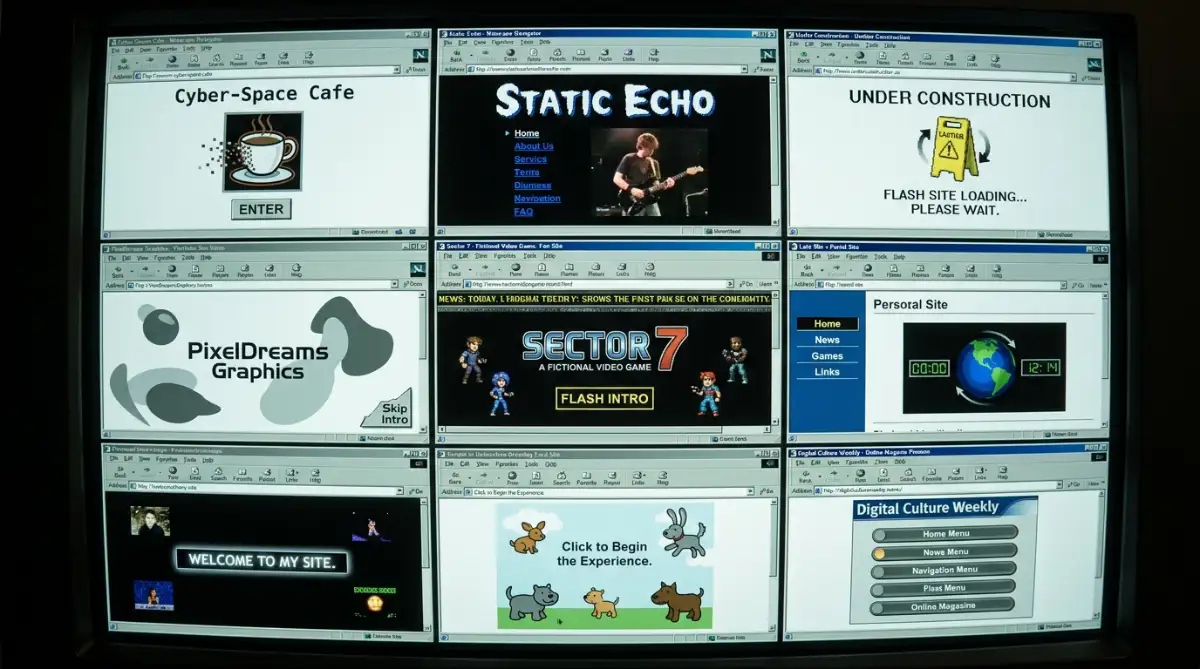
Flash was the first mainstream visual authoring environment that let non programmers ship interactive experiences globally. Before judging it by current standards, it's worth remembering what slot it filled.
FutureWave Software, founded in 1993, originally built SmartSketch for the doomed PenPoint OS. When that market vanished, the founders retooled the vector engine for the web and shipped FutureSplash Animator in May 1996. Macromedia acquired the company that December and renamed it Flash.
The product's superpower was vector graphics in a dial up era. Files stayed small, scaled infinitely, and rendered animation that animated GIFs couldn't touch. By the time Adobe acquired Macromedia in December 2005 for $3.4 billion, Flash powered YouTube, most banner ads, and a generation of experimental websites.
| Era | Web's Default Visual Layer | Limitation |
|---|---|---|
| 1995 to 1999 | Animated GIFs and table layouts | Static, raster, slow |
| 2000 to 2009 | Flash and ActionScript | Plugin dependent, opaque to search |
| 2013 to 2020 | HTML5, CSS3, JS frameworks | Higher skill floor |
| 2021 to today | No code visual builders | Vendor lock in risk |
Flash was the beautiful ancestor of modern web tools, and it sat in a lineage that included Microsoft FrontPage and the early WYSIWYG experiments of the mid 1990s. The pattern is older than most founders realize.
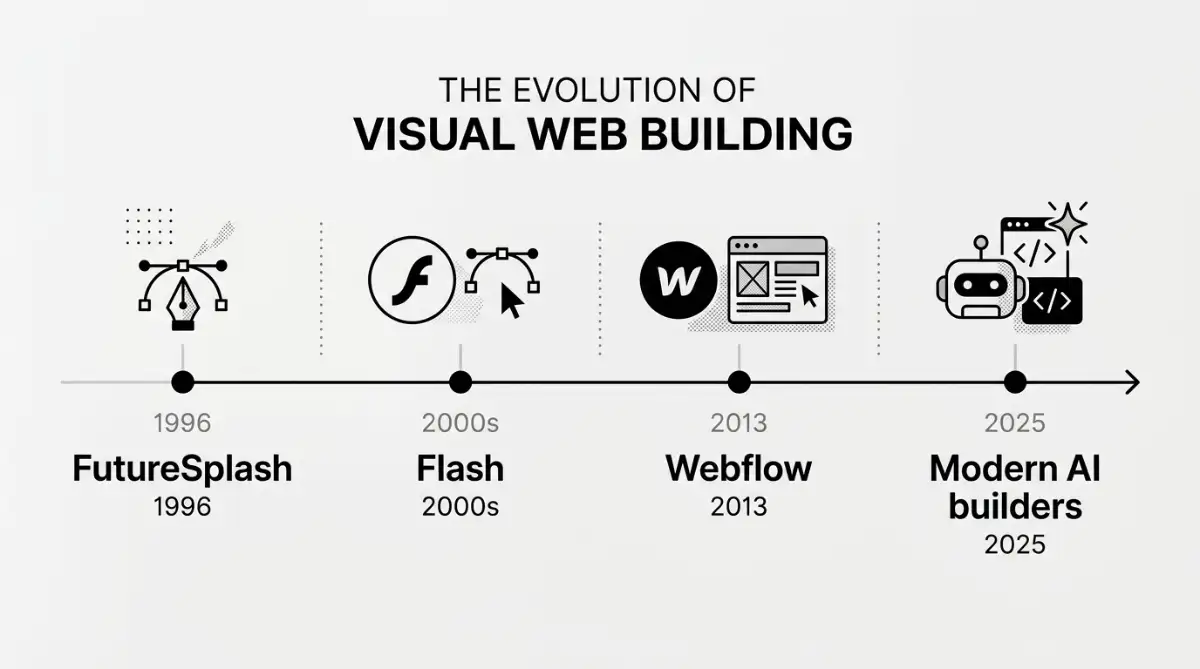
How No Code Builders Replaced the Plugin With Native Code
Modern no code builders solved the exact problem that killed Flash: they generate the browser's native code instead of asking it to run a foreign runtime. That choice is why this generation of visual builders survived where Flash didn't.
Flash files (.SWF) were compiled binaries. The browser couldn't parse them, search engines couldn't index the text inside, and screen readers usually failed. Flash relied on its own drawing APIs and the ActionScript Virtual Machine, fast but memory heavy.
Webflow, Bubble, and similar platforms work differently. They use what's called "encapsulation": you drag a visual element onto a canvas, and the platform writes the matching HTML tags, CSS classes, and JavaScript event listeners. The output is the browser's native language, not a binary blob.

What encapsulation gave the modern visual web generation:
- Search engines can index the output (Flash sites famously couldn't be crawled)
- Accessibility tools work because the DOM is real
- Code is exportable on some platforms, hedging against vendor lock in
- Updates ship without forcing a global plugin install
The catch: not every modern platform is equally transparent. Webflow generates clean HTML and CSS, while Bubble runs your app on its proprietary backend interpreter. That's the meaningful difference between Framer and Webflow, and it's the modern echo of the same plugin versus native debate from 2010.
The Market That Grew in Flash's Vacuum
The visual development industry didn't just replace Flash, it scaled past it by an order of magnitude. The financial weight makes the lineage hard to ignore.
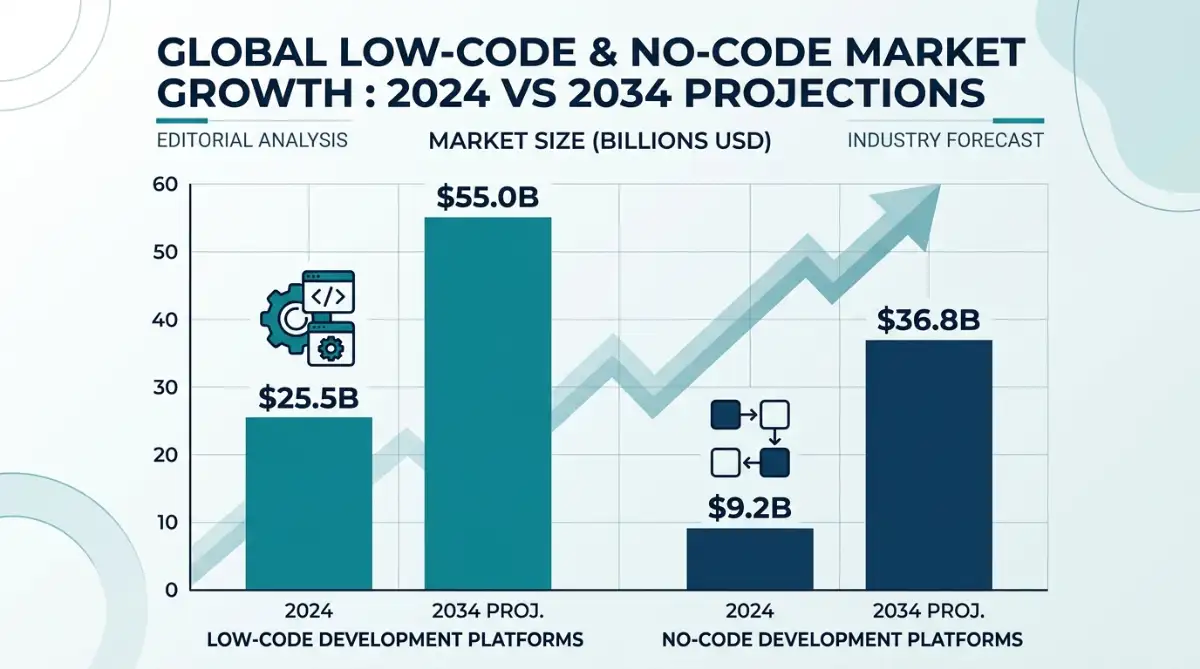
According to G M Insights research on the global low code platform market, the LCNC sector was valued at $34.7 billion in 2024 and is projected to reach $91.8 billion by 2034 at an 11.6% CAGR. More aggressive estimates from Qubit Capital push that figure to $264.4 billion by 2032.
The talent shortage is doing the pushing. A widely cited Korn Ferry projection puts the global gap at 85.2 million missing technical workers by 2030, threatening $8.5 trillion in unrealized revenue. Gartner forecasts that 70% of new enterprise applications will use LCNC tools by the end of next year, up from less than 25% three years prior.
| Platform | FY2025 Revenue | User or App Count |
|---|---|---|
| Wix | $1.99 billion | 304 million users |
| Adobe Digital Media | $17.65 billion | 37 million subscribers |
| Webflow | $200M to $500M (est.) | 3.5 million users |
| Bubble | $106M funding | 7.2 million apps |
The newest entrant is Base44, an AI driven "vibe coding" platform Wix acquired in 2025. According to Wix's official Q4 and full year 2025 earnings release, Base44 reached $100 million in ARR nine months after acquisition. One of the fastest software growth trajectories on record.
Start exploring launch ready no code templates here!
Honest Tradeoffs in the Post Flash No Code Era
The architectural lessons from Flash's collapse don't make modern visual builders risk free. They shift the risks to different parts of the stack.
The first tradeoff is speed for technical debt. Industry benchmarks consistently show visual development apps run 20% to 50% slower than custom built equivalents. Most teams that scale past a few thousand active users eventually face a rebuild in a traditional stack. You're trading months of engineering for a future migration.
The second is vendor lock in as the recurring tax. The Bubble pricing change in early 2023, when the platform shifted to consumption based "Workload Units," is the cleanest case study. Founders running apps with $5,000 in monthly revenue suddenly faced $400 monthly hosting bills. Wix has been described as a "walled garden" with poor code export.
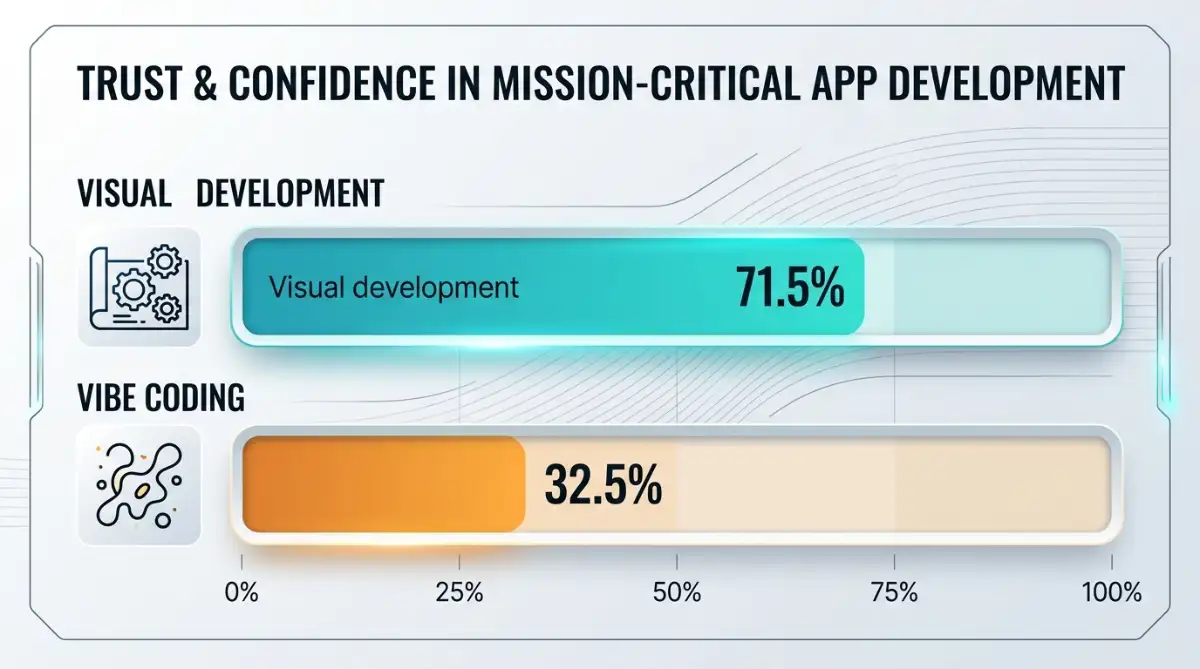
The third is the AI confidence gap. According to Bubble's 2025 State of Visual Development report, 71.5% of builders trust visual development for mission critical apps, compared to 32.5% for prompt based vibe coding. A 39 point gap on the same survey. People will use AI to scaffold, but they want a transparent visual layer to edit and audit the result. The same lesson Flash taught about opaque runtimes, in a new costume.
There's a governance angle too. Industry surveys show 42% of IT managers cite shadow IT as a major LCNC adoption challenge, because business users ship apps without audit trails or proper privacy rules.
Key Takeaways
- Flash's death wasn't a software story, it was a hardware story. Mobile devices forced the architectural shift; one open letter accelerated what was already inevitable.
- Modern visual builders inherited Flash's mission (visual authoring for non programmers) while solving its core flaw (the proprietary runtime) by generating native browser code.
- Vendor lock in didn't disappear with Flash, it migrated. Bubble's 2023 pricing pivot and Wix's export limits are the same risk in a different costume.
The thesis underneath this arc is simple. Every generation of visual web tools, from FutureSplash to Flash to Webflow to Base44, has solved the previous generation's openness problem while introducing a new dependency. Flash bet on the plugin model, and mobile killed it. Today's visual builders bet on hosted SaaS architecture, and the next forcing function will reshape this market again. The visual abstraction layer always wins. The company providing it rarely stays the same.
FAQ
What is vibe coding and how does it differ from no code?
Vibe coding is a paradigm where AI generates entire applications from natural language prompts, distinct from drag and drop visual builders that use a canvas. The term refers specifically to prompt based generation, while no code relies on encapsulated visual components. Most platforms now blend both.
Who actually killed Adobe Flash?
The mobile shift killed Flash, with Steve Jobs' April 2010 open letter "Thoughts on Flash" acting as the public catalyst. Apple's June 2007 decision to ship the iPhone without Flash support was the structural cause; Adobe formally ended support in December 2020.
Is no code better than learning to code today?
It depends on what you're building. For marketing sites, MVPs, and internal tools, visual builders ship faster and cheaper. For high volume B2C apps or anything requiring custom algorithms, traditional code still wins. Industry surveys put customization limits at the top of business managers' dealbreakers, with around 40% citing it as the primary blocker.
What replaced ActionScript after Flash died?
JavaScript and its ecosystem absorbed most of ActionScript's work, alongside CSS3 animations and HTML5 canvas APIs. Webflow's October 2024 acquisition of GreenSock, the leading JavaScript animation library, directly fills the motion graphics gap Flash left.
What's the relationship between WordPress and the no code movement?
WordPress predates the modern visual builder movement and shaped its template economy, which is why WordPress's 2003 launch is treated as a turning point. It coexisted with Flash for years and outlasted it by leaning on PHP, themes, and plugins rather than a proprietary runtime.
Start building without code
Browse thousands of no-code templates for Webflow, Framer, Bubble, Lovable, Replit and more.
Explore Templates