What Is a Cross-Platform App? Build Once, Deploy Everywhere (2026)
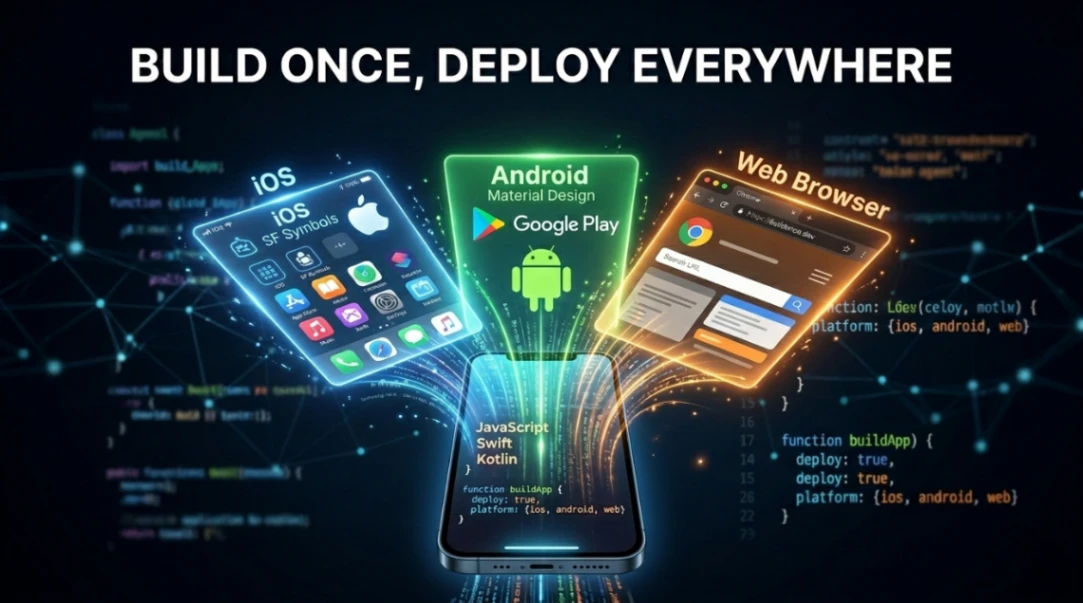
A cross-platform app is built from a single codebase that runs on iOS, Android, web, and desktop. Modern frameworks like Flutter and React Native compile or render to near-native performance, cutting development costs by 30 to 50 percent versus building two separate native apps.
Table of Contents
- So What Actually Is a Cross-Platform App?
- The Money Question: How Much Do You Actually Save?
- Flutter vs React Native vs Kotlin Multiplatform
- Performance in 2026: Can Users Tell the Difference?
- When Cross-Platform Is the Wrong Call
- What's Next: AI, Wasm, and Cloud IDEs
- Key Takeaways
- FAQ
Introduction
Here's a number that should make every non-technical founder pay attention: building a basic app natively for both iOS and Android can run anywhere from $105,000 to over $500,000, while the cross-platform equivalent often lands between $40,000 and $300,000. That gap is why cross platform app development has stopped being a "scrappy startup hack" and become the default choice for most new mobile projects in 2026.
If you're a non-technical founder evaluating your first mobile app build, the framework decision you make in week one will follow you for years. This piece breaks down what a cross-platform app actually is, what it costs, which framework fits which type of product, and the specific scenarios where going cross-platform will burn you. No throat-clearing, just the trade-offs.
So What Actually Is a Cross-Platform App?
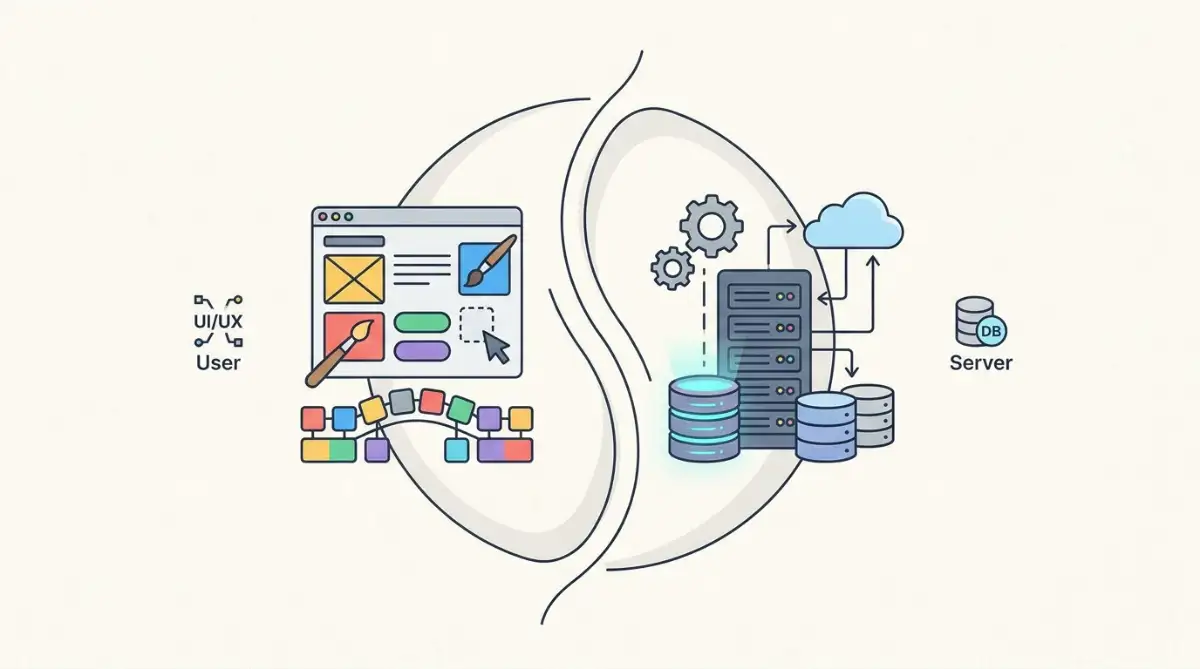
A cross-platform app is one codebase that ships to multiple operating systems. Instead of hiring a Swift team for iOS and a Kotlin team for Android, you write the app once (in Dart, JavaScript, or Kotlin) and deploy everywhere.
The "Build Once, Deploy Everywhere" (BODE) philosophy isn't new, but the underlying tech finally caught up. According to the research, modern frameworks now hit 90 to 95 percent of native performance benchmarks for standard business use cases. That's a different universe from the clunky WebView wrappers of the early 2010s.
Three architectural flavors dominate today:
- Native bridge frameworks (React Native): JavaScript talks to real native UI components
- Custom-rendered frameworks (Flutter): The framework draws every pixel itself using its own engine
- Logic-sharing frameworks (Kotlin Multiplatform): Business logic is shared, UI stays fully native per platform
If you want the deeper context on how this fits into the broader app landscape, this guide to mobile apps for solopreneurs is a useful primer, and the native app deep-dive covers the other side of the coin.
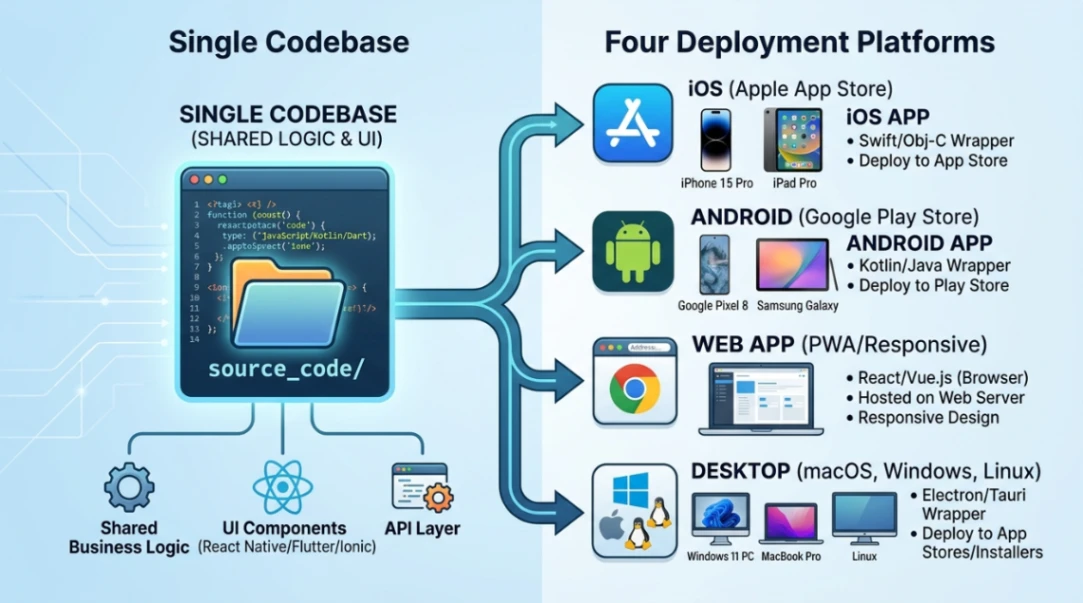
The Money Question: How Much Do You Actually Save?
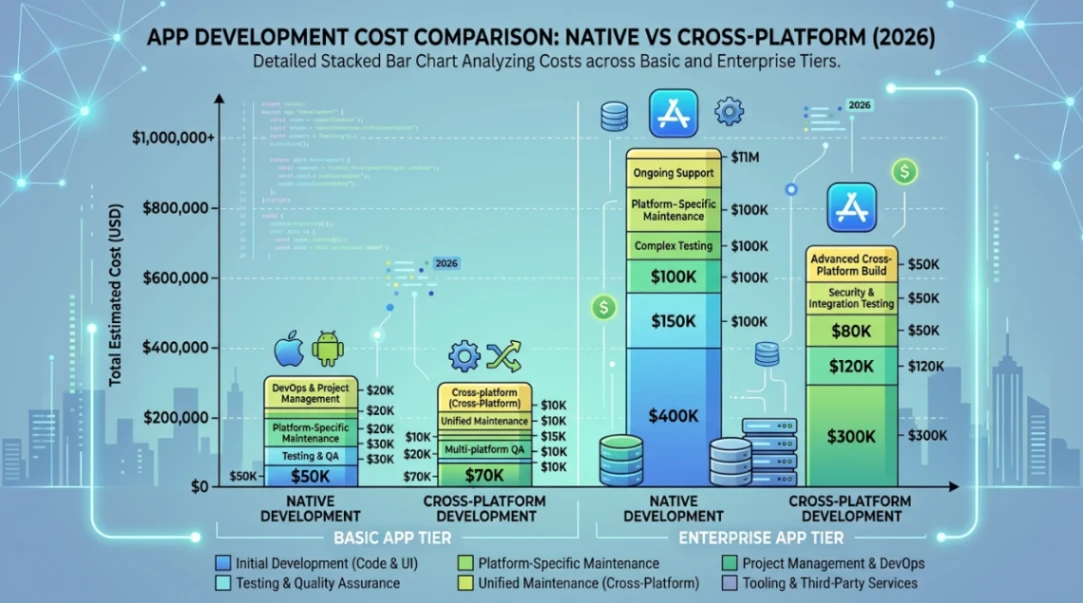
Cross platform app development typically cuts initial costs by 30 to 50 percent and accelerates time-to-market by roughly 1.5x compared to dual-track native builds.
Here's the breakdown straight from the 2026 data:
| Approach | Basic Cost | Enterprise Cost | Time to Market |
|---|---|---|---|
| Native (iOS + Android) | $105,000 - $500,000+ | $1,000,000+ | 6 - 12 months |
| Cross-Platform (Flutter/RN) | $40,000 - $300,000 | $300,000 - $600,000 | 3 - 6 months |
| Kotlin Multiplatform | $59,500 - $106,250 | $250,000 - $400,000 | 4 - 6 months |
The savings compound over time. Annual maintenance typically eats 15 to 25 percent of your original development budget, and a cross-platform app means one bug fix ships to every platform simultaneously. No more "the iOS version is two releases behind Android" headaches.
For a non-technical founder running on a seed round, this is the difference between testing your idea in two markets at once or burning runway on one platform while competitors ship to both.
Flutter vs React Native vs Kotlin Multiplatform
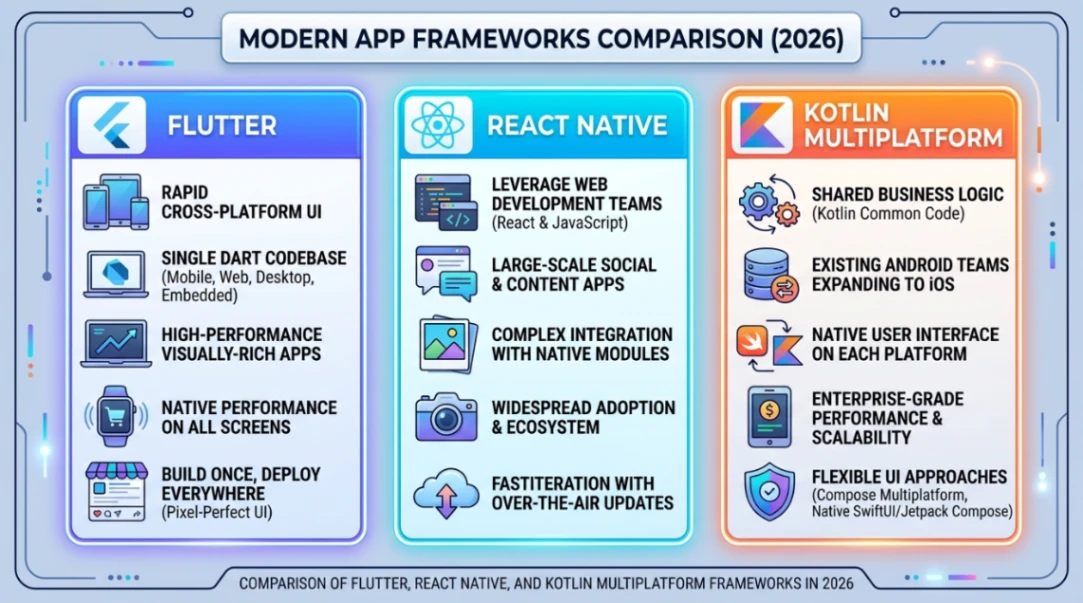
The market has consolidated around three serious players. According to 2025 framework adoption data, Flutter leads with 42 to 46 percent global market share, while React Native holds 32 to 38 percent. Together they power roughly half of all mobile projects.
| Pick This | If Your Priority Is | Best For |
|---|---|---|
| Flutter | Custom UI, pixel-perfect consistency, smooth animation | Multimedia, entertainment, branded experiences |
| React Native | Speed to MVP, reusing JavaScript talent, huge npm ecosystem | Social apps, e-commerce, content-driven products |
| Kotlin Multiplatform | Native UX with shared business logic | Fintech, enterprise apps with deep platform integration |
Discord and Shopify are the React Native poster children at scale. Netflix, McDonald's, and Cash App lean on Kotlin Multiplatform. Flutter's strength shows up in apps where the brand owns the visual identity end-to-end.
For non-technical founders, the honest shortcut: if your dev team already knows JavaScript, React Native gets you shipping in weeks. If you're hiring fresh and want the most polished default UI, Flutter is the safer bet.
Performance in 2026: Can Users Tell the Difference?
For 90 percent of business apps, no. According to recent benchmarks on iPhone 15 Pro and Pixel 9 hardware, Flutter scrolls at 59 to 60 FPS versus native's 60+, with React Native trailing slightly at 53 to 56 FPS.
The gap that mattered five years ago has mostly closed. Flutter's Impeller engine (which replaced Skia) eliminated the dreaded "shader compilation jank" by leveraging Metal on iOS and Vulkan on Android. React Native's New Architecture ditched the old asynchronous bridge for the JavaScript Interface (JSI), enabling synchronous UI updates through the Fabric renderer.
Where you'll still feel the gap:
- Professional video or photo editing tools
- Graphics-heavy 3D games
- Apps doing real-time computer vision or AR
- Anything pushing low-level Bluetooth or hardware sensor APIs
For a content-driven product (e-commerce, social, SaaS dashboard, booking app), users will not notice. The difference between 56 and 60 FPS while scrolling a feed is genuinely invisible to humans.
When Cross-Platform Is the Wrong Call
Airbnb is the cautionary tale every founder should know. They adopted React Native in 2016, then sunset it in 2018, citing the technical debt of maintaining "three platforms" (iOS, Android, and the bridge), hiring difficulty, and performance bottlenecks in the legacy bridge.
The lesson isn't that cross-platform is broken. It's that abstraction layers become liabilities once you need deep, exotic native integration. If your app's core value is intense geolocation, low-level Bluetooth, AR/VR, or custom hardware interaction, native often wins long-term.
Deal-breaker questions worth answering before you commit:
- Will users notice? For business apps, no. For pro creative tools or AAA games, yes.
- What about new iOS/Android features? Native SDKs get them on day one. Cross-platform frameworks usually catch up within weeks to months.
- Can I hire for it? JavaScript developers are 66 to 68.8 percent of the global dev population per the Stack Overflow 2025 survey, so React Native talent is everywhere. Flutter/Dart talent is rarer but growing fast.
- What if I outgrow it? Kotlin Multiplatform is the easiest exit ramp because the UI is already native; you just keep more of it over time.
What's Next: AI, Wasm, and Cloud IDEs
Three forces are reshaping cross platform app development heading into 2026.
On-device AI. Frameworks now plug directly into Apple's Neural Engine and Android's NNAPI, so a fitness app can analyze workout video locally without round-tripping to the cloud.
WebAssembly + PWAs. Wasm lets C++, Rust, or Go run at near-native speed in a browser. Pair it with a Progressive Web App and you can deliver one experience across mobile, desktop, and IoT without app store gatekeepers. This blurs the line between web apps and native ones.
Cloud-native IDEs. Google's Firebase Studio (formerly Project IDX) runs each workspace in a dedicated VM with Gemini AI assistance and browser-based iOS/Android emulators. The "works on my machine" excuse is officially dying.
The cross-platform industry is projected to grow from $15.67 billion in 2025 to over $42.60 billion by 2034, an 11.75 percent CAGR. The bet on BODE is paying off.
Start exploring launch-ready no-code templates here!
Key Takeaways
- Cross platform app development is the default in 2026, not the budget option. Flutter and React Native power roughly 50 percent of all mobile projects and generated $570 million in net revenue in a single 30-day window in Q4 2024.
- The savings are real and measurable. Expect 30 to 50 percent lower initial costs and 1.5x faster time-to-market versus dual-track native, with payback periods often under six months.
- Pick the framework that matches your product, not the hype. Flutter for visual polish, React Native for speed and JS talent, Kotlin Multiplatform for native fidelity at enterprise scale.
The honest punchline: the question stopped being "should I go cross-platform?" years ago. In 2026, the only question is which flavor of cross-platform best fits the product you're actually trying to build, and whether you have the discipline to pick a lane and stay in it.
FAQ
Is a cross-platform app the same as a hybrid app? No. Hybrid apps wrap a website in a WebView. Modern cross-platform apps either drive real native UI components (React Native) or render their own UI at near-native speed (Flutter). The performance difference is significant.
Which is cheaper, Flutter or React Native? Costs are comparable, with both landing in the $40,000 to $300,000 range for basic apps. React Native often saves on hiring because JavaScript developers are far more abundant globally than Dart developers.
Can a cross-platform app be published on the App Store and Google Play? Yes. Flutter, React Native, and Kotlin Multiplatform all compile to standard iOS and Android binaries that pass App Store and Play Store review processes like any other app.
How long does cross-platform app development take? Typically three to six months for a basic to mid-complexity app, versus six to twelve months for the equivalent native build. Enterprise projects scale up but maintain the roughly 1.5x speed advantage.
Will my cross-platform app feel slower than a native one? For standard business apps, no. Benchmarks show Flutter hitting 59 to 60 FPS versus native's 60+ on flagship hardware. The gap only matters for graphics-intensive or hardware-heavy apps.
Start building without code
Browse thousands of no-code templates for Webflow, Framer, Bubble, Lovable, Replit and more.
Explore Templates