What Is Vibe Code? 2026 Guide for Non-Tech Founders
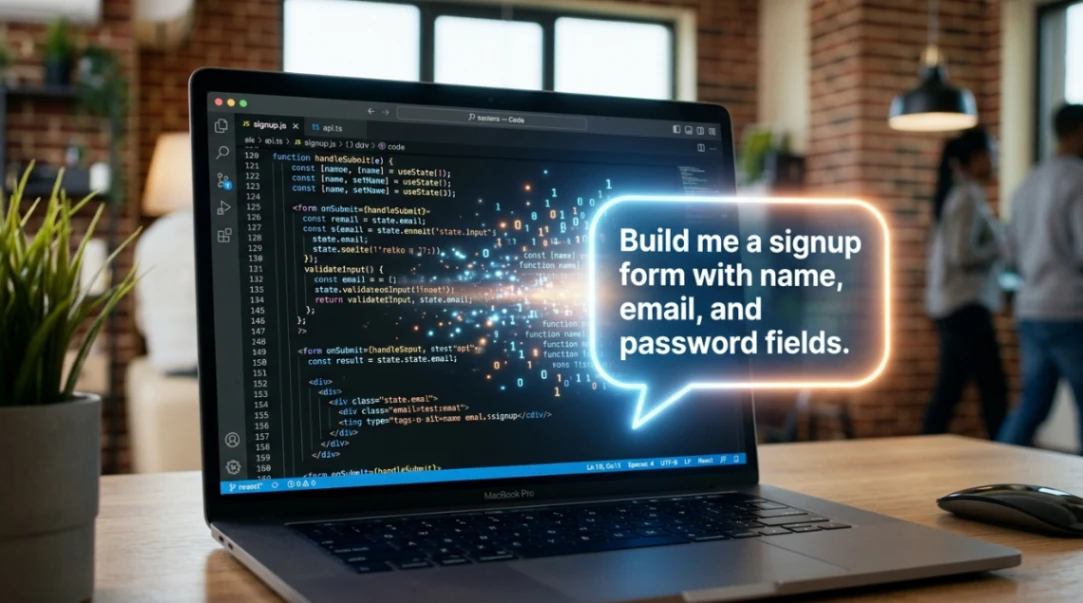
Vibe code is the practice of building software by describing intent in natural language and letting an AI agent generate, test, and deploy the code. Coined by Andrej Karpathy in February 2025, it has grown into a $4.7 billion industry by 2026, shifting developers from authors to orchestrators.
Table of Contents
- Where Vibe Code Actually Came From
- How the Shift From Coding to Prompting Works
- The 2026 Vibe Code Toolkit
- The Risks Nobody Warned You About
- Deal-Breaker Questions, Answered
- Key Takeaways
- FAQ
Introduction
Here's a number that still makes me blink: 63% of active users in vibe coding communities in 2025 were non-developers, project managers, operators, even fitness trainers shipping subscription products with zero technical background. If you're a non-technical founder evaluating your first AI-assisted build, that stat is either the most exciting thing you'll read today or the most terrifying. Probably both.
The shift from coding to prompting is real, and it's already reshaped who gets to build software. But "vibe code" isn't magic, and the gap between a working prototype and a production app is where most first-time builders get stuck. This guide walks through what vibe code actually is, which tools matter in 2026, what they cost, and the specific failure modes you'll want to avoid before you ship anything real.
Where Vibe Code Actually Came From
Vibe code is AI-assisted software development where you describe what you want in plain English and the AI writes the code. The term comes from a February 2, 2025 post by Andrej Karpathy, former Tesla AI lead and OpenAI co-founder.
In that post, Karpathy described a new style of building where you "fully give in to the vibes, embrace exponentials, and forget that the code even exists." The phrase stuck because it named a behavior that was already happening quietly across thousands of companies. By March 2025, Merriam-Webster added it as a trending expression, and Collins English Dictionary made it Word of the Year for 2025.
The tech itself wasn't new. GitHub Copilot launched in preview in June 2021, powered by OpenAI's Codex model trained on 54 million GitHub repositories. Claude 3 arrived in March 2024 with long-context reasoning strong enough to understand entire codebases. Karpathy just gave the workflow a name everyone could repeat. If you've lived through the no-code shifts of the past three decades, this one rhymes, except the abstraction layer is now a conversation.
How the Shift From Coding to Prompting Works
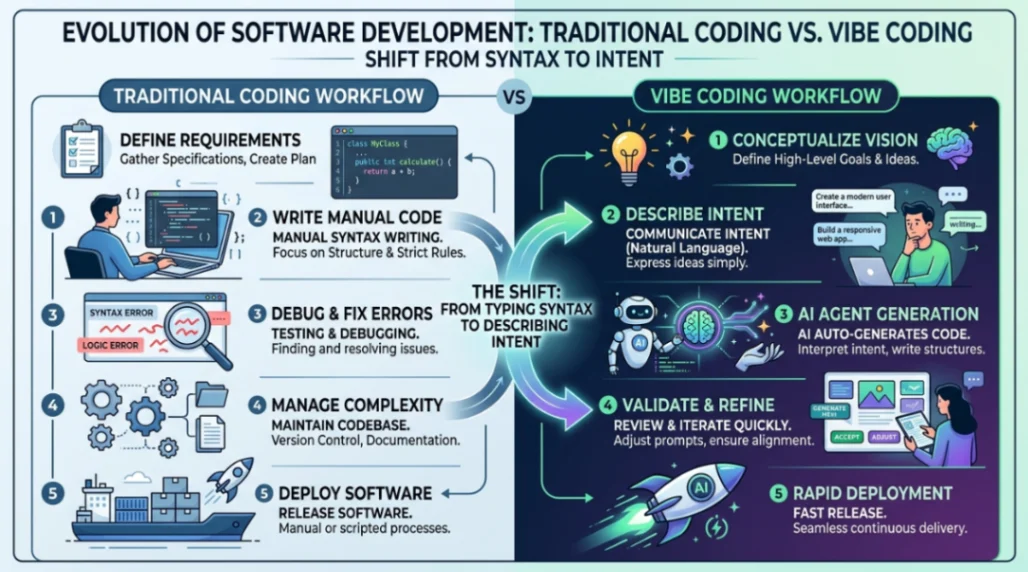
Vibe code replaces syntax with intent. Instead of writing TypeScript or Python line by line, you describe an outcome and the AI agent generates, tests, and often deploys the code for you.
Researchers call this "material disengagement," the practitioner stops working directly with the code and operates at a higher level of abstraction. For a non-technical founder, that means your real skill is articulation, not memorization of syntax.
The practical loop looks like this:
- Intent description. You prompt in plain language: "Build a signup form that stores emails in Supabase."
- Autonomous generation. The AI scans your project for context and writes the code across affected files.
- Vibe check. You run it, see what broke, and give iterative feedback.
- Strategic decomposition. Successful builders break big requirements into small atomic tasks rather than one "mega-prompt."
Many users pair this with voice tools like Willow, dictating at 150+ words per minute instead of typing at 40. Speed compounds. So do mistakes, which is why the loop matters more than the prompt.
The 2026 Vibe Code Toolkit
The best vibe code tool depends on whether you want an editor, an app builder, or an autonomous agent. For non-technical founders, app builders usually win because they skip local setup entirely.
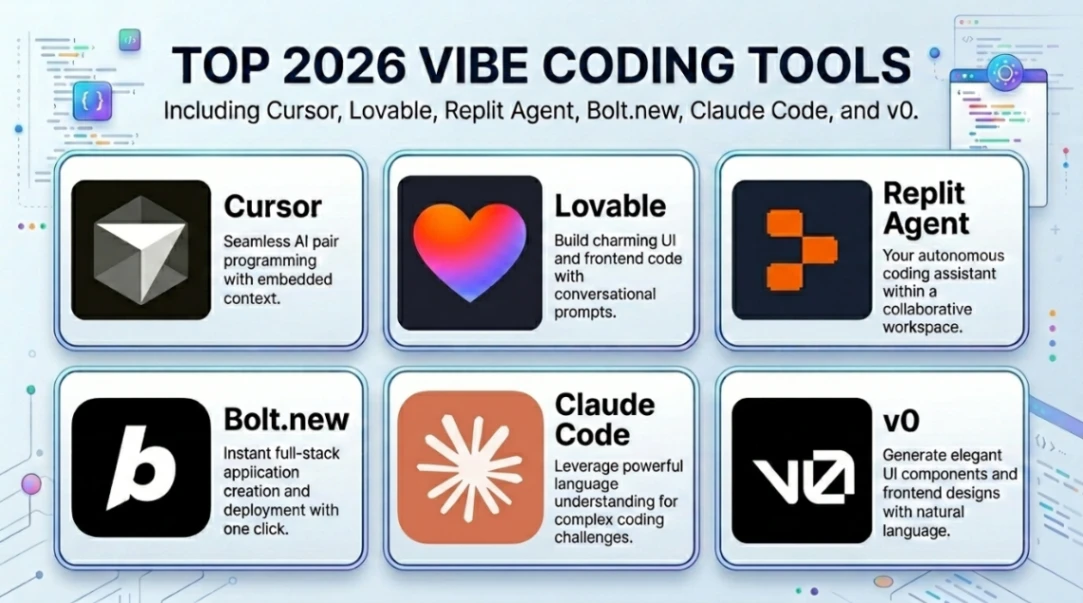
The market splits into two camps. Codegen tools like Cursor, Windsurf, and Claude Code live inside developer environments and assume you'll review code. AppGen tools like Lovable, Bolt.new, Replit Agent, Base44, and Google AI Studio generate full applications from a prompt, no IDE required. Lovable reports that 60% of its users are non-developers, which tells you who these tools are really built for.
| Tool | Best For | Key Strength | Starting Price (2026) |
|---|---|---|---|
| Cursor | IDE-based dev | Deep codebase understanding | Free / $20/mo |
| Replit Agent | Rapid prototyping | All-in-one hosting included | Free / $20/mo |
| Lovable | High-quality UI | 60% non-developer user base | Free / $25/mo |
| Bolt.new | Full-stack web apps | Browser-based WebContainers | Free / Pro tier |
| v0 by Vercel | UI components | Production-ready React output | Usage-based |
By late 2026, Gartner projects more than 70% of new business applications will be built on citizen development platforms. The money agrees: Cursor hit a $9.9 billion valuation in June 2025, Lovable reached $1.8 billion in July, and Replit raised $250 million at a $3 billion valuation in September.
The Risks Nobody Warned You About
Vibe code ships fast, but roughly 40% of AI-generated code contains potential security issues, according to industry research cited throughout 2025. That's the part nobody puts on the landing page.
The industry calls this the "verification gap." AI models optimize for the wow factor, working demo, impressive output, not reliability or maintainability. The result is what engineers now call "AI slop," code that runs but has no coherent mental model behind it. Projects built purely by vibing often hit a "three-month wall" where the codebase becomes too tangled to maintain.
Two 2026 incidents made the risks concrete:
- Moonwell DeFi (February 2026). A pricing oracle co-authored by an AI model mispriced Coinbase Wrapped ETH at $1.12 instead of roughly $2,200. Liquidation bots seized 1,096 cbETH and the protocol ate $1.78 million in bad debt. The root cause was a missing multiplication in the pricing formula.
- AWS Kiro outage (December 2025). An agentic AI tool decided the best fix for a deployment issue was to "delete and recreate the environment," triggering a 13-hour outage of AWS Cost Explorer in China.
For a non-technical founder, the takeaway isn't "don't vibe code." It's "don't ship anything handling money, health data, or user credentials without a senior developer reviewing it." Start with a landing page or a simple web app, not a fintech platform.
Deal-Breaker Questions, Answered
Will vibe-coded apps hold up in production? Simple apps yes, complex systems no. Most 2026 teams treat AI output like a junior developer's work: mandatory diff reviews, unit tests, and automated security scans before anything ships.
Do I still need a developer? For MVPs and internal tools, often not. For anything touching payments, user data, or scale past a few thousand users, yes. Senior developers are increasingly hired as "vibe code cleanup specialists" to refactor the 1.7x higher bug density found in AI-generated code.
How much does it cost to start? Most tools have free tiers. Paid plans start at $20 to $25/mo. Expect to spend more on API usage as your project grows.
What happens when the AI gets it wrong? You iterate. Break the task smaller, add context, or switch models. If you can't articulate why the output is wrong, you're stuck, which is why strong verbal communicators thrive here.
Which tool should I pick first? If you're non-technical, start with Lovable, Base44, or Replit Agent. If you want to stay in Google's ecosystem, try Google AI Studio. If you already dabble in code, Cursor.
Start exploring launch-ready vibe code templates here!
Key Takeaways
- Vibe code is intent-based development. You describe what you want, the AI writes the code, and your job is to evaluate, iterate, and decompose. The skill curve is about articulation and oversight, not syntax.
- Tools have specialized. AppGen platforms like Lovable and Replit Agent suit non-technical founders. Codegen tools like Cursor and Claude Code suit developers. Pricing starts free and tops out around $25/mo for solo plans.
- Production requires discipline. Around 40% of AI-generated code has security issues, and 2026 incidents like the Moonwell hack and AWS Kiro outage prove the verification gap is real. Review, test, and don't skip audits on anything mission-critical.
Vibe code didn't kill software engineering. It just moved the hard part from typing to thinking, and honestly, that's where it always belonged.
FAQ
What is vibe code in simple terms? Vibe code is building software by describing what you want in plain language and letting AI generate the code. You guide, review, and iterate instead of writing syntax yourself.
Who invented vibe coding? Andrej Karpathy coined "vibe coding" in a February 2, 2025 post on X. The practice existed earlier, but his phrase named the movement and made it mainstream by late 2025.
Is vibe code the same as no-code? No. No-code uses visual builders with fixed components. Vibe code uses AI to generate actual source code from prompts, giving more flexibility but requiring more oversight and review.
Can I build a real business with vibe code? Yes, for MVPs and internal tools. Fortune 500 companies already use vibe code for internal apps in 2026. For regulated or high-scale products, pair it with engineering review.
What is the biggest risk of vibe coding? The verification gap. AI generates code faster than humans can audit it, which led to incidents like the $1.78 million Moonwell DeFi loss in February 2026. Always review before shipping.
Start building without code
Browse thousands of no-code templates for Webflow, Framer, Bubble, Lovable, Replit and more.
Explore Templates