Can No-Code Apps Make Money? Real Revenue Proof
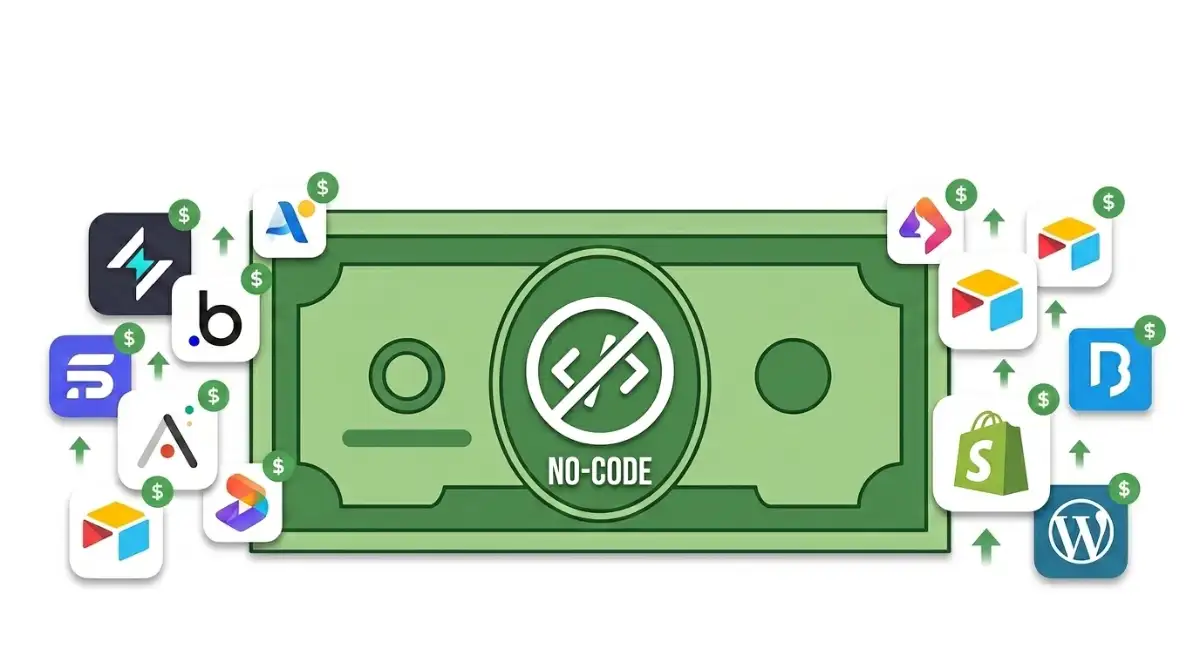
Yes. No-code apps generate real, recurring revenue across several business models. Builders have used platforms like Bubble to reach hundreds of thousands in monthly recurring revenue, while solo-maintained tools clear over a million dollars a year.
Table of Contents:
- Key Takeaways
- Introduction
- How Much Money Do No-Code Apps Actually Make?
- Which Business Models Turn No-Code Into Recurring Revenue?
- Why Has Bubble Become the Go-To for Profitable Apps?
- What Does It Cost to Launch a Revenue-Ready No-Code App?
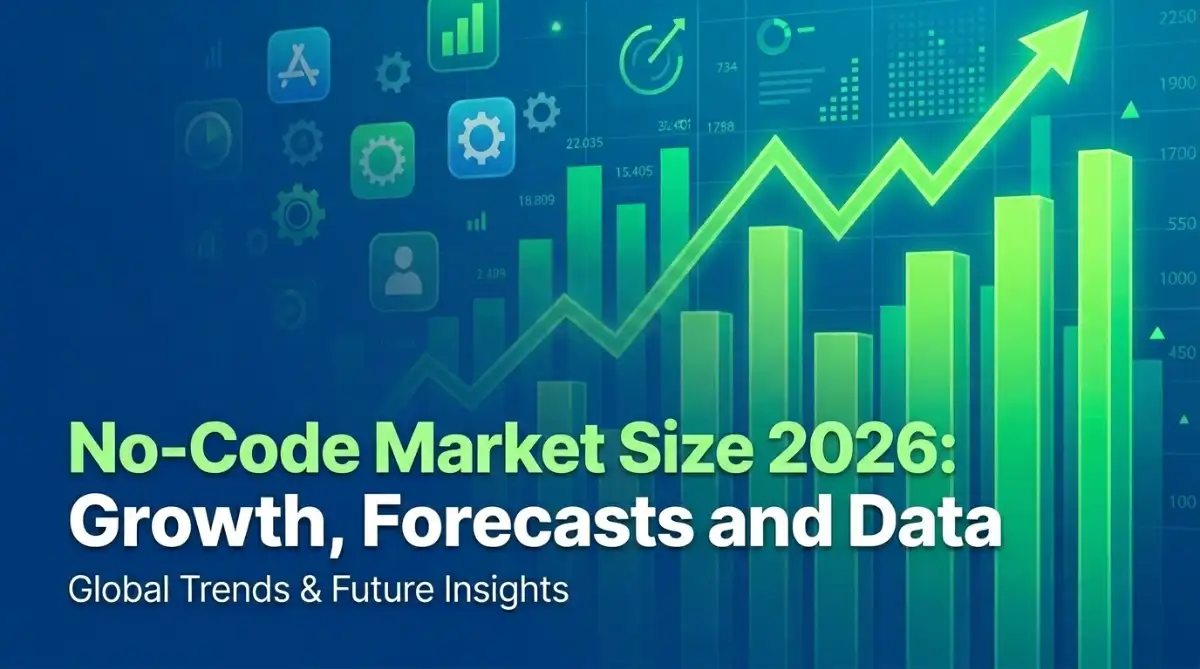
- How Big Is the No-Code Market in 2026?
- Honest Tradeoffs
- FAQ
Key Takeaways
- Comet's founder built a freelancer marketplace to $800,000 in monthly recurring revenue on Bubble without writing a single line of code first.
- The money is real, but so are the failure modes: pricing surprises and security gaps have quietly sunk plenty of promising builds.
- Knowing where no-code stops paying off matters as much as knowing where to start, and the threshold is more specific than you'd expect.
Introduction
A freelancer marketplace reached $800,000 in monthly recurring revenue before its founder learned to code. That's the kind of number that makes bootstrapped indie makers rethink what no-code apps can actually do, because it shrinks the distance between an idea and a paying product.
The real question is whether stories like that are flukes or a pattern you can repeat. The honest answer carries more nuance than a flat yes, since the path runs straight through pricing traps, security gaps, and platform lock-in. This piece walks through the revenue, the receipts, and the exact point where building without code stops being the smart move.
How Much Money Do No-Code Apps Actually Make?
No-code apps span a wide revenue range, from solo tools earning four figures a month to platforms moving over a billion dollars in transactions. The standouts share a pattern: a narrow problem, a clear way to charge, and a founder who shipped fast instead of waiting for a perfect codebase.
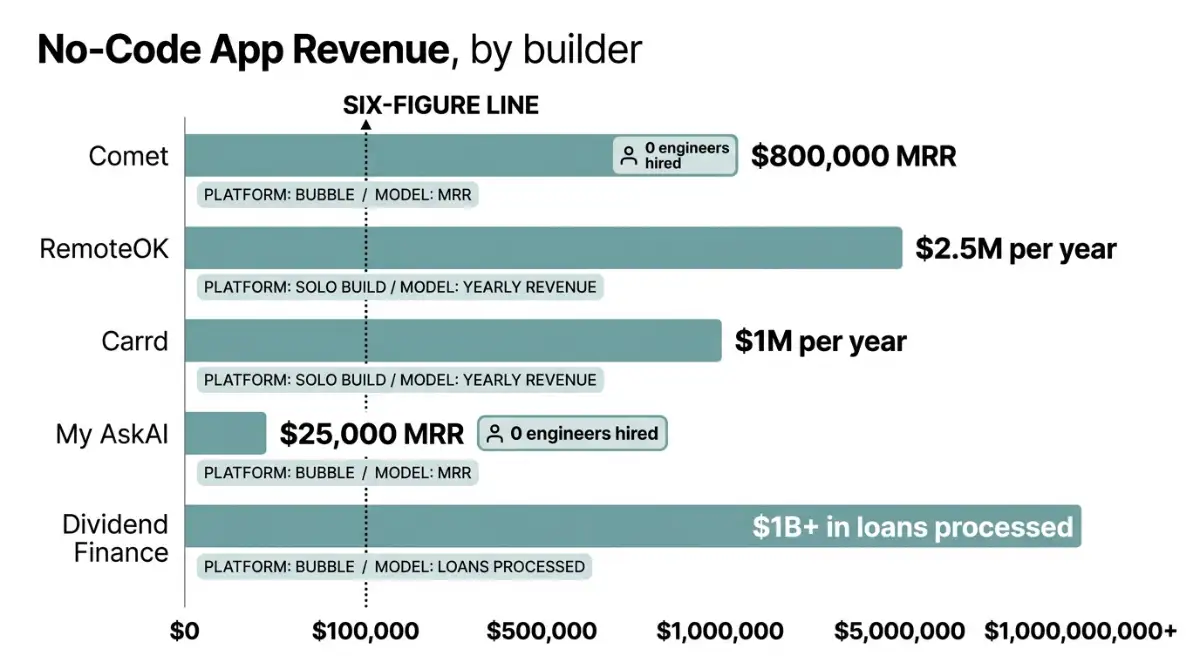
Comet, a vetted freelancer marketplace, scaled to $800,000 in monthly recurring revenue on Bubble before raising a €14 million round, according to founder Charles Thomas. My AskAI, a two-person AI support tool, reached $25,000 in monthly revenue with more than 40,000 registered users, per co-founder Alex Rainey. At the solo end, single-page builder Carrd clears over $1 million a year on its own.
The thread running through all of them is unglamorous: revenue follows distribution and a working payment loop, not the language the app was built in.
| App | Built on | Reported revenue | Model |
|---|---|---|---|
| Comet | Bubble | $800K MRR | Freelancer marketplace |
| My AskAI | Bubble | $25K MRR | AI micro-SaaS |
| Carrd | Solo build | $1M+/yr | One-page sites |
| RemoteOK | No-code | $2.5M/yr | Job board |
Which Business Models Turn No-Code Into Recurring Revenue?
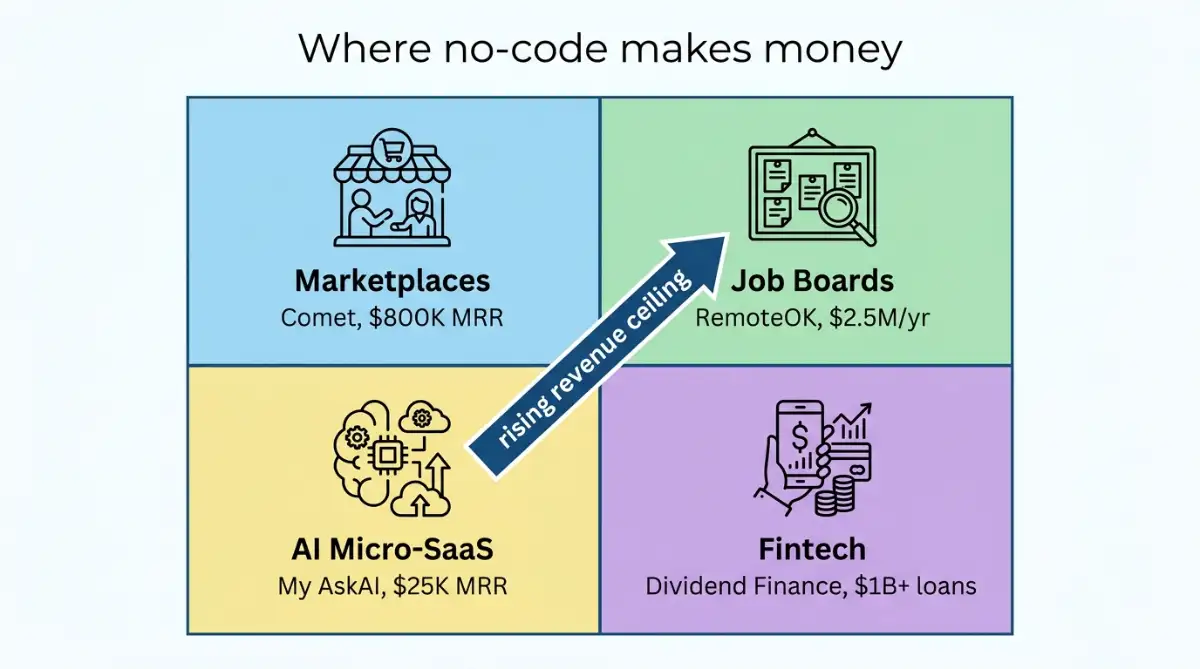
Four models dominate the profitable end of no-code: two-sided marketplaces, niche job boards, AI-assisted micro-SaaS, and transactional fintech. Each works because the platform handles the parts that used to need a team (profiles, search, payments, logic) while the builder focuses on demand. The model you pick shapes the ceiling far more than the tool does.
- Marketplaces: Comet and the French subletting platform Ohana both ran on Bubble, with Ohana reaching multimillion-dollar profitability in year one.
- Job boards: RemoteOK charges $299 to $748 per post and pulls roughly $2.5 million a year; WeWorkRemotely brings in about $1.5 million.
- AI micro-SaaS: My AskAI turns company knowledge bases into support agents, built in six weeks by a single Bubble developer.
- Fintech: Dividend Finance built solar-loan and CRM tooling on Bubble and processed over $1 billion in loans before its 2022 acquisition by Fifth Third Bank.
That last example matters because it kills the "no-code is only for toys" assumption. A billion dollars in loan volume is not a prototype. This wave is part of the broader rise of solo builders and small teams shipping real products alone.
Why Has Bubble Become the Go-To for Profitable Apps?
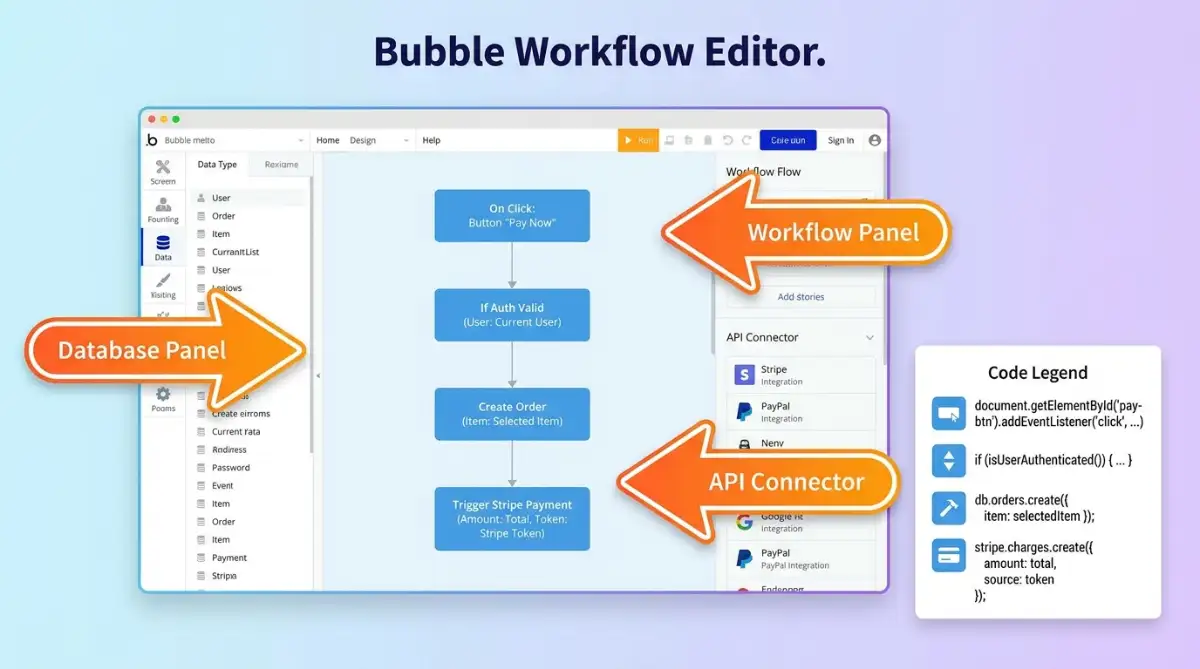
Bubble, launched in 2012 by Emmanuel Straschnov, was the first platform to fold frontend design, a relational database, and backend logic into one visual builder. That full-stack reach is why so many revenue case studies (Comet, My AskAI, Dividend Finance) run on it instead of a design-only tool. When your app needs accounts, data relationships, and payments, a pretty page editor isn't enough.
I keep coming back to how often the founders themselves credit speed over polish. The pattern in nearly every Bubble success story is the same: ship the ugly version fast, get paid, then optimize.
No-code allowed us to not only build the platform but also scale our revenue to more than $800,000 in monthly recurring revenue.
That's Charles Thomas of Comet, who had no prior coding experience when he shipped the first version in a few weeks. Alex Rainey of My AskAI frames the advantage the same way.
The speed with which you can build on no-code and Bubble will completely set you apart from your competition and keep your costs super low.
Bubble's edge sits in its integrated relational database and plugin marketplace, the parts that let a non-technical builder model real data without a backend engineer. You can read more on the platform's full-stack origins in 2012.
What Does It Cost to Launch a Revenue-Ready No-Code App?
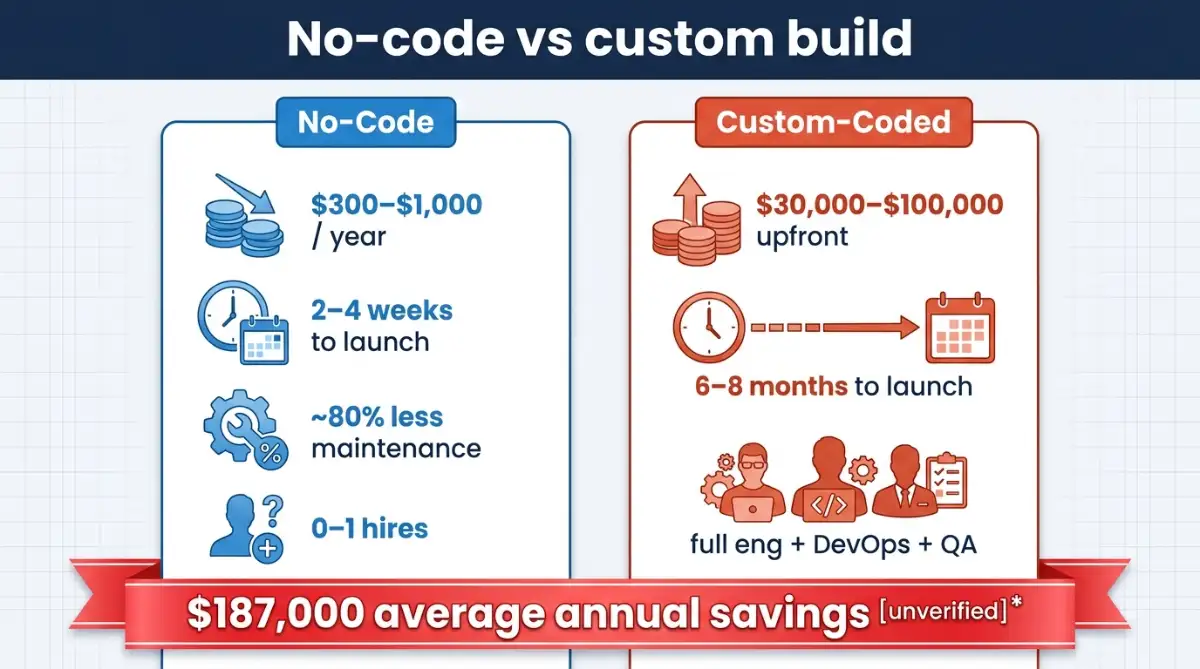
A no-code stack typically runs $300 to $1,000 a year, against $30,000 to $100,000 upfront for custom-coded software. That gap is the entire pitch: you test whether anyone will pay for the price of a few dinners, then reinvest revenue once it shows up. For bootstrapped indie makers, that changes which ideas are even worth trying.
The time math is just as lopsided. A no-code build ships in two to four weeks versus six to eight months for custom development, which means you learn whether the market cares before a traditional team would have finished the schema.
| Metric | No-code stack | Custom-coded |
|---|---|---|
| Initial MVP cost | $300–$1,000/yr | $30,000–$100,000 upfront |
| Time to market | 2–4 weeks | 6–8 months |
| Maintenance | ~80% reduction | Standard lifecycle |
| Staffing | Avoids ~2 IT hires | Engineering + DevOps + QA |
If I had to name the single biggest reason no-code apps make money, it's this cost asymmetry. You can run lean stacks like FlutterFlow or Lovable synced to Supabase for under $150 a month, keeping early burn near zero while you hunt for traction.
How Big Is the No-Code Market in 2026?
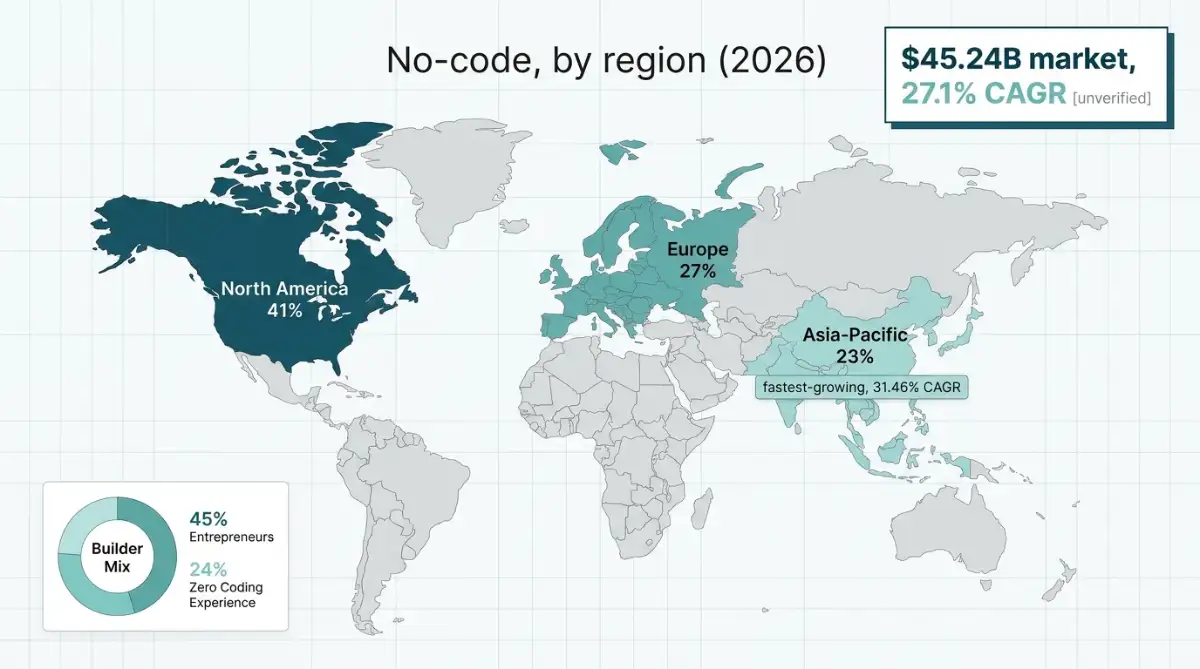
The no-code market reached $45.24 billion in 2026 and keeps compounding, with North America holding the largest share. Behind the headline number sits a workforce shift: according to Gartner, 41% of corporate employees are now "business technologists" who build their own software tools, which means demand for no-code apps is structural rather than a passing trend.
The user base skews heavily non-technical. Reported demographics put 45% of builders as entrepreneurs and small business owners, while 24% had zero coding experience before they started. That's the audience actually paying for and building these products.
| Region | No-code AI market share |
|---|---|
| North America | 41% |
| Europe | 27% |
| Asia-Pacific | 23% (fastest-growing) |
A projected global tech talent shortage of 85.2 million workers by 2030 is part of why this keeps accelerating: when you can't hire engineers, you hand the tools to the people closest to the problem. For the full picture, see the broader no-code market forecasts.
Honest Tradeoffs
Here's where I'd push back on the highlight reel: no-code apps make money, but the same speed that gets you to revenue can get you to a breach or a surprise bill just as fast. Three tradeoffs deserve a hard look before you commit.
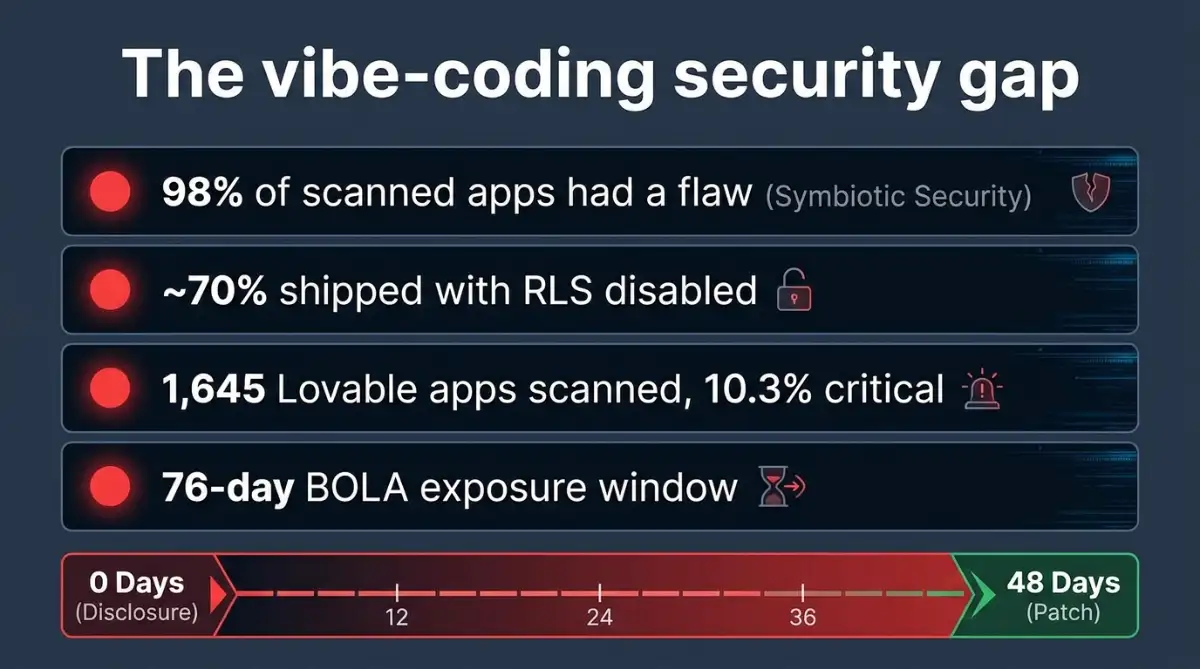
Security is the loudest one. A scan by Symbiotic Security of more than a thousand vibe-coded apps found that 98% contained exploitable flaws, often missing database Row-Level Security. CVE-2025-48757 revealed that roughly 70% of analyzed Lovable apps shipped with RLS entirely disabled, and a separate BOLA flaw left user projects exposed for a 76-day window.
AI code generators optimize for "does it work?" not "is it secure?"
That line from the MetaMindz technical report captures the gap cleanly. It's worth reading a closer look at no-code security risks before you ship anything handling payments.
Pricing can flip on you. When Bubble moved to consumption-based Workload Units in 2023, unoptimized startups got hit with overage bills at $0.30 per 1,000 units, and the October 2025 restructure nearly doubled plans for mobile access. Vendor lock-in compounds it, because Bubble doesn't export code, so leaving means a rewrite. A useful rule: when platform fees approach 8% to 10% of monthly revenue, the cost edge starts eroding and migration deserves a serious conversation.
Start exploring launch-ready no-code templates here!
FAQ
What counts as a no-code app? A no-code app is software built through visual configuration and natural-language prompts instead of hand-written code. The platform compiles your inputs into real HTML, databases, and APIs. Tools like Bubble, Webflow, and FlutterFlow cover everything from marketing sites to full marketplaces.
Can no-code apps handle real payments?
Yes. No-code platforms connect to payment processors and APIs through visual integrations, which is how marketplaces and job boards collect subscription and transaction fees. RemoteOK charges $299 to $748 per post this way [unverified], and fintech tools have processed large transaction volumes on the same foundations.
Is no-code or low-code better for a paid product? No-code targets non-technical builders with fully visual tools, while low-code mixes visual building with custom code for more control. According to a Kissflow survey, the visual model has become a default way enterprises build software. Low-code suits teams that expect heavy custom logic later.
Can you build a native mobile app without code? Yes. Bubble launched native iOS and Android compilation into general availability in August 2025 using a React Native base, and FlutterFlow exports clean Flutter code. The tradeoff is a steeper learning curve around mobile state and reported Android performance quirks. You'd want to explore the newer wave of AI-driven vibe coding too.
Do investors take no-code startups seriously? Increasingly, yes. Accelerators like Y Combinator now fund startups launched on no-code stacks, treating real customer traction and transaction volume as stronger signals than a custom codebase. Comet, for example, raised a multimillion-euro round after validating on Bubble. Investors care about revenue, not the build method.
Start building without code
Browse thousands of no-code templates for Webflow, Framer, Bubble, Lovable, Replit and more.
Explore Templates