Best No Code Builder for SaaS Founders 2026
The leading no-code builders for SaaS and startups going into 2026 are Bubble for full-stack web apps, WeWeb paired with Xano for scalable B2B SaaS, FlutterFlow for native mobile, Webflow for marketing sites, Softr for data-driven portals, and Retool or ToolJet for internal tools. Selection depends on whether code export, multi-tenancy, or pricing predictability matters most to your team.
Table of Contents
- Why the no-code builder market hit critical mass
- Bubble: the full-stack workhorse
- WeWeb + Xano: the scalable SaaS stack
- FlutterFlow: native mobile without the codebase
- Webflow: design-led marketing sites
- Softr: the fastest data-to-app bridge
- Retool and ToolJet: internal tools without the rebuild
- Adalo: the budget mobile MVP option
- Decision Framework: which no code builder fits your situation
- Key Takeaways
- FAQ
Best No Code Builder Picks for SaaS Founders and Startup Teams
Gartner now forecasts that 75% of new enterprise applications are built on low-code or no-code platforms, up from under 25% just five years ago. For technical founders and product leads at early-to-growth-stage SaaS startups, that shift changes the math on how a small team ships software. A no code builder is no longer a prototyping shortcut, it is a legitimate production stack that can carry thousands of paying users.
This article cuts through the marketing pages of the eight platforms I think are worth a serious look right now. I'll cover what each one actually does well, where it falls apart, and what your monthly bill looks like once you scale past the free tier. By the end you'll know which stack fits your product, your team size, and your tolerance for vendor lock-in.

Why the no-code builder market hit critical mass
The no-code market crossed into mainstream territory because the global developer shortage made traditional hiring impossible for most startups. According to IDC, the world is short roughly 4 million full-time software developers, and Grand View Research values the global low-code platform market at $28.75 billion with a 32.2% compound annual growth rate.
What changed is not just the volume of tools, it is what they can produce. The current "Pro" no-code stacks generate real Vue.js, React, or Flutter code that runs on global CDNs. AI agents now scaffold entire data models from a paragraph of plain English. Gartner expects 40% of enterprise applications to ship with task-specific AI agents by the end of the year, an eightfold increase in twelve months.
A few numbers that matter for any founder evaluating the space:
- 90% reduction in development timelines reported by organizations switching to no-code, per Integrate.io's trends report
- 70% lower project costs versus traditional engineering builds
- 362% average ROI across no-code initiatives, with 91.9% of projects recovering investment inside year one
- $140,000 to $300,000 saved annually by avoiding specialized IT recruitment
If you're catching up on how we got here, the history of no-code from GeoCities to the modern visual builders is worth a read. The rest of this guide is the practitioner version: which tool, for which job, at what price.
Bubble: the full-stack workhorse for web SaaS
Bubble remains the most complete single-platform no code builder available today. Founded in 2012 by Josh Haas and Emmanuel Straschnov, the platform integrates a visual frontend, a relational database, and server-side logic into one environment. By 2025 it had surpassed 5 million applications built on the platform, with Bubble-built companies raising over $15 billion in funding, according to Contrary Research.
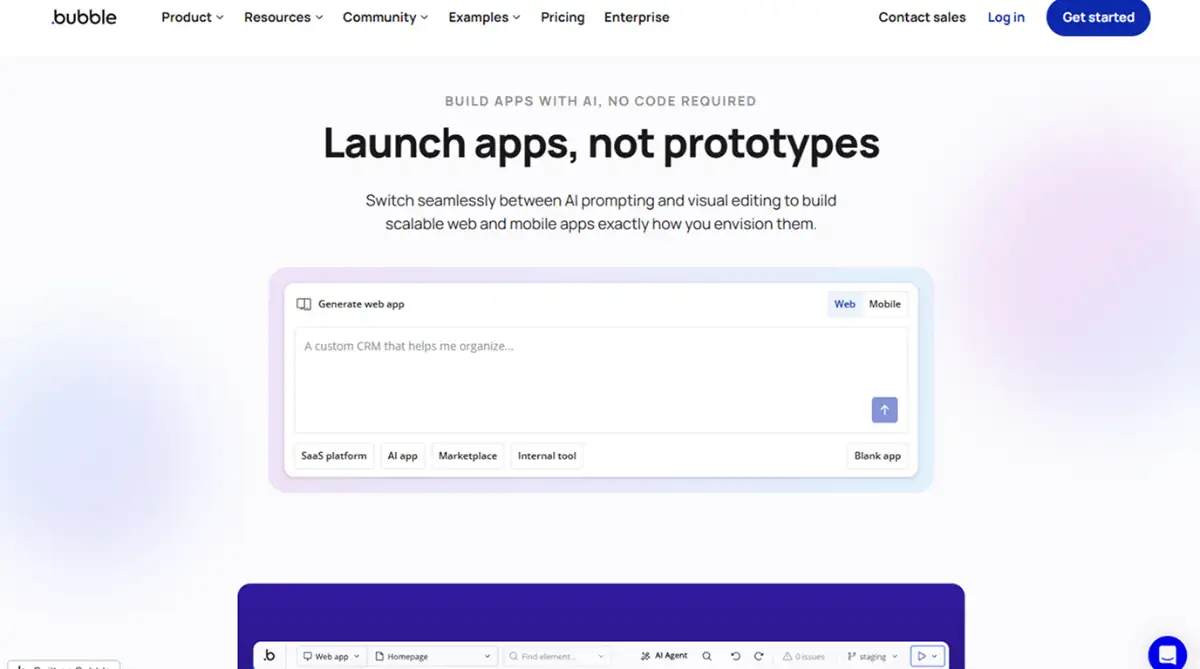
The pitch is simple: if you want one tool to run your entire web app, this is it. The downside is that Bubble apps cannot be exported, and the workload-based pricing model can spike during viral traffic.
Where Bubble wins:
- Marketplaces, social apps, and complex web SaaS with deep logic
- Massive plugin ecosystem (Stripe, OpenAI, Twilio, etc.)
- Mature enough to handle thousands of concurrent users
- Strong community and learning resources
Where Bubble struggles:
- Workload Units pricing makes viral spikes expensive
- No code export, full vendor lock-in
- Proprietary rendering engine cannot be CDN-cached the way standard HTML can
- "Bubble Fatigue" is real once your app crosses a complexity threshold
Bubble's status log shows a Core uptime of 99.64% this year, with a 40-minute full outage on April 24 and intermittent DNS issues on ".co" domains in mid-April. Pricing starts at the free tier, then jumps to paid plans on the Bubble pricing page. The official Bubble YouTube tutorial is the fastest way in.
For a deeper origin story, see our piece on Bubble as the first true visual builder for founders. You can also get more details and no code templates from Bubble tool for screenshots and templates feature breakdowns.
WeWeb + Xano: the scalable B2B SaaS stack
If Bubble is the monolith, WeWeb plus Xano is the modular alternative that most serious SaaS founders are reaching for. WeWeb handles the frontend and compiles to Vue.js. Xano runs the backend, the database, and your API layer. They were built to talk to each other.
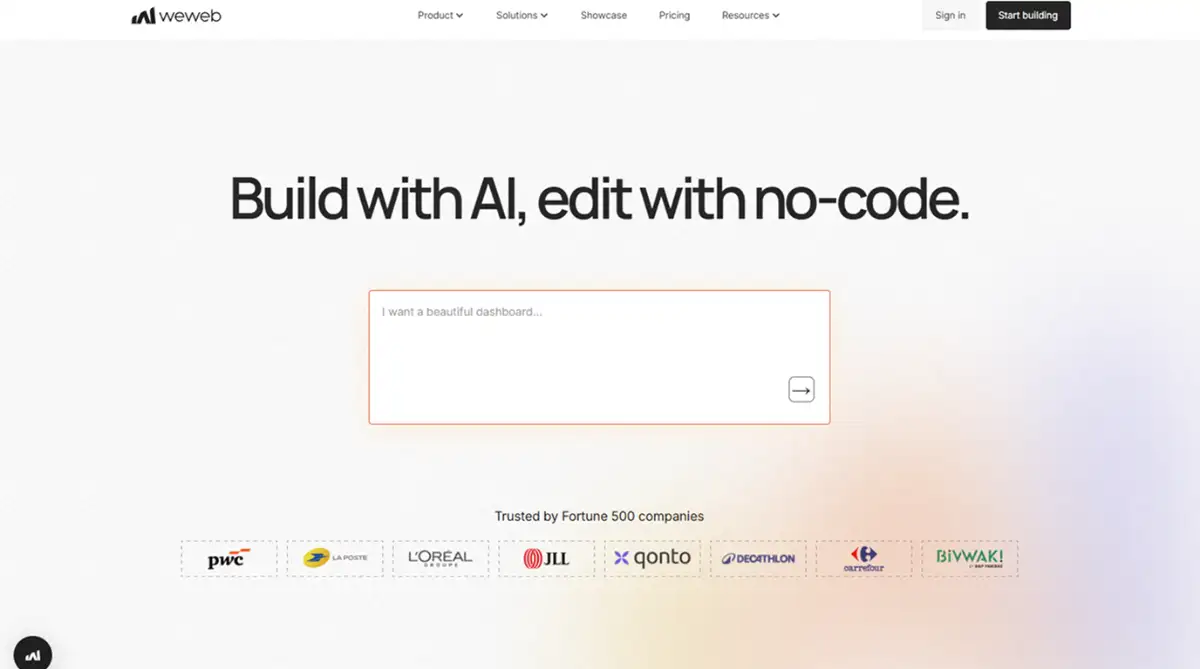
This is the stack I'd recommend for any B2B product that expects to need multi-tenant data isolation, SOC 2 readiness, or eventually a hand-off to a real engineering team.
| Component | What it does | Starting price |
|---|---|---|
| WeWeb (frontend) | Visual builder, compiles to Vue.js, hosts on its CDN | $20/mo per builder |
| Xano (backend) | Visual API builder, scalable database, multi-tenancy | $85/mo for the entry instance |
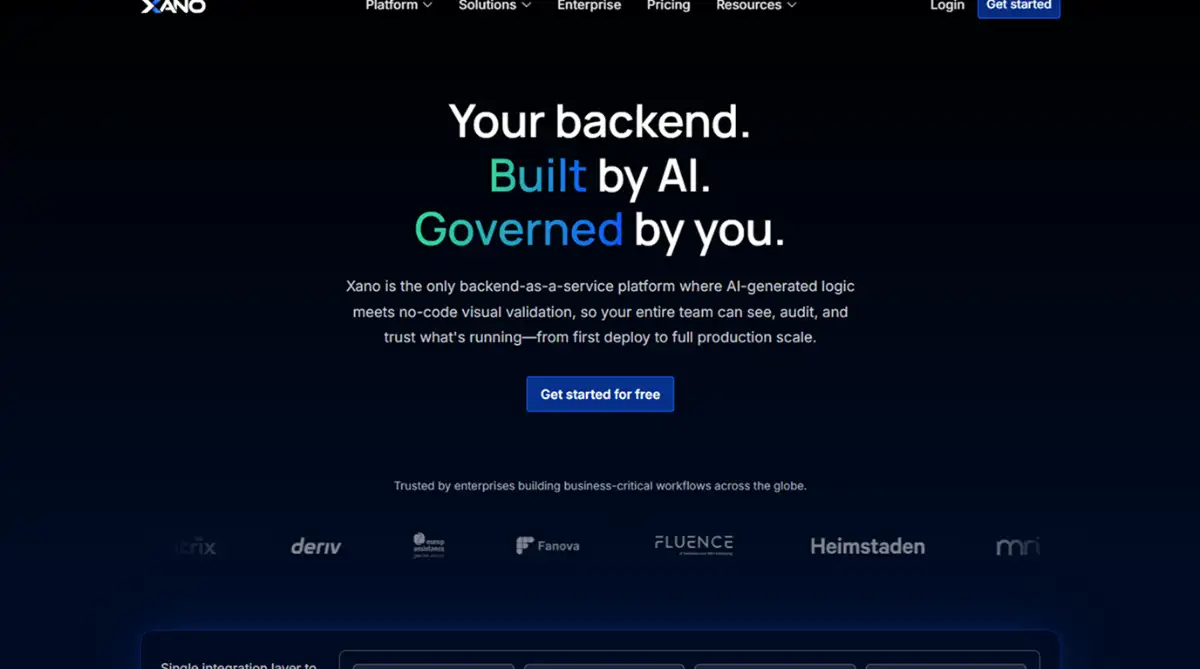
Xano's instance-based pricing is the headline feature for traffic-heavy apps. You pay for dedicated server capacity, not per operation, so a viral spike does not change your bill. The catch is that $85/month minimum is a premium versus usage-based competitors for low-traffic prototypes.
The combined argument:
- True multi-tenancy with row-level security and per-tenant data partitioning
- Code-free backend that exposes proper REST and GraphQL endpoints
- Frontend code export through WeWeb's Vue.js output, so you can self-host on AWS or GCP
- Predictable costs at scale (Xano) plus per-seat clarity (WeWeb)
A three-person team running WeWeb Pro plus Xano Pro lands around $340 per month total. That is the cheapest "production-grade SaaS stack" you can assemble today without writing custom backend code. Pricing tiers for both sit on the WeWeb pricing page and the Xano pricing page. For walkthroughs, the WeWeb tutorial video covers frontend basics
and the Xano walkthrough video handles the backend side. Our WeWeb tool review and Xano tool review explore the capabilities, pricing and no code templates for both tools.
FlutterFlow: native mobile without maintaining a codebase
FlutterFlow is the platform I'd pick for any mobile-first product today. Founded in 2020 by Abel Mengistu and Alex Greaves, both former senior engineers from Google's Flutter and Firebase teams, FlutterFlow generates actual Flutter and Dart code that you can export and own. According to PitchBook, the company has raised roughly $50 million from GV (Google Ventures) and surpassed 1.5 million developers by 2025.
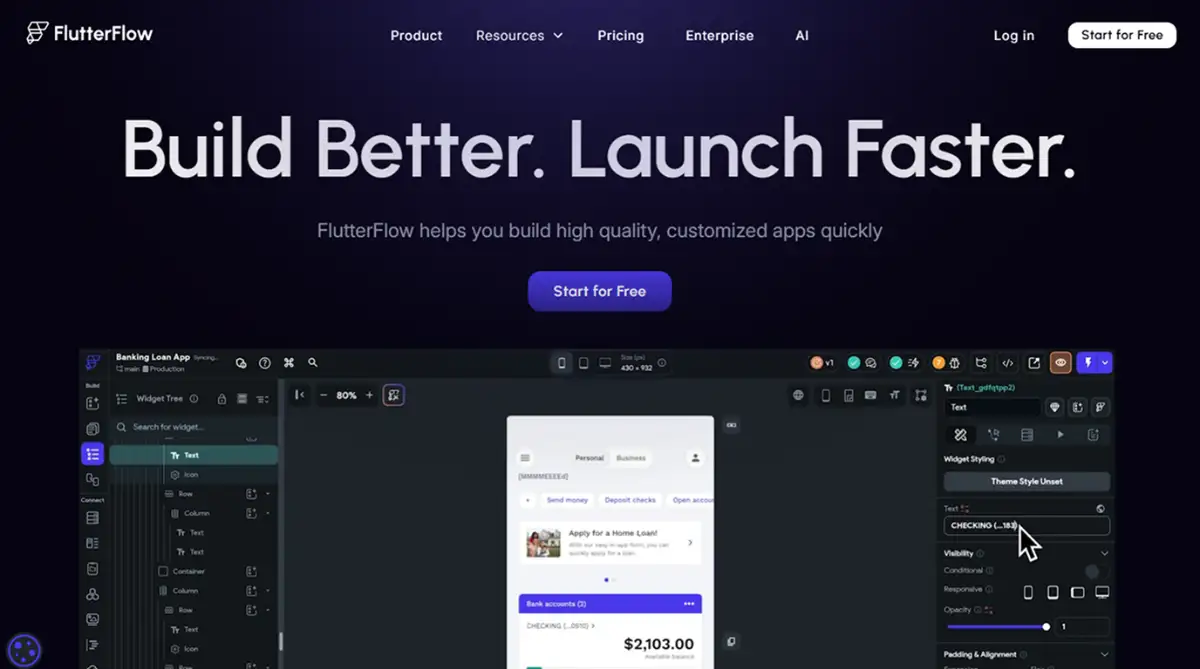
The key idea is "code ownership." If you ever want to leave the platform, you walk out with a working Flutter codebase that any mobile developer can pick up and continue.
FlutterFlow strengths:
- Real native performance on iOS and Android (single codebase)
- Code export to Flutter/Dart, no vendor lock-in
- Strong animation, offline, and device-feature support
- Active marketplace of components and templates
FlutterFlow weaknesses:
- Learning curve is steeper than spreadsheet-based builders
- Business plan jumps to roughly $490/month for a five-seat team
- Less suited to content-heavy marketing sites (use Webflow instead)
If you're undecided on mobile architecture, we wrote a primer on native apps versus cross-platform builds that lays out the tradeoffs. The official FlutterFlow pricing page has current tiers, and the FlutterFlow tutorial playlist is genuinely useful
You can discover FlutterFlow tool free templates here and more info about the tool.
Webflow: the design-first authority for marketing sites
Webflow is not a SaaS builder, and that's the point. Launched in 2013 by Vlad Magdalin, Sergie Magdalin, and Bryant Chou, Webflow generates clean, semantic HTML and CSS through a visual interface that mirrors the actual DOM. It is the right tool for your marketing site, your blog, and your landing pages, not your application backend.
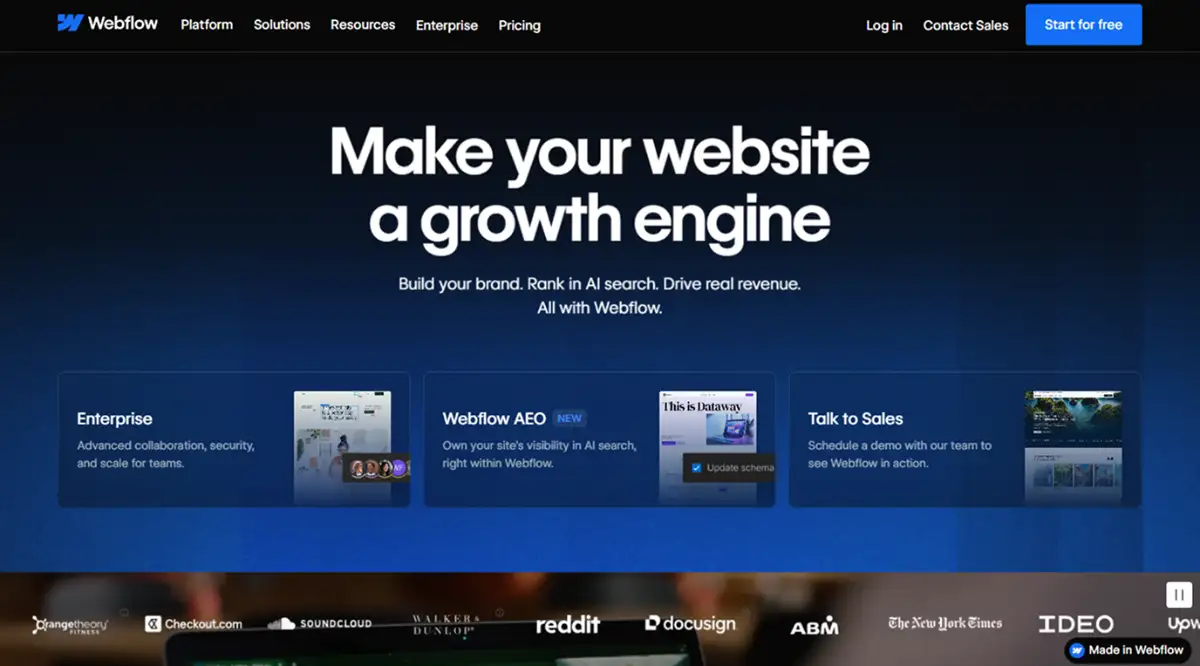
In 2024 Webflow acquired the JavaScript animation library GSAP, which cemented its lead on the design and motion side. For an SEO-driven content site or a Series A landing page that has to convert, this is still the platform to beat. Compare it directly with the alternative in our Framer vs Webflow breakdown.
A note on reliability: between April 14 and 15 this year, Webflow experienced a significant service disruption totaling roughly 16 hours, with 5xx errors affecting both the editor and live production sites, according to StatusGator's incident log. April 14 alone saw 9 hours and 8 minutes of total downtime. That is a real risk to weigh if your site is mission-critical.
Webflow is best when you need:
- Pixel-perfect design control
- Clean exportable HTML/CSS
- Strong on-page SEO performance
- A CMS for blogs and structured content
Webflow is wrong when you need:
- Application logic, user accounts, or a real database
- Stripe subscriptions or complex workflows
- 100% uptime guarantees (the recent April outage is a cautionary case)
The Webflow tutorial series is the official entry point.
Our Webflow tool page will help you discover free Webflow templates and features.
Softr: the fastest data-to-app bridge
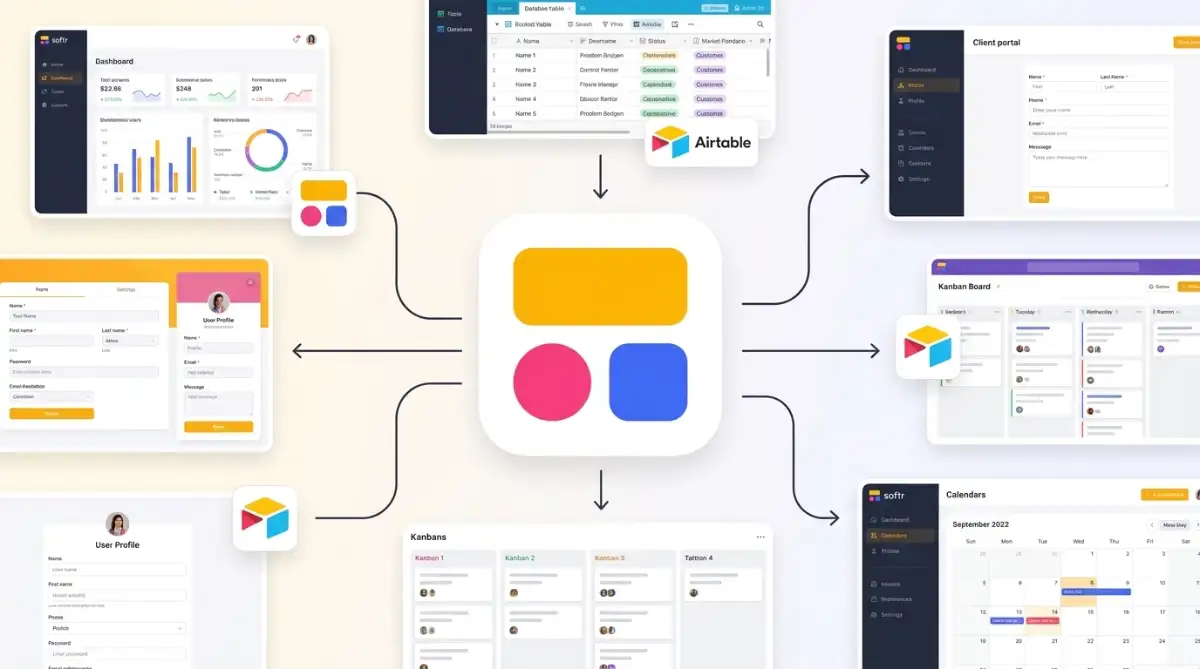
Softr wins one specific job and wins it cleanly. If you already have data in Airtable, Google Sheets, or a SQL database, Softr turns that data into a working web app, often in under a day. Founded in 2018 by Mariam Hakobyan and Artur Mkrtchyan, the platform is built for B2B portals, internal apps, and simple SaaS frontends where the data layer already exists.
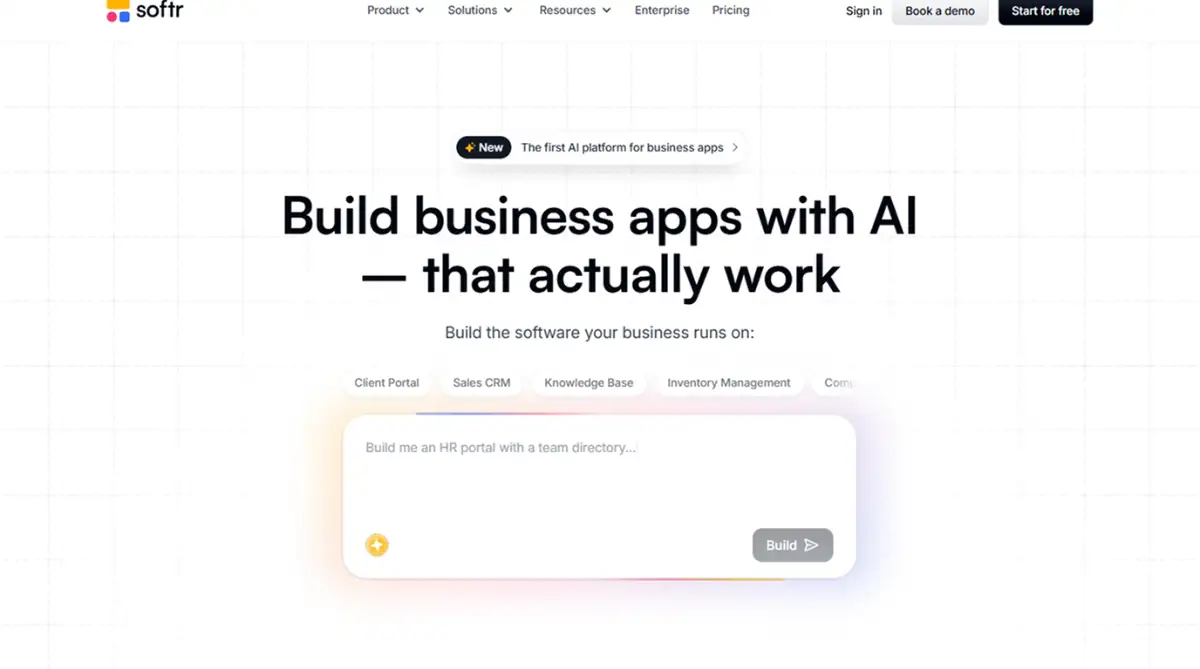
Softr current pricing tiers (full breakdown on the Softr pricing page):
- Basic ($49/mo): 20 app users, custom domains, branding removal
- Professional ($139/mo): 100 app users, advanced roles and permissions, PWA support
- Business ($269/mo): 500 app users, SSO via Okta or OneLogin, domain-restricted signups
The honest take: Softr is incredible for client portals, member directories, and CRM frontends. It is not the tool to build a marketplace or a social network. The data model is only as flexible as the underlying Airtable base, and complex relational logic gets awkward quickly.
If you want to see it in action this Softr walkthrouhg video shows a portal built end-to-end.
Our Softr tool page covers data-source integrations, templates and features in more details.
Retool and ToolJet: internal tools without rebuilding the wheel
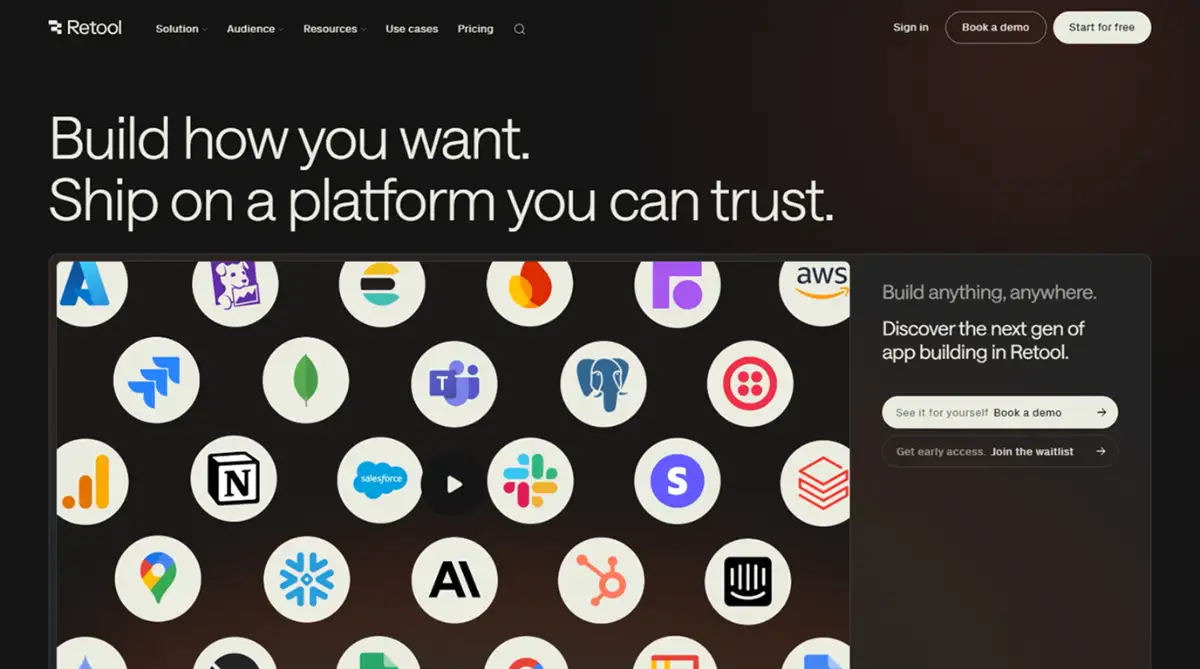
For internal dashboards, ops tools, and admin panels, the current choice is between Retool and ToolJet. They solve the same problem (visual UIs on top of your existing databases and APIs) with different philosophies.
| Feature | Retool | ToolJet |
|---|---|---|
| Source model | Closed-source, hosted | Open-source, self-hostable |
| Pricing model | Per end-user | Per builder |
| Air-gapped deployment | Enterprise tier only | Standard |
| Pre-built components | 100+ | 50+ |
| Best for | Engineering-heavy admin panels | Security-conscious enterprises |
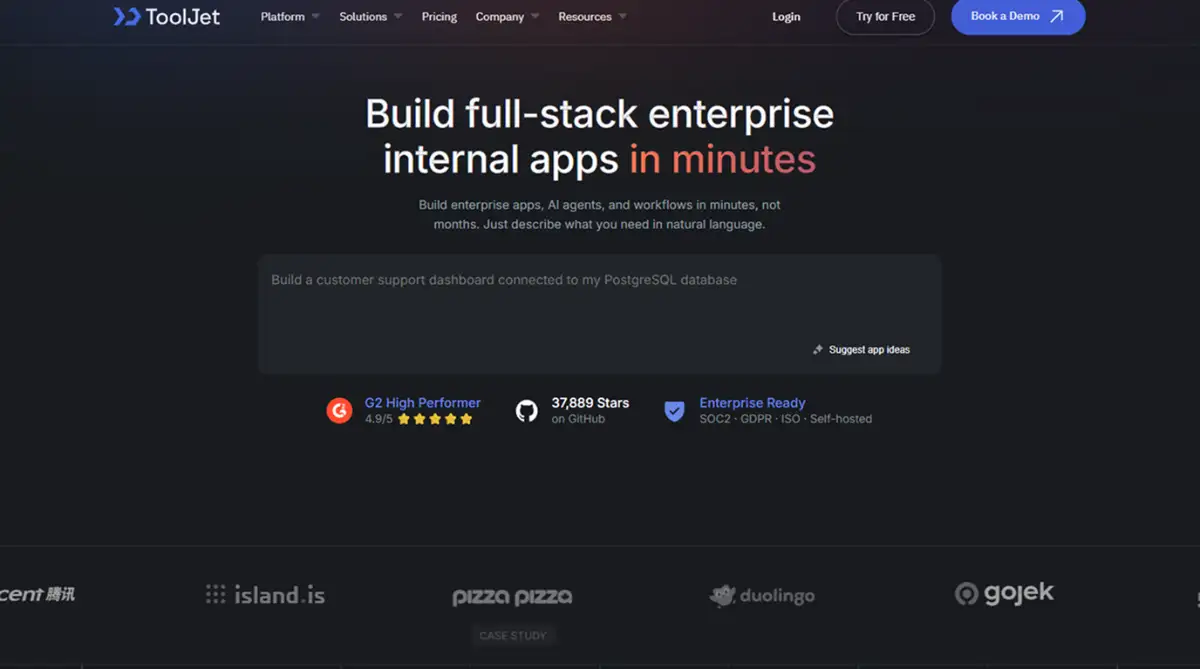
Retool is the more polished product and has the larger component library. Its Retool pricing page shows per-end-user pricing, which gets expensive once non-technical staff start using the tools you build. The Retool getting started video is a good 20-minute primer.
ToolJet has gained serious ground recently because of two things: per-builder pricing (not per end-user), and full air-gapped self-hosting for regulated industries. Audit logs are included rather than gated behind enterprise tiers. The ToolJet pricing page lays out the open-source versus cloud split, and the ToolJet tutorial playlist is comprehensive.
My take: if you have 5 internal users, pick Retool for polish. If you have 50 internal users or you're in healthcare, finance, or government, pick ToolJet for the pricing and self-hosting story.
Adalo: the budget mobile MVP option
Adalo is the affordable counterpoint to FlutterFlow. It remains the cheapest mobile-first builder with fixed monthly pricing, which makes it a fit for solo founders and indie hackers who want to validate a mobile concept without committing $490 a month.
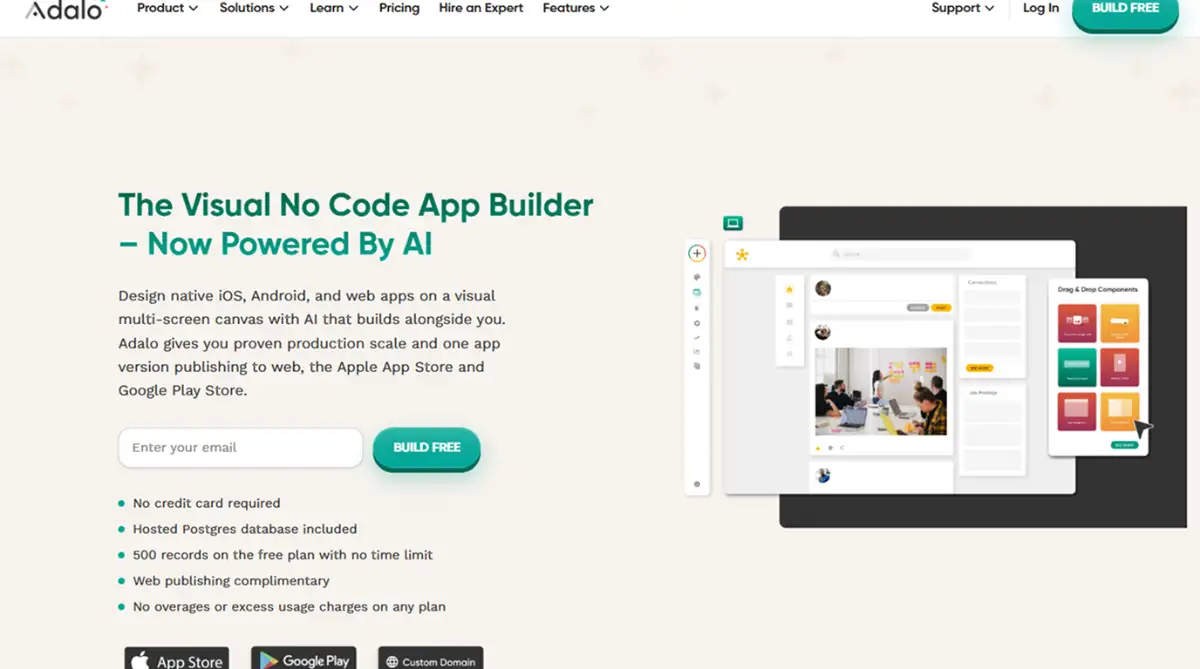
The honest tradeoff: Adalo apps are not as performant as FlutterFlow-generated native apps, and the platform struggles with high-traffic or computationally heavy use cases. For a consumer MVP, a directory app, or a community tool, it is enough. For a venture-funded native product, it is not.
Where Adalo fits:
- Consumer MVPs and validation builds
- Simple community apps, marketplaces, or directories
- Founders who need predictable fixed pricing
- Teams without a developer to pick up exported code
The Adalo pricing page keeps things simple, and this Adalo walkthrough shows a full app build.
You can discover Adalo no code templates and features if you want to speed up your building process.
Decision Framework: which no code builder fits your situation
The right pick depends on three variables: what you're shipping (web app, mobile, marketing site, internal tool), how much code ownership you need, and how predictable your costs have to be. Match your scenario to the table below.
| Your situation | Recommended stack | Why |
|---|---|---|
| Solo founder, full-stack web MVP in under a month | Bubble | One platform, no integration work, deepest logic for a non-coder |
| Funded startup, B2B SaaS targeting 5,000+ users | WeWeb + Xano | Multi-tenancy, Vue.js export, instance-based pricing stays flat under load |
| Mobile-first product, planning native iOS and Android | FlutterFlow | Real Flutter code export, no vendor lock-in, native performance |
| Marketing site or content-led SEO play | Webflow | Pixel-perfect design, semantic HTML, fastest SEO ceiling |
| You already have data in Airtable or Sheets | Softr | Fastest data-to-portal workflow, ready in hours |
| Internal ops tools, 5-20 admin users | Retool | Largest component library, polished UX for non-technical staff |
| Internal tools in regulated industry (health, finance, gov) | ToolJet | Open-source, air-gapped self-hosting, audit logs included |
| Indie hacker validating a mobile concept on a budget | Adalo | Lowest fixed monthly cost, fastest to a working prototype |
Three rules to apply on top of the matrix:
- Pricing predictability beats pricing minimums. A $49 plan that triples during a viral week costs more than a $200 plan that stays flat. If your traffic is unpredictable, prefer per-builder or instance-based pricing over consumption-based or per-end-user models.
- Code export is a board-level decision, not a feature comparison. If your investors care about acquisition optionality, FlutterFlow, WeWeb, ToolJet, and Webflow are the only platforms here that hand you a working codebase on exit.
- Hosted platforms own your uptime. Webflow's recent 16-hour outage and Bubble's DNS incidents are not anomalies, they're the cost of convenience. If 99.99% matters more than ease of use, go self-hosted (ToolJet) or code-exported (FlutterFlow, WeWeb).
Work through these in order: scenario, then pricing model, then code ownership, then uptime tolerance. That sequence narrows eight options to one in about ten minutes.
Start exploring launch-ready no-code templates here!
Key Takeaways
- The right no code builder depends on what you're building, not on which platform has the loudest marketing. Bubble owns full-stack web apps. WeWeb plus Xano owns scalable B2B SaaS. FlutterFlow owns native mobile. Webflow owns marketing sites. Pick by job, not by hype.
- Code export is the single biggest architectural decision you'll make. FlutterFlow, WeWeb, Webflow, and ToolJet all give you something you can take with you. Bubble, Xano, Softr, Adalo, and Retool do not. That tradeoff is worth pricing into year-three planning, not year-one.
- Pricing predictability matters more than pricing minimums. A $49/month plan that triples during a launch week is more expensive than a $200/month plan that stays flat. Read the meter on every platform before you sign.
The maturity of these tools today means the question is no longer "can I build it with no-code?" but "which no-code stack matches my team's three-year plan?" That is a more grown-up question, and the platforms above are mature enough to deserve a grown-up evaluation. Choose deliberately, document your assumptions, and revisit the stack every twelve months. The cost of switching later is real, but it is dramatically lower than the cost of building on the wrong foundation in the first place.
FAQ
What is a no code builder? A no code builder is a visual platform that lets you create functional software, websites, or mobile apps without writing source code. Modern platforms now generate production-grade output and handle databases, authentication, payments, and AI integrations through drag-and-drop interfaces.
Is no-code good enough for production SaaS? Yes, with caveats. Platforms like Bubble, Xano, and FlutterFlow now run apps with thousands of paying users. The limits are usually pricing predictability and code ownership, not technical capability. Pick a stack that matches your scale and exit-strategy assumptions.
How much does a no-code SaaS stack cost monthly? A typical three-person startup running a "Pro" no-code stack lands between $340 and $500 per month. WeWeb plus Xano is around $340 for three seats. FlutterFlow Business with five seats is closer to $490. Add hosting and integrations on top.
Can non-developers actually build apps with these tools? Yes, but the learning curve varies. Softr and Adalo are approachable for non-developers. Bubble and WeWeb expect basic logic comfort. Xano and ToolJet are easier with a backend or API background. Plan for two to six weeks of ramp time depending on your starting point.
Which no-code builder is best for AI-powered apps? Most major platforms now integrate OpenAI, Anthropic, and other model APIs through native components or plugins. Bubble has the most mature plugin ecosystem for AI workflows. Newer entrants like Lovable and Atoms emphasize "vibe coding" where AI scaffolds the full app from a prompt. Match the platform's AI tooling to your specific use case.
Start building without code
Browse thousands of no-code templates for Webflow, Framer, Bubble, Lovable, Replit and more.
Explore Templates