Glide App Builder: Turn Google Sheets Into an App (No Code)
Glide app builder is a no-code platform that converts spreadsheets into Progressive Web Apps without writing code, launched publicly in February 2019 by four former Xamarin and Microsoft engineers. By late 2024 it had reached $3.7 million in ARR while supporting more than 100,000 paying customers across SMB and enterprise accounts. Its core innovation, real-time bidirectional synchronization between a live spreadsheet and a deployed web interface, made custom internal tools accessible to non-technical teams for the first time at scale.
Table of Contents:
- Key Takeaways
- Introduction
- Who Built Glide, and Why Did Four Microsoft Engineers Bet on Spreadsheets?
- How Does the Sheet-to-App Engine Actually Work?
- From Zero to $3.7M ARR: The Growth Story Behind Glide
- The 2024 Pricing Restructuring That Shook the Community
- The AI Pivot: How Glide Stopped Selling Tools and Started Selling Work
- Glide vs. Bubble, FlutterFlow, and Airtable Interfaces
- Honest Tradeoffs: What the Spreadsheet Paradigm Can't Fix
- FAQ
Key Takeaways
- Glide's four co-founders surveyed nearly 100 no-code platforms before launching in 2019, identifying a gap no competitor had closed: the speed of spreadsheet logic combined with production-quality visual design.
- The platform's sheet-native architecture makes it one of the fastest paths from existing data to a deployed app, but introduces hard constraints around row limits, offline functionality, and native App Store distribution.
- A January 2024 pricing restructuring that slashed included user seats triggered widespread community backlash, a case study in how pricing volatility can fracture even a well-regarded no-code platform faster than any product decision.
Introduction
In February 2019, a Hacker News post titled "Mobile Apps from Google Sheets" quietly announced something that operations managers and department heads had been waiting for without fully realizing it. The glide app builder offered a premise no other platform had managed cleanly: if your team's data already lived in a spreadsheet, you could skip the database design, the developer hire, and the months-long IT approval queue.
The platform went on to attract more than 100,000 paying customers and $23.6 million in total funding, not by reinventing the software stack, but by building on top of exactly where most business workflows already lived. This piece traces the platform's origin, the architectural choices that define it, and the controversies that reveal as much about Glide as the growth numbers do.
Who Built Glide, and Why Did Four Microsoft Engineers Bet on Spreadsheets?
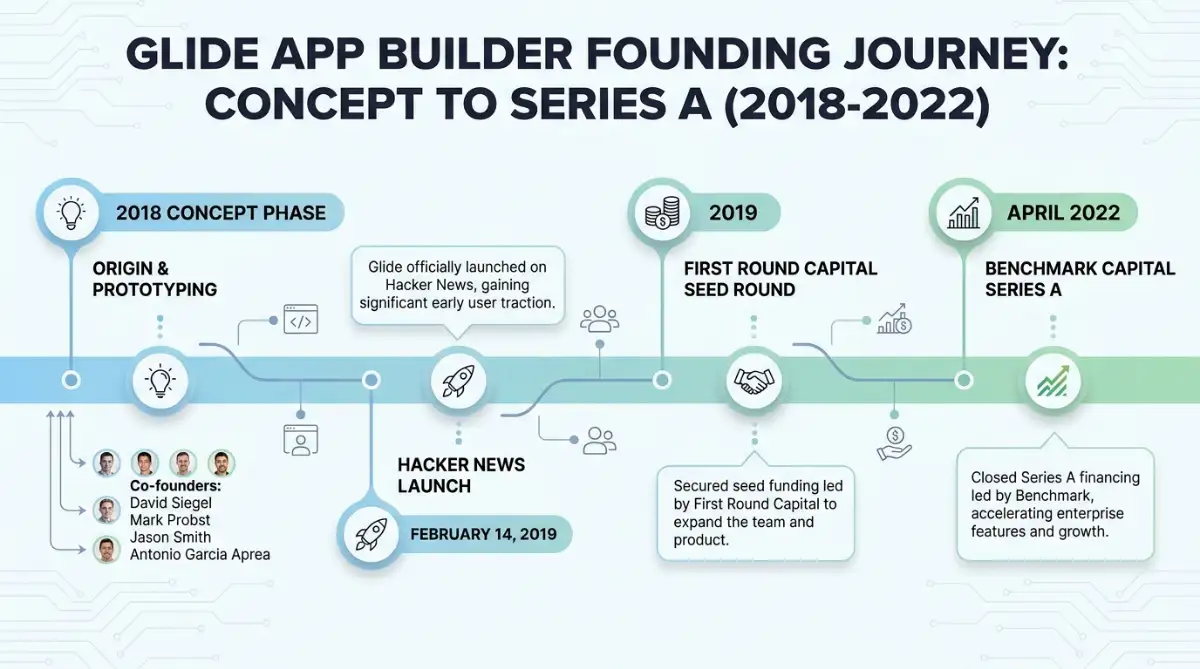
Glide was founded in 2018 by David Siegel, Jason Smith, Mark Probst, and Antonio Garcia Aprea, four engineers who had worked together at Xamarin before Microsoft's $500 million acquisition of the company in 2016, according to AppMaster's founder profile. After surveying nearly 100 existing no-code tools, they concluded that none delivered both same-day deployment and production-quality visual design. That gap was Glide's founding premise.
Siegel holds dual degrees in computer science engineering and philosophy from the University of Pennsylvania and contributed design work to GNOME and Ubuntu before serving as a design lead in Microsoft's Developer Division.
That mix of technical architecture and aesthetic sensibility explains the product's deliberate bet on constrained, opinionated design rather than the open-canvas flexibility favored by competitors like Bubble.
The core insight was structural rather than technical. Operations managers already had their data in spreadsheets; what they lacked was a deployable interface on top of it. Glide's first prototype programmatically parsed Google Sheets column headers and mapped them to mobile UI components with no manual schema work required. According to Glide's Y Combinator company profile, the platform launched publicly on Hacker News on February 14, 2019.
"A spreadsheet is the IDE, the app, and the database at the same time." - David Siegel, Glide CEO, Glide Blog interview, May 2026
Key founding milestones:
- February 14, 2019: Public launch on Hacker News via YC Winter 2019 cohort, positioned as "Mobile Apps from Google Sheets"
- Late 2019: $3.6 million seed round from First Round Capital, enabling form submissions and write-back functionality
- April 2022: $20 million Series A from Benchmark Capital, with GP Sarah Tavel joining the board
The spreadsheet had always functioned as an IDE for business operators. Glide was the first platform to treat that as an engineering directive, not just a metaphor.
How Does the Sheet-to-App Engine Actually Work?
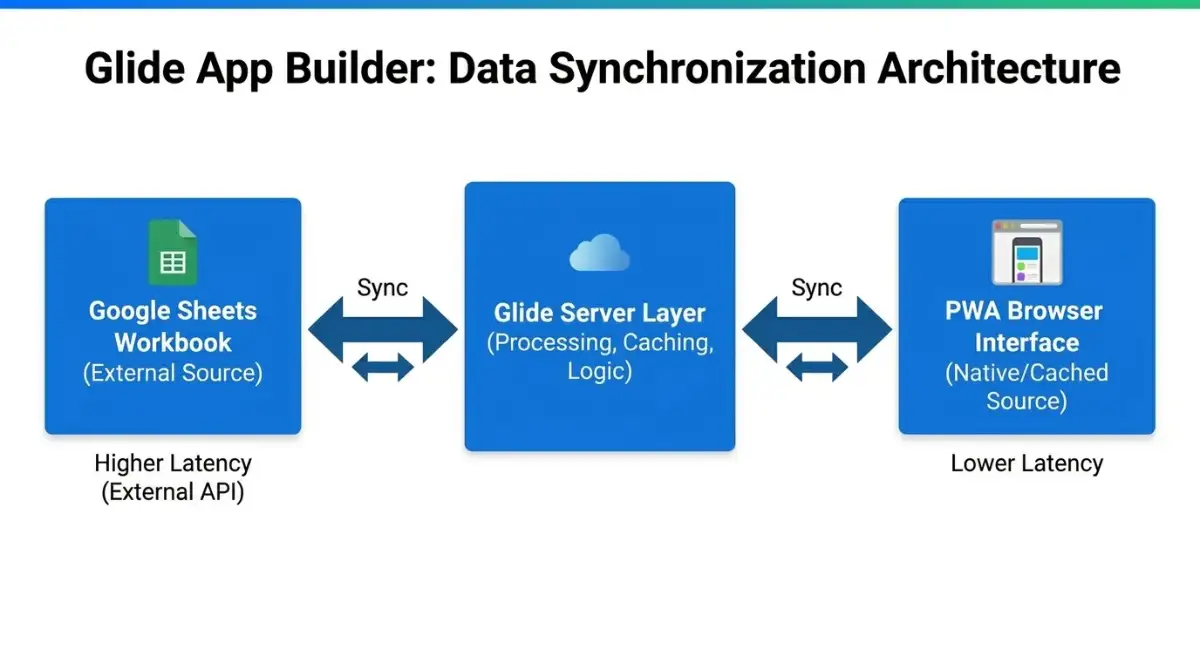
The glide app builder's architecture connects a spreadsheet, an application layer, and a deployed interface in continuous real-time synchronization. When a user binds a Google Sheets workbook, Airtable base, or Microsoft Excel file, Glide parses the column headers automatically, infers data types, and maps them to UI components with no manual schema design required. The output is a Progressive Web App delivered via URL.
The synchronization method relies on self-adjusting computation, which propagates data changes from the underlying spreadsheet to the live interface in under one second for native Glide Tables. External spreadsheets, however, operate on a 10-to-30-second sync latency depending on the external API's response conditions, according to Glide's official documentation and technical analysis by LowCode Agency.
Three architectural constraints matter significantly in practice:
- Glide can only connect to a single Google Workbook per app; additional tables must exist as sheet tabs within that workbook
- Computed columns created inside Glide's Data Editor do not write back to Google Sheets, even though row edits and deletions sync bidirectionally
- The PWA output runs in the device's browser engine (Safari on iOS, Chrome on Android), which means no native App Store listing and no true offline write capability
Glide does not obscure these constraints. It makes them the product. Speed, opinionated design, and browser-based delivery are the architecture, not the tradeoffs.
From Zero to $3.7M ARR: The Growth Story Behind Glide
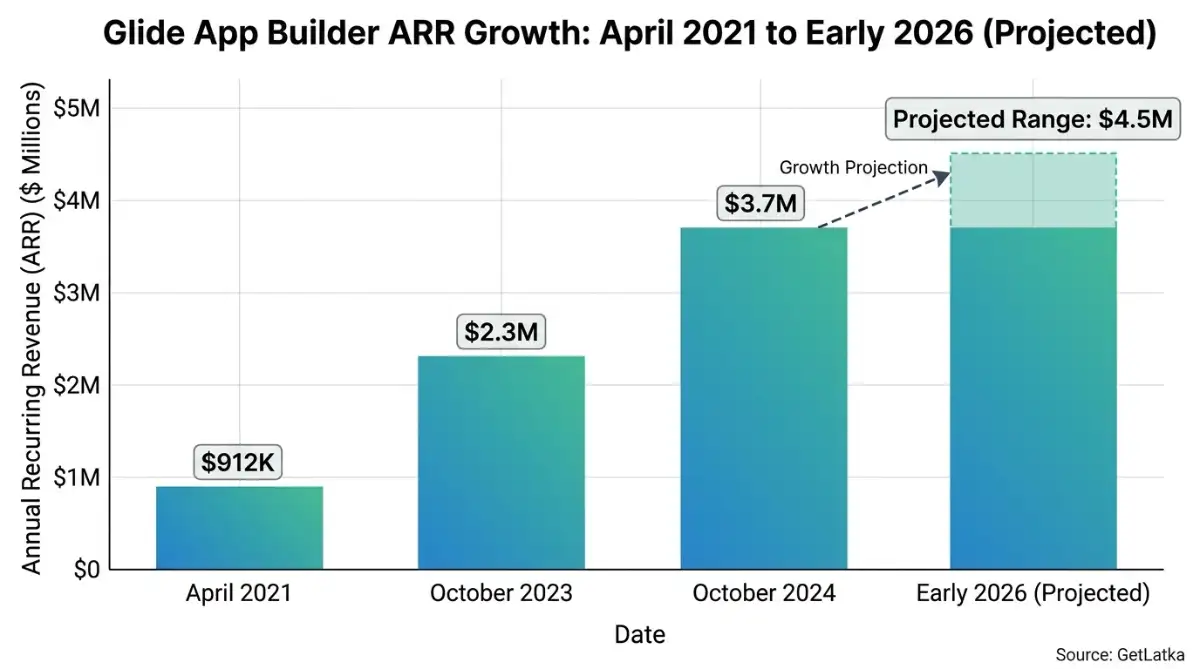
Glide grew from zero to $3.7 million in annual recurring revenue between its 2019 launch and late 2024, according to verified figures from GetLatka and founder interviews. Total funding across two rounds reached $23.6 million: a $3.6 million seed from First Round Capital and a $20 million Series A from Benchmark Capital in April 2022. According to Y Combinator's verified company profile, that capital base supports a team of 46 employees, a unit-economics ratio that most venture-backed software companies cannot match.
According to GetLatka, the ARR trajectory tracked as follows:
- April 2021: $912,000 ARR
- October 2023: $2.3 million ARR
- October 2024: $3.7 million ARR
- Early 2026 projection: $3.7 million to $4.5 million ARR
The customer base skews heavily toward SMBs and independent builders. According to platform statistics, 75% of active users identify as freelancers, solopreneurs, or individual builders, while 65% of total revenue comes from small businesses and startups. Enterprise accounts, including Lowe's, Whirlpool, and Zapier, represent 20% of revenue despite an 85% year-over-year enterprise adoption increase throughout 2025, according to platform statistics.
"Can't we just build this in Glide?" - Liz Elliot, Director at PGA of America, Glide Series A announcement, April 2022
That line from a PGA of America director captures exactly the operational reflex Glide spent its first years building. The unit economics here are worth pausing on. A platform supporting 85,000 corporate clients on under $24 million in total funding is a different kind of SaaS story.
Glide's capital efficiency is a direct product of the SMB flywheel: low setup friction drives high adoption, which drives word-of-mouth, which reduces customer acquisition cost.
The 2024 Pricing Restructuring That Shook the Community
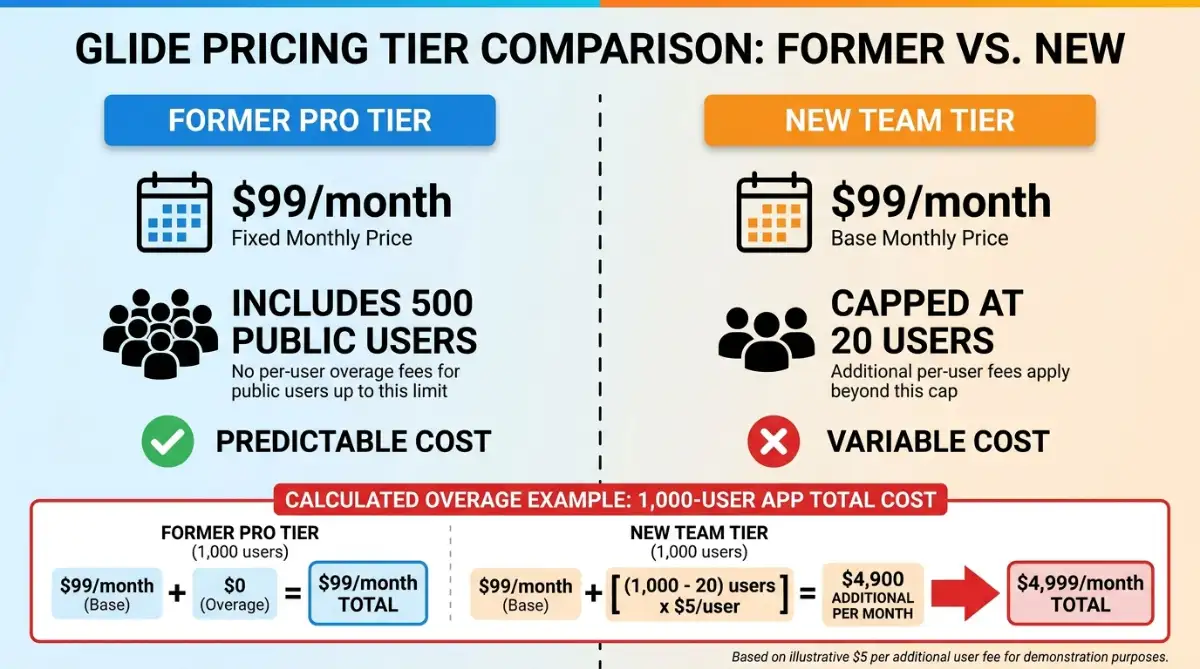
On January 17, 2024, Glide deprecated its "Pro" tier, which had included up to 500 public users for $99 per month, replacing it with a "Team" tier at the same price but capped at only 20 users. For operations managers and freelance builders running public-facing apps, the math turned severe almost overnight. According to a cost analysis by No Code MBA, a public app with 1,000 active monthly users on the Team plan faced the following calculation:
980 additional users × $5 per user per month = $4,900 in added monthly charges on top of the base plan fee.
The backlash played out publicly and in detail. Community threads on Glide's official forums and Reddit's r/glideapps documented a lack of advance notice, no grandfathering for existing plans, and no clear migration path for builders whose apps had grown beyond the new caps. According to community.glideapps.com forum records, the pricing page changed multiple times without official announcement, which deepened the frustration.
Three things the restructuring made visible:
- Public consumer apps are a fundamentally poor fit for Glide's pricing model once user counts grow unpredictably
- The gap between "great tool for internal teams" and "viable platform for public products" is wider than early marketing implied
- Pricing volatility is a structural risk on any opinionated no-code platform, but Glide demonstrated it more dramatically than most
A product can go from exceptional value to unworkable expense in a single pricing update, with no migration path and no warning. The 2024 restructuring is the clearest example of that dynamic in the modern no-code market.
The AI Pivot: How Glide Stopped Selling Tools and Started Selling Work
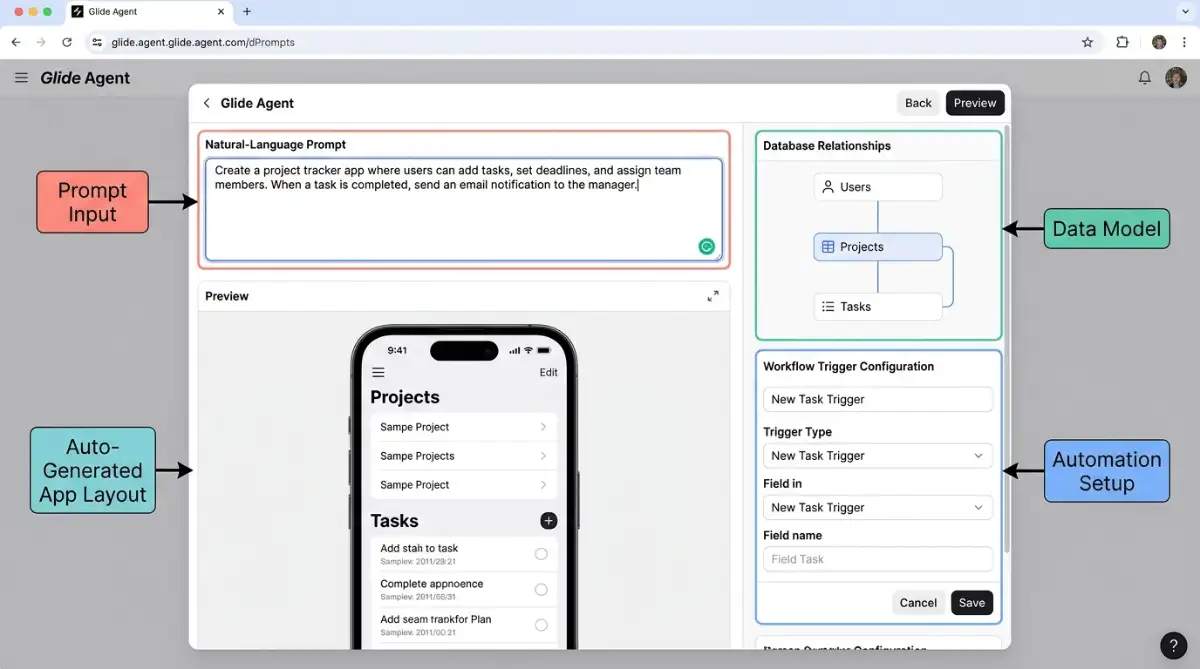
Between mid-2025 and early 2026, Glide repositioned from a visual no-code app builder into what it calls an "AI-first business process automation platform." The centerpiece is the Glide Agent, an LLM-powered tool that takes a natural-language description of an operational workflow and automatically assembles the interface, database structure, and backend triggers. For operations teams tracking the broader low-code/no-code market, this represents the spreadsheet-to-app premise carried to its logical end.
The 2025 feature rollout included three structural additions:
- January 2025: Workflows engine launched out of beta, supporting loops, webhooks, and scheduled triggers, putting Glide in direct competition with Zapier and Microsoft Power Automate
- 2025: Bidirectional enterprise sync added for Salesforce, QuickBooks, and HubSpot, allowing teams to build custom frontends on top of corporate record systems without full CRM seat licensing
- 2025-2026: Native AI Agents and the Glide Agent released, enabling natural-language app generation for non-technical operations teams
The intellectual frame behind this shift comes from Benchmark General Partner Sarah Tavel, who articulated it in a February 2024 World of DaaS podcast appearance:
"The idea with selling work is that you're getting out of that mental model of selling a 10% productivity improvement." - Sarah Tavel, Benchmark Capital GP, World of DaaS Podcast, February 2024
Glide is no longer building a faster way to create apps. It is building a platform that runs portions of a business's operations while the team focuses elsewhere. That is a meaningfully different product, even if the spreadsheet sits at the center of both.
Glide vs. Bubble, FlutterFlow, and Airtable Interfaces
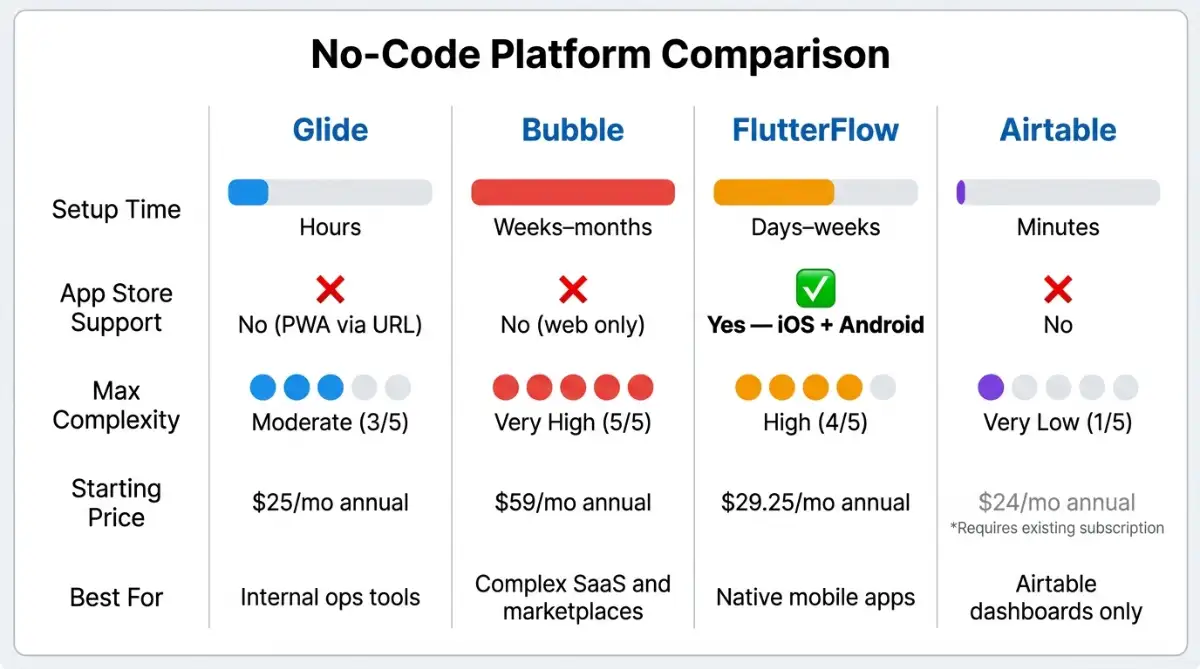
The glide app builder occupies a specific position in the no-code landscape: fastest to deploy, most constrained on flexibility, and optimized for internal tools rather than public consumer products. Which platform fits depends almost entirely on what the app needs to do after it is built.
| Platform | Setup Speed | App Store Support | Architectural Ceiling | Starting Price |
|---|---|---|---|---|
| Glide | Very High | No (PWA only) | Moderate | $25/mo (annual) |
| Bubble | Low | No (Web only) | Very High | $59/mo (annual) |
| FlutterFlow | Moderate | Yes (iOS + Android) | High | $29.25/mo (annual) |
| Airtable | Very High | No | Very Low | $24/mo (annual) |
Glide wins on setup speed, and it is not close. An operations manager who already has a Google Sheet can have a working internal app running the same day. Bubble, by contrast, requires learning a visual programming environment that takes weeks to become genuinely productive in. I've watched capable teams spend a month inside Bubble's interface just to reach a functional MVP.
FlutterFlow is the right platform when native App Store distribution is the goal. It compiles directly to clean Dart code and deploys to both iOS and Android. For teams building consumer mobile products that need organic discovery via the App Store, Glide's PWA output is simply not an option.
Airtable Interfaces are competitive for teams who already live inside Airtable's ecosystem, but they offer minimal customization outside it. The ceiling is low by design.
Choosing a no-code platform is a bet on a ceiling, not a floor. Glide's floor is the lowest barrier in the category. Its ceiling arrives earlier than most teams anticipate.
Honest Tradeoffs: What the Spreadsheet Paradigm Can't Fix
The spreadsheet-as-IDE model is genuinely powerful and genuinely limited in ways that do not surface until a team is already committed.
The most significant constraint is vendor lock-in at the logic layer. Raw data can be exported as a CSV in seconds, but computed columns, workflow automations, and AI-generated layouts all execute inside Glide's proprietary engine. Migrating to another platform means rebuilding the application logic from scratch, not porting it. That is a rebuild, not a migration.
The row cap hits later and harder than the documentation suggests. Standard spreadsheet-connected apps are capped at 25,000 rows, and in early 2026, Glide began strictly enforcing that ceiling. According to community forum records on community.glideapps.com, apps exceeding the limit began displaying persistent warning popups to end users and experienced significant load delays. Migrating to Big Tables, Glide's 10-million-row enterprise database, is not a clean path upward; it breaks existing relational schemas, according to developer reports on Reddit's r/glideapps.
Pricing volatility is a third structural risk. The January 2024 restructuring showed that a no-code platform can shift from excellent value to unworkable expense without warning. Organizations scaling on any opinionated platform must factor in the possibility that costs will change as the product moves upmarket toward enterprise targets.
Finally, offline functionality is limited by design rather than oversight. Form submissions, data writes, and workflow triggers all require an active internet connection, making Glide a poor fit for field operations in remote or low-connectivity environments. That is worth knowing before committing to the platform in any context where connectivity is unreliable.
Start exploring launch-ready no-code templates here!
FAQ
Is Glide good for public-facing consumer apps with thousands of users? It can technically serve public apps, but the pricing model creates real exposure at scale. The Team plan includes only 20 users; each additional user costs $5 per month, meaning a 1,000-user public app adds approximately $4,900 in monthly charges above the base plan fee, according to No Code MBA's cost analysis.
Can Glide apps be published to the Apple App Store or Google Play? No, not natively. Glide builds Progressive Web Apps delivered via URL, not native binaries. Third-party wrapping tools such as Median.co exist as workarounds, but these are officially unsupported by Glide and add technical complexity the platform does not maintain or document.
What is the difference between Glide Tables and Big Tables? Glide Tables are the standard native database, capped at 25,000 rows per app and suited for most internal tool use cases. Big Tables scale to 10 million rows per app but have limited relational operation support, including a cap of 100 matching rows on multi-relation lookups, according to Glide's official Big Tables documentation.
How does Glide compare to Bubble for building complex SaaS apps? Bubble offers a Turing-complete visual programming environment with uncapped relational data, making it far more capable for complex SaaS products or commercial web marketplaces. Glide trades that architectural depth for extreme setup speed and opinionated design templates. Bubble takes weeks to learn productively; Glide can produce something functional in hours.
Does Glide work offline? Only partially. Cached data may be viewable offline in some circumstances, but form submissions, data writes, and workflow triggers all require an active internet connection. This makes Glide poorly suited for field operations teams working in remote or low-connectivity environments, which is a design constraint rather than a bug.
Start building without code
Browse thousands of no-code templates for Webflow, Framer, Bubble, Lovable, Replit and more.
Explore Templates