Bubble (2012): First True Visual Builder for Founders
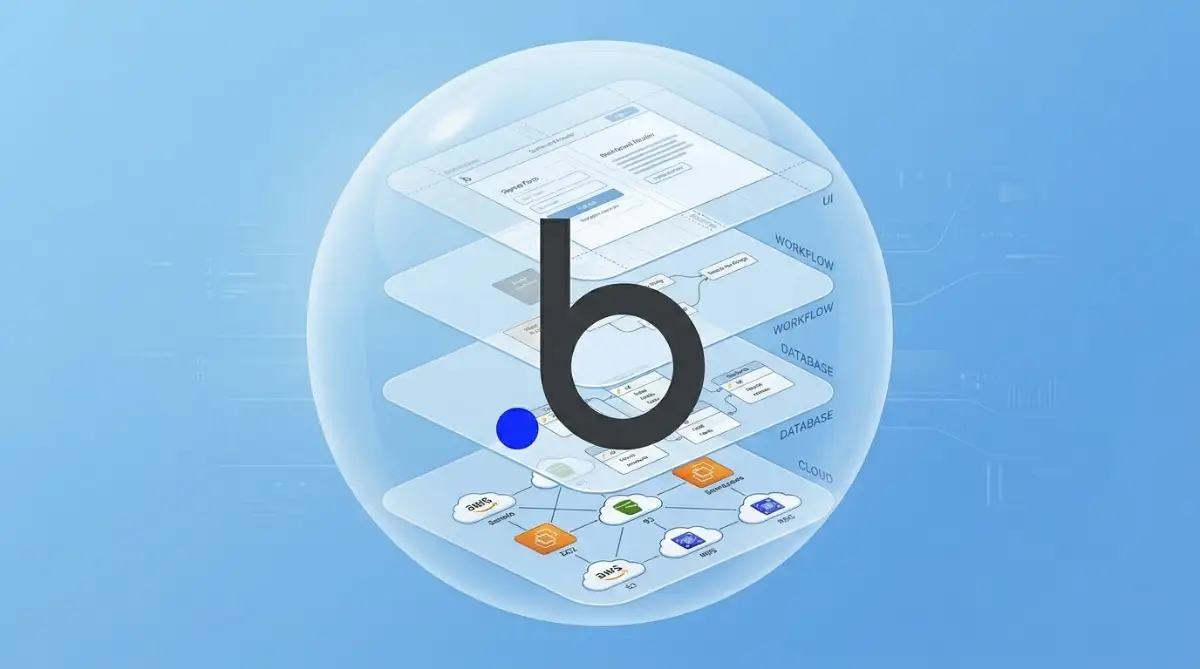
Bubble launched in 2012 as the first full-stack visual programming language, letting non-developers build complete web applications through a drag-and-drop interface backed by a relational database and workflow engine. Founded by Joshua Haas and Emmanuel Straschnov, it bootstrapped for seven years before raising $100M Series A in 2021.
Table of Contents
- The Coffee-Shop Origin Story Most People Miss
- What "True Visual Programming" Actually Means
- The Numbers Behind a Platform Most People Underestimate
- Why It Mattered for No-Code History
- The Parts Founders Don't Talk About Enough
- Key Takeaways
- FAQ
Introduction
When Joshua Haas and Emmanuel Straschnov shipped Bubble in 2012, the no-code idea wasn't new. Geocities had let people drag images around in 1994. Microsoft FrontPage was teaching teenagers HTML by accident in 1997. What Bubble did differently mattered to one specific group: non-technical startup founders who wanted to build software businesses, not just websites.
I've watched founders bounce between five different builders before landing on Bubble, and the reason is almost always the same. Most "no-code" tools generate code underneath. Bubble doesn't. The visual elements are the program.
That single architectural choice is why this no code app builder still anchors the conversation more than a decade later. This piece traces how that happened, what it cost, and what it broke along the way.
The Coffee-Shop Origin Story Most People Miss
Bubble started in 2012 when Harvard philosophy grad Joshua Haas teamed up with École Polytechnique-trained Emmanuel Straschnov to solve a bottleneck: too many people wanted to build software businesses, too few could write code. They met through CoFoundersLab, had coffee on a Thursday, and Straschnov turned down a competing job offer by Friday.
The detail that gets glossed over is the seven-year bootstrap. From 2012 to 2019, both founders ran the company out of New York coffee shops and WeWork desks, funded entirely by customer revenue. No seed round. No press tour.
The first viral moment came in September 2015, when Straschnov published a guide showing how to clone Twitter's core features in Bubble without writing code.
A rough timeline of how the company actually grew:
| Era | Period | What Happened |
|---|---|---|
| Bootstrapping | 2012–2019 | Core visual engine built on customer revenue alone |
| Seed | June 2019 | $6.25M raised, led by SignalFire, with Warby Parker and Allbirds founders participating |
| Series A | July 2021 | $100M led by Insight Partners; recognized by Fast Company that same year |
| Pricing pivot | April 2023 | Switched to usage-based Workload Units, sparking community revolt |
| AI and mobile | 2024–2025 | Acquired security firm Flusk; launched native mobile development |
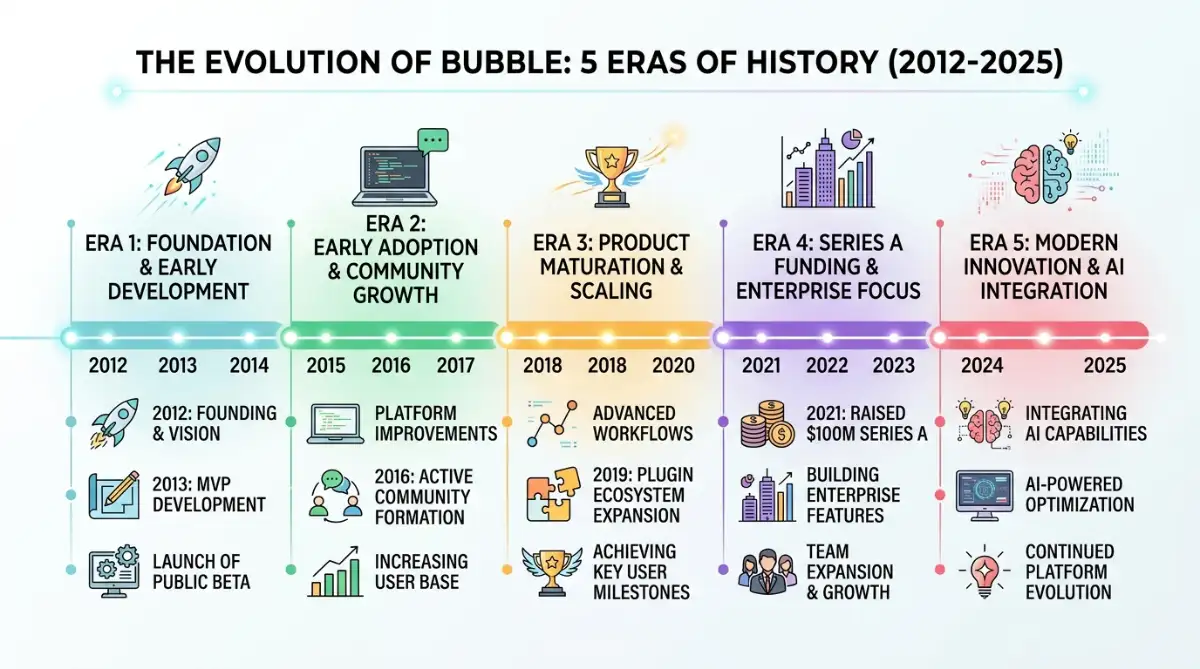
The bootstrap period is the part that's worth studying. It forced Bubble to build a product non-developers actually paid for, rather than a product that looked impressive in a pitch deck. That's a structural difference from most platforms in the history of no-code builders.
What "True Visual Programming" Actually Means
A true visual programming language treats visual elements as the program itself, not as a pretty front-end for hidden text-based code. Most platforms labeled "no-code" generate JavaScript, HTML, or proprietary scripts underneath. Bubble interprets the visual canvas directly, which is the technical claim its whole architecture rests on.
The editor splits into four working areas:
- Design: drag-and-drop UI with a flexbox-based responsive engine
- Workflows: event-driven logic that runs client-side or server-side
- Data: relational database with custom types, fields, and server-side privacy rules
- Plugins: API connectors for REST, GraphQL, and SQL sources
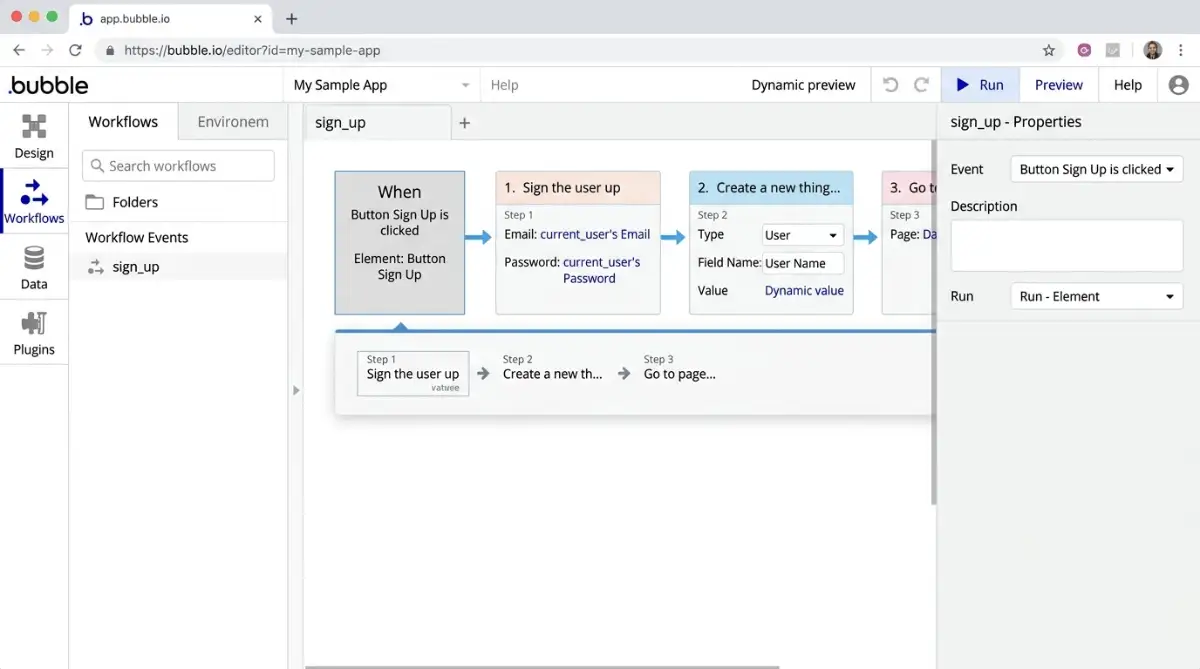
Workflows follow a simple grammar: "When [Event] occurs → Do [Action]." That logic can fire in the browser for instant UI feedback, or on the server for things like Stripe payments and bulk data jobs. The database lives on AWS, content runs through Cloudflare, and Privacy Rules act as server-side constraints rather than client-side suggestions.
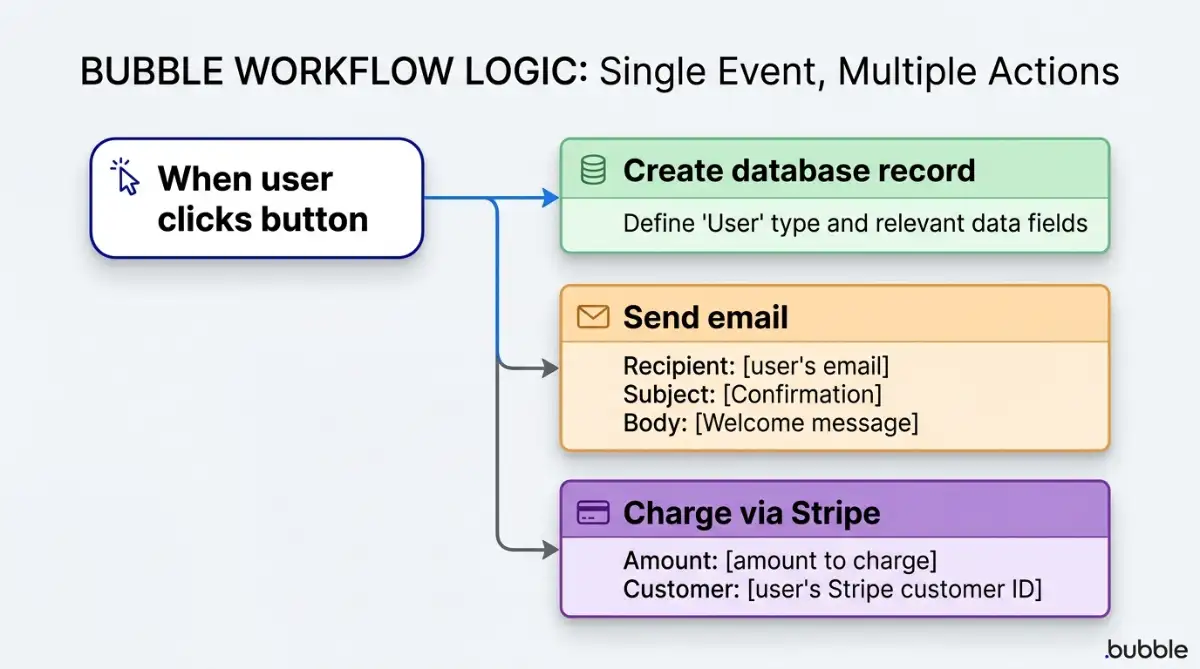
The tradeoff is real and worth naming. Because Bubble doesn't compile to code you can take with you, leaving the platform means rebuilding from scratch. That's the philosophical opposite of how earlier WYSIWYG tools worked.
If you've read about why spaghetti code killed early WYSIWYG builders, Bubble's answer is to skip the messy intermediate output entirely. Cleaner in theory. More locked in by design.
The Numbers Behind a Platform Most People Underestimate
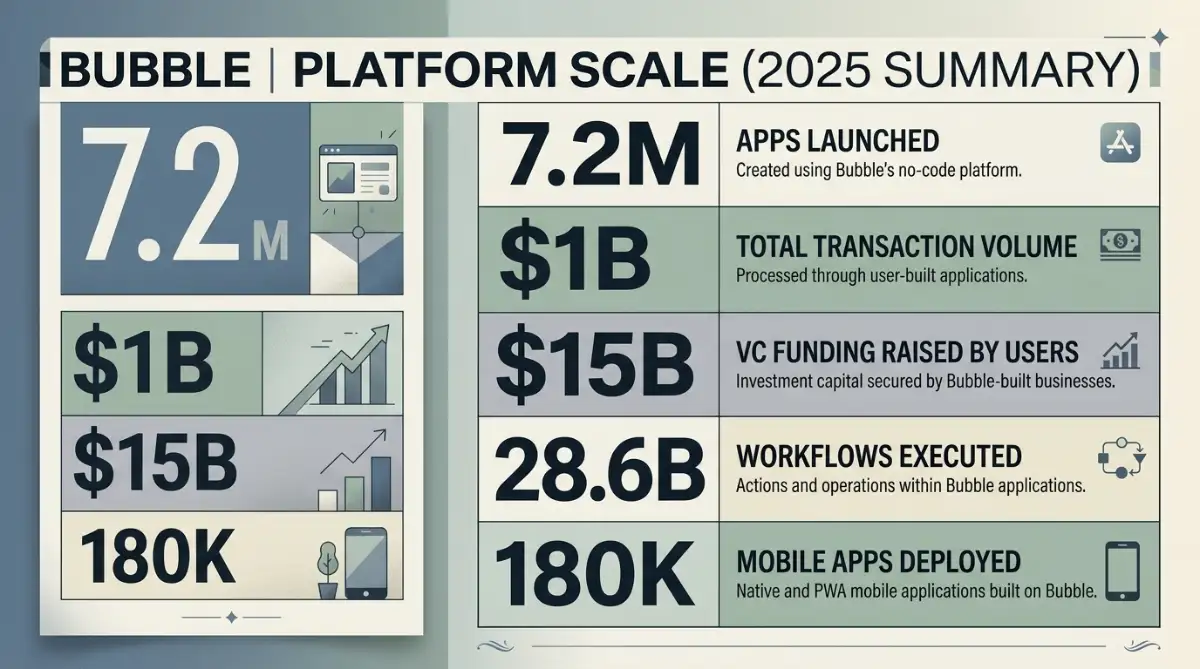
By the end of 2025, Bubble had become the largest full-stack no code app builder by application volume, with 7.2 million launched apps and over $1 billion in annual transaction volume processed through user-built applications. The economic footprint is bigger than the press coverage suggests.
According to Bubble's own 2025 State of Visual Development research, 87.6% of builders successfully completed projects they could not have built using traditional code, and 32.5% reported being 10x faster than they would have been writing code manually.
Some operational numbers worth pinning down:
- 28.6 billion workflows executed across the platform in 2025
- $15 billion cumulative venture capital raised by Bubble-built startups
- 180,000+ native mobile apps created since the June 2025 launch
- 508 employees on staff heading into the platform's next growth phase
- 30–35% estimated annual user growth rate
The cost-savings data is the part that matters for solo operators. Bubble reports that 27.4% of users save $10,000 to $50,000 annually compared to hiring engineers, and 21.7% save between $50,000 and $250,000. A small but meaningful 2.6% save over $1 million per year. Those numbers come from self-reported survey data, so take them as directionally honest rather than audited.
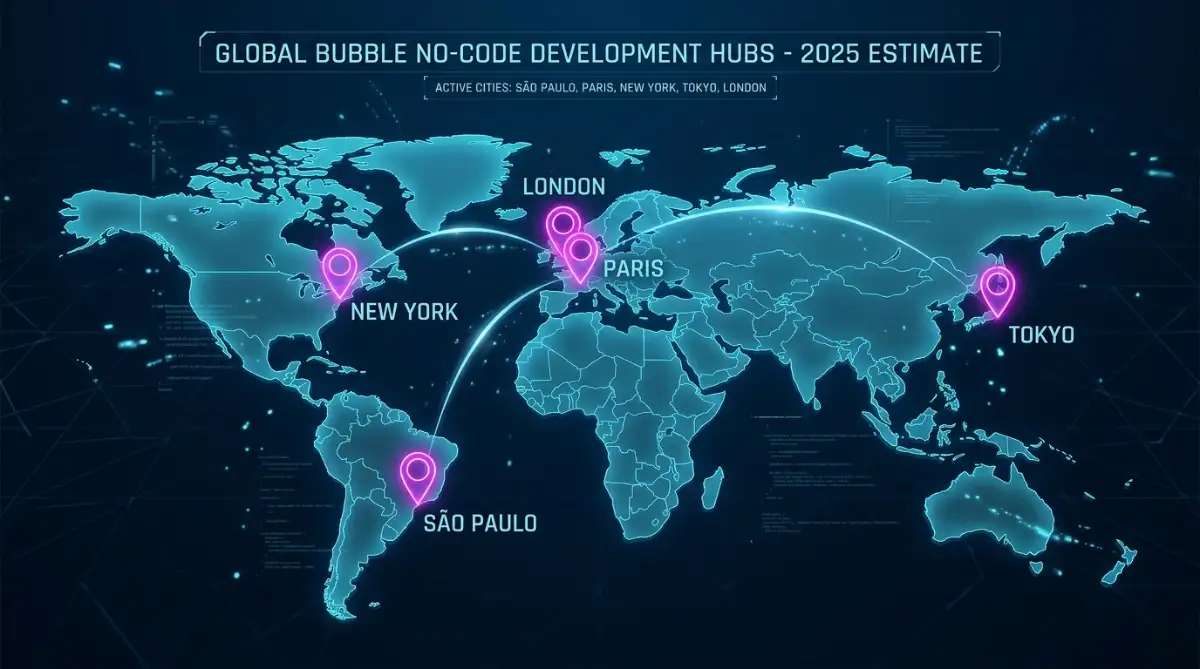
Geography is the surprise. According to Bubble's 2025 wrap-up, the most active cities for building on the platform were São Paulo, Paris, New York, Tokyo, and London. The center of gravity isn't Silicon Valley.
Why It Mattered for No-Code History
Bubble shifted what "no-code" meant. Before 2012, the category was dominated by site builders. After Bubble, the conversation included full applications: marketplaces, SaaS products, internal tools, CRMs. That redefinition expanded the addressable problem and changed what non-technical founders could plausibly attempt.
The lineage runs through some predictable ancestors. Microsoft FrontPage taught a generation that you could ship a web page without HTML. Macromedia and Adobe Flash showed that motion and interactivity could come from a timeline rather than a script.
WordPress arrived in 2003 and made content management feel routine. Shopify made e-commerce democratic for non-developers, and Wix took drag-and-drop mainstream. Bubble's contribution was making logic itself visual.
The other 2012 milestone matters here too. Zapier launched the same year and gave the world visual automation between SaaS tools. Together, Bubble and Zapier formed the spine of what the industry now calls the no-code stack:
- Bubble handled the application layer (interface, database, logic)
- Zapier handled the integration layer (moving data between services)
- Later platforms like Webflow added pixel-perfect design
- Later still, Airtable added the spreadsheet-as-database pattern
According to TechCrunch's coverage of Bubble's 2021 Series A, Insight Partners viewed Bubble as infrastructure for an emerging category, not a single product. Straschnov has gone further publicly, predicting that traditional text-based programming will be largely obsolete within fifty years.
I'll be honest: I think the fifty-year prediction is over-confident. Visual development will keep gaining share, but text remains the most precise way to specify behavior, and "no-code replaces all code" has been predicted since the 1980s. What's defensible is the narrower claim that visual platforms will handle most application-layer work most of the time. Bubble proved that's already true for a meaningful slice of the market.
The Parts Founders Don't Talk About Enough
Bubble's biggest controversies aren't bugs. They're consequences of its architectural choices, and any honest assessment of a no code app builder has to sit with the uncomfortable parts.
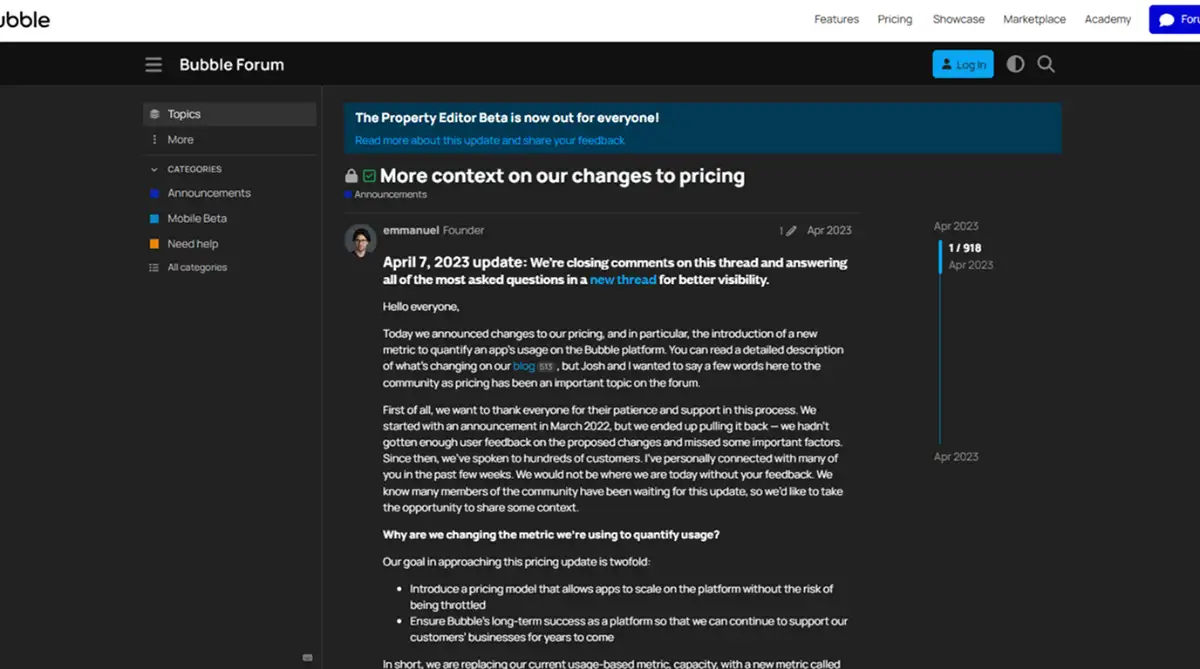
The 2023 Workload Unit pricing change is the obvious one. When Bubble shifted from server-capacity pricing to usage-based Workload Units in April 2023, the announcement thread on the Bubble forum drew over 2,000 replies, with many users reporting projected cost increases of 2x to 10x. Straschnov publicly acknowledged receiving personal death threats during the peak of the backlash, according to coverage by Momentum Group.
Bubble eventually revised the WU weights, making key activities 50% to 99% cheaper than originally proposed, and grandfathered existing users on legacy plans through October 2024. The episode revealed something structural: when your customers can't take their code and leave, pricing changes feel like rent hikes, not menu updates.
Then there's the technical ceiling. Bubble is bad at real-time multiplayer features, anything requiring 60fps animation, heavy data processing on massive datasets, and direct native hardware access on mobile. According to AlterSquare's analysis on the $10K wake-up call, apps tend to hit a point where unoptimized Workload Unit costs start eating margin.
The August 2024 outage postmortem made a different ceiling visible: AWS forced an upgrade to a deprecated database version that broke Bubble's code, causing roughly three hours of editor downtime and a two-hour data loss window. That's not Bubble's fault exactly, but it's a reminder that platform abstraction comes with platform dependency.
The vendor lock-in question is the one I'd weight heaviest. Bubble doesn't allow source code export. If you outgrow the platform, you rebuild from scratch, which industry estimates put at $50,000 to $250,000 for a complex application.
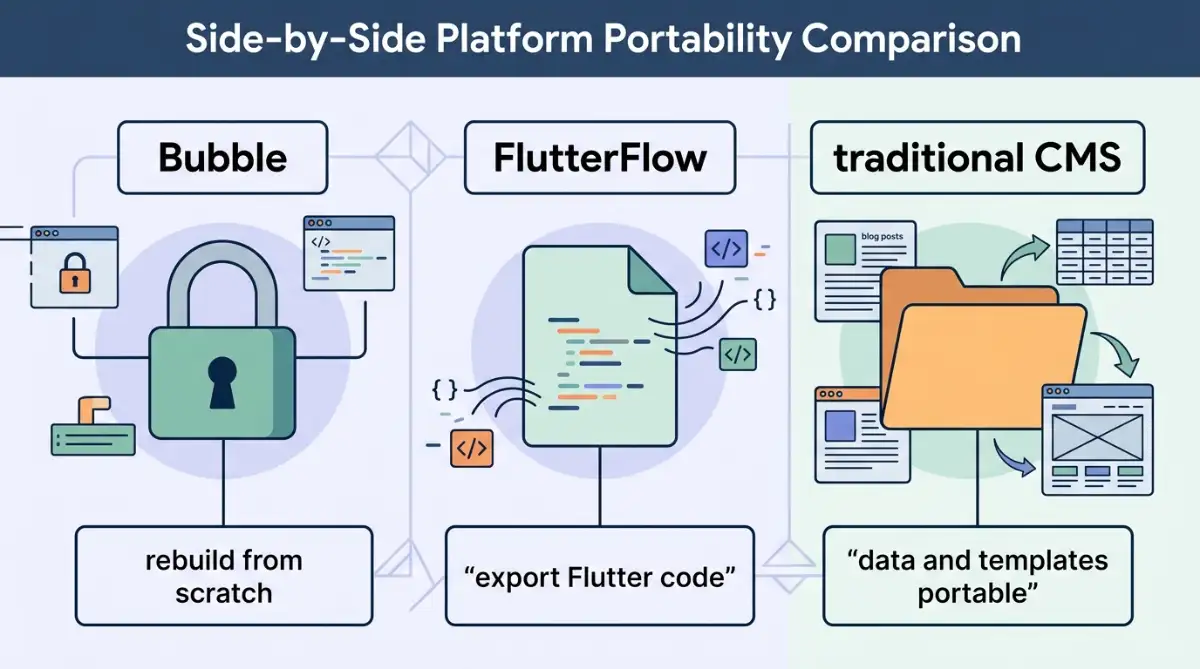
Compare that to FlutterFlow, which exports clean Flutter code, or even old-school CMSes like the ones in the 20-year Joomla vs Drupal battle, where your data and templates were always portable. Bubble's bet is that the value of the platform exceeds the value of portability. For most users, that bet pays off. For some, it won't.
Start exploring launch-ready no-code templates here!
Key Takeaways
-
Bubble's 2012 architectural choice still defines the category. Treating visual elements as the program itself, rather than as a wrapper around generated code, is what separates a true visual programming language from a fancier site builder. Every "no-code vs low-code" debate since 2012 has been a footnote to that distinction.
-
The seven-year bootstrap built a different kind of product. Bubble had to be useful enough that strangers paid for it before investors paid for it. That's why the platform handles logic-heavy applications better than competitors that optimized for demo-friendliness first.
-
Lock-in is the price of integration. Bubble's database, workflows, and UI all live inside the same proprietary runtime. That's why it works as smoothly as it does, and also why leaving costs real money. Pretending otherwise does founders a disservice.
Bubble matters because it forced an honest question: do you want code or do you want software? For the last fourteen years, an increasing number of non-technical founders have decided they wanted software, and were willing to accept a proprietary runtime to get there faster. That's not a feature comparison. It's a worldview shift, and Bubble is the platform that made it commercially obvious.
FAQ
What is Bubble used for? Bubble is used to build full web and mobile applications without writing code, including SaaS products, marketplaces, internal tools, CRMs, and MVPs. It handles interface design, database storage, and business logic in one platform, making it suitable for production apps rather than just landing pages.
Is Bubble actually free to use? Bubble offers a free tier for learning and prototyping, but apps deployed on a custom domain require a paid plan starting around $32 per month. Pricing scales with Workload Units, which measure computational usage, so monthly costs grow alongside app traffic and complexity.
Can you export your code from Bubble? No. Bubble does not support exporting source code, which is one of its most-discussed limitations. Apps run on Bubble's proprietary cloud infrastructure, so leaving the platform requires rebuilding the application from scratch in another framework or codebase.
How does Bubble compare to Webflow? Webflow focuses on pixel-perfect design and CMS-driven websites, while Bubble handles full application logic, relational databases, and user authentication. Designers tend to prefer Webflow for marketing sites; founders building functional SaaS products tend to prefer Bubble for its backend depth.
Is Bubble good for beginners? Bubble has a steeper learning curve than typical website builders because it teaches logic concepts like workflows, conditionals, and relational data. Beginners can build their first app in a weekend, but mastering complex features typically takes a few weeks of consistent practice and tutorial work.
Start building without code
Browse thousands of no-code templates for Webflow, Framer, Bubble, Lovable, Replit and more.
Explore Templates