Who Owns FlutterFlow? Founders, History, and the Google Link

FlutterFlow is a visual mobile IDE founded in 2020 by former Google engineers Abel Mengistu and Alex Greaves that compiles drag-and-drop layouts directly into clean, exportable Flutter (Dart) source code. Unlike most no-code builders, it produces native iOS (.ipa) and Android (.aab) binaries that meet Apple App Store and Google Play submission requirements. Backed by GV (Google Ventures) as its largest institutional investor, the platform reported $25.2 million ARR and 1.5 million users by early 2026 while remaining an independent private company.
Table of Contents:
- Key Takeaways
- Introduction
- How Did a Failed Food App Become FlutterFlow?
- How Does FlutterFlow's Visual Compilation Engine Actually Work?
- FlutterFlow by the Numbers: Revenue, Users, and Market Position
- Where Does FlutterFlow Sit Against Bubble, Adalo, and Draftbit?
- Honest Tradeoffs: Where FlutterFlow Falls Short in Production
- What Does Google's Deep Partnership Mean for FlutterFlow Developers?
- FAQ
Key Takeaways
- FlutterFlow was born from a failed pandemic-era food startup, pivoting to solve the exact problem that sank it: time wasted on repetitive infrastructure setup instead of building the actual product.
- Unlike no-code tools that trap you inside proprietary runtimes, FlutterFlow compiles visually built layouts into real, exportable Flutter (Dart) source code, giving developers an exit ramp if they outgrow the platform.
- Google Ventures led FlutterFlow's $25.5M Series A and is a major shareholder, while a deep 2025 partnership with Google Cloud has aligned the product roadmap with Firebase and Gemini — raising real questions about long-term neutrality for non-Google backends.
Introduction
Most no-code tools top out somewhere around functional prototype, but FlutterFlow broke through that ceiling. For mobile-first startup founders and indie product builders trying to ship a real iOS or Android app without a full engineering team, it was the first visual builder that could produce binaries Apple and Google would actually accept. Founded in Mountain View in 2020 by two former Google engineers who watched their own startup fail during COVID-19, the platform grew from a $125,000 Y Combinator pre-seed into a $170 million-valued company backed by Google Ventures. This is the full story of how that happened and what it means for anyone building apps today.
How Did a Failed Food App Become FlutterFlow?
FlutterFlow was not designed in a conference room. It was reverse-engineered from failure. Its founders spent more time configuring backend routing, state management, and cross-platform layouts for their COVID-era food app than building the actual product. When that startup collapsed, that frustration became a design brief for everything FlutterFlow would eventually solve.
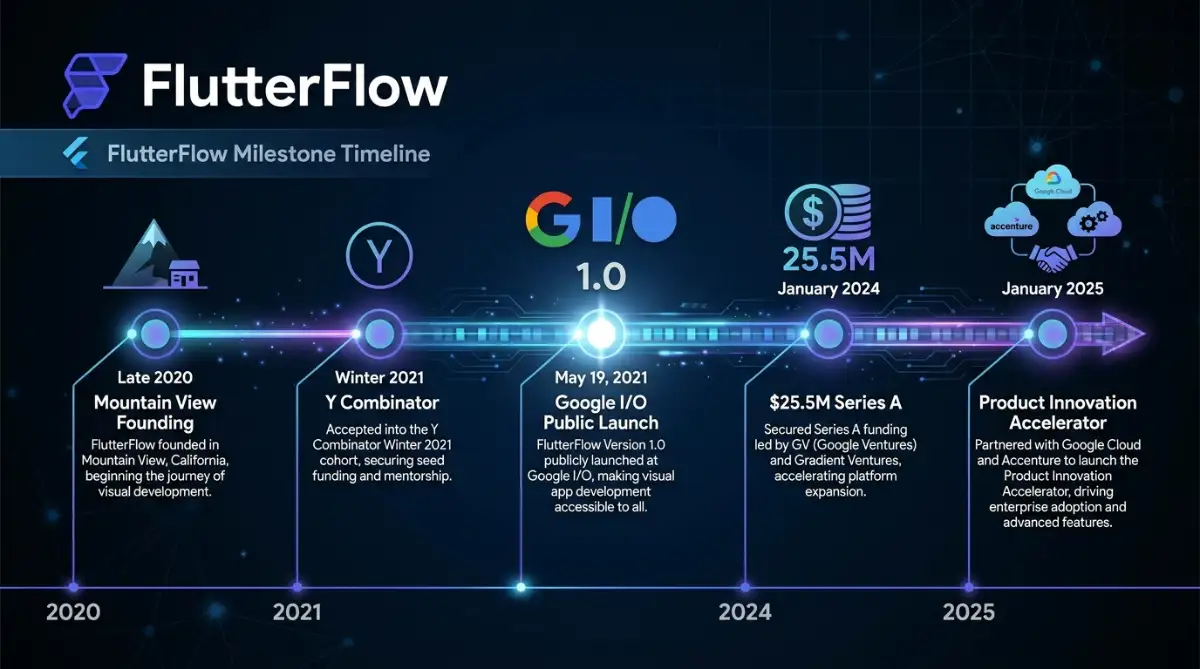
Abel Mengistu and Alex Greaves met while working as senior software engineers on the Google Maps team (Source: StartupIntros Profile, 2026). After leaving Google, they built a culinary recommendation app designed to match consumers with local restaurants (Source: AppMaster News, January 2024). COVID-19 killed the startup before it found traction (Source: AppMaster News, January 2024). What the founders kept from the failure was a precise diagnosis: mobile development velocity was systematically bottlenecked by repetitive frontend and database configuration, not by the quality of the product idea itself (Source: AppMaster News, January 2024).
FlutterFlow was built to solve the exact problem that killed its founders' previous startup, and that origin story is the platform's most defensible product decision.
They pivoted to building a visual IDE that automated Flutter layout generation while preserving developer code ownership (Source: Business Model Canvas Template Blog, Early 2026). The company joined Y Combinator's Winter 2021 cohort, collecting a $125,000 pre-seed investment, then launched Version 1.0 at Google I/O on May 19, 2021, with one defining design choice: developers could export their raw Dart source code at any stage (Source: The Droids on Roids Blog, January 2025). Early pre-seed and seed rounds ranged from $500,000 to $3 million from strategic angel investors and developer-tool funds (Source: Business Model Canvas Template Blog, Early 2026).
The major inflection point came in January 2024, when GV, Gradient Ventures, Xoogler Ventures, and Y Combinator co-led a $25.5 million Series A that valued the platform at approximately $170 million post-money (Source: Preqin Asset Profile, January 2024). GV's participation in the Series A made Google Ventures one of FlutterFlow's largest institutional shareholders, and a January 2025 strategic partnership with Google Cloud and Accenture formalized the product alignment — while the company has remained independently operated.
How Does FlutterFlow's Visual Compilation Engine Actually Work?
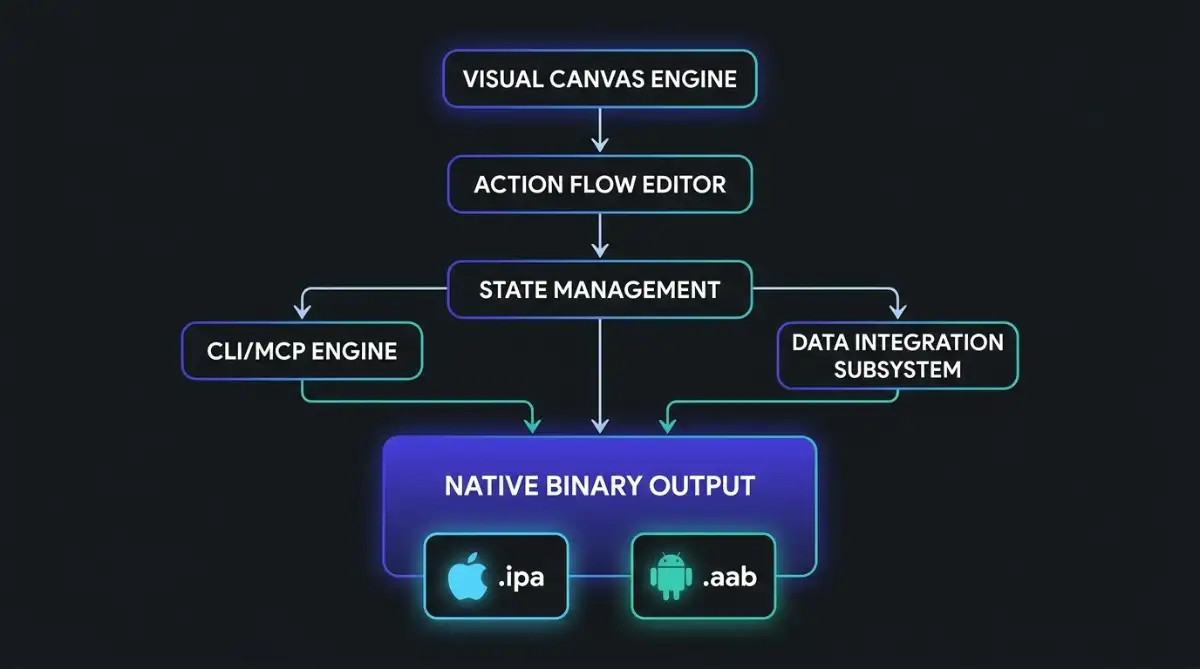
FlutterFlow is not a template wrapper or a web-view builder. It translates visual component configurations into clean Dart widgets compiled by Google's native Flutter engine, producing real native binaries rather than pseudo-native approximations. That single architectural fact is what separates it from almost every other visual app builder on the market.
Most cross-platform app frameworks, including Cordova and Capacitor, wrap web views inside a native shell (Source: Kreante Blog, May 2026). FlutterFlow compiles directly to machine code. The rendered app runs through Flutter's Skia and Impeller graphics engines, maintaining native scroll gestures and hardware transitions (Source: Kreante Blog, May 2026). If you want to understand what that means for real-world feel, the distinction between a native app and a web-wrapped one is worth understanding before committing to any builder.
The platform is structured around five core layers:
- Visual Canvas Engine: Translates drag-and-drop layouts into responsive Flexbox structures aligned with Google's Material Design 3 and Apple's Cupertino design systems (Source: Startupa.ge Best Tech Stack Guide, 2026).
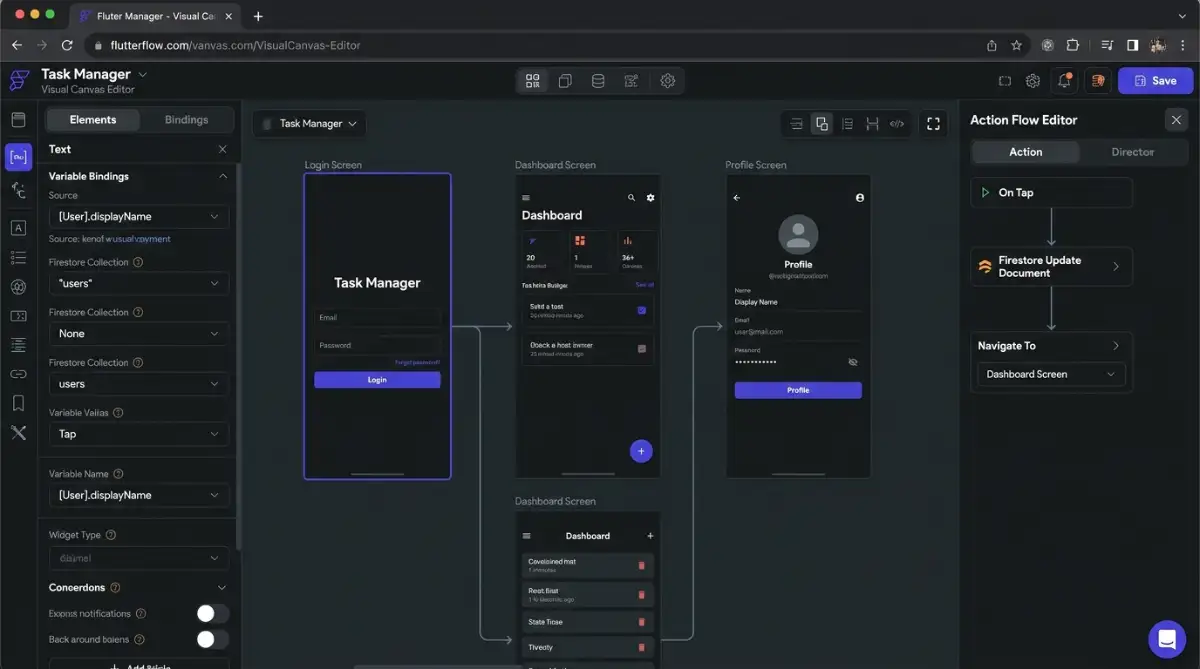
- Visual Action Flow Editor: A node-based state machine that maps user gestures (taps, long presses, double taps) to asynchronous Dart functions, API requests, and local database writes (Source: Ortem Technologies Review, 2026).
- State Management Architecture: A dual-layer system using a global AppState class persisted via SharedPreferences alongside page-level models bound to specific widget instances (Source: Theodo Blog, 2024).
- Data Integration Subsystem: Dedicated SDKs for Firestore and Supabase, plus a REST engine that uses JSON path-mapping to bind API responses directly to visual components (Source: Theodo Blog, 2024).
- CLI and MCP Engine: Supports a Model Context Protocol (MCP) server, enabling AI agents like Claude Code or Gemini CLI to push structural changes directly to FlutterFlow's cloud databases from a local terminal (Source: FlutterFlow Docs, 2026).
"FlutterFlow allows organizations to establish their core building blocks such as design systems and components. This framework can then be utilized across different projects, mitigating the need for vendor reliance." (Abel Mengistu, Co-founder and CEO, FlutterFlow, AppMaster News, January 2024)
A visual builder that compiles to real native binaries rather than running inside a proprietary runtime changes what no-code is allowed to build.
FlutterFlow by the Numbers: Revenue, Users, and Market Position
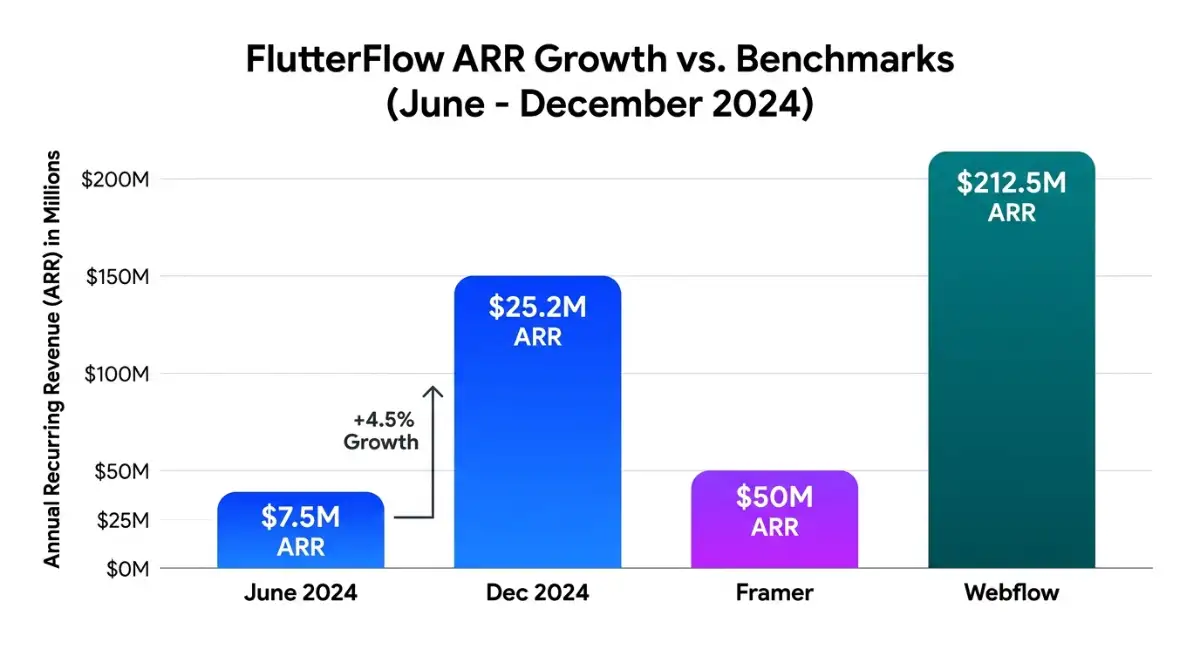
According to GetLatka, FlutterFlow reported $25.2 million in annual recurring revenue in December 2024, up from $7.5 million in June of the same year. The platform surpassed 1.5 million users globally by early 2025 (Source: Business Model Canvas Template Blog, Early 2026), and according to Ahrefs Blog (June 2026), its organic brand search traffic grew by 8,330% over five years, reaching 436,218 monthly organic visitors.
I'll be direct: the funding numbers are genuinely messy across different private market databases, and that's worth acknowledging. Tracxn lists total funding at $26.1 million across three rounds (Source: Tracxn Company Profile, December 2024), while PitchBook puts the total at $30 million (Source: PitchBook Company Profile, January 2024). A capital table analysis incorporating a likely Series B round puts total funding closer to $50 million (Source: Business Model Canvas Template Blog, Early 2026). FlutterFlow remains a privately held, independent company with GV and Gradient Ventures as major shareholders.
Key figures at a glance:
- $25.2M ARR as of December 2024, up from $7.5M in June 2024 (Source: GetLatka Profile, December 2024)
- 1.5M+ users globally by early 2025 (Source: Business Model Canvas Template Blog, Early 2026)
- 8,330% organic brand search growth over five years as of June 2026 (Source: Ahrefs Blog, June 2026)
- $170M post-money valuation at Series A in January 2024 (Source: Preqin Asset Profile, January 2024)
The broader market context explains why Google moved when it did. According to Gartner (via Taskade Blog, 2026), the global low-code/no-code market reached an estimated $44.5 billion in 2026. According to Startupa.ge Best Tech Stack Guide (2026), Flutter holds 46% of the cross-platform mobile framework market, with React Native at 35%. FlutterFlow sits at the intersection of both growth curves, which is a more strategic position than the ARR numbers alone suggest.
Where Does FlutterFlow Sit Against Bubble, Adalo, and Draftbit?
For mobile-first startup founders choosing a no-code builder for their first app, FlutterFlow occupies a specific lane: cross-platform native mobile with a real code export option. Whether it's the right choice depends almost entirely on whether native mobile is what you actually need. For web applications, or apps with unusually complex local hardware requirements, a different builder might be the stronger fit.
| Platform | Primary Output | Code Export | Starting Price (2026) | Best For |
|---|---|---|---|---|
| FlutterFlow | Native iOS + Android apps | Full Dart/Flutter source | $39/mo | Design-led mobile teams needing real store deployment |
| Bubble | Complex web applications | None (proprietary runtime) | $32/mo | Web app logic and intricate database structures |
| Adalo | Simple database-driven mobile apps | None | $36/mo (annual) | Non-technical entrepreneurs with basic CRUD needs |
| Draftbit | React Native cross-platform apps | Full React Native + TypeScript | $25/mo | Agencies with React Native expertise |
Sources: No Code MBA FlutterFlow Pricing Guide, 2026; CatDoes Blog, 2026; Adalo Blog, 2026; Bilt.me Blog, 2026
Bubble is the most common comparison, but the two tools are genuinely built for different outputs. Bubble has no code export option, which creates platform dependency that FlutterFlow's founders explicitly built against. Adalo is friendlier for non-technical users but hits architectural ceilings faster. Draftbit is the closest structural competitor: it exports clean React Native code and targets a similar design-led mobile audience at a comparable price point.
Enterprise adoption also signals FlutterFlow's real positioning. According to StartupIntros Profile (2026) and the FlutterFlow Developer Conference Keynote, organizations including Axis Bank, Capital One, IBM, and Wendy's now maintain parts of their digital operations through FlutterFlow workspaces. That is not the client roster of a prototyping tool.
Honest Tradeoffs: Where FlutterFlow Falls Short in Production
FlutterFlow has real strengths. It also has documented production problems the funding-round version of its story tends to skip.
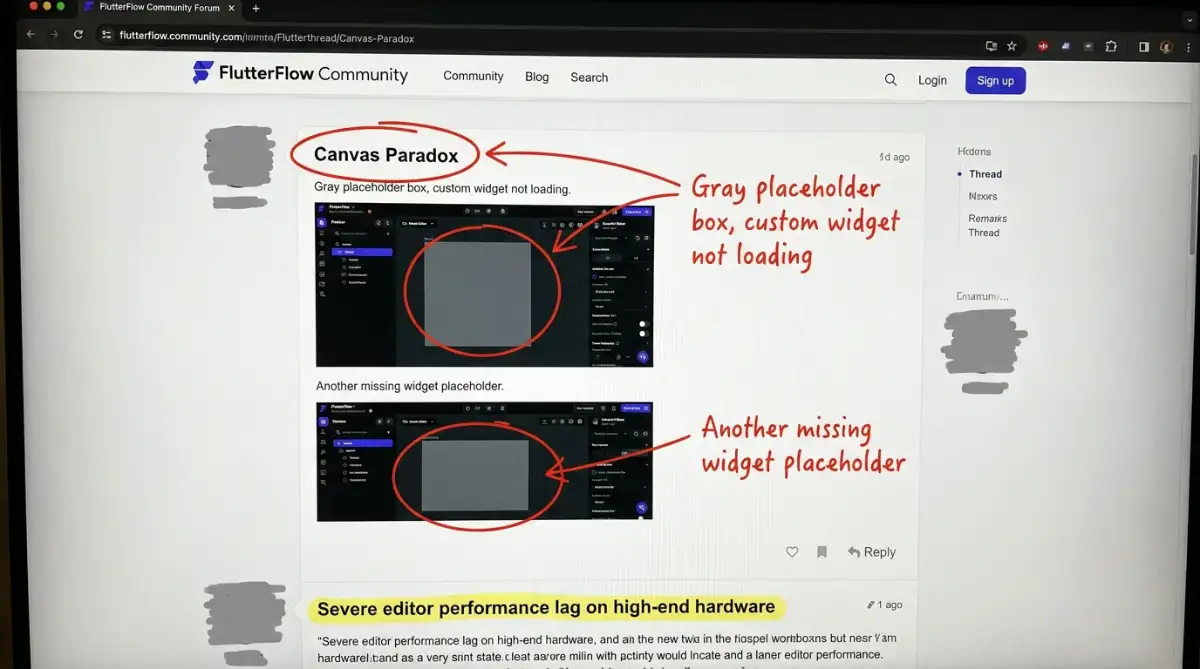
The most structurally frustrating limitation is what developers call the "Canvas Paradox" (Source: FlutterFlow Community Forum, 2025/2026. Build a custom widget using external Dart code and the canvas displays a blank gray placeholder box instead of rendering the component. Seeing how it actually behaves requires switching to Test Mode or exporting to a separate IDE. A visual builder that cannot render its own custom components in real time is working against its own core promise.
Performance degradation is the second issue. Developers on Apple M3 Pro hardware have reported input lag of three to five seconds for basic widget tree updates, with text inputs inside properties panels lagging up to 40 seconds on complex projects (Source: FlutterFlow Community Forum, 2025/2026. This scales with project complexity, meaning the teams most invested in the platform feel it the most.
What strikes me about the DreamFlow controversy is less the AI feature itself and more the sequencing. During 2025 and 2026, the launch of DreamFlow, an AI-driven design-to-code prompt engine, drew backlash from developers who accused leadership of shipping speculative features instead of resolving long-standing bugs and editor memory leaks (Source: FlutterFlow Community Forum, 2025/2026. FlutterFlow then closed its public feature-voting roadmap, which many users read as a pivot toward enterprise sales over community priorities (Source: FlutterFlow Community Forum, 2025/2026.
The code export is real, and that matters. But the exported Dart layouts use rigid nested containers tied to specific packages like go_router (Source: Theodo Blog, 2024). The exit ramp exists; it just is not smooth.
Start exploring FlutterFlow templates and no-code mobile tools here.
What Does Google's Deep Partnership Mean for FlutterFlow Developers?
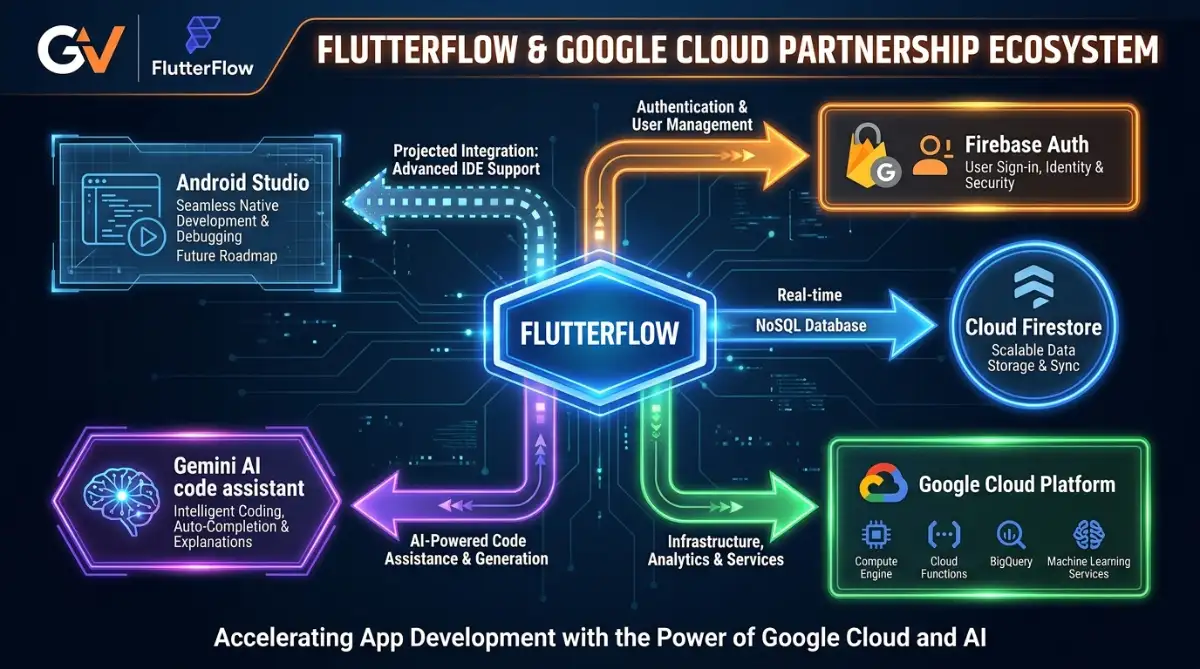
Google's late 2025 acquisition did not just change FlutterFlow's ownership structure. It redefined the platform's strategic purpose. Since the acquisition, the product roadmap has aligned directly with Flutter and Firebase release cycles, bringing tighter SDK integrations, automated Firestore indexing, and native Gemini-powered code generation inside the visual assistant (Source: Ortem Technologies Review, 2026; Kreante Blog, May 2026). The platform has also reached SOC 2 Type II compliance and added SSO authentication and visual branching tools for parallel team development (Source: Ortem Technologies Review, 2026).
"Generative AI is transforming how product teams explore quality ideas, blending human creativity with machine learning insights." (Abel Mengistu, Co-founder and CEO, FlutterFlow, PR Newswire, January 28, 2025)
The enterprise trajectory is clear. On January 28, 2025, FlutterFlow and Google Cloud launched the Product Innovation Accelerator alongside Accenture, targeting consumer packaged goods companies building and testing apps with generative AI integrations (Source: PR Newswire, January 28, 2025). Strategic analysts project that Google may eventually bundle FlutterFlow directly into Android Studio, positioning it as a native visual editor for cross-platform layouts and a direct competitor to Microsoft Power Apps (Source: Business Model Canvas Template Blog, Early 2026).
Google Ventures didn't back FlutterFlow because it loves no-code builders: GV backed FlutterFlow because FlutterFlow routes developers directly into Firebase and Google Cloud. The open question for developers is whether Supabase, PostgreSQL, and custom REST API integrations survive deepening Google influence intact (Source: Business Model Canvas Template Blog, Early 2026). If Google tilts the platform toward its own services at the expense of third-party backends, developers who built on neutral infrastructure will be the first to notice.
Exploring the broader low-code landscape puts FlutterFlow's positioning in sharper relief. Tools at this level of the market are increasingly shaped by the cloud vendors that back them, not just the communities that built around them.
FAQ
Is FlutterFlow free to use? FlutterFlow offers a free tier for prototyping, but publishing to the App Store or Google Play requires a paid plan. Paid tiers start at $39 per month for Basic, $80 per month for Growth, and $150 per month for Business, according to No Code MBA's FlutterFlow Pricing Guide (2026). Code export and automated testing features are gated behind higher-tier plans.
Who owns FlutterFlow in 2026? FlutterFlow remains an independent, privately held company. Co-founders Abel Mengistu and Alex Greaves retain significant ownership stakes alongside institutional investors GV (Google Ventures), Gradient Ventures, Xoogler Ventures, and Y Combinator (Source: Business Model Canvas Template Blog, Early 2026). GV and Gradient together are estimated to control roughly 30-40% of the company. The relationship with Google is one of investment and partnership, not acquisition.
Can FlutterFlow apps get rejected by Apple's App Store? Yes. Apps cloned from shared FlutterFlow templates can trigger rejections under Apple's Guideline 4.2.6 (banning apps from commercialized template or app-generation services) and Guideline 4.3 (the spam rule). Apple's automated binary review can detect matching metadata and layout structures across template-cloned submissions (Source: FlutterFlow Community Forum, 2024. Customizing layouts and adding unique code hooks significantly reduces the rejection risk.
Is FlutterFlow good for non-technical founders with no coding background? It depends on the complexity of the app. FlutterFlow requires a working understanding of state management, API binding, and basic database structure, which gives it a steeper learning curve than tools like Glide or Adalo. For straightforward CRUD apps connected to Firebase, non-technical founders can get surprisingly far. For apps requiring complex logic or custom hardware integration, having a developer involved makes a meaningful difference.
How does FlutterFlow compare to Bubble for building apps? They are designed for different outputs. Bubble is optimized for complex web applications with intricate database logic, while FlutterFlow targets native mobile apps for iOS and Android. Bubble has no code export option, locking projects into its proprietary runtime indefinitely. FlutterFlow exports clean Dart source code. For web applications specifically, Bubble's visual builder architecture is the stronger choice for that use case.
Start building without code
Browse thousands of no-code templates for Webflow, Framer, Bubble, Lovable, Replit and more.
Explore Templates