Adalo No-Code App Builder: From Foundry to 1M Makers
Adalo is a no-code app builder, incorporated in 2017 and headquartered in St. Louis, that turns visual drag-and-drop designs into native React Native apps for the App Store and Google Play. Unlike web-wrapper tools, it produces true native binaries. By late 2026 it served more than one million makers and had raised $9.7 million in venture capital.
Table of Contents
- Key Takeaways
- Introduction
- What Is the Adalo No-Code App Builder?
- How Did Adalo Go From "Foundry" to a Million Makers?
- How Does Adalo Turn Drag-and-Drop Into Real Native Apps?
- What Does the Adalo No-Code App Builder Cost in 2026?
- Why Did Adalo's "App Actions" Fees Nearly Break Trust?
- What Is Ada, and Where Is the Adalo No-Code App Builder Headed?
- FAQ
Key Takeaways
- Adalo changed its name four times before landing on a tribute to Ada Lovelace, and the rebrand fixed a problem far bigger than vanity.
- The "App Actions" fee that nearly torched community trust got abolished within weeks of a new owner walking in the door.
- Adalo's biggest strength and its sharpest risk are the same thing: you never touch code, and you can never take it with you.
Introduction
Roughly 0.3% of people on the planet can write code, a figure Adalo itself likes to cite. If you run a small business, coach clients, or have an app idea rattling around your head and you are not in that 0.3%, you have historically faced two choices: learn to program or pay someone who can. The Adalo no-code app builder was built to delete that choice for non-coding makers. This is the story of how a St. Louis startup that renamed itself four times ended up letting people publish real iOS and Android apps from a drag-and-drop canvas, plus the messy parts the marketing pages skip.
What Is the Adalo No-Code App Builder?
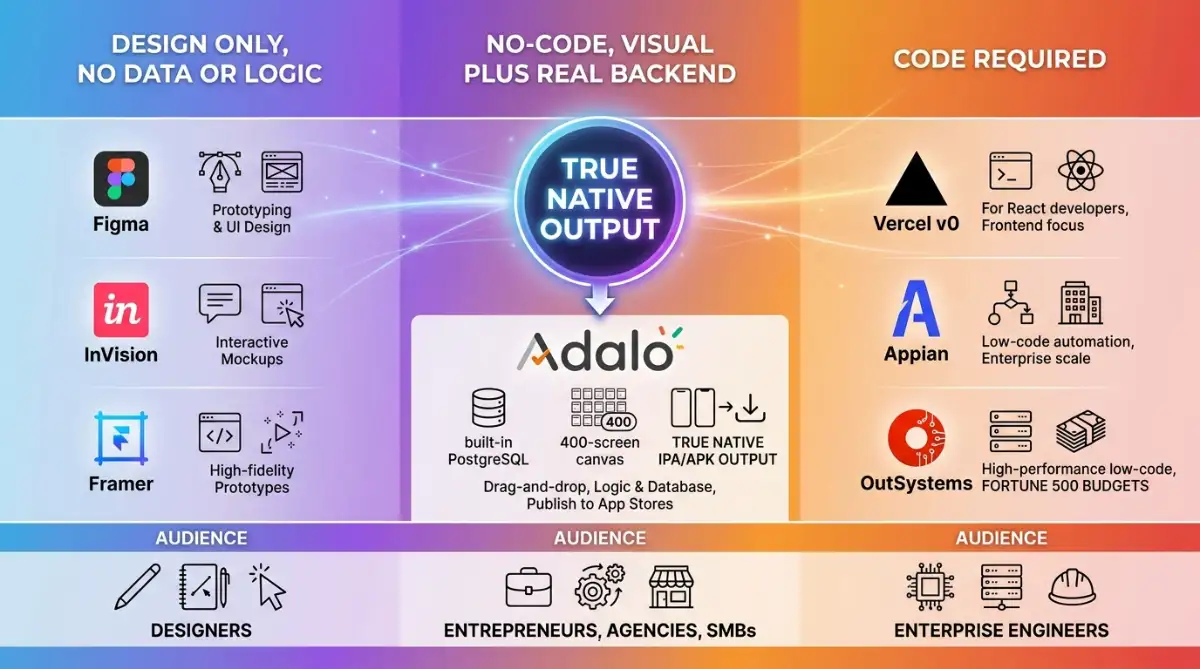
Adalo sits in the middle of the no-code market: friendlier than developer-leaning tools like Vercel's v0, far more capable than mockup apps like Figma. The pitch to non-technical creators is blunt. Build a working, data-backed app on a visual canvas, then ship it to real stores without opening a code editor.
That positioning came straight from a frustration co-founder Jeremy Blalock had while leading engineering teams. He noticed that prototyping tools like InVision, Figma, and Framer produced gorgeous interfaces that looked like apps but stored no data, called no APIs, and ran no business logic. Adalo's answer was to fuse the prototyping canvas with a live, publishable backend.
A few things separate it from a glorified mockup:
- A single visual canvas that renders up to 400 interactive screens at once, so you can trace user flows before launch.
- A built-in PostgreSQL relational database on every paid tier, with no record limits.
- "External Collections" that wire the app to Xano, Firebase, or Airtable through standard JSON REST APIs.
If you are still fuzzy on the category itself, this primer on what a no-code builder actually does is a useful detour. The short version: Adalo's promise is not a website, it is a genuinely native mobile app you own as a product.
How Did Adalo Go From "Foundry" to a Million Makers?
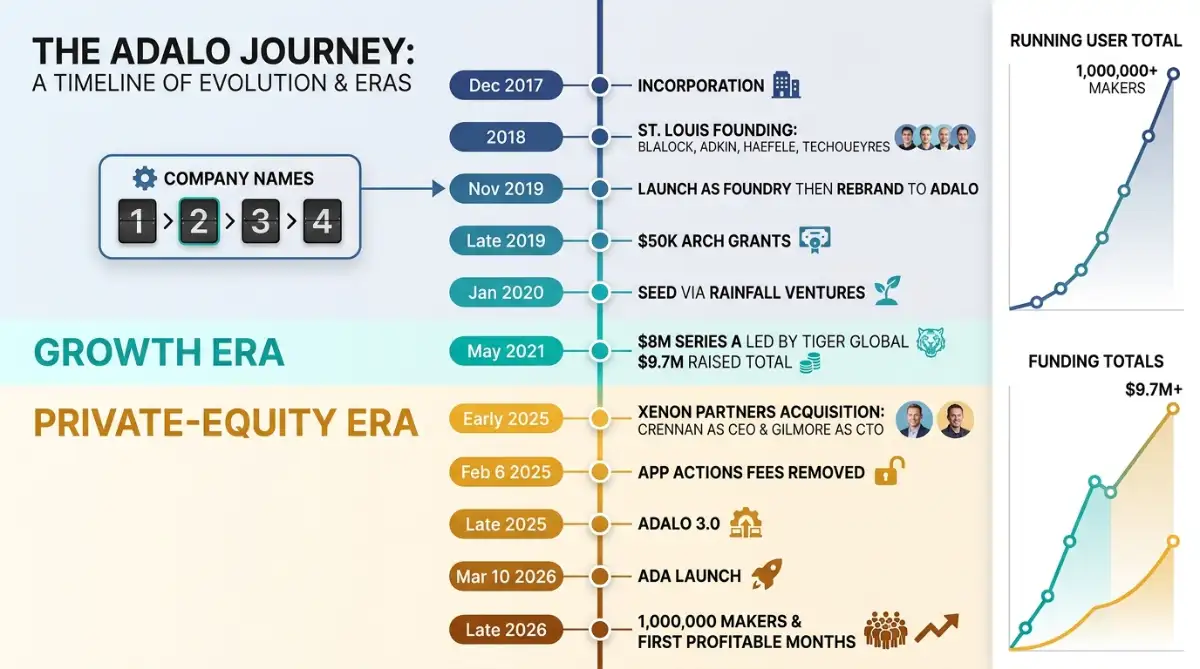
The company took shape in 2018 in St. Louis under four co-founders: Jeremy Blalock, David Adkin, Ben Haefele, and Tom Techoueyres. Adkin, then finishing a Master's in Architecture, joined believing visual design was the defining skill of the century and that building software should feel like assembling a slide deck.
It launched publicly in November 2019 under the name Foundry. That lasted about as long as it took to hit trademark overlaps, search visibility problems, and outright brand confusion. The team rebranded to Adalo, a nod to Ada Lovelace, the woman widely credited as the first computer programmer. So the rename was not cosmetics, it was a survival move.
Adalo changed its name four times before settling on a tribute to the first programmer, fixing a brand problem that was quietly strangling its growth.
The funding timeline tells the rest:
| Stage | Date | Detail |
|---|---|---|
| Arch Grants award | Late 2019 | $50,000 from the St. Louis incubator |
| Seed round | January 2020 | Led by Rainfall Ventures plus angels |
| Series A | May 2021 | $8M led by Tiger Global Management |
According to Crunchbase News reporting on the round, that Series A brought the total raised to $9.7 million and pulled in operators like Zapier CEO Wade Foster (worth reading alongside Zapier's own no-code automation origin story), GitHub CTO Jason Warner, and Makerpad founder Ben Tossell. Leadership churned too: Blalock departed after culture disagreements, Adkin stepped up as CEO, and Haefele left in 2022 for a product role at Webflow.
We're not trying to take away developers' jobs. We're allowing them to do what developers usually want to work on, which is solving more technical problems. — Jeremy Blalock, co-founder, January 2021
How Does Adalo Turn Drag-and-Drop Into Real Native Apps?
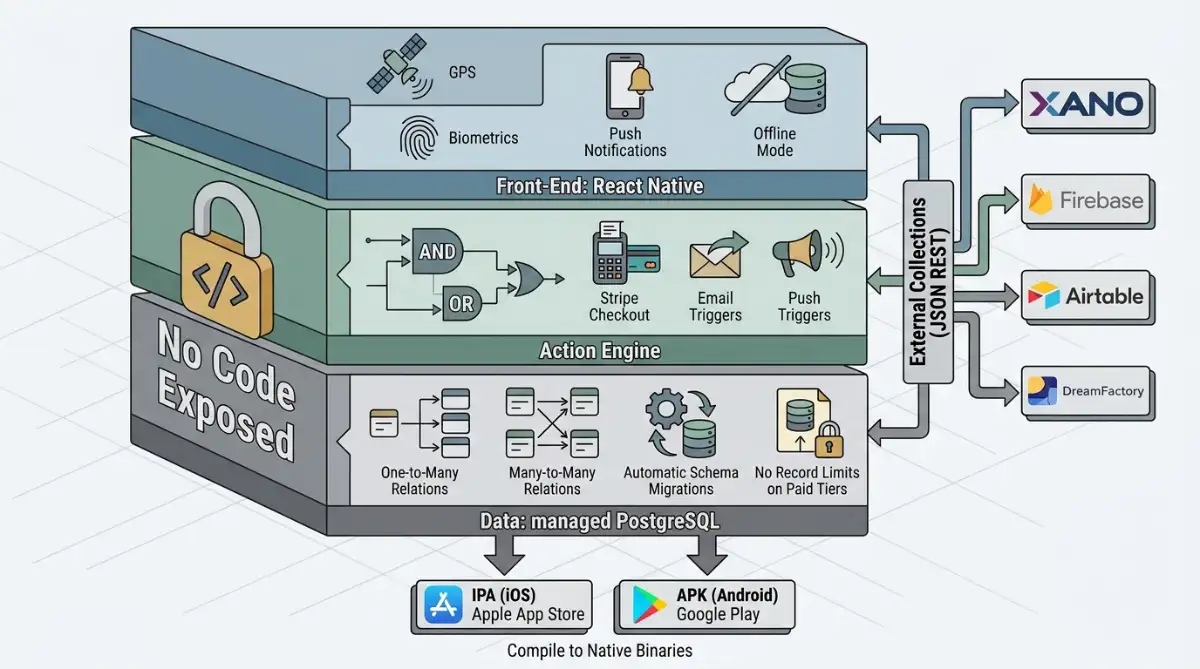
Adalo compiles your visual design into React Native, the same Meta-built framework behind plenty of apps in your phone right now. That is the whole trick. Instead of wrapping a website in a shell, it produces clean IPA and APK binaries you can submit directly to Apple and Google.
Under the hood, the platform stacks three layers, and understanding them explains both its power and its ceiling:
| Layer | Technology | What it does |
|---|---|---|
| Front-end engine | React Native | Renders native UI with GPS, biometrics, push, offline support |
| Action Engine | Visual logic | Maps conditional AND/OR events, Stripe checkout, emails, push |
| Data layer | PostgreSQL | Managed relational database with one-to-many and many-to-many links |
The Action Engine is where non-coders quietly become developers without noticing. You drag a button, attach an action, and set a condition, and you have just written logic. For anything heavier, External Collections let the front-end talk to outside databases as if they were native tables.
This native-first approach is exactly the bet FlutterFlow made when it went after the app store from a different angle. Adalo's distinguishing move is doing it from one drag-and-drop viewport, no Dart, no Flutter widgets, no exposed code.
What Does the Adalo No-Code App Builder Cost in 2026?
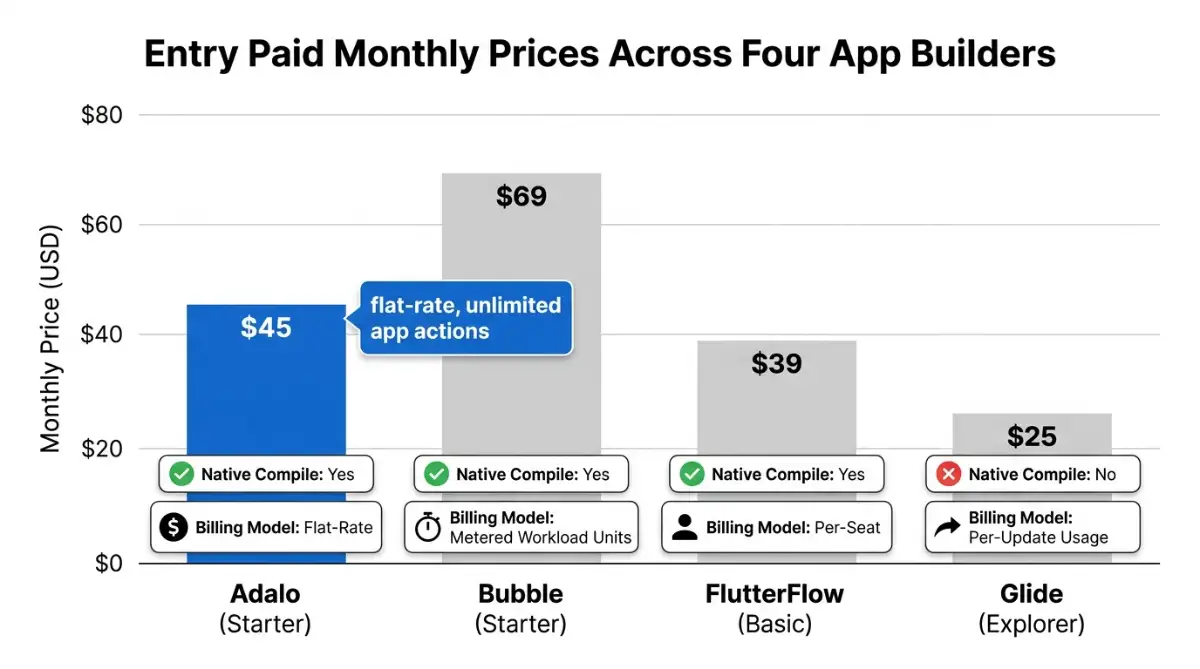
Adalo's 2026 pricing is flat-rate with zero usage-based fees, which matters more than it sounds. Four tiers run from a free plan up to the Team plan, and publishing to app stores starts on the paid Starter plan, not the free one.
Here is how the entry pricing compares across the obvious rivals:
| Platform | Entry paid plan (billed monthly) | Native iOS/Android compile | Billing model |
|---|---|---|---|
| Adalo | $45 (Starter) | Yes (built-in) | Flat-rate |
| Bubble | $69 (Starter) | Yes (native mobile editor) | Metered (workload units) |
| FlutterFlow | $39 (Basic) | Yes (via Flutter) | Per-seat above entry |
| Glide | $25 (Explorer) | No (PWAs only) | Usage-based (per update) |
The flat-rate detail is the quiet differentiator. With Bubble's usage-metered model, a viral spike can mean a surprise invoice, whereas Adalo's bill stays the same whether ten people or ten thousand open your app. For makers comparing the lighter spreadsheet-driven route, Glide's spreadsheet-to-app approach trades native publishing for speed.
On Adalo itself, the four tiers stack like this: the Free plan caps you at 500 records with mobile preview but no store publishing, Starter ($45/month) unlocks one published app and automated app store publishing, Professional ($65/month) bumps you to two apps with push notifications and custom formulas, and the Team plan ($200/month) adds the Xano integration and Collections API you will want at scale. Annual billing runs cheaper than these monthly rates. Predictable pricing is the headline, but predictability is also why the next part stings.
Why Did Adalo's "App Actions" Fees Nearly Break Trust?
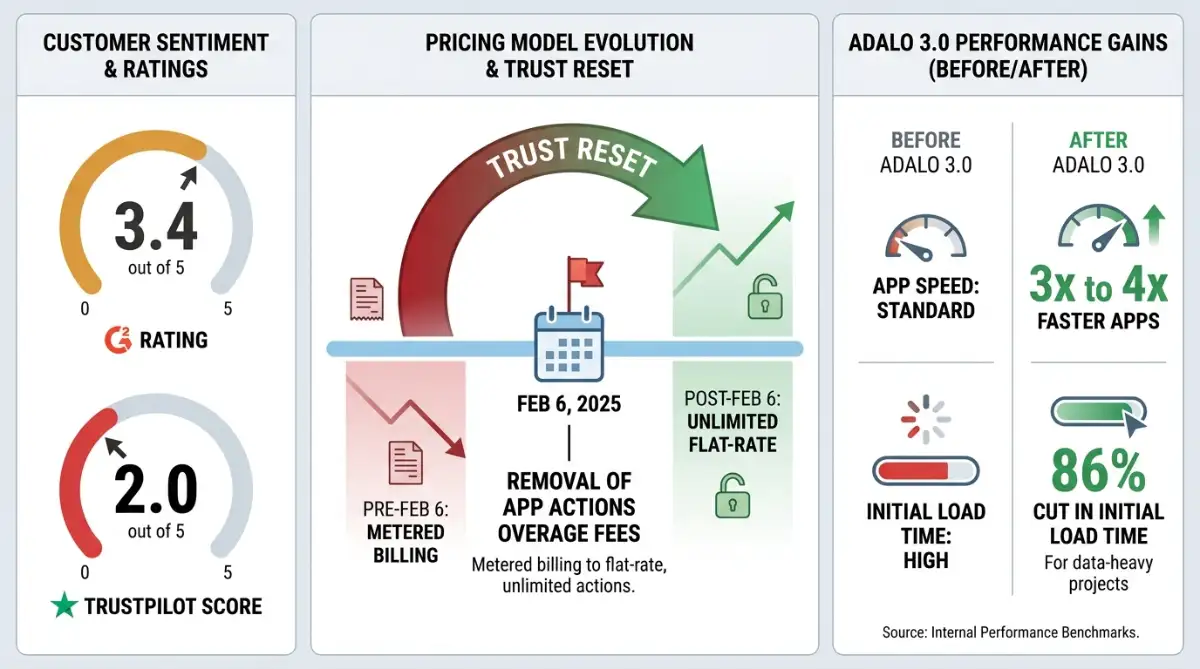
The ugliest chapter came from a pricing model called "App Actions." Adalo metered dynamic interactions, things like database updates, screen navigation, and API requests, and charged overage fees on volume. The incentives were backwards: the more your app succeeded, the more you paid, often before you had monetized a single user.
The community named it the "App Actions Event," and the backlash was loud. The fix arrived fast under new ownership. On February 6, 2025, incoming CEO James Crennan abolished App Actions billing entirely and moved every paid plan to flat-rate, unlimited actions, eating the short-term revenue hit to win back trust.
Billing was not the only sore spot. Three limitations still define who Adalo is wrong for:
- Absolute lock-in. There is no source code export. Outgrow Adalo and you rebuild from scratch in React Native or Flutter.
- Performance ceilings. Apps past roughly 50 screens or 1,000 relational records can lag unless paired with an external database.
- Mixed reviews. A G2 score of 3.4 out of 5 and a Trustpilot rating of 2 out of 5 reflect historical support and canvas-lag complaints.
The trade is real: you get speed and zero code, and in exchange you accept that your product lives entirely on Adalo's infrastructure. That is a fine deal for a booking app and a terrible one for a compliance-heavy enterprise build.
What Is Ada, and Where Is the Adalo No-Code App Builder Headed?
Adalo's current era began when private equity firm Xenon Partners acquired it in early 2025 and installed James Crennan as CEO and Jason Gilmore as CTO. They migrated about 140 backend services and over 3 million active PostgreSQL databases to a microservices setup, then shipped Adalo 3.0, which internal data says runs apps 3x to 4x faster with an 86% cut in initial load times.
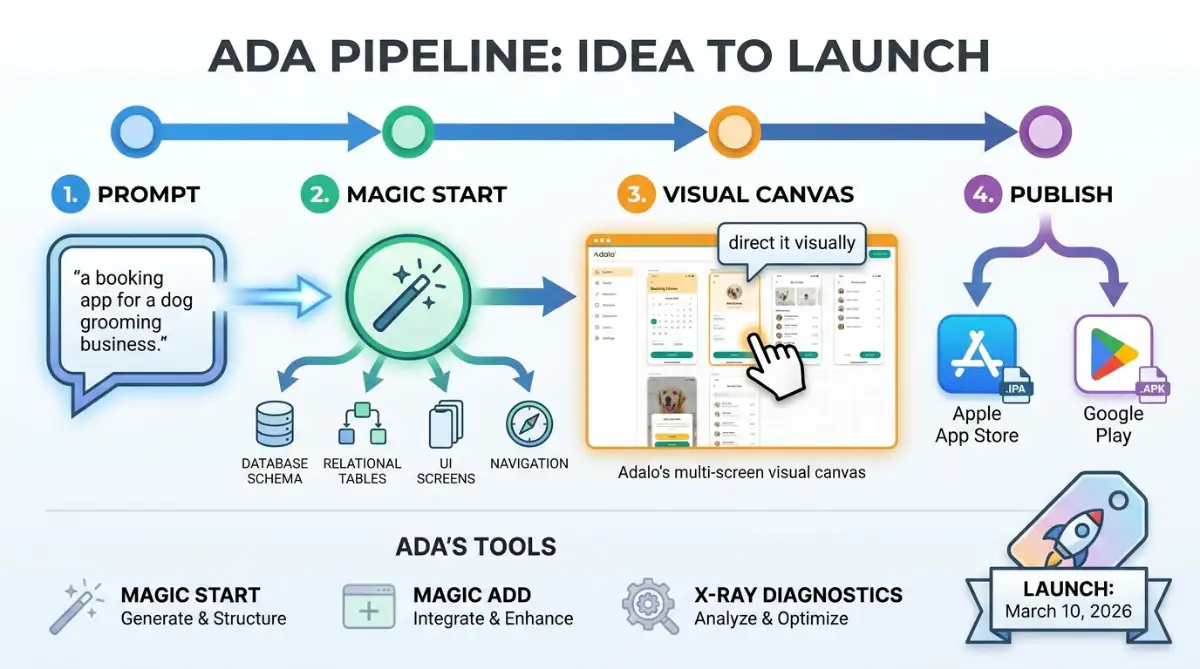
The marquee launch landed on March 10, 2026: Ada, a conversational AI layer. Describe an app in plain language and Ada generates the database schema, relational tables, screens, and navigation directly onto the canvas, where you can then click components to redirect it. If you have followed the broader shift toward building apps by talking, often called vibe coding, Ada is Adalo's version, except the output stays editable on a visual canvas instead of dumping a code repo on you.
You can see every screen at once, point at what you want to change, and publish a real native app to the App Store without touching code. — James Crennan, CEO, March 10, 2026
What is genuinely interesting is the unresolved question. Leadership has said it is exploring code export, the one feature that would flip Adalo from a closed box into a scaffolding tool professional developers could actually adopt. LeadIQ pegs the platform's historical peak revenue somewhere between $50 million and $100 million, and the company logged its first sustained profitable months in late 2026. That is a meaningfully different Adalo than the one that launched as Foundry.
Start exploring launch-ready no-code templates here!
FAQ
Is Adalo free to use? Yes, there is a free plan at $0, but it caps you at 500 records per app and has no app store publishing. To publish to the Apple App Store or Google Play, you need the Starter plan at $45 per month billed monthly, and annual billing brings that rate down.
Can you publish Adalo apps to the App Store and Google Play? Yes. Adalo compiles your design into React Native and produces true native iOS and Android binaries, not browser wrappers. That direct-to-store publishing is its main edge over PWA-only tools like Glide, which cannot list apps natively.
Can you export your code from Adalo? No. Adalo does not support source code or database export, which the company calls a limitation it is exploring fixing. If your app outgrows the platform, you must rebuild it from scratch in a framework like React Native or Flutter.
Adalo vs Bubble: which is for whom? Adalo suits non-technical makers building native, database-driven mobile apps on a visual canvas. Bubble suits web-first teams needing complex logic and custom workflows. Adalo bills flat-rate, while Bubble uses usage-based Workload Unit fees that scale with activity.
Who owns Adalo now? Private equity firm Xenon Partners acquired Adalo in early 2025 for an undisclosed sum. The deal installed James Crennan as CEO and Jason Gilmore as CTO, and the new leadership scrapped the App Actions fees and launched Adalo 3.0 and the Ada AI suite.
Start building without code
Browse thousands of no-code templates for Webflow, Framer, Bubble, Lovable, Replit and more.
Explore Templates