Softr Case Study: Client Portals Built on Airtable
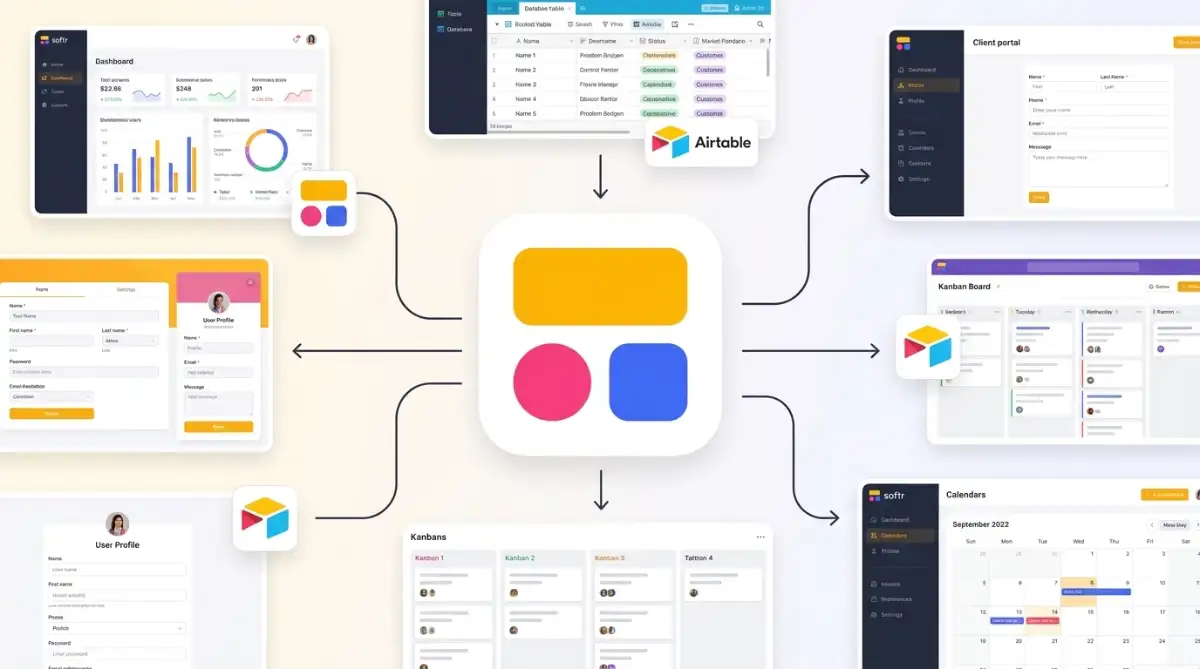
Softr is a no-code platform founded in Berlin in 2018 that converts database records into authenticated web applications. It debuted publicly in 2021 as an interface layer for Airtable and expanded to more than 14 native data connectors between 2024 and 2025.
Table of Contents:
- Key Takeaways
- Introduction
- What Problem Was Softr Actually Built to Solve?
- How Did a Weekend Hackathon Become a Profitable Company?
- Why Did Softr Break Its Airtable Dependency?
- What Do Client Portals Replace for Agency and Accounting Ops Teams?
- How Does the AI Co-Builder Avoid Hallucinated Code?
- How Does It Compare to Bubble, Retool, and Airtable Interfaces?
- Honest Tradeoffs
- Frequently Asked Questions
Key Takeaways
- Three and a half years passed between the first prototype and the first paying customer, and that stretch of silence explains the architecture better than any feature page does.
- Cutting the single-database dependency in 2024 looked like a routine product update. It was closer to an escape from somebody else's rate limits and pricing decisions.
- The portal that saved a music distributor five hours a week did it by deleting a file format, not by adding another piece of software to the stack.
Introduction
Softr is the no-code platform that ops leads at client-facing service businesses reach for when a spreadsheet stops being enough and a developer is still out of budget. If you run an accounting practice, a creative agency, a veterinary supply chain, or a landscaping crew, you already know the specific pain: your data lives in Airtable, it is organized beautifully, and your clients cannot see any of it without you emailing them a PDF.
According to PitchBook, the Berlin company raised just $15.7 million total and then stopped. That number matters more than it sounds. Below is the full arc: the architecture, the money, six real deployments with numbers attached, and the parts nobody puts on a landing page.
What Problem Was Softr Actually Built to Solve?
Softr exists because of a gap the software industry never priced properly. Small and mid-sized teams routinely outgrow cloud spreadsheets, but they cannot fund an engineering hire to build the interface layer on top. Mariam Hakobyan and Artur Mkrtchyan started the company in Berlin in 2018 to sit exactly in that space, which insiders call the missing middle.
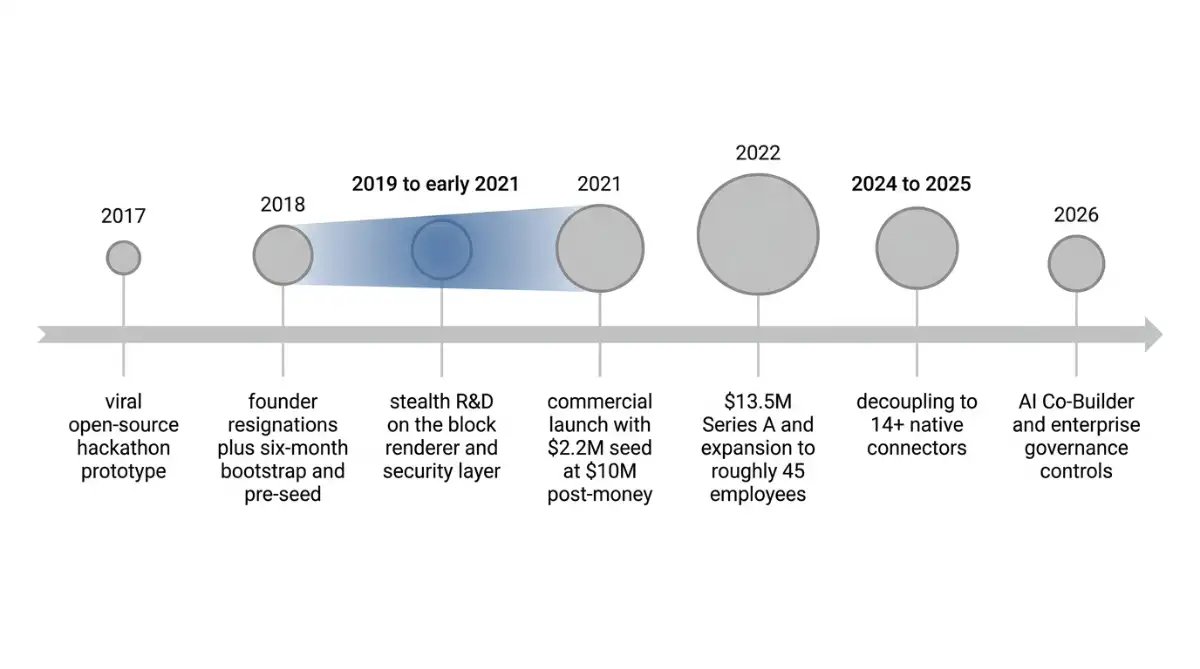
The origin story is unusually slow for a venture-backed product. A 2017 weekend hackathon produced a viral open-source prototype. The founders quit their corporate engineering jobs in 2018, bootstrapped for six months, took pre-seed money, and then went quiet for three and a half years.
What they built during that stealth phase from 2019 to early 2021 was not a website builder. It was a composition engine that reads a backend database schema and renders it as a secure, production-grade web app:
- Block-based rendering rather than freeform canvas drawing
- Authentication and access control treated as core architecture, not a plugin
- Schema-aware layouts that adapt when the underlying table changes
Organizing relational data was solved years ago. Showing that data safely to a client who should never touch the database was not.
How Did a Weekend Hackathon Become a Profitable Company?
Two rounds, then nothing. PitchBook's company profile puts total capital raised at $15.7 million: $2.2 million in seed funding in January 2021, then $13.5 million in Series A in January 2022, with no round since. For a category where annual raises are normal, that is the outlier detail.
| Round | Date | Amount | Lead Investor | Post-Money Valuation |
|---|---|---|---|---|
| Seed | January 2021 | $2.2M | Atlantic Labs | $10.0M |
| Series A | January 2022 | $13.5M | FirstMark Capital | Not disclosed |
The seed round pulled in EQT Ventures, Point Nine Capital, HV Capital, and angels from GitHub and SumUp. The Series A brought Accel, Andreessen Horowitz, Atomico, and Bond. Then the leadership team pivoted the whole operating model toward profitability instead of the next round.
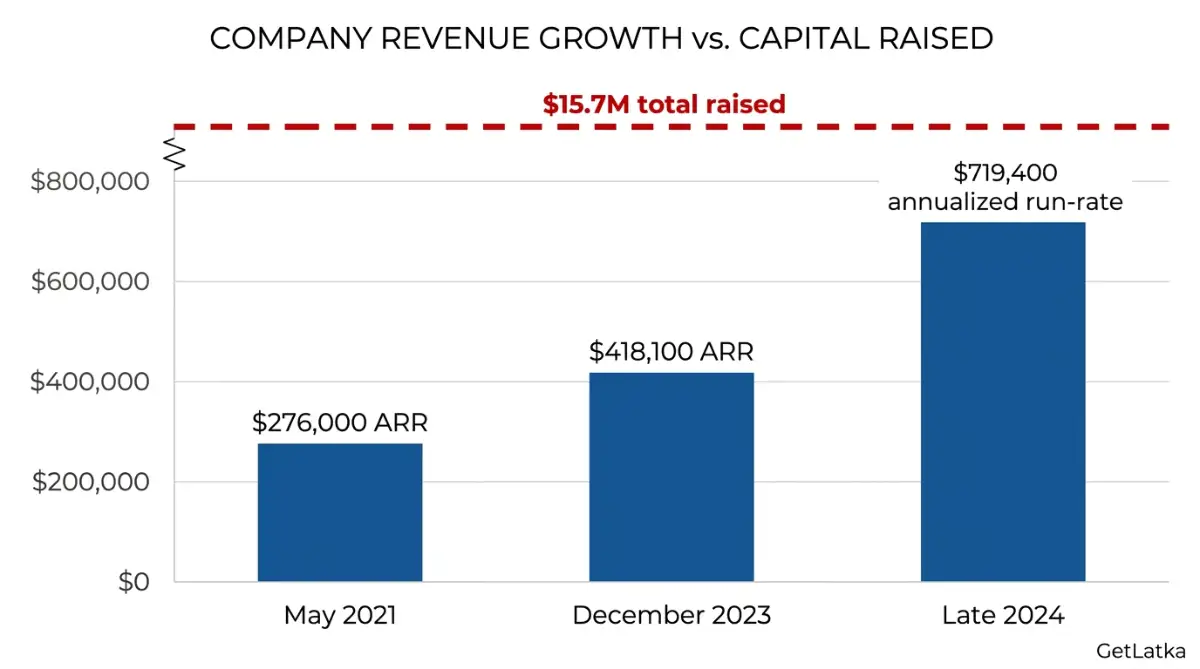
Here is where I would push back on the tidy version of this story. The revenue figures are modest: GetLatka's revenue tracking shows annual recurring revenue moving from $276,000 in May 2021 to $418,100 in December 2023, reaching a $719,400 run-rate by late 2024. That is not a rocket ship. It is a distributed team of roughly 45 to 64 people across 15 countries deliberately choosing a slower curve, and whether you read that as discipline or as a ceiling honestly depends on what you think the no-code market becomes by 2030.
Why Did Softr Break Its Airtable Dependency?
Launching as an Airtable-only interface was smart and dangerous in equal measure. It gave the platform instant product-market fit inside a booming ecosystem. It also meant one partner's API rate limits, schema rules, and pricing changes could reshape the business overnight.
Between 2024 and 2025 the company rebuilt itself as data-agnostic, engineering native connectors for more than 14 sources. The list now covers the tools operations teams actually have open:
- Databases: PostgreSQL, Supabase, BigQuery
- Workspaces: Google Sheets, Notion
- Business systems: HubSpot, Xano, custom REST APIs
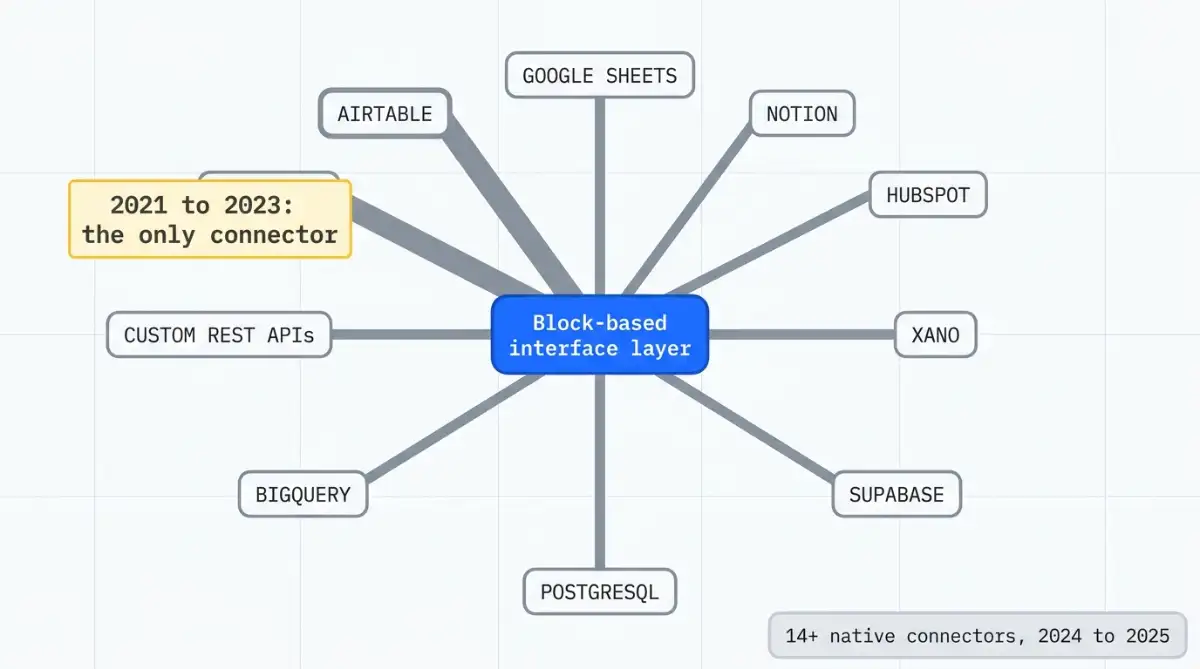
That change quietly redefined the product. A single portal can now aggregate a CRM, a data warehouse, and a spreadsheet that became a real database into one interface, which is a different business from being a skin on somebody else's product.
Decoupling the interface layer from the storage layer turned a single-vendor add-on into an operational portal that sits above fragmented enterprise systems.
The runtime choice supports this. A React component library renders native HTML DOM elements in the browser instead of canvas output, so pages load fast, adapt to mobile viewports, and stay crawlable by search engines. Apps publish as responsive web apps or progressive web apps. That rendering decision is the first thing worth checking against other web app builders, because canvas-based tools trade away exactly those properties.
What Do Client Portals Replace for Agency and Accounting Ops Teams?
In practice, these portals rarely replace software. They replace a manual habit: someone exporting a file, attaching it to an email, and doing it again next Tuesday. The six deployments below all follow that pattern, and the time savings come from killing the export step.
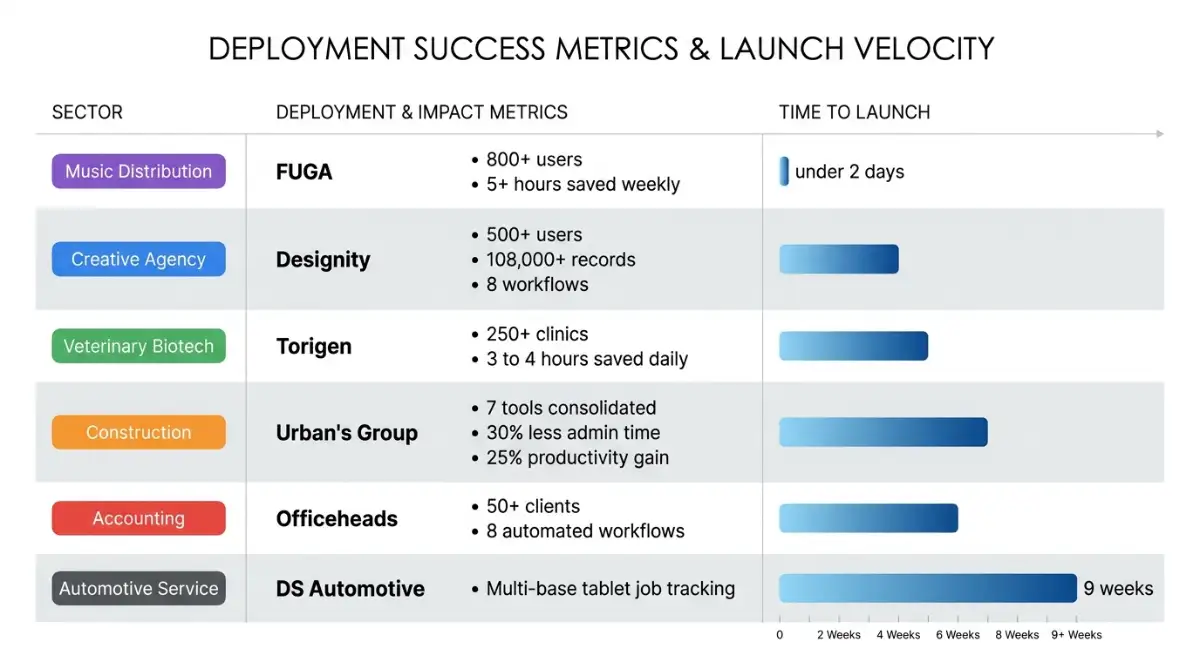
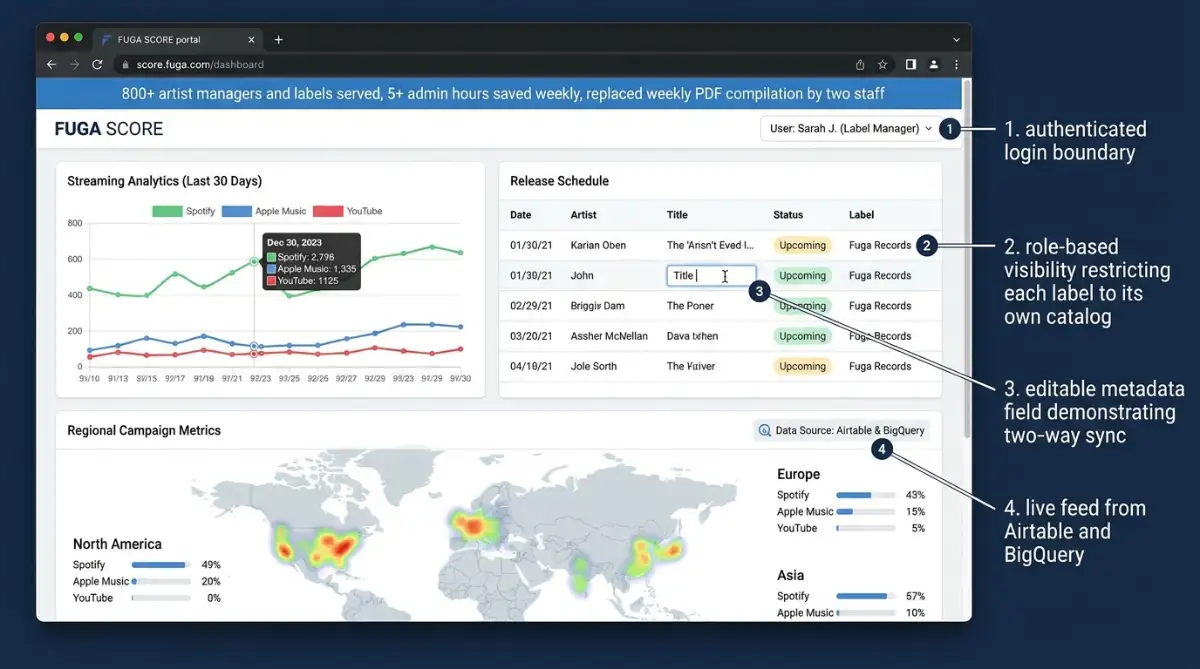
Take FUGA, the global music distribution platform. Two operations employees spent half a day every week compiling static PDF performance reports for hundreds of clients. Their SCORE portal now connects Airtable and BigQuery directly to an authenticated interface serving 800+ artist managers and labels, saving over five hours weekly and giving each label live access to only its own catalog data.
Officeheads, an accounting firm, went the other direction on effort. It built a client dashboard in under two days, automating eight workflows for 50+ corporate clients, including financial reporting views, service request forms, and custom video walk-throughs.
| Organization | Sector | What It Replaced | Stack | Outcome |
|---|---|---|---|---|
| FUGA | Music distribution | Manual PDF reports | Softr, Airtable, BigQuery | 800+ users, 5+ hours saved weekly |
| Designity | Creative agency | monday.com and Asana | Softr, Airtable, Fillout | 3 portals in 9 weeks, 108K+ records |
| Torigen | Veterinary biotech | Paper submission forms | Softr, HubSpot API | 250+ clinics, 3 to 4 daily hours saved |
| Urban's Group | Construction services | 7 disconnected tools | Softr, Airtable, Make, Zoho Forms | 30% less admin time, 25% productivity gain |
| Officeheads | Accounting | Static spreadsheets | Softr, Airtable | Built in under 2 days, 50+ clients |
| DS Automotive | Automotive service | Disconnected repair logs | Softr, Airtable | Real-time tablet job tracking |
Designity is the one I keep coming back to. The creative agency launched three interconnected portals for clients, creative directors, and freelance designers in nine weeks with no developers, running 500+ active users across 108,000+ Airtable records.
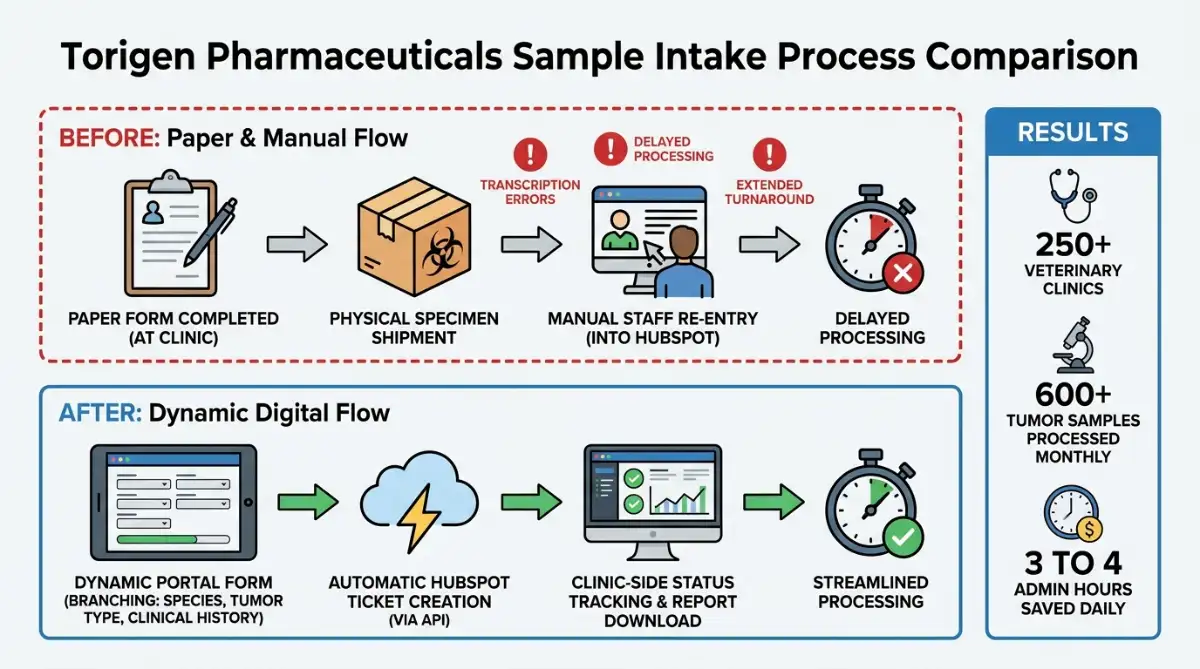
The field cases matter for a different reason. Urban's Group, a landscaping and construction firm with 80+ employees, folded seven tools including Excel files, Trello boards, and legacy construction software into one hub, cutting administrative overhead by 30%. Torigen Pharmaceuticals rebuilt its entire sample submission workflow over a single weekend when lab requirements changed, which is the part a developer-built system would have made expensive.
How Does the AI Co-Builder Avoid Hallucinated Code?
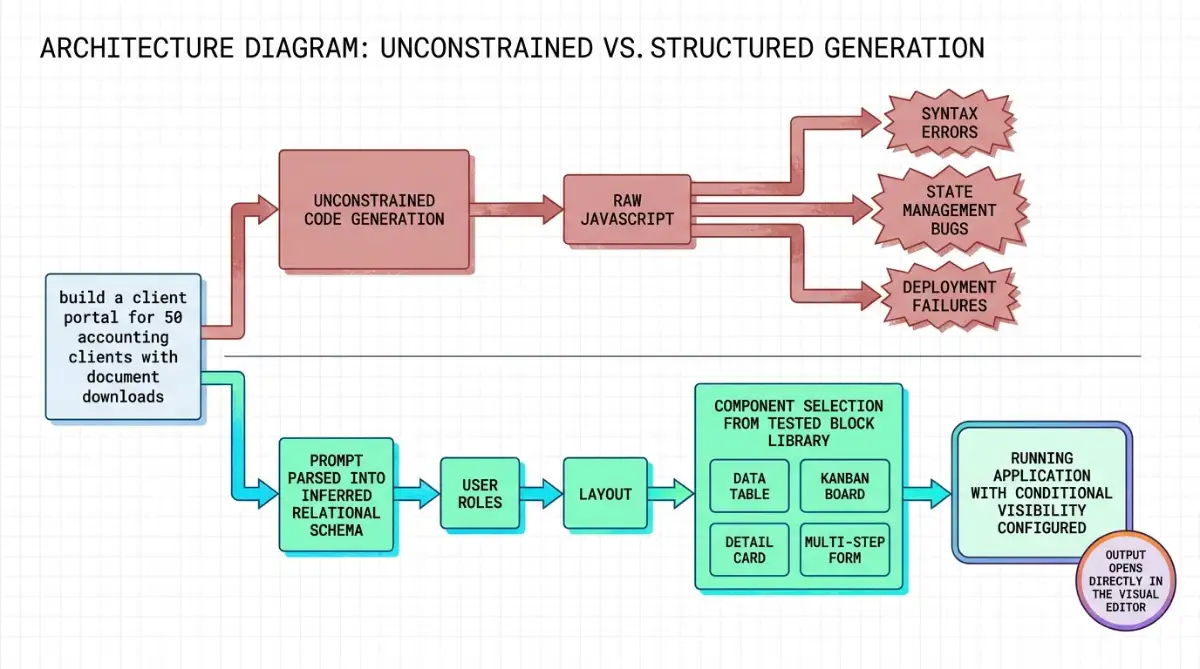
The AI Co-Builder shipped in 2026, and its design choice is the interesting part. Rather than generating raw source code from a prompt, it generates configuration. The engine parses natural language, infers a relational schema, then selects and wires up tested components from the existing block library.
VentureBeat's coverage of the March 2026 launch put the platform at more than one million builders and 7,000 organizations, including Netflix, Google, and Stripe. The distinction against prompt-to-code tools is concrete:
- Unconstrained code generation can produce syntax errors, state management bugs, and deployment failures
- Constrained block assembly can only produce combinations that already work in production
- The output stays editable in the visual editor, by prompt or by drag and drop
The tradeoff is honest: you cannot ask it for something the block library does not contain. Generated apps arrive with connected tables, user roles, and conditional visibility already configured, which is a meaningfully different starting point from a blank canvas or a wall of generated JavaScript you now have to debug.
Constraining what the model can build is not a limitation of the AI. It is the reason the output runs on the first try.
How Does It Compare to Bubble, Retool, and Airtable Interfaces?
Four tools, four different assumptions about who is sitting at the keyboard. The table below is the fastest way to see where each one draws its line, and picking correctly matters more than picking the most capable option.
| Dimension | Softr | Bubble | Retool | Airtable Interfaces |
|---|---|---|---|---|
| Target builder | Operations teams, agency founders | Visual developers | Software engineers, IT | Existing Airtable users |
| Data connectivity | 14+ native sources, REST APIs | Proprietary internal DB | SQL, GraphQL, REST | Airtable bases only |
| Code requirement | Zero, optional code blocks | Visual logic, steep curve | JavaScript and SQL | Zero, constrained blocks |
| Deployment output | Web apps, PWAs | Web apps, custom domains | Web apps, self-hosted Docker | Views inside Airtable |
| Source code export | None | None | Self-hosted containers only | None |
Bubble's visual programming model gives you far more logical control and charges you in learning curve. It also operates at a completely different scale: Contrary Research reports Bubble at $74.2 million in 2024 revenue on $106.3 million raised, roughly seven times the capital for a much broader developer platform. Retool and the low-code internal tool category assume a developer is on staff, since JavaScript and SQL proficiency is the entry fee. Airtable Interfaces is native and quick, but everything stays inside Airtable, which fails the moment an external client needs a login.
The practical read: if the hard part of your project is presenting existing data to people with different permission levels, the block-based approach wins on speed. If the hard part is the logic itself, you are buying the wrong abstraction. The full Softr platform profile covers features, plan tiers and review in more depth, and the wider no-code tool directory is the faster way to scan adjacent options side by side.
Honest Tradeoffs
Three limits are structural, not roadmap items. There is no source code export, so what you build stays on hosted infrastructure permanently. There are no native iOS or Android binaries either, which means progressive web apps are the mobile ceiling and anyone who needs App Store distribution should start with a dedicated mobile app builder instead. And the block system that guarantees your layout never breaks on a phone is the same system that stops you from moving an element eight pixels to the left.
The real-time API sync deserves more skepticism than it usually gets. Read and write operations hit your connected backend live, so you inherit that backend's rate limits, downtime, and pricing changes. Decoupling from a single vendor reduced this risk without eliminating it, and anyone evaluating no-code security and risk should map that dependency before launch.
Who is it wrong for? Teams that need custom algorithms, heavy computational logic, or the ability to walk away with their codebase. If your application's value lives in proprietary logic rather than in presenting data securely to the right people, you are fighting the tool. Weigh that against the real cost of scaling on no-code before committing a core business process.
Start exploring launch-ready no-code templates here!
Frequently Asked Questions
What is Softr used for?
It builds authenticated web applications on top of existing databases, most commonly client portals, internal CRMs, membership sites, and operations dashboards. Users connect a data source, arrange pre-built blocks, set permissions, and publish without writing code.
Does it still require Airtable?
No. Airtable was the original and only backend at launch, but native connectors now cover Google Sheets, Notion, HubSpot, Xano, Supabase, PostgreSQL, BigQuery, and custom REST APIs. You can also aggregate several sources inside one application.
Is it free to use?
The platform runs a freemium subscription model, so you can build and test without paying. Paid tiers add the things production portals need: role-based permissions, white-labeling, custom domain connectivity, and enterprise database integrations.
Can you export the code?
No. Applications run on a fully hosted software-as-a-service runtime with no source code download and no native mobile binary output. The company handles deployment, hosting, and infrastructure maintenance in exchange for that constraint.
How long does building a client portal take?
Faster than most teams expect. Officeheads launched a working client portal in under two days, while Designity built three interconnected portals across eight workflows in nine weeks. Complexity of permissions and data relationships drives the timeline more than design work does.
Start building without code
Browse thousands of no-code templates for Webflow, Framer, Bubble, Lovable, Replit and more.
Explore Templates