Gumroad: The No-Code Way to Sell Digital Goods
Gumroad is a no-code platform that lets creators sell digital goods by uploading a file, setting a price, and sharing a payment link, with no web development or merchant account required. Founded by Sahil Lavingia in 2011, it now generates over $20 million in annual revenue. In 2026 it charges a flat 10% platform fee plus payment processing.
Table of Contents:
- Key Takeaways
- Introduction
- What Makes Gumroad a No-Code Way to Sell Digital Goods?
- How Did a Weekend Project Become an $8M-Funded Startup?
- What Does Gumroad Actually Cost Creators in 2026?
- How Does Gumroad's No-Code Operation Run on Zero Full-Time Staff?
- What Do AI Agents Like Devin and Gumclaw Actually Do at Gumroad?
- How Does Gumroad Compare to Lemon Squeezy, Payhip, and Whop?
- FAQ
Key Takeaways
- Gumroad began as a weekend project to sell one design icon, then pulled roughly 50,000 visitors on launch day and rewrote how creators sell digital goods.
- The platform now clears over $20 million a year with zero full-time employees, and the reason goes deeper than automation alone.
- That flat 10% fee feels friendly at first, until your monthly sales cross a certain line and the math quietly turns against you.
Introduction
Sahil Lavingia built Gumroad in one weekend because he wanted to sell a single design icon and couldn't find an easy way to do it. That origin matters to anyone shipping digital goods today: ebook authors, course creators, and design-asset sellers who never want to touch a line of code. Gumroad turned "sell a file online" from a multi-week development project into a five-minute setup.
Fifteen years later, the same platform runs with no full-time employees and lets AI agents write most of its code. This article walks through exactly how a throwaway checkout prototype became one of the most-studied minimalist businesses on the internet.
What Makes Gumroad a No-Code Way to Sell Digital Goods?
Gumroad's no-code appeal is subtraction, not addition. Before it existed, selling a digital file usually meant hiring a developer, opening a merchant account, and building your own file-delivery system. Gumroad folded all three chores into a single browser tab, which is exactly why non-technical creators adopted it so fast.
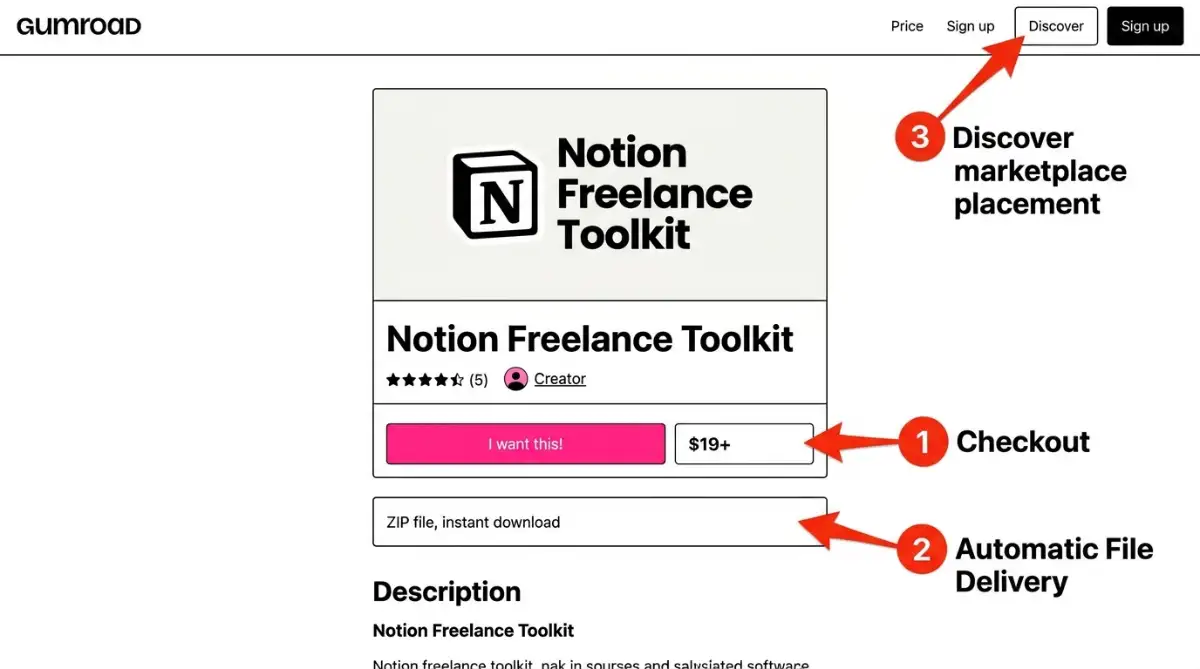
The platform handles hosted product pages, embeddable checkout, and automatic file delivery, so a seller never touches infrastructure. You can drop a checkout widget onto a Carrd or WordPress page, or send buyers straight to a Gumroad-hosted page. Its Discover marketplace even surfaces products to browsing shoppers, adding a discovery layer most simple checkout tools skip.
What Gumroad removed from selling online, in practice:
- Merchant accounts: payment processing is built in, with no bank underwriting.
- Dev work: no servers, databases, or checkout code to maintain.
- Manual delivery: files, license keys, and receipts all send automatically.
Gumroad's real product was never the checkout. It was deleting every step between making something and getting paid for it.
That deletion is the entire thesis. If you want the fuller picture of what counts as a no-code builder, the category has grown well beyond checkout, but Gumroad stays one of its cleanest examples.
The design choice that made this stick was hosting everything itself. A creator does not need their own domain, storefront, or hosting bill to start earning, which is a real difference from tools that only handle payment and leave the rest to you. For a course creator who wants to validate an idea this week, that self-contained setup is the whole point.
How Did a Weekend Project Become an $8M-Funded Startup?
Sahil Lavingia, a Pinterest and Turntable.fm designer who had dropped out of USC, built Gumroad over a single weekend in April 2011 to sell one icon. He launched it on Hacker News on April 4, and according to SaaS Club, the site drew roughly 50,000 first-day visitors with zero marketing spend. Product-market fit showed up before the funding did.
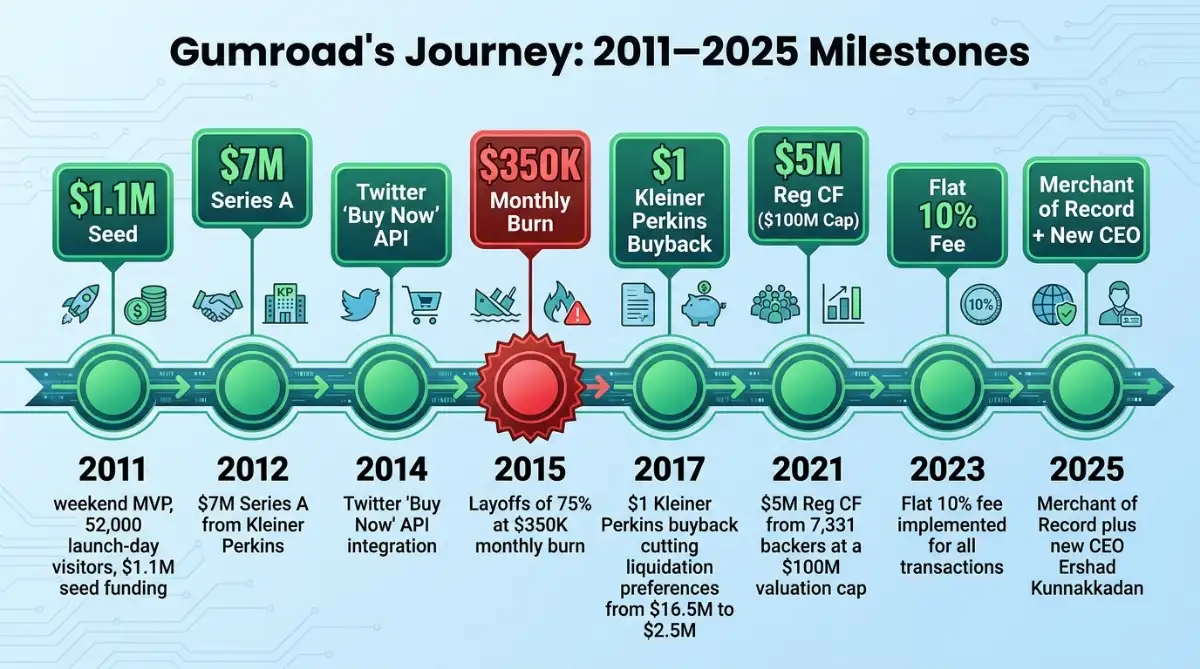
The money followed fast. A $1.1 million seed round led by Accel arrived in late 2011, with angels including Max Levchin, Chris Sacca, Marissa Mayer, Ron Conway, and Naval Ravikant, part of the $8 million-plus Gumroad raised before it changed course. Kleiner Perkins led a $7 million Series A in May 2012, and by 2014 Gumroad had a Twitter "Buy Now" button running on its payment API. Then the venture math caught up: the creator economy of 2015 was too small to sustain the 20% monthly growth a Series B needed.
The layoffs weren't a failure of the product. They were a mismatch between a venture timeline and a market that hadn't arrived yet.
| Year | Structural milestone |
|---|---|
| 2011 | Weekend MVP; $1.1M seed from Accel and angels |
| 2012 | Kleiner Perkins leads $7M Series A |
| 2014 | Twitter "Buy Now" API; official iOS Library app |
| 2015 | Series B stalls; 75% of staff laid off; Lavingia goes solo |
| 2017 | Kleiner Perkins sells its stake back for $1; platform hits cash-flow profitability |
| 2021 | $5M Reg CF crowdfund from 7,331 backers at a $100M cap |
| 2025 | Full Merchant of Record model; Ershad Kunnakkadan named CEO |
That $1 buyback in November 2017 is the pivot point. Lavingia consolidated ownership and cut total liquidation preferences from $16.5 million to $2.5 million, swapping the hunt for hyper-growth for a profit-first business. It mirrors the rise of solopreneurs that Gumroad's own customers were living through.
What Does Gumroad Actually Cost Creators in 2026?
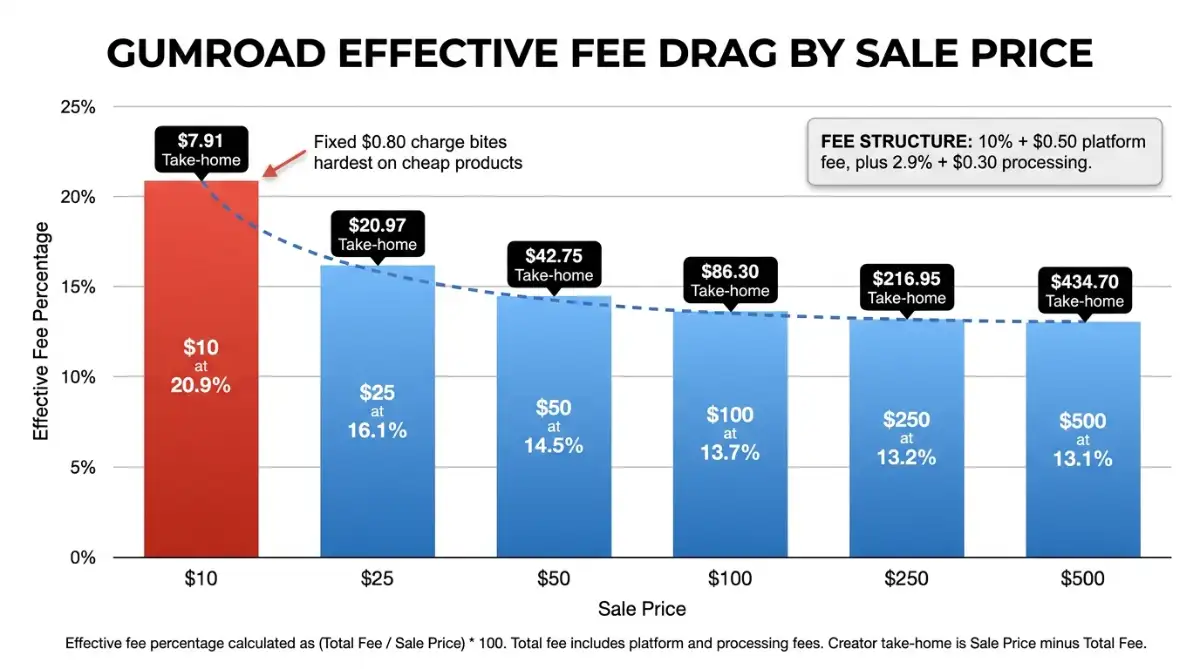
Gumroad charges a flat 10% platform fee plus a $0.50 per-transaction charge, then payment processing on top (2.9% + $0.30 for US Stripe cards). On a $10 sale the effective drag is about 20.9%, but on a $500 sale it falls to roughly 13.1%. The fixed cents punish cheap products hardest.
That flat 10% arrived in January 2023, replacing an older tiered system that ran from 2.9% up to 9%. The move was financially decisive: according to Sacra's teardown, Gumroad flipped from a roughly $1 million loss in 2022 to a $9 million profit in 2023 on about $21 million in revenue. Two extra costs catch creators off guard. Sales through the Discover marketplace carry a flat 30% fee, and on refunds Gumroad keeps its 10% cut, so a refunded $100 sale leaves the seller down about $13.98.
| Sale price | Total fees | Creator take-home | Effective drag |
|---|---|---|---|
| $10.00 | $2.09 | $7.91 | 20.9% |
| $25.00 | $4.03 | $20.97 | 16.1% |
| $50.00 | $7.25 | $42.75 | 14.5% |
| $100.00 | $13.70 | $86.30 | 13.7% |
| $250.00 | $33.05 | $216.95 | 13.2% |
| $500.00 | $65.30 | $434.70 | 13.1% |
Here's the part nobody puts on the pricing page: most sellers make very little. One creator who booked $61,411 in net sales in 2025 still ranked only #238 globally, per a widely shared Medium write-up, placing him in the top 1.22% of accounts. The long tail below him mostly earns under $5,000 a year, which is worth remembering before you test whether no-code tools actually make money.
How Does Gumroad's No-Code Operation Run on Zero Full-Time Staff?
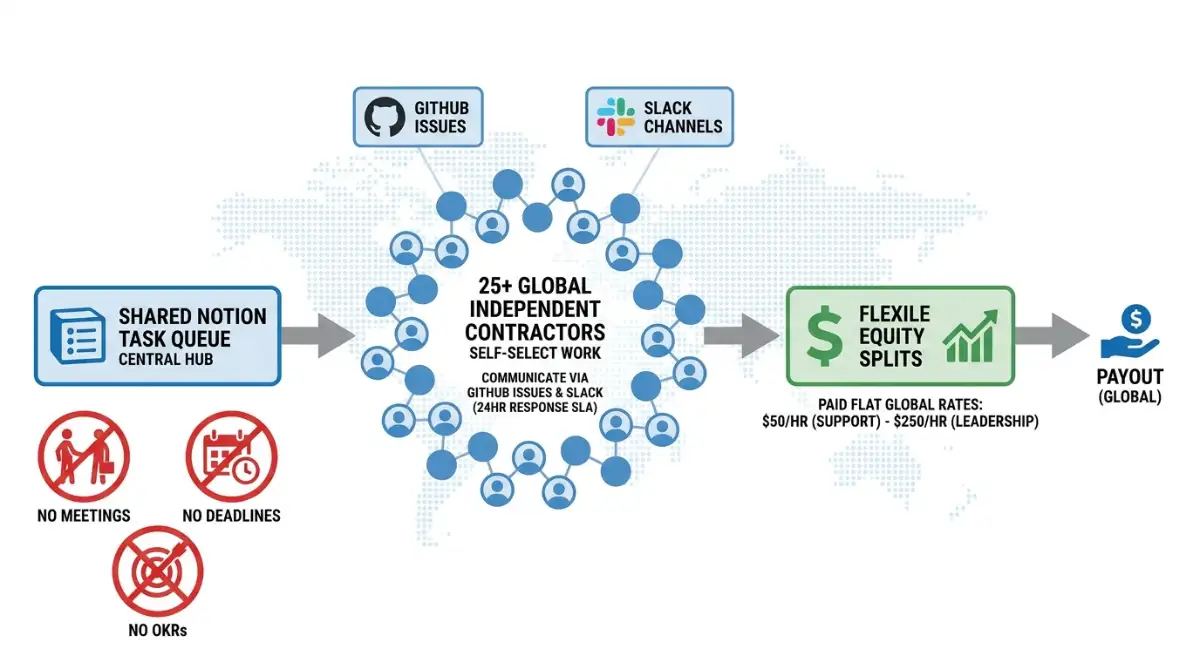
Gumroad generates over $20 million a year with no full-time employees. Instead, roughly 25 global contractors claim tasks from a shared Notion queue, with no meetings, no deadlines, and no OKRs. Flat hourly rates from $50 to $250 flow through Gumroad's own tool, Flexile, so pay stays consistent worldwide. Communication is written only.
The logic is what Lavingia calls avoiding the "alignment tax", the compounding waste of syncing calendars across a distributed team. Work happens through public GitHub issues, Notion cards, and occasional Slack, with a 24-hour response expectation rather than live calls. First Round Review has documented this flat structure in detail, and it screens hard for one trait: people who can write clearly and work without supervision.
Getting hired reflects that. Applicants pass a questionnaire, then an unpaid task that mirrors real production work, then a paid multi-week trial inside the actual repository.
| Vector | Traditional venture model | Gumroad model |
|---|---|---|
| Headcount | Full-time employees with benefits | ~25 global hourly contractors |
| Communication | Meetings, standups, syncs | 100% async Notion, GitHub, Slack |
| Compensation | Location-based salary | Flat global hourly via Flexile |
| Roadmap | Quarterly OKRs and sprints | Notion queue, ship when ready |
Gumroad didn't shrink its team to save money. It rebuilt the company itself like a product, stripping out every process that didn't ship value.
What Do AI Agents Like Devin and Gumclaw Actually Do at Gumroad?
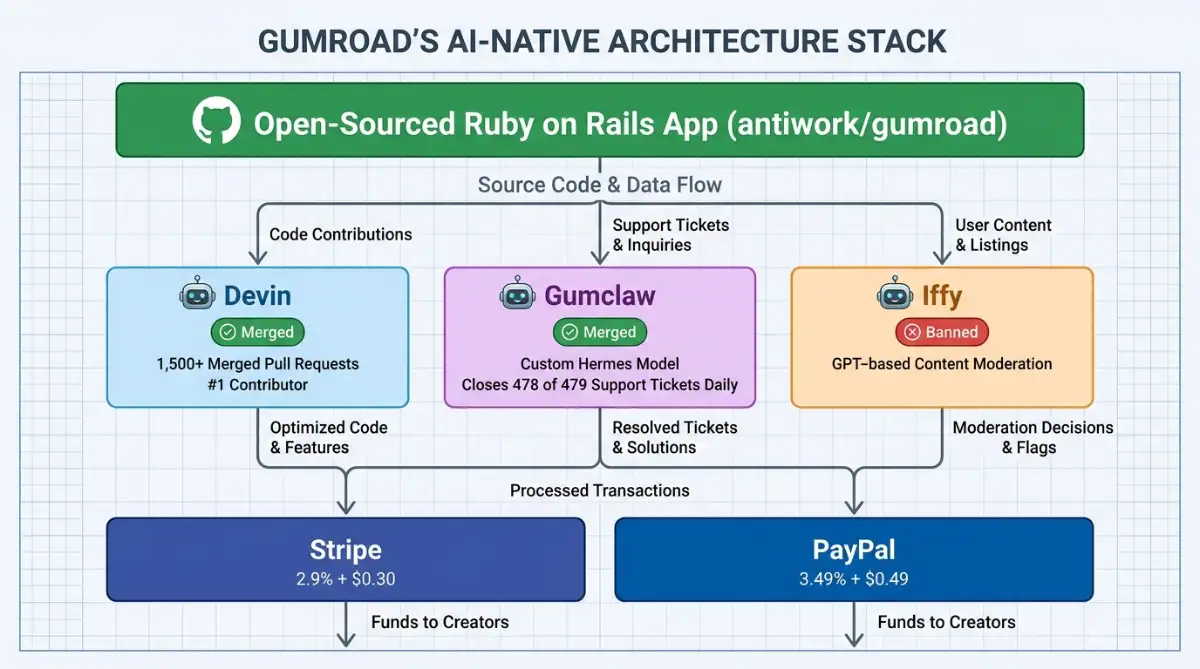
Gumroad open-sourced its Ruby on Rails codebase in April 2025 under the "antiwork" GitHub organization, exposing its schemas, routing, and payment webhooks to public review. That openness let the team wire autonomous AI agents straight into development. By Devin's own case study, the agent has merged over 1,500 pull requests, becoming the repository's most active contributor.
The agents run the business, not just the code. Gumclaw, built on a custom Hermes model, closes 478 of 479 support tickets in a typical 24-hour window, escalating only the single hardest case to a human. A separate GPT-based moderation API called Iffy scans listings and seller behavior to keep the payment gateways compliant with Stripe and PayPal.
That automation has a sharp edge. Independent sellers have reported instant, permanent account bans from Iffy with no human review or warning, laid out in one seller's permanent-ban account on Indie Hackers.
- Devin: fixes flaky tests, upgrades dependencies, runs multi-file refactors.
- Gumclaw: analyzes transaction risk, issues refunds, resolves payout disputes.
- Iffy: flags policy violations to protect Stripe and PayPal processing.
This all sits on top of Gumroad's January 2025 shift to full Merchant of Record status, where it legally resells creators' products and remits sales tax, VAT, and GST across thousands of jurisdictions. The compliance load that shift created is precisely why the moderation agents exist, echoing how Stripe made merchant accounts obsolete a decade earlier.
For solo sellers, the trade is stark. You offload every international tax headache to Gumroad, which is genuinely valuable, but you also hand a fraud-detection model the power to close your storefront overnight. That is the quiet cost of running a business on someone else's fully automated compliance stack.
How Does Gumroad Compare to Lemon Squeezy, Payhip, and Whop?
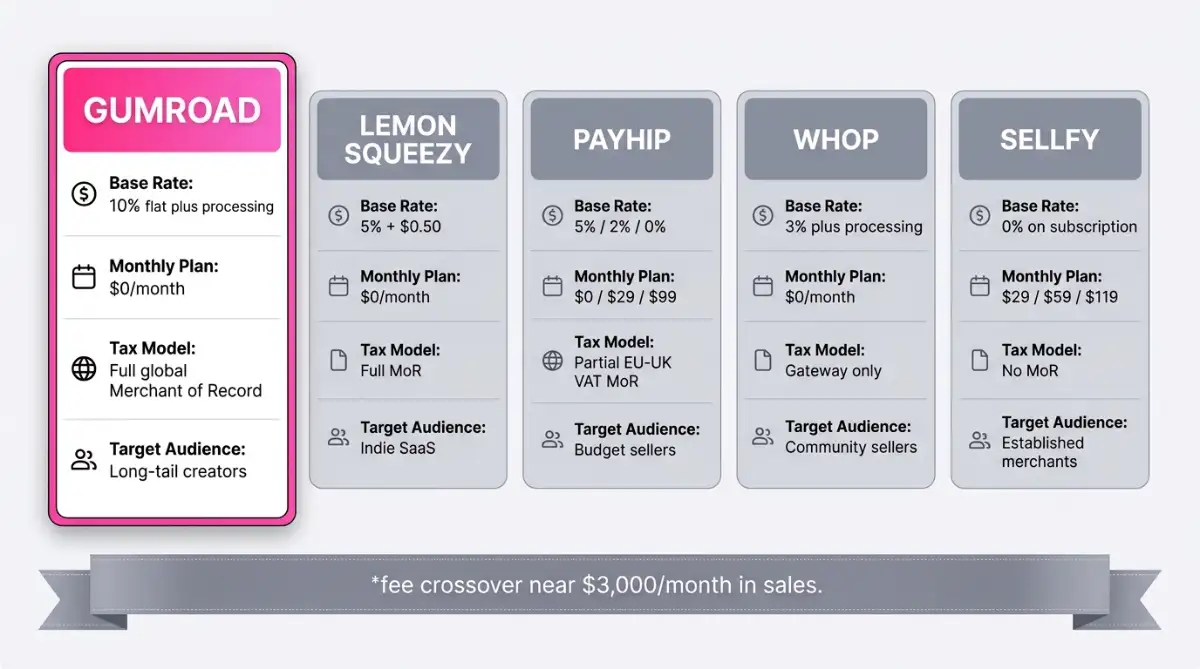
Gumroad's flat 10% wins for early creators who want zero upfront cost, but the math flips once monthly sales pass roughly $3,000. At that point subscription-based rivals get cheaper per transaction. Lemon Squeezy charges 5% + $0.50, Payhip scales down to 0% on its $99 plan, Whop takes 3%, and Sellfy offers 0% commission on its paid tiers.
Each platform is really built for a different seller. Gumroad suits validation and side projects; the others reward scale or a specific niche. The trick is knowing which stage you are actually in before you commit.
| Platform | Base rate | Monthly plan | Tax model | Best for |
|---|---|---|---|---|
| Gumroad | 10% flat + processing | $0 | Full global MoR | Long-tail creators, validation |
| Lemon Squeezy | 5% + $0.50 | $0 | Full global MoR | Indie SaaS, subscriptions |
| Payhip | 5% / 2% / 0% | $0 / $29 / $99 | Partial MoR (EU/UK VAT) | Budget-conscious sellers |
| Whop | 3% + processing | $0 | None (gateway only) | Community and Discord sellers |
| Sellfy | 0% (subscription) | $29 / $59 / $119 | None | Established merchants |
Gumroad is the cheapest place to start and one of the most expensive places to scale, and that tension is the whole trade.
My honest read: if you're selling your first ebook this month, the zero-cost entry beats optimizing fees you don't owe yet. Once you're consistently profitable, run the numbers against a flat-fee plan. That same graduation curve shows up across the space, from Shopify's push to democratize e-commerce to today's creator tools. You can see Gumroad's current setup on the Gumroad tool overview.
Start exploring launch-ready no-code templates here!
FAQ
What is Gumroad and how does it work? Gumroad is a platform for selling digital goods without any coding. Creators upload a product, set a price, and share a link or embed a checkout, while Gumroad handles payment processing and file delivery. It supports ebooks, courses, software, memberships, and design assets.
How much does Gumroad charge in 2026? Gumroad takes a flat 10% platform fee plus $0.50 per transaction, then payment processing of about 2.9% + $0.30 on top. Effective costs run near 21% on a $10 sale and drop toward 13% on higher-priced products. Discover marketplace sales carry a 30% fee.
Is Gumroad really run with no employees? Yes. Gumroad operates with roughly 25 global independent contractors and no full-time staff, coordinating asynchronously through Notion, GitHub, and Slack. There are no meetings or deadlines, and AI agents handle much of the coding and customer support, per Gumroad and First Round Review.
What are the best Gumroad alternatives? Lemon Squeezy (5% + $0.50) suits indie software and subscriptions, Payhip scales to 0% commission on paid plans, Whop (3%) fits community sellers, and Sellfy offers 0% commission on subscription tiers. The right pick depends on your monthly sales volume and product type.
What is a Merchant of Record and why does it matter? A Merchant of Record legally resells your product and takes on tax compliance, calculating and remitting sales tax, VAT, and GST worldwide. Gumroad became a full global MoR in January 2025, which removes international tax filing from solo creators but adds automated moderation risk.
Start building without code
Browse thousands of no-code templates for Webflow, Framer, Bubble, Lovable, Replit and more.
Explore Templates