How Memberstack Made No-Code Authentication Mainstream
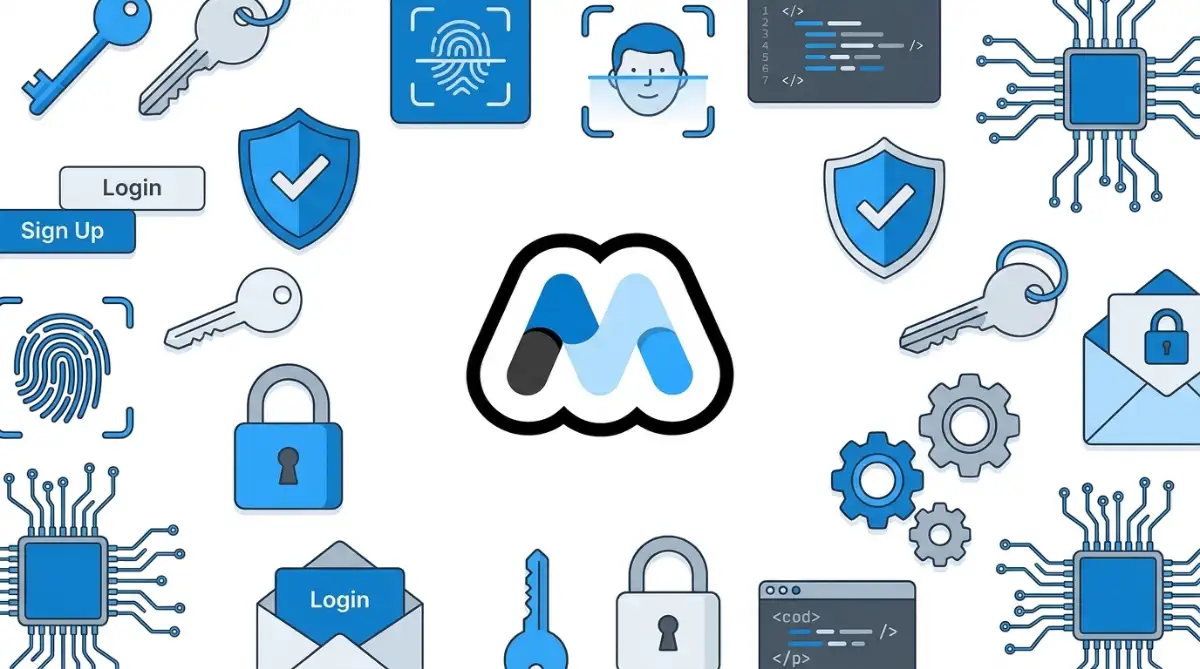
Memberstack changed no-code by letting builders add login, gated content, and Stripe subscriptions to static sites through HTML data-attributes, no server required. Founded in 2018 and launched in 2019, it turned authentication, the one thing visual builders couldn't fake, into a copy-paste snippet. That shift made full membership businesses possible without a backend team.
Table of Contents:
- Key Takeaways
- Introduction
- What Made Memberstack Different From Earlier No-Code Tools?
- How Did Two Virginia Developers Turn a Stripe Headache Into a Platform?
- How Does No-Code Authentication Actually Work in Memberstack?
- Why Did Webflow Hand Memberstack Its Biggest Growth Opportunity?
- What Are the Real Limits of No-Code Authentication?
- What Does Memberstack's Rise Tell Us About No-Code's Future?
- FAQ
Key Takeaways
- Memberstack's real trick was not a new builder but a data-attribute system that let designers gate content without writing a single line of server code.
- Webflow sunsetting its own User Accounts feature turned a competitor's retreat into Memberstack's biggest growth window, and the timing was no accident.
- The same client-side design that makes setup feel magical also bakes in a security tradeoff most no-code builders never fully read about.
Introduction
For years, indie builders and small design agencies could fake almost anything in a visual tool except one thing: a real login. You could design a gorgeous Webflow site in an afternoon, then hit a wall the second a client asked for member accounts and paid subscriptions. That gap is exactly where no code authentication stopped being a buzzword and started being a business.
Memberstack walked into that gap in 2019 with a deceptively simple idea. According to the platform's own figures, it now manages over 10 million member accounts and has handled more than $200 million in builder transactions. This is the story of how a Stripe headache became infrastructure, and what it taught the no-code world.
What Made Memberstack Different From Earlier No-Code Tools?
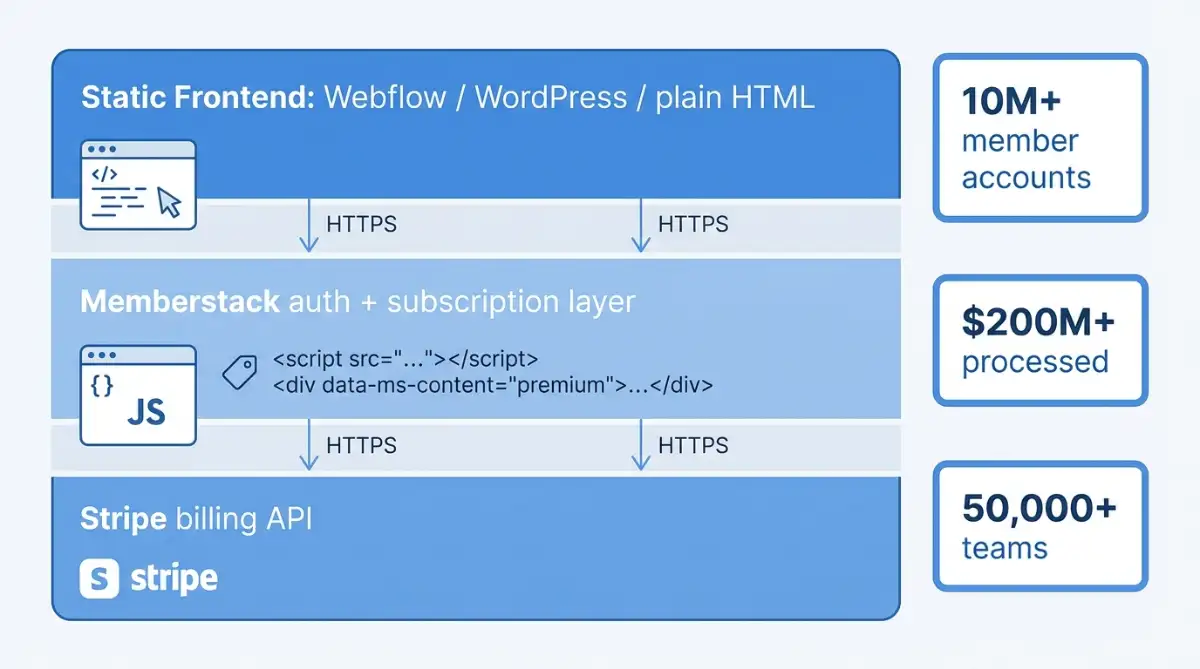
Earlier no-code tools nailed design and publishing but punted on the hard part: identity. Memberstack's difference was scope. Instead of being a website builder, it became a decoupled layer that overlays accounts, paywalls, and Stripe billing onto whatever frontend you already use. It solved the one job visual builders kept skipping.
Most platforms before it treated membership as a bolt-on. Wix and Squarespace bundled basic logins, but you were locked into their templates and their rules. Tools like Bubble's visual app builder could build full apps, but they owned your whole stack. Memberstack went the other direction.
It stayed deliberately small and portable:
- No proprietary backend to migrate into or out of later.
- Works across engines including Webflow, WordPress, and plain static HTML.
- Stripe-native billing, so subscriptions and dunning are handled upstream.
- Design stays yours, because forms and portals are styled inside your own builder.
Memberstack did not try to be the website. It tried to be the one part of the website that builders could never draw.
How Did Two Virginia Developers Turn a Stripe Headache Into a Platform?
Memberstack was founded in late 2018 in Williamsburg, Virginia, by Tyler Bell and Duncan Hamra, who had been building software together since 2014. The recurring pain was real and specific: they kept rebuilding the same Stripe integrations and identity logic for client after client. So Bell built one flexible system instead of fifty fragile ones.
The early arc reads like a textbook maker launch. The prototype was first called Authramp, and Hamra spun up a landing page to test whether other developers felt the same pain. They did. The public launch as Memberstack landed in March 2019, and by July 2019 it took the coveted top spot on Product Hunt as #1 Product of the Day.
Momentum followed fast:
| Milestone | Date | Detail |
|---|---|---|
| Public launch | March 2019 | Renamed from Authramp prototype |
| Product Hunt #1 | July 2019 | Product of the Day |
| Pre-seed round | January 2020 | Enabled team expansion |
| Y Combinator | Summer 2020 | YC S20 batch |
The funding figures come with an asterisk worth noting. Tracxn lists a single $150,000 seed, while PitchBook reports total capitalization of $1.32 million, including the 1517 Fund, Village Global, Alphabet, and Gradient Ventures. Either way, this was a lean, builder-led company, not a war-chest startup.
They were not chasing a market. They were scratching their own scar tissue, which is usually how the durable tools get made.
How Does No-Code Authentication Actually Work in Memberstack?
No code authentication in Memberstack works through declarative HTML attributes instead of scripts. You drop a JavaScript snippet in your site header, then tag elements with data-ms-* attributes. The library reads those tags, talks to Memberstack's identity servers over HTTPS, and handles login, gating, and billing. You describe what you want; the library does the wiring.
The mechanics break into a few clear moves:
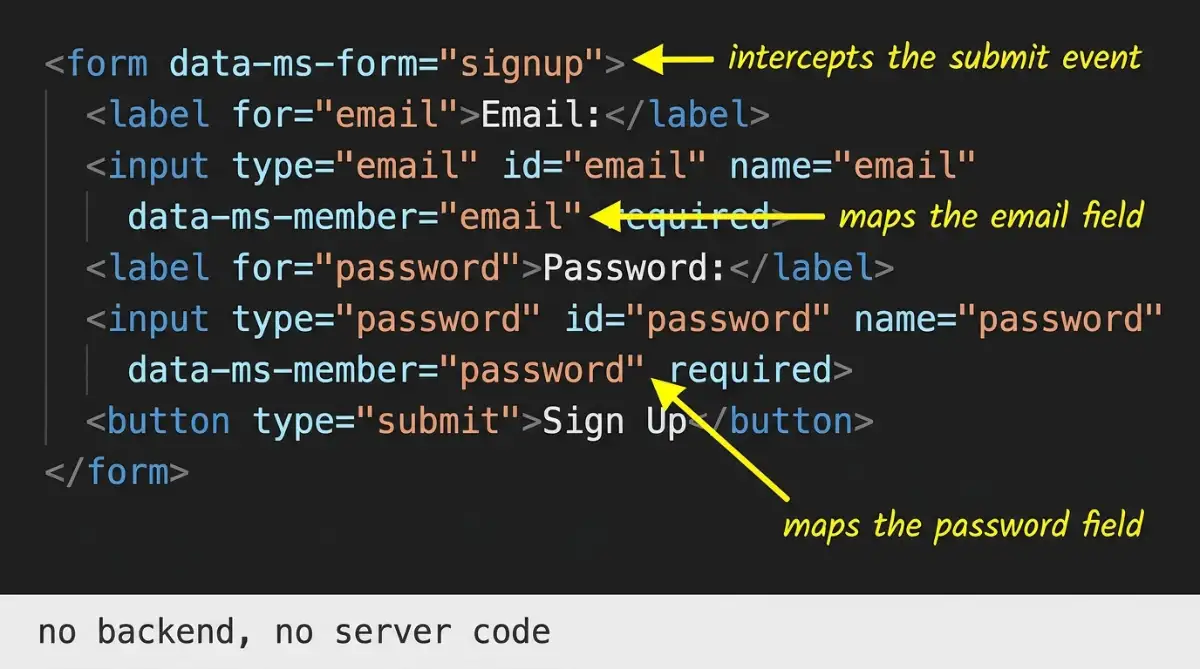
- Form mapping: add
data-ms-form="signup"to a form, mark fields withdata-ms-member="email", and submissions route to identity endpoints automatically. - Content gating: tag an element with a plan ID, and the script hides it (
display: none) or redirects users who lack access. - Hosted Content: sensitive HTML lives off-site and is injected only after the server approves, keeping it out of page source.
- Admin SDK: for serverless backends like Xano or Cloudflare Workers, a JSON Web Token gets verified server-side before any database query runs.
Underneath, Memberstack acts as an orchestration layer over Stripe's payment infrastructure, managing subscription states like active, trialing, past_due, and canceled. No custom database tables, no cron jobs. That is the part designers find genuinely freeing.
The genius is linguistic: it turns "only paying members can see this" into a single HTML attribute a designer can type from memory.
Why Did Webflow Hand Memberstack Its Biggest Growth Opportunity?
Webflow is sunsetting its native User Accounts feature as it repositions into a "Website Experience Platform." That deprecation strands every site relying on Webflow's built-in membership logic, and Webflow named Memberstack a primary migration partner. A competitor's exit became Memberstack's open door, with official endorsement attached.
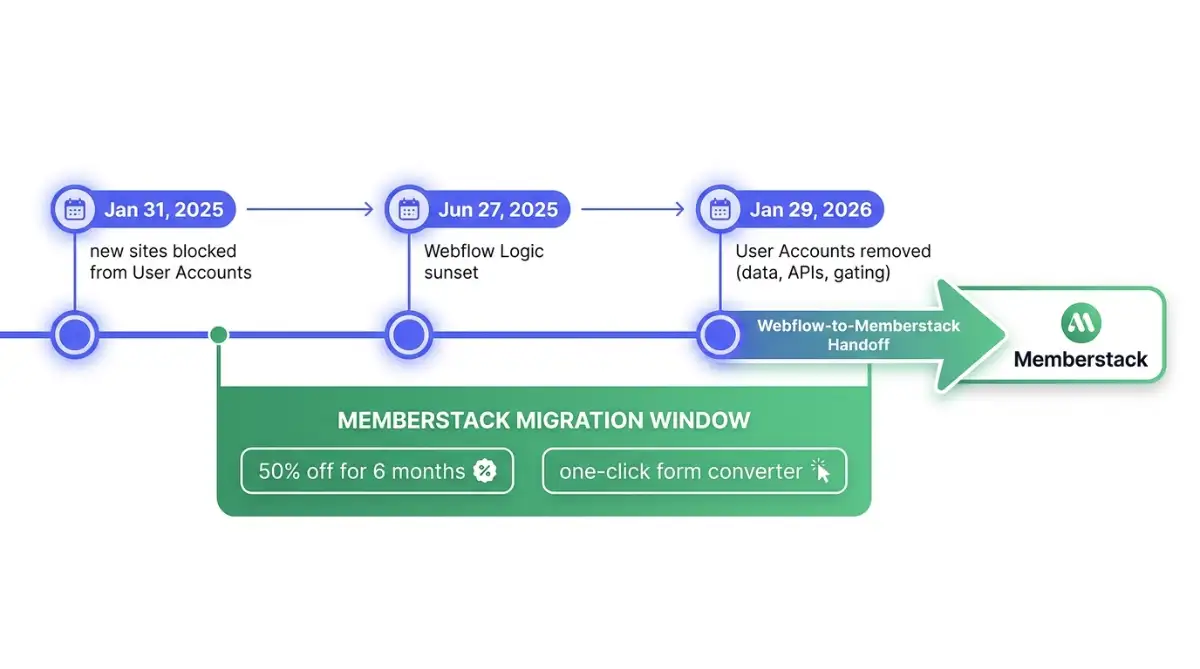
The timeline is blunt. Webflow blocked new sites from activating User Accounts on January 31, 2025, and plans to permanently remove the feature, its databases, APIs, and gating logic, on January 29, 2026. For agencies that built client membership sites on the native tool, that is a hard migration deadline, not a suggestion.
Memberstack sweetened the path considerably:
- 50% off any plan for six months for migrating customers.
- Hands-on migration support from the Memberstack team.
- An automated form converter that rewrites legacy Webflow User Accounts code into
data-ms-*attributes with one copy-paste.
It also shipped a Conversions and Analytics engine built on Clickhouse, offering signup funnels, retention cohorts, and visual A/B testing without external tracking pixels. I'll be honest, the converter tool is the smart move here. Migration friction is what keeps people stuck on dying features, and removing it is how you win a displaced market. This is no-code growth strategy at its most surgical, and it leans on the same designer trust Webflow spent years building.
What Are the Real Limits of No-Code Authentication?
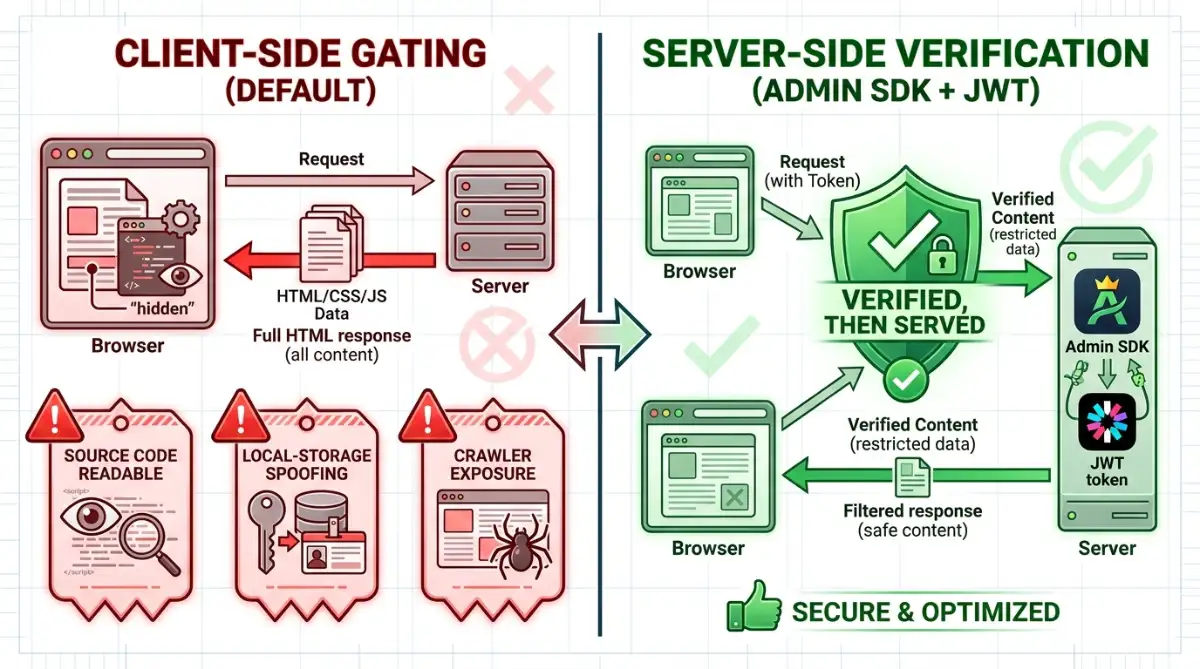
The convenience of no code authentication has a structural cost: standard gating runs in the browser, not on a server. By default, Webflow sends the full page to the visitor first, then Memberstack's script hides what they should not see. That means the protected content technically reached the device before permission was checked. It depends on your threat model whether that matters.
For a paid newsletter or a course portal, it usually does not. For regulated or genuinely sensitive data, it absolutely does. The documented weak points:
- Source-code leakage: gated text and private asset URLs can sit in the initial HTML response, readable by anyone inspecting the page.
- Local-storage spoofing: a savvy user can flip a session value or block the script to slip past redirects.
- Crawler exposure: misconfigured sitemaps can let non-JavaScript bots index private pages into search snippets.
Then there is uptime. Because static dashboards need live calls to Memberstack to render, an outage breaks customer access in real time. According to StatusGator, more than 79 disruptions have been logged since monitoring began in September 2025, including a system-wide outage on May 10, 2026 that lasted 1 hour and 20 minutes. Memberstack does offer Hosted Content and Admin SDK verification to close the security gaps, but both require more technical work, which quietly erodes the pure no-code promise. This tension sits at the heart of the broader no-code security debate.
Client-side gating is not fake security, but treating it as full security is the mistake that turns a feature into a liability.
What Does Memberstack's Rise Tell Us About No-Code's Future?
Memberstack proves a paid membership business no longer needs a backend team, and that fact reshapes who gets to build. It validated the Jamstack idea that a static, fast frontend can run real transactions by offloading identity and billing to specialized cloud endpoints. The next question is whether middle-layer tools survive the AI wave.
The success stories are concrete. The solo design subscription DesignJoy scaled to $2 million in annual recurring revenue on Webflow and Memberstack alone, and the components framework Relume reached a $35 million valuation while leaning on Memberstack for auth and subscription state. Those are not toys; they are proof that no-code apps can generate real revenue.
Where this goes next is genuinely uncertain:
| Platform | Entry cost | Entry take-rate | Focus |
|---|---|---|---|
| Memberstack | $29/mo | 4.0% | Webflow / WordPress / static |
| Outseta | $47/mo | 2.0% | Multi-CMS business suite |
| MemberSpace | $49/mo | 5.0% | Universal legacy CMS |
| RevenueCat | Free tier | 0.0% | Native iOS and Android apps |
The pricing reveals the pressure. Memberstack stacks a 4.0% take-rate on the Basic plan on top of Stripe's roughly 2.9% plus 30 cents, dropping to 0.0% only on the $499/mo Established tier. As generative AI and "vibe coding" make custom databases and Stripe wiring cheaper to spin up, that middle-tier premium faces real deflationary pressure.
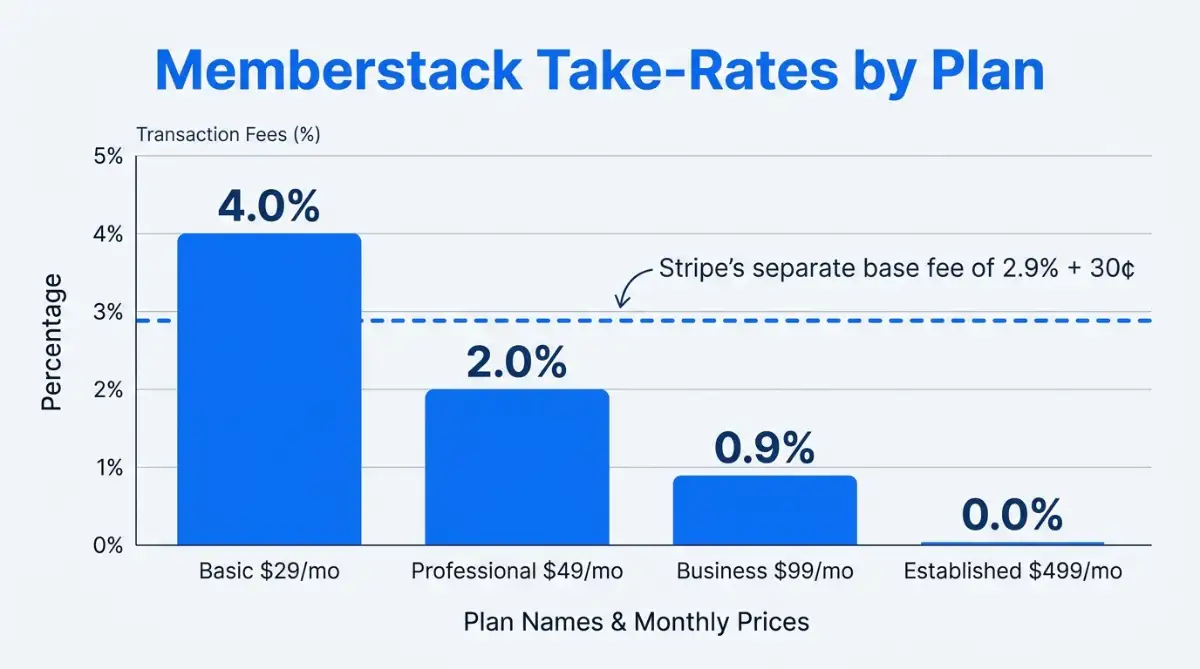
Memberstack's bet is that visual polish, component libraries, and frictionless setup stay worth paying for even when the underlying no-code stack gets commoditized.
Start exploring launch-ready no-code templates here!
FAQ
What is no-code authentication? No-code authentication is the ability to add user logins, accounts, and gated content to a website without writing server code. Tools like Memberstack handle it through configuration, often HTML attributes or simple snippets, instead of custom backend programming.
Is Memberstack free to use? Memberstack does not have a permanent free tier for live billing. Paid plans start at $29 per month on the Basic plan, which supports up to 1,000 members and carries a 4.0% transaction fee on top of standard Stripe processing charges.
How is Memberstack different from Webflow Memberships? Webflow Memberships was a native feature being sunset on January 29, 2026, after which its databases and gating logic are removed. Memberstack is an independent layer that works across Webflow, WordPress, and static sites, and Webflow named it a primary migration partner.
Is client-side content gating actually secure? It depends on your needs. Client-side gating suits paid content like courses and newsletters but is not safe for regulated or highly sensitive data, since pages can be sent before permission checks. Server-side verification through Memberstack's Admin SDK closes that gap.
What happens to my Webflow membership site after the sunset? After January 29, 2026, Webflow removes native User Accounts entirely, so affected sites lose login and gating. Memberstack offers an automated form converter, migration support, and 50% off for six months to ease the transition.
Start building without code
Browse thousands of no-code templates for Webflow, Framer, Bubble, Lovable, Replit and more.
Explore Templates