The Maker Movement and How Solopreneurs Took Over
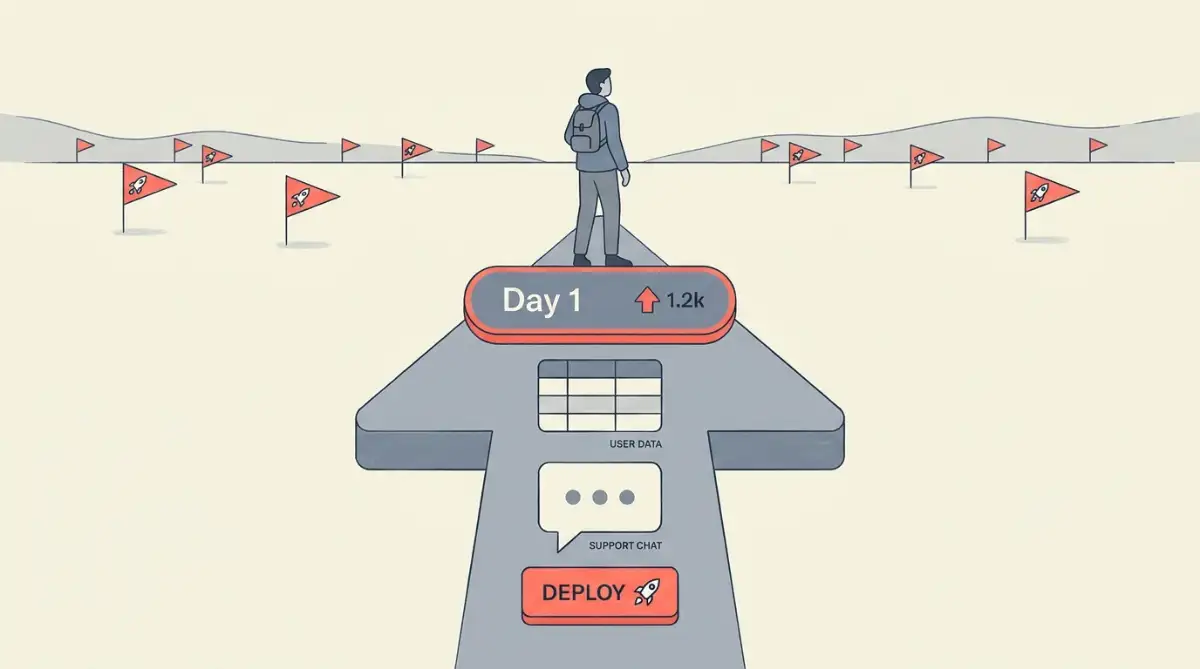
The maker movement is the cultural and technical shift that turned non-coders into software builders through low-code tools, AI agents, and launch platforms like Product Hunt. It started accelerating in 2013 and now powers a $65 billion global market of citizen developers.
Table of Contents
- Key Takeaways
- Introduction
- Why Did Product Hunt Become the Heart of the Maker Movement?
- How Did Citizen Developers Become a 16-Million-Person Workforce?
- The Validation Stack: How Solopreneurs Actually Launch in 2026
- Why Did Indie Hackers and BetaList Matter as Much as Product Hunt?
- Where the Maker Movement Breaks: Spam, Shadow IT, and Pay-to-Win Rankings
- Honest Tradeoffs
- FAQ
Key Takeaways
- Product Hunt did not invent the maker movement, but its November 2013 launch built the distribution layer solopreneurs had been missing for a decade.
- The $20 million AngelList acquisition in 2016 sounds small, and that price tag tells a story the headlines usually skip.
- Citizen developers now outnumber traditional engineers in entire job categories, and the cause is not what most "AI is replacing coders" takes assume.
Introduction
In November 2013, a former product guy at PlayHaven sent out an email newsletter to a handful of friends. According to Wired's December 2015 reporting, Ryan Hoover built that first version of Product Hunt on Linkydink, a tool meant for sharing links by email. Twelve years later, that newsletter has mutated into the launch infrastructure for an entire generation of solopreneurs who never learned to code yet still ship full-stack apps before lunch.
This piece traces how that happened, who built the rails, and what solopreneurs need to understand about citizen developers, validation hubs, and the messy economics behind a discovery feed that now serves 3.37 million monthly visits.
Why Did Product Hunt Become the Heart of the Maker Movement?
Product Hunt became central because it solved distribution, the one problem solopreneurs could not code their way out of. Founded by Ryan Hoover on November 6, 2013, the platform grew from an email list into a daily leaderboard that aggregates the attention of investors, journalists, and early adopters in one place. It gave makers a stage when nothing comparable existed.
The growth story moved quickly. According to Wired's December 2015 feature, Hoover and Nathan Bashaw built the first web version over Thanksgiving 2013, then secured Y Combinator backing in July 2014 and a $6.1 million Series A from Andreessen Horowitz that fall. Product Hunt won TechCrunch's "Best New Startup" Crunchie Award on February 5, 2015, a recognition that put the platform on every founder's radar.
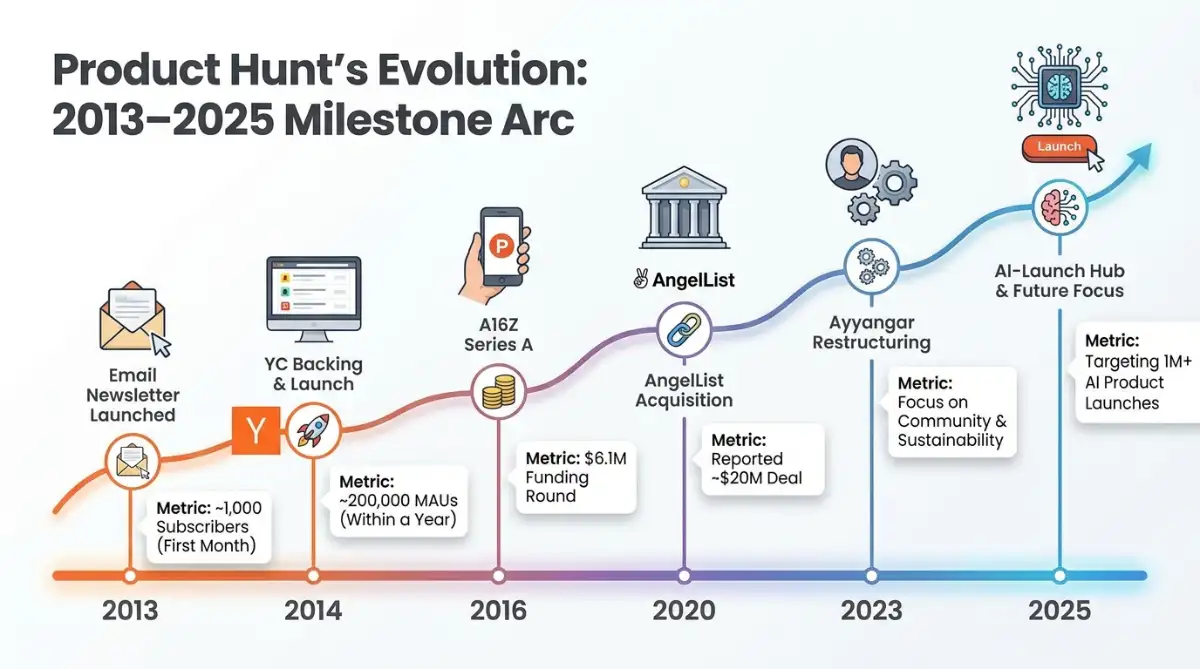
What makes Product Hunt unusual is the asymmetric value it offers solopreneurs. A bootstrapped builder with no marketing budget can land on the daily leaderboard and reach the same eyeballs as a Series B startup. That single mechanic, peer voting on a public board, is the engine.
One newsletter, built over a weekend, became the launchpad for an entire economy of non-technical builders shipping software they never learned to write.
How Did Citizen Developers Become a 16-Million-Person Workforce?
Citizen developers became a workforce because the tools finally caught up to the demand. According to Forrester Research, there are 16.2 million citizen developers worldwide as of 2026, compared to 28.7 million professional developers. That ratio would have been laughable a decade ago. Today it reflects a structural reorganization of who actually builds software.
The market math is wild. According to the Gartner Market Guide, the global low-code and no-code platform market is valued at $65 billion in 2026, growing at a 26.1% CAGR since 2022 toward a projected $94 billion by 2028. IDC reports a global shortage of roughly 4 million full-time software developers, which means companies stopped treating citizen development as experimental and started treating it as survival.
| Metric | 2024 | 2026 | Source |
|---|---|---|---|
| Enterprise LCNC adoption | 65% | 77% | Forrester, 2026 |
| Formal governance policies | 42% | 78% | Gartner, 2026 |
| Avg project time (weeks) | n/a | 3.2 vs 14.8 | McKinsey, 2026 |
| Dev cost reduction | n/a | 62% | Forrester, 2026 |
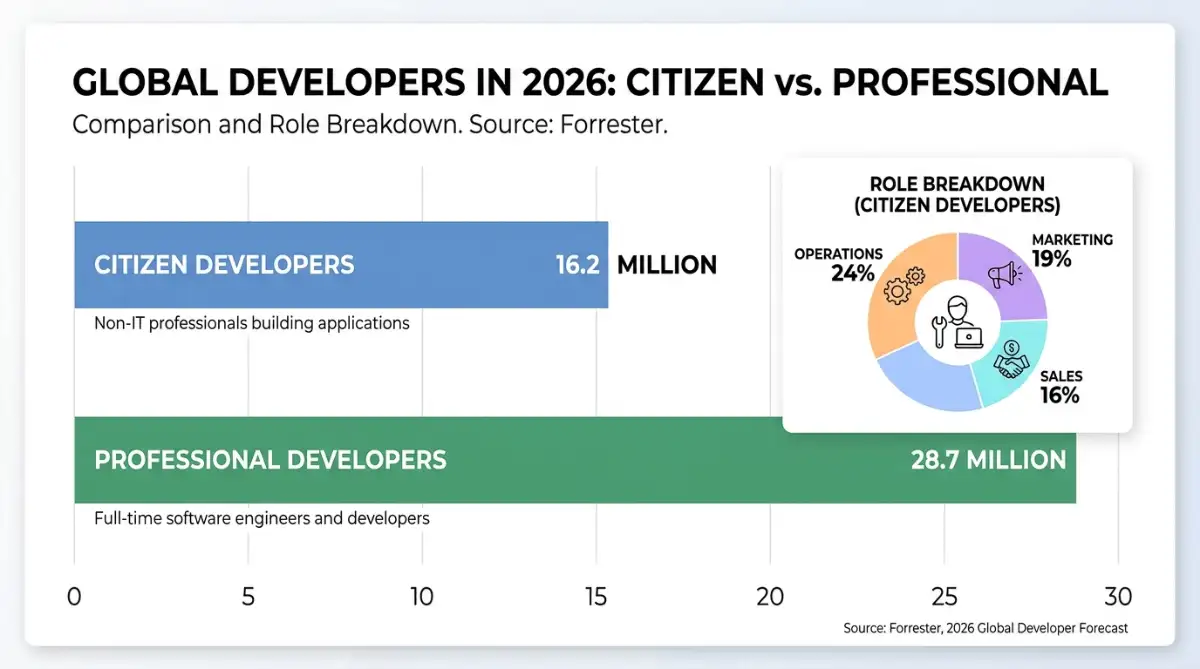
The demographic mix tells the deeper story. Forrester reports that operations managers (24%), marketing managers (19%), and sales managers (16%) make up the bulk of citizen developers. These are not failed engineers. They are domain experts who finally got tools that match their skill ceiling.
When 16.2 million people can ship software without writing a single line of syntax, the bottleneck stops being code and starts being attention.
The Validation Stack: How Solopreneurs Actually Launch in 2026
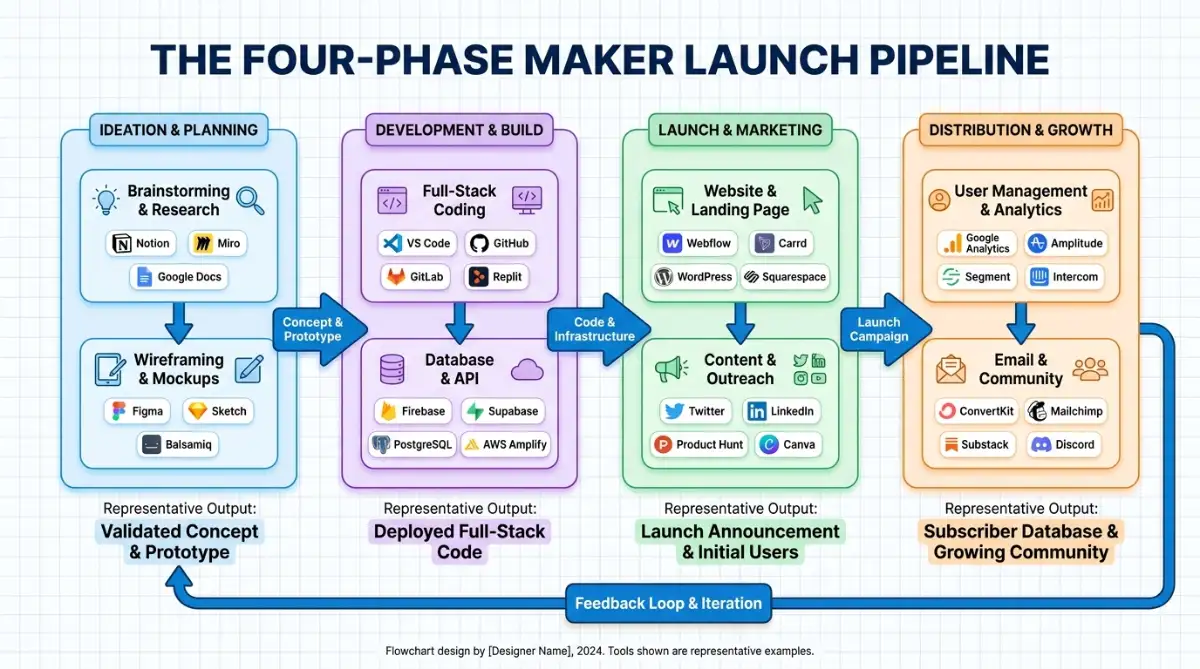
Solopreneurs launch in 2026 by stitching together four distinct layers: ideation, assembly, pre-launch validation, and distribution. Each layer has dominant platforms, and the smart move is matching the right tool to your actual stage instead of trying to do all four inside one product.
Here is the modern stack solopreneurs are running:
- Ideation: Cursor, v0 by Vercel, and Bolt.new generate functional UI from natural language prompts
- Assembly: Lovable runs full-stack React with Supabase integration; Bolt.new uses WebContainers to compile Node.js inside the browser
- Pre-launch: Product Hunt Ship and BetaList capture email signups and beta testers before a public launch
- Distribution: Product Hunt's leaderboard, Indie Hackers community, and Twitter/X amplify launch-day traffic
The Lovable numbers are worth pausing on. According to TechFundingNews reporting from December 2025, Lovable raised a $330 million Series B at a $6.6 billion valuation, hit $200 million in ARR, and supports over 100,000 daily projects. That is not a tool. That is infrastructure.
Honestly, this is where most first-time solopreneurs trip. They pick a builder, ship something, and assume distribution will happen on its own. It will not. The validation layer is where launches live or die, and it is the layer most makers skip.
The 2026 solopreneur stack treats coding as the cheapest input and distribution as the scarce one, which inverts the entire 2010s startup playbook.
Start exploring launch-ready no-code templates here!
Why Did Indie Hackers and BetaList Matter as Much as Product Hunt?
Indie Hackers and BetaList mattered because they served the parts of the maker journey Product Hunt was not built for. BetaList focused on pre-launch validation and email capture, while Indie Hackers gave bootstrapped solopreneurs a place to share transparent revenue and operational truths. Together they completed the discovery ecosystem.
The backstories are worth knowing. BetaList was founded in 2011 by Marc Köhlbrugge as a free submission service for pre-launch startups. According to Köhlbrugge's September 2021 Typefully retrospective, the platform eventually featured over 15,000 companies and generated nearly $1 million in cumulative revenue. By 2026, BetaList removed its free submission tier entirely and established a minimum entry fee of $39, a pivot that drew predictable criticism on Reddit's r/SaaS in November 2025.
Indie Hackers had an even stranger path. Courtland Allen launched it in August 2016. Stripe acquired it in April 2017 to support online business growth, then spun it back out to Allen in March 2023 at exactly $0 in monthly recurring revenue. As Allen put it in his April 2023 farewell post:
"Specifically, this means we're back to running Indie Hackers as a standalone business, owned by the founders."
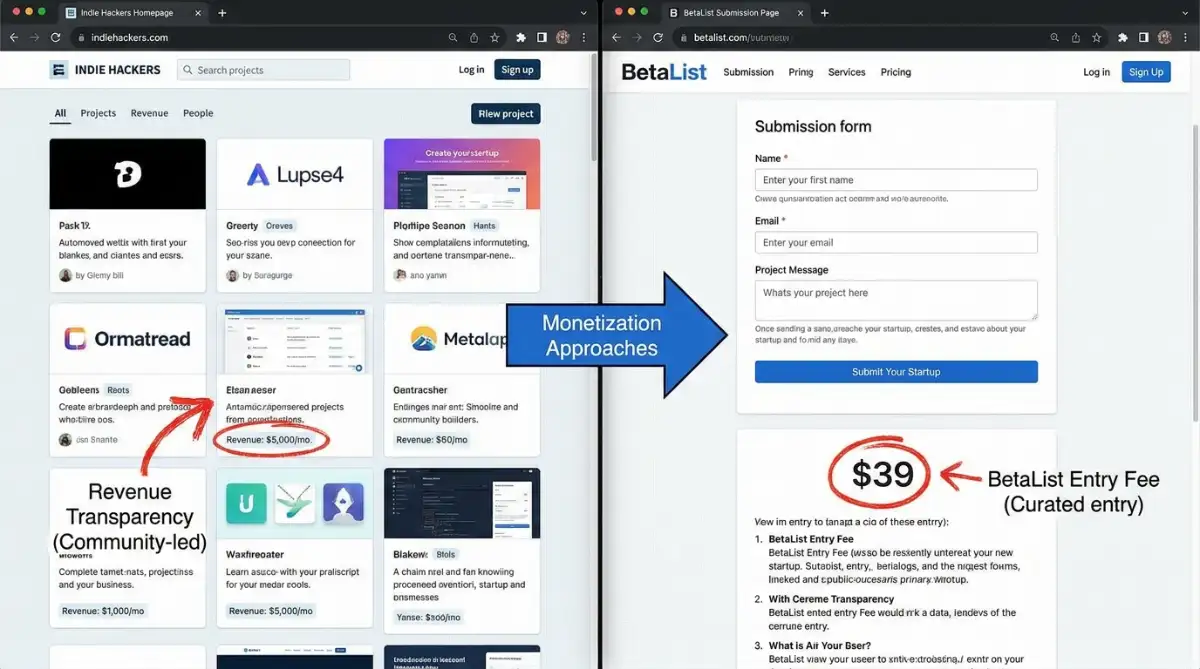
For solopreneurs, the practical lesson is that the maker stack is not a single platform. It is a relay. BetaList captures pre-launch demand, Indie Hackers builds community and credibility, and Product Hunt delivers the launch-day spike. Treating any one of them as the whole game is how launches flop.
If the historical thread interests you, the pre-launch validation playbook many solopreneurs still use draws directly from this three-platform pattern.
Discovery did not consolidate into one winner because pre-launch, community, and launch-day distribution are genuinely different problems requiring different tools.
Where the Maker Movement Breaks: Spam, Shadow IT, and Pay-to-Win Rankings
The maker movement breaks at two intersecting points: discovery platforms struggle with manipulation, and enterprise IT struggles with ungoverned tools. Both problems trace back to the same root cause, which is that lowering the barrier to ship software also lowered the barrier to ship abuse.
The Product Hunt manipulation problem is well documented. Founders frequently report unsolicited offers from marketing networks promising guaranteed top-five leaderboard placement through coordinated voting rings. Paid promotions on the platform itself cost roughly $4,000 per day, fueling a pay-to-win sentiment among bootstrapped solopreneurs. According to Hacker News discussions from February 2023, the platform also faces an influx of ChatGPT-generated comment spam.
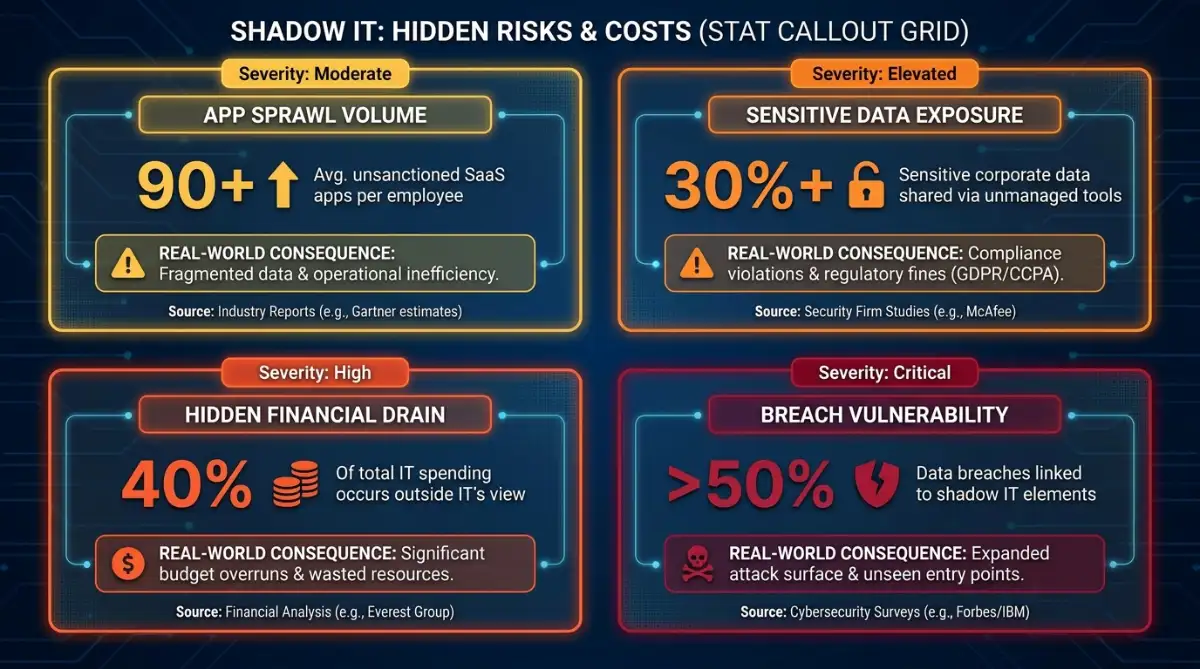
The shadow IT numbers are scarier. Here is the breakdown:
- 80% of enterprises experience unauthorized software usage (Uniqkey, 2025)
- 30 to 40% of total enterprise IT spending goes to shadow IT (Flexera, 2026)
- $135,000 average annual software license waste per organization (Flexera, 2026)
- $670,000 added breach cost when shadow AI is involved (IBM, 2025)
The Disney incident is the cautionary tale every solopreneur eyeing enterprise sales should know. According to UpGuard's 2025 reporting, an unapproved AI art tool infected with malware led to the unauthorized exposure of 44 million internal corporate Slack messages at The Walt Disney Company. Samsung engineers separately leaked proprietary source code by pasting internal schemas into public ChatGPT, triggering a company-wide ban on generative AI tools.
Product Hunt has responded with programmatic spam detection, LinkedIn-verified logins, and a doubled human moderation team. Whether those measures hold against AI-generated manipulation is the open question heading into the next launch cycle.
The maker movement's biggest vulnerability is not bad code, it is the fact that frictionless creation also produces frictionless abuse, and neither platform owners nor IT departments have caught up.
Honest Tradeoffs
The maker movement narrative is genuinely exciting, and the boring parts get glossed over too often.
What the movement gets wrong about itself: The "anyone can build" framing oversells what tools like Lovable and Bolt actually produce. They generate functional MVPs, not maintainable production codebases. Forrester's 74% faster time-to-market stat is real, but it comes with the silent footnote that traditional engineers usually get pulled in later to refactor.
Who it is not for: Solopreneurs working on regulated financial products, healthcare data, or anything requiring custom encryption protocols. The "no-code can do it all" pitch breaks fast at the compliance boundary.
Where the obvious narrative cracks: Product Hunt's $20 million AngelList acquisition is sometimes framed as a triumphant exit. It was a modest one. According to Inc. Magazine's December 2016 coverage, the deal closed at a price that, in venture terms, suggests the platform had not figured out monetization at the scale its traffic suggested. GetLatka's 2024 figures show Product Hunt finally reaching $3.9 million in ARR, up from $2.2 million in 2023, a respectable bootstrap number but well below what its cultural footprint implies.
What experts disagree on: Even Gartner publishes conflicting LCNC market sizes. The $65 billion figure sits alongside a separate $30 billion projection and a third $44.5 billion estimate, all from the same firm. Treat any single number with appropriate skepticism.
FAQ
What is a citizen developer? A citizen developer is an employee who builds software using low-code or no-code platforms instead of writing traditional code, usually working outside the formal IT department. They typically come from operations, marketing, or sales roles.
Is Product Hunt free for solopreneurs to launch on? Yes, launching a product on Product Hunt is free. Paid promotions run around $4,000 per day and job postings cost $299, but the standard launch pathway through the daily leaderboard does not require any payment.
What is the difference between low-code and no-code? No-code platforms like Lovable and Bolt.new let users build software entirely through visual interfaces and natural language. Low-code platforms allow some custom scripting alongside visual builders, giving developers a middle ground between speed and flexibility.
How does BetaList compare to Product Hunt? BetaList focuses on pre-launch validation and email capture for unreleased products, while Product Hunt focuses on launch-day discovery. As of 2026, BetaList charges a minimum $39 entry fee, whereas Product Hunt remains free to launch on.
Are no-code tools good for non-tech founders building serious businesses? Yes, but with limits. Solopreneurs use tools like Lovable and Bolt to validate ideas and ship MVPs quickly, though scaling to enterprise complexity often requires traditional engineers to refactor the generated codebase later.
Start building without code
Browse thousands of no-code templates for Webflow, Framer, Bubble, Lovable, Replit and more.
Explore Templates