Make Automation: How Visual Logic Beat Linear Zaps
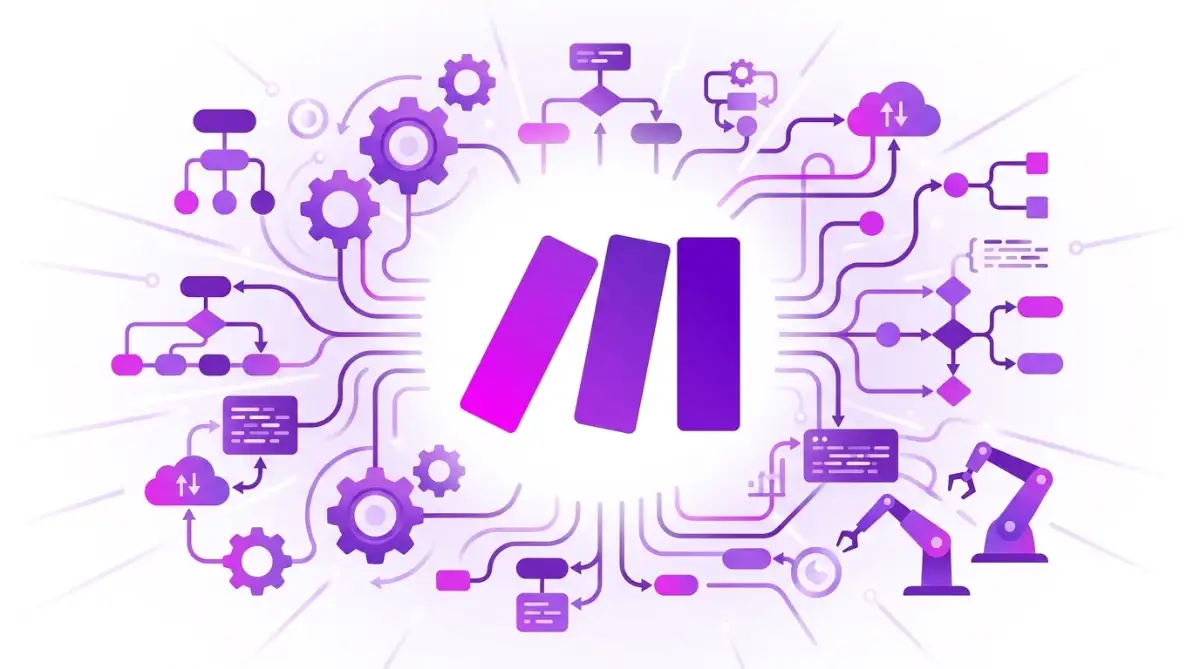
Make (formerly Integromat) is a cloud automation platform that builds workflows as visual node graphs, so branching, looping and array handling happen on a canvas rather than in code. It is used mainly by operations teams and automation agencies who need multi-step logic that linear trigger-action tools handle awkwardly.
Table of Contents:
- Key Takeaways
- Introduction
- What Makes Make Automation Different From Linear Tools?
- How Did Integromat Grow From Prague Side Project to a $100M Exit?
- Why Did the Integromat Rebrand Damage Its Search Presence?
- What Happens When a Make Automation Scenario Fails?
- How Much Does Make Cost After the 2025 Credit Switch?
- Is Make Turning Into an AI Agent Platform?
- Honest Tradeoffs
- Frequently Asked Questions
Key Takeaways
- Integromat spent roughly four years in private development before its public launch, and that unusually long runway is why its canvas handles nested logic rivals still struggle with.
- The March 2022 rebrand to Make bought Celonis strategic room and cost the platform years of accumulated search equity, a trade the community argued about loudly.
- August 2025's switch from operations to credits quietly changed who Make is cheap for, and polling-heavy builders were the ones who noticed first.
Introduction
Six co-founders in Prague funded their own integration tool with roughly 15 million CZK, about €600,000, pulled from other engineering work rather than from investors. Eight years later Celonis bought it, and make automation became the default canvas for the operations consultants and small automation agencies who build client workflows for a living. I have watched an agency owner screen-share a scenario during a sales call and win the deal on the picture alone, because the client could finally see their own process.
The interesting part is not the exit. It is that a bootstrapped Czech team spent years refining a graph-based execution model while most of the category shipped simple trigger-action bridges.
Here is how the canvas actually works, what it costs after the credit change, and the three limits that stop teams cold.
What Makes Make Automation Different From Linear Tools?
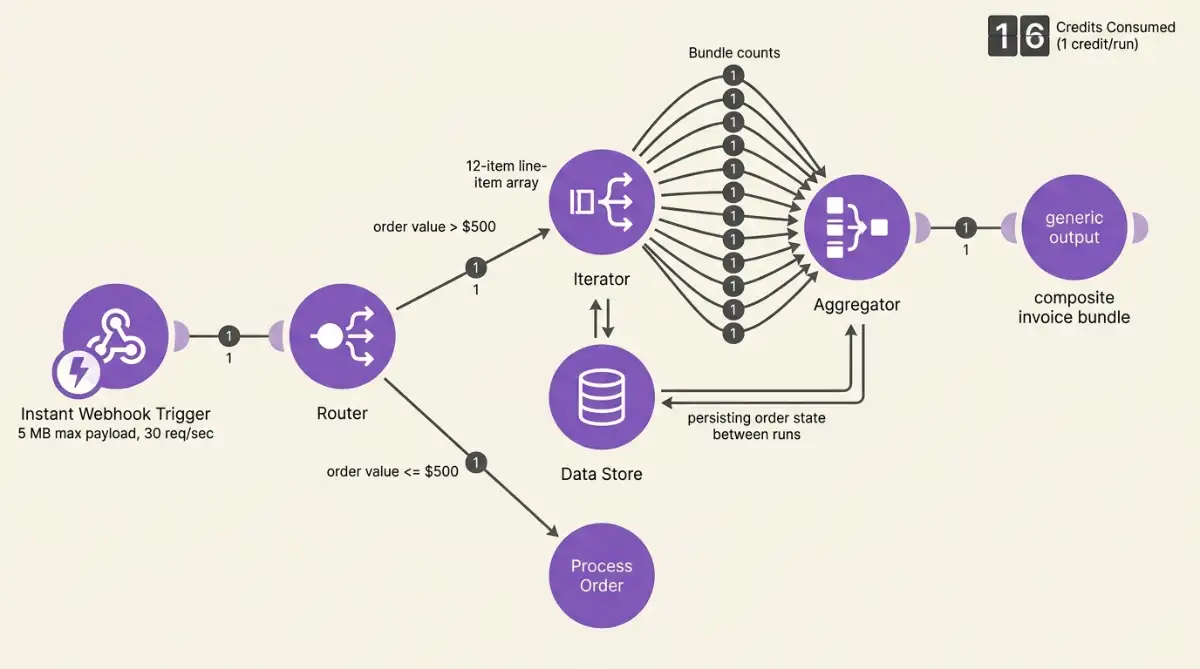
Make runs on a node graph instead of a step list. A scenario is a set of connected modules where triggers emit packets of data called bundles, routers split the flow into conditional branches, iterators break arrays apart, and aggregators put them back together. Loops and branching are native behaviour, not workarounds.
That difference sounds academic until you hit an array. Compare it to Zapier's original trigger-action model, where anything nested turns into a chain of helper steps and filters.
The canvas is built from seven primitives, and six of them do most of the work:
- Triggers either poll an endpoint on a schedule or listen continuously through webhooks.
- Routers split one stream into several conditional paths, each with its own filter.
- Iterators turn an array inside a bundle into separate bundles processed one at a time.
- Aggregators collect those bundles back into a single array or composite document.
- Data stores are Make's built-in key-value database, holding state between separate runs.
- HTTP and JSON modules hit any REST or GraphQL endpoint when no prebuilt connector exists.
Make sits closer to the low-code developer middle ground than to click-together builders, without ever asking you to open an editor.
The moment a workflow has to loop through 400 line items and rejoin them into one invoice, the linear model stops being a simplification and becomes a wall.
How Did Integromat Grow From Prague Side Project to a $100M Exit?
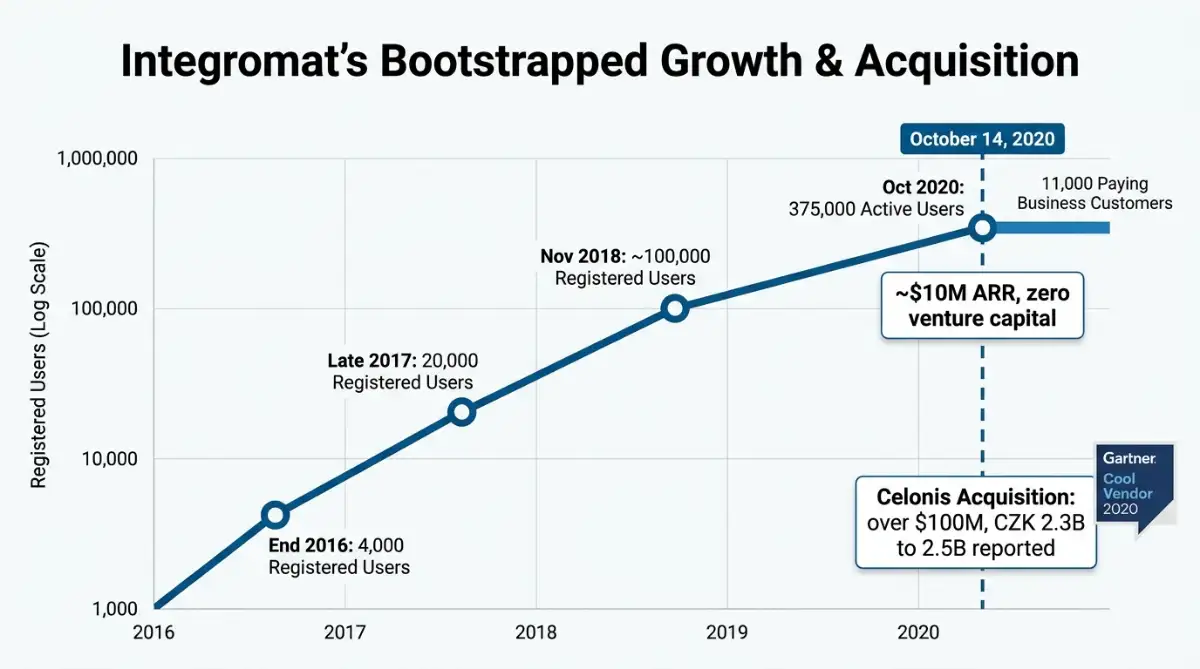
Integromat was founded in Prague in 2012 by six co-founders, including CEO Ondřej Gazda and CTO Patrik Šimek, and it stayed bootstrapped for its entire independent life. It launched publicly in mid-2016, grew organically for four years, then sold to process-mining firm Celonis SE in October 2020.
The growth curve is the part I find genuinely unusual, because there was no funding round propping it up while the rest of the no-code platform category raised aggressively. According to the company's own reported figures, adoption climbed steadily:
| Milestone | Registered or active users | Paying business customers |
|---|---|---|
| End of 2016 | 4,000 | Not disclosed |
| Late 2017 | 20,000 | Not disclosed |
| November 2018 | ~100,000 | Not disclosed |
| October 2020 | 375,000 active | 11,000 |
By the acquisition, Gartner had named Integromat a Cool Vendor in Business Process Automation, and annual recurring revenue sat near $10 million. Czech financial reporting at the time cited a transaction value between CZK 2.3 billion and CZK 2.5 billion, and TechCrunch's report on the deal captured the only figure Celonis would give.
Celonis co-CEO Alexander Rinke described the price as "a three-digit amount of over $100 million," confirming the scale of the exit without naming a precise figure.
Šimek has been blunt about the origin story, which started as an internal time-saver rather than a product plan.
"Integromat is a project whose primary purpose was to save us time, and the idea that we could turn it into a cloud integration platform came only later."
Why Did the Integromat Rebrand Damage Its Search Presence?
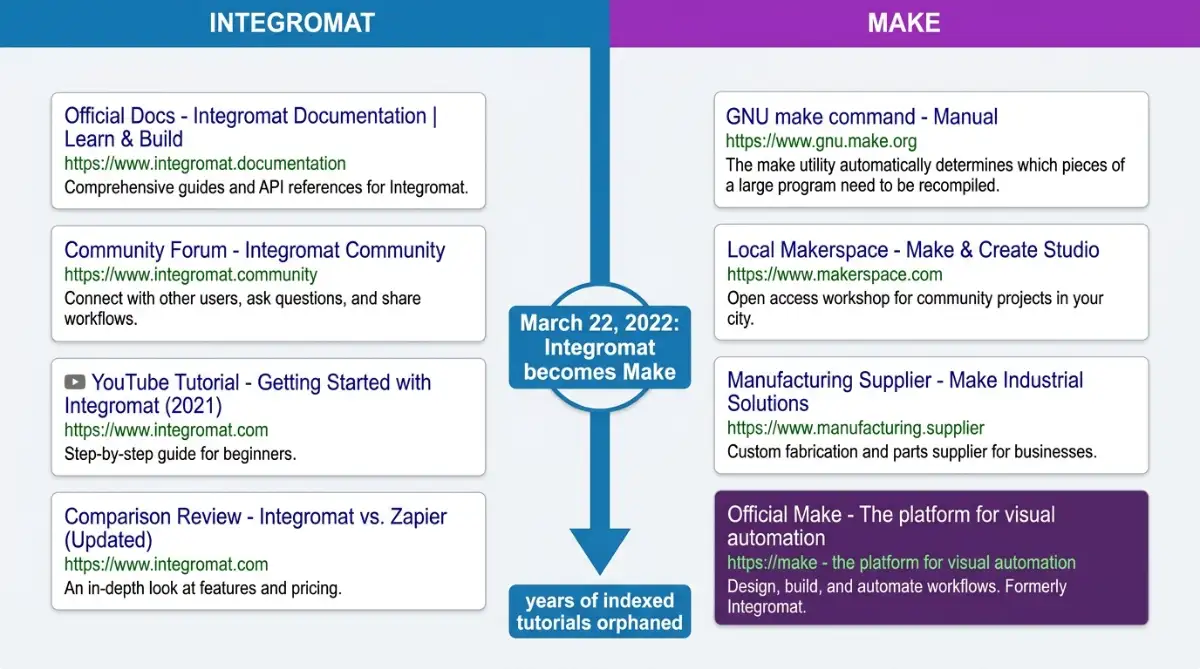
On March 22, 2022, Celonis relaunched Integromat as Make, shipping a rebuilt visual platform alongside the new name. The product improved. The discoverability did not. A distinctive invented word was traded for one of the most common verbs in English, and the community's accumulated tutorials, forum threads and indexed documentation lost much of their signal.
What the rebrand cost, in practice:
- Years of community tutorials suddenly pointed at a product name nobody searched for.
- Queries for "Make" collided with general software development and manufacturing results.
- Developers hunting technical documentation had to append qualifiers to find anything useful.
- Third-party knowledge hubs and course content aged out overnight.
What it bought was room to move. "Integromat" described an integration utility, and Celonis wanted a creation canvas that could eventually host autonomous agents, which is a much larger category than API plumbing. Anyone managing a content library through a rename should read the same lesson in this evergreen SEO guide before touching their URLs.
Renaming a technical product is a bet that future positioning is worth more than a decade of accumulated search equity, and that bet takes years to settle.
What Happens When a Make Automation Scenario Fails?
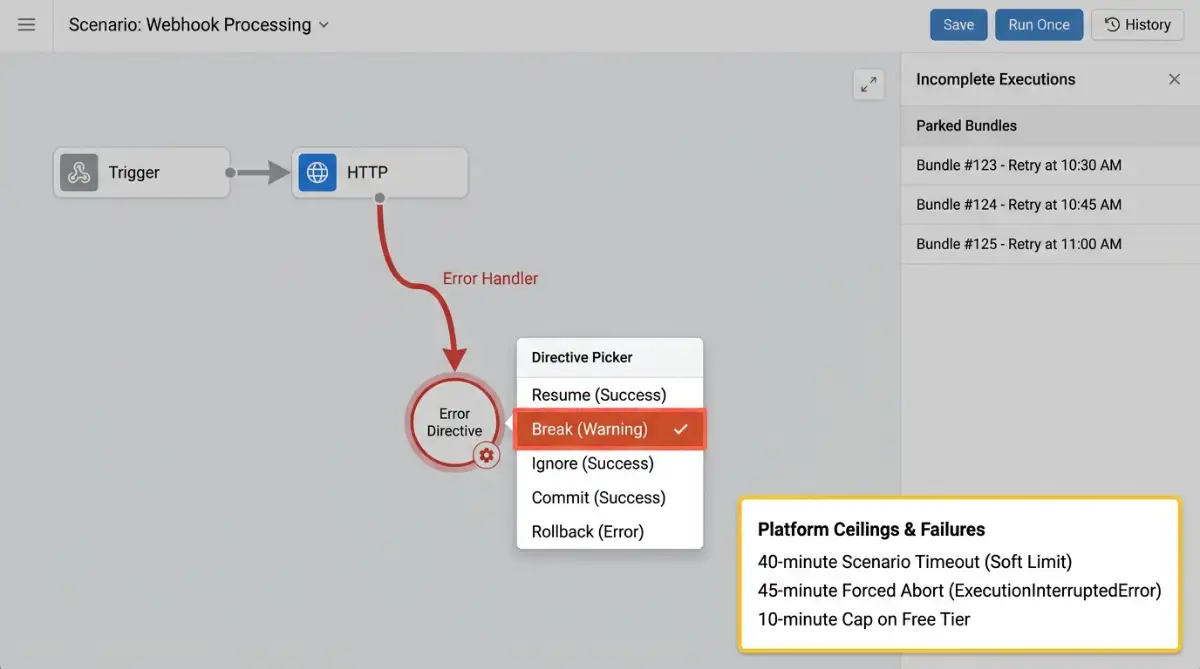
Make treats errors as a design decision rather than a crash. Any module can carry a dedicated error-handler route, and Make's documentation defines five directives that decide whether the scenario recovers, pauses, skips the bad record, saves what it completed, or reverses itself entirely.
| Directive | Behaviour | Result status |
|---|---|---|
| Resume | Substitutes a fallback dataset for the failed output | Success |
| Break | Halts the bundle and stores it in Incomplete Executions | Warning |
| Ignore | Skips the failing bundle, later bundles continue | Success |
| Commit | Saves all pending database operations up to the failure | Success |
| Rollback | Aborts and reverts supported database actions | Error |
Break is the one worth knowing. It parks the failed bundle in a queue for manual inspection or automated retry with exponential backoff, so a temporary API outage does not silently drop a client's order.
The platform limits are less forgiving. Make sets a hard scenario timeout of 40 minutes, extending to about 45 before execution is forcibly aborted, and the Free tier caps runs at 10 minutes, a ceiling builders hit often enough to fill long community threads on timeout workarounds. Inbound webhooks are limited to 5 MB, a cap that surfaces in recurring questions about payload size, and they accept up to 30 requests per second per scenario before returning a 429.
How Much Does Make Cost After the 2025 Credit Switch?
On August 27, 2025, Make replaced operations with credits as its billing unit, mainly to account for generative AI steps that consume variable token overhead. A standard module run still costs one credit. An AI step does not, and that is where budgets get slippery. On November 6, 2025 it standardised extra credits at a 25% premium, which trimmed the auto-purchase markup down from 30% but ended free manual top-ups.
Published entry pricing on Make's own plans page, billed annually:
- Free: $0, 1,000 credits, two active scenarios, 10-minute execution cap
- Core: $9, 10,000 credits, unlimited scenarios, API access, 1-minute scheduling
- Pro: $16, priority execution, custom variables, full-text log search
- Teams: $29, role-based access control, shared templates, team folders
- Enterprise: custom quote, SSO, SCIM provisioning, 30-day log retention
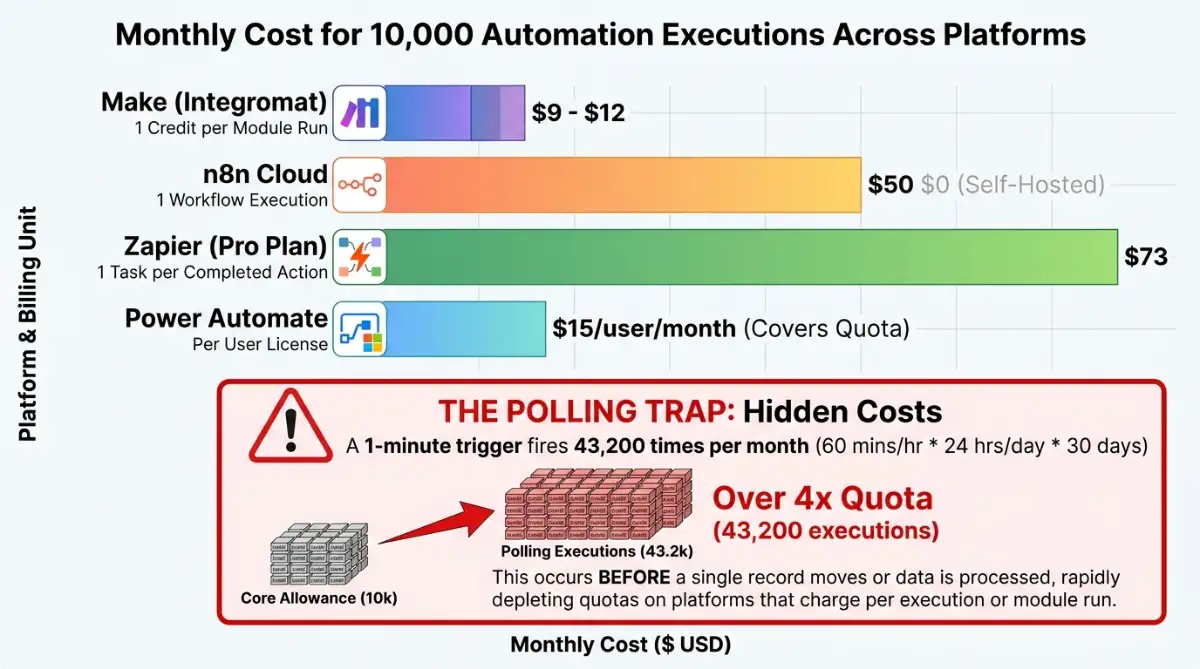
Against competitors, the cost gap at volume is the headline, and it is why cost-conscious builders migrate. If you are still weighing the broader economics, this cost and scaling breakdown covers the pattern across tools.
| Dimension | Make | Zapier | n8n | Power Automate |
|---|---|---|---|---|
| Billing unit | Credit per module run | Task per completed action | Workflow execution | User licence |
| Entry paid cost | $9/month | $19.99/month | $20/month | $15/user/month |
| 10,000 executions | ~$9 to $12 | ~$73 | ~$50 cloud, $0 self-hosted | Within per-user quota |
| App directory | 3,000+ | 6,000 to 9,000+ | 1,250+ | Microsoft ecosystem |
| Self-hosting | No | No | Yes | On-prem gateway |
One trap catches new builders repeatedly: a trigger polling every minute fires 43,200 times a month, which burns more than four times the Core tier's base allowance before a single useful record moves.
Is Make Turning Into an AI Agent Platform?
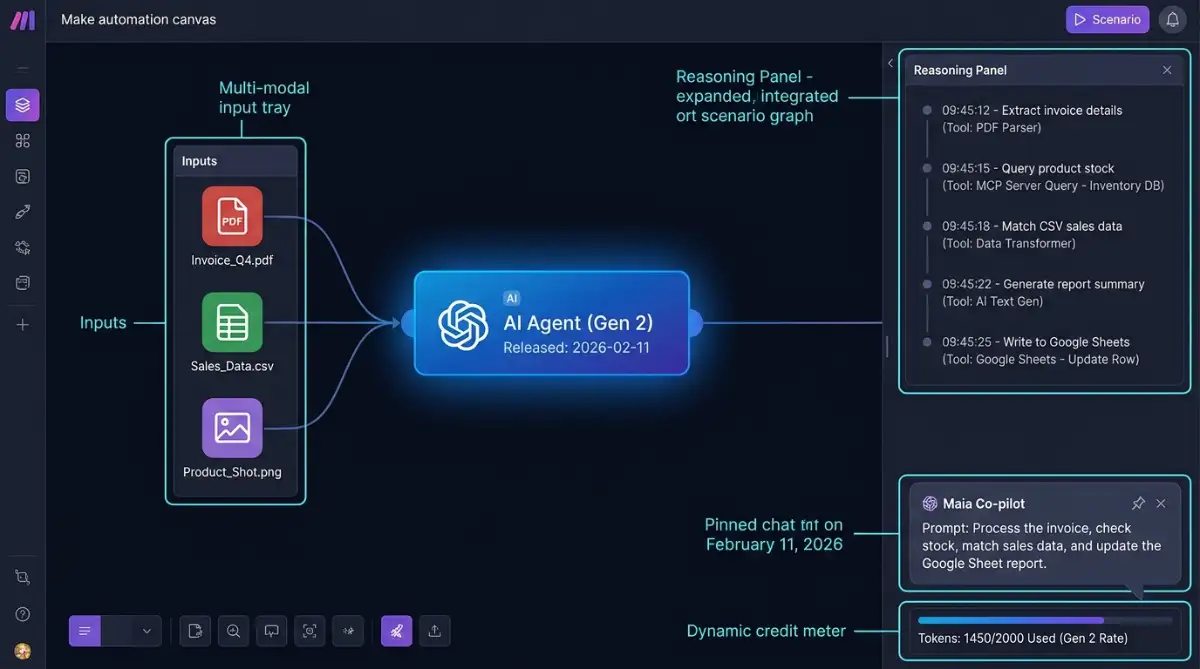
Yes, deliberately. Make launched embedded AI Agents on April 14, 2025, using natural language to interpret goals rather than fixed rules. It previewed a next generation at its Waves '25 event in October 2025, then shipped those agents on February 11, 2026, built and debugged inside the scenario canvas itself.
The newer agents change what the canvas is for:
- They accept multi-modal input including raw PDFs, images and CSV files.
- A Reasoning Panel shows in real time which tools the agent called and why it took each path.
- Agents and full scenarios can be shared across teams, backed by a Library of Agents of ready-made examples.
- "Maia", an inline conversational co-pilot, builds and edits complete scenarios from plain-language prompts.
Make also added native support for Anthropic's Model Context Protocol, meaning external agents like Claude and ChatGPT can call Make scenarios as tools while Make scenarios query external MCP servers for context. That two-way position is strategically smart, and it puts Make in the same conversation as the newer wave of AI app builders.
A reasoning panel sitting on the canvas is the first honest answer to the biggest objection about agents, which is that nobody can see what they did.
Honest Tradeoffs
The visual canvas is genuinely better for complex logic, and it is genuinely worse for simple things. Wiring a form submission into a spreadsheet takes longer in Make than in Zapier, because you are configuring a graph when you only needed a wire. Depends entirely on where your workflows sit on that curve, and plenty of teams pay Zapier's premium purely to skip the learning.
Three constraints are hard blockers rather than annoyances. Make executes no Business Associate Agreements for HIPAA compliance on any tier, which rules it out for protected health information outright. There is no self-hosting option, so air-gapped or data-residency-bound teams cannot use it at all, and n8n exists largely because of that gap. The 40-minute execution ceiling forces anyone doing bulk PDF generation or deep database syncs into chained sub-scenarios linked by webhooks and external state tables, which is exactly the complexity no-code was supposed to remove.
Then there is governance. Single sign-on, SCIM provisioning and extended log retention all sit behind custom Enterprise contracts, which lands awkwardly on mid-market companies that outgrew Teams but cannot justify a sales-led deal. Anyone evaluating platform risk should read this security reality check before committing client data.
Credit forecasting is the newest complaint. AI modules consume dynamically by token, so the honest answer to "what will this cost" is that you find out after you ship.
Start exploring launch-ready automation templates here!
Frequently Asked Questions
Is Make the same product as Integromat?
Yes. Integromat was rebranded as Make on March 22, 2022, following its acquisition by Celonis. The underlying platform, scenarios and accounts carried over, alongside a rebuilt visual builder designed for faster rendering and larger enterprise workloads.
What is a scenario in Make?
A scenario is one complete automation workflow on the Make canvas, made of connected modules, routers and filters. Data travels through it as bundles, and every module execution consumes credits from your monthly allowance, which is how the platform meters usage.
Does Make have a free plan?
Yes. The Free tier includes 1,000 monthly credits, two active scenarios, a 15-minute minimum polling interval and a 10-minute execution cap. It is enough to learn the canvas and run light workflows, though scheduling and volume limits arrive quickly.
Can Make connect to an app with no prebuilt connector?
Yes, through its universal HTTP and JSON modules, which handle REST and GraphQL endpoints directly. Make lists over 3,000 native app integrations, but the generic modules mean any documented web API is reachable without waiting for official support.
Who typically uses Make instead of Zapier?
Operations teams, automation agencies and API-centric product builders, usually once workflows need branching, iteration or array handling. This is close to the emerging no-code operations career path, where visual logic sits between business teams and engineering.
Start building without code
Browse thousands of no-code templates for Webflow, Framer, Bubble, Lovable, Replit and more.
Explore Templates