How WordPress Plugins and Contact Form 7 Killed the PHP Script Era

WordPress plugins replaced manual PHP scripts after the 1.2 "Mingus" release in May 2004 introduced the Hooks and Filters API. Contact Form 7, launched in 2007 by Takayuki Miyoshi, became the dominant replacement, reaching over 40 million downloads by 2016 and 10+ million active installs by 2026. It succeeded by abstracting away insecure mail() calls, CRLF injection risks, and hours of manual coding.
Table of Contents
- The PHP Script Era Was a Mess
- Why Manual Mail Scripts Were a Security Nightmare
- How WordPress 1.2 "Mingus" Changed Everything
- Why Contact Form 7 Won the Plugin Wars
- Contact Form 7 vs Modern Form Builders
- Is Contact Form 7 Still Safe in 2026?
- Key Takeaways
- FAQ
The PHP Script Era Was a Mess
Before plugins existed, adding a contact form meant downloading a dusty "formmail" script from Matt's Script Archive and praying it worked. I remember FTP-ing files into /cgi-bin/ at 2am wondering why my form kept emailing itself into the void. If you're a self-taught tinkerer or freelancer reading this, you probably lived it too.
According to WPBeginner's WordPress history timeline, the b2/cafelog ancestor powered roughly 2,000 blogs by May 2003, and every customization required editing core files directly. Any update wiped your changes. Early community members literally described the maintenance cycle as "painful."
This was the same era that gave us table-based layouts that broke the web and spaghetti code killing the first WYSIWYG tools. The web worked, barely, held together by duct tape and hope.

Why Manual Mail Scripts Were a Security Nightmare
Manual PHP scripts turned legitimate websites into "spam cannons" through a flaw called email header injection. The PHP mail() function handed every security responsibility to the script author, and most authors were hobbyists.
Here's the problem in plain English. The SMTP protocol uses \r\n characters to separate headers. If your script pasted a user's email straight into the headers string (which almost every tutorial told you to do), an attacker could type something like sender@example.com\r\nBcc: victim-list@attacker.com and instantly BCC thousands of strangers using your server's reputation.
The fallout went beyond annoying spam:
- Domain blacklisting from mass BCC injection
- Phishing via spoofed
From:headers - Remote code execution through poorly escaped shell parameters
- Denial of service from automated submission floods
Writing a regex to block bcc:, cc:, and content-type: strings was beyond what most people using WordPress in its early days could handle. The barrier was brutal.
How WordPress 1.2 "Mingus" Changed Everything
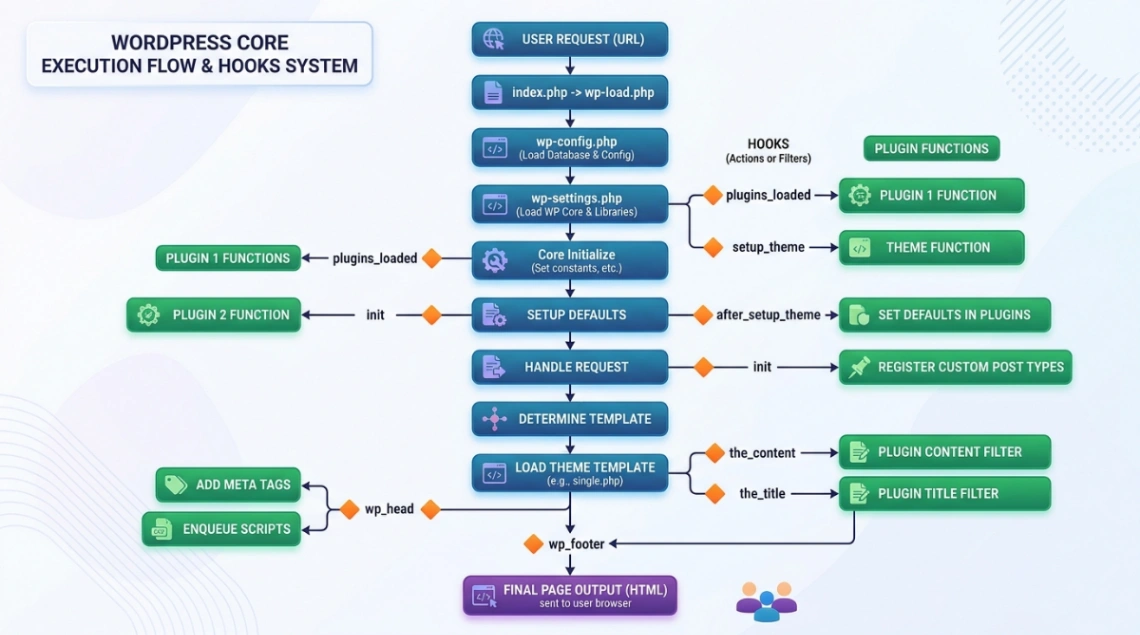
On May 22, 2004, WordPress 1.2 "Mingus" introduced the Plugin API, and the monolithic web quietly died. This release gave developers Hooks and Filters, letting them inject functionality at specific "checkpoints" in WordPress's execution without ever touching core files.
Matt Mullenweg shipped the "Hello Dolly" plugin as a demo, a silly little thing that printed Louis Armstrong lyrics in the dashboard. It wasn't useful, but it proved the point: you could add features "at will."
The timing was perfect. In 2004, competitor Movable Type changed its pricing and alienated its user base, sending a flood of refugees toward WordPress. These users found a free platform with a fast-growing library of plugins, echoing the earlier SaaS builder shift that reshaped the web.
Why Contact Form 7 Won the Plugin Wars
Contact Form 7 won because Japanese developer Takayuki Miyoshi built it for stability, kept it free forever, and abstracted every scary part of sending email. Released in 2007, it consolidated five messy stages (rendering, validation, sanitization, mail execution, user feedback) into one dashboard.
| Year | Milestone |
|---|---|
| 2007 | Initial release, markup-driven tags like [text* your-name] |
| 2008 | Integrated with WordPress 2.5 Shortcode API |
| 2009 | Nearly 400,000 downloads |
| 2011 | Most popular plugin in the official directory |
| 2016 | 40 million downloads, 1M+ active installs |
| 2026 | Still shipping 6.x updates, 10M+ active sites |
The real genius move: Contact Form 7 ditched raw mail() entirely in favor of PHPMailer, which auto-sanitizes headers, supports SMTP, handles attachments, and kills CRLF injection at the library level. Every form built with it is safer than a hand-coded script from the same era.
Contact Form 7 vs Modern Form Builders
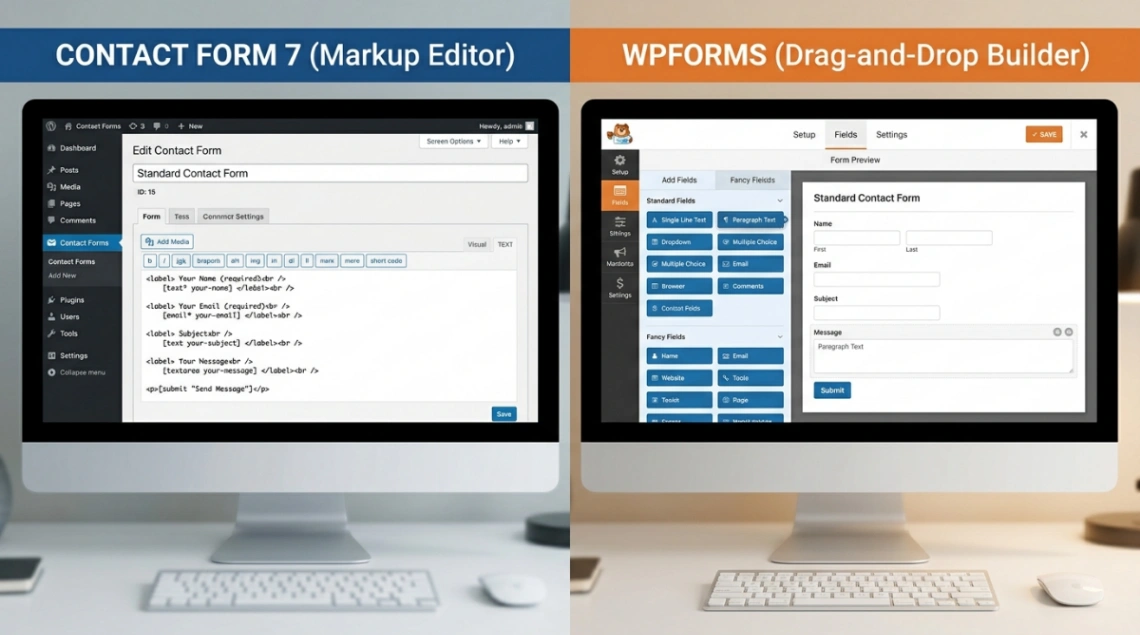
For self-taught WordPress users, the real question in 2026 isn't whether to use plugins, it's which form plugin matches your workflow. Security auditor Patchstack's ranked breakdown of WordPress form plugins is a solid starting point, but here's the freelancer-friendly summary:
| Plugin | Philosophy | Best For | Cost |
|---|---|---|---|
| Contact Form 7 | Markup-based, lightweight | Freelancers wanting total control, free forever | 100% free |
| WPForms | Visual drag-and-drop | Absolute beginners | Freemium |
| Ninja Forms | Modular with clean hooks | Intermediate devs | Freemium |
| Gravity Forms | Enterprise workflows | Agencies, e-commerce | Premium only |
Deal-breaker answers for freelancers:
- Free? Yes, Miyoshi pledged "free forever" in 2012 and has kept that promise.
- Modern PHP? Yes, the 6.x line supports current WordPress and PHP standards.
- Spam? Built-in Akismet integration via
akismet:author_emailtags. - Extensible? Hundreds of add-ons exist, from Flamingo (logging) to Jetpack CRM (workflows).
- Safe? Mostly, but read on.
Is Contact Form 7 Still Safe in 2026?
Contact Form 7 itself remains solid, but its integrations are now the weak link. In 2025, researchers disclosed CVE-2025-7697, a PHP Object Injection flaw in a popular Contact Form 7 to Google Sheets integration that could let unauthenticated attackers trigger arbitrary file deletion or remote code execution.
This is the modern trade-off. Plugins solved the 2004 problems (header injection, unsanitized input) but created new ones around deserialization and third-party API chains. Security firms like Patchstack and Sucuri now audit the ecosystem the way individual devs used to audit their own scripts.
The evolution mirrors the broader arc from Netscape Composer's browser-based builder to today's modular web: easier tools, higher abstraction, new attack surfaces.
Start exploring launch-ready no-code templates here!
Key Takeaways
- Plugins replaced PHP scripts because manual mail handlers were genuinely dangerous. Email header injection turned hobbyist sites into spam relays, and most script authors lacked the skill to defend against it.
- WordPress 1.2 "Mingus" in May 2004 made extensibility a commodity. The Hooks and Filters API let developers add functionality without editing core, which is the single architectural decision that let WordPress eat the web.
- Contact Form 7 won on stability, price, and abstraction. By wrapping PHPMailer and Akismet into a markup-driven interface, Takayuki Miyoshi gave non-developers a tool that was safer than hand-written scripts and cost nothing.
Twenty-two years after "Mingus" shipped, we're still living in the world it built. The next time you drop a shortcode into a page in three seconds flat, pour one out for the formmail scripts that didn't make it.
FAQ
What did people use for contact forms before Contact Form 7? Most webmasters used standalone PHP scripts like Matt's Script Archive's formmail, or early WordPress plugins like Ryan Duff's WP-ContactForm. These required manual integration and offered minimal security.
Why is the PHP mail() function considered unsafe?
The function provides zero built-in sanitization or authentication. Attackers can inject CRLF characters into form fields to add BCC headers, turning legitimate contact forms into spam distribution tools.
When did WordPress plugins officially launch? WordPress 1.2 "Mingus" introduced the formal Plugin API on May 22, 2004, with the Hooks and Filters system that let developers extend the platform without editing core files.
Is Contact Form 7 really free in 2026? Yes, Takayuki Miyoshi committed in 2012 that Contact Form 7 would remain free forever, and the core plugin has no paid tiers, unlike WPForms or Gravity Forms.
How does Contact Form 7 block spam without coding?
It integrates directly with Akismet through field tags like akismet:author_email, sending submissions to Akismet's cloud API for pattern-based spam detection before any email is sent.
Start building without code
Browse thousands of no-code templates for Webflow, Framer, Bubble, Lovable, Replit and more.
Explore Templates