Microsoft FrontPage: The Web Builder That Built a Generation
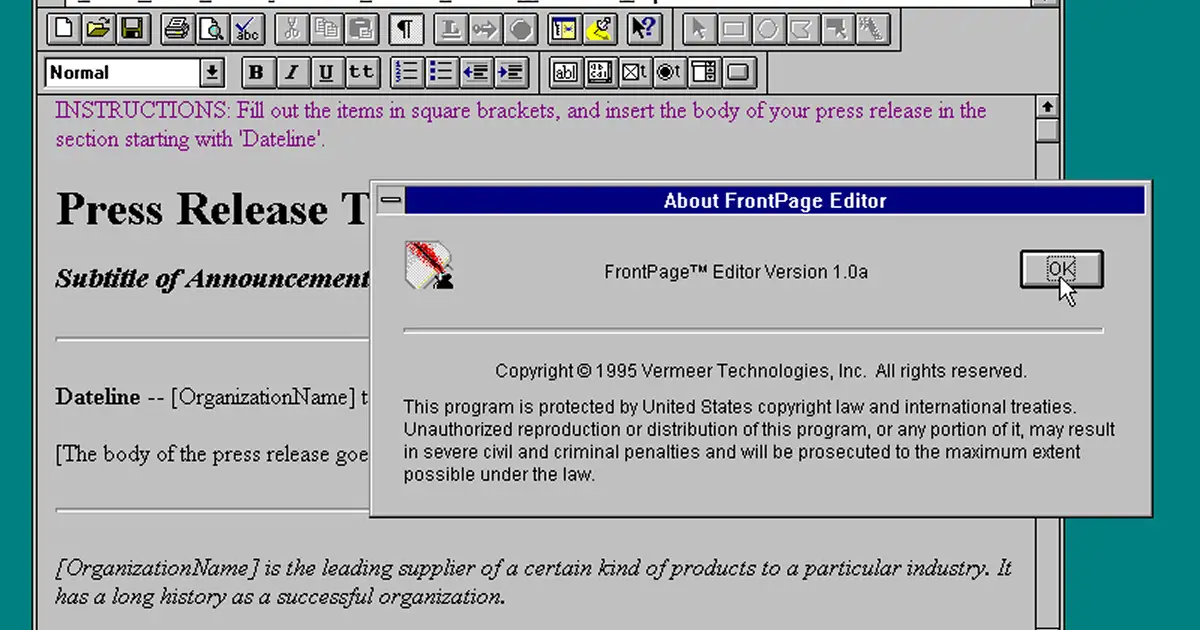
Microsoft FrontPage was a WYSIWYG web builder launched in 1995 that let non-coders build websites without touching HTML. Acquired by Microsoft for $133 million in 1996, it introduced millions of entrepreneurs and hobbyists to the web. Its visual drag-and-drop approach directly inspired today's no-code platforms like Squarespace and Wix.
Table of Contents
- What Was Microsoft FrontPage?
- How FrontPage Became the Web Builder Everyone Used
- The Technical Stuff (And Why It Got Messy)
- Why Professionals Eventually Walked Away
- FrontPage's Real Legacy: The No-Code Web Builder Movement
- Key Takeaways
- FAQ
What Was Microsoft FrontPage?
If you've ever dragged an image into a website editor and thought "yep, that works," you owe a small debt to FrontPage.
Back in 1994, two guys named Charles H. Ferguson and Randy Forgaard founded a tiny company called Vermeer Technologies in Cambridge, Massachusetts. The internet was exploding at a rate of 20% per month, but building a website still required you to hand-write HTML like some kind of digital monk. Ferguson saw the gap and wanted to "pave the roads" of the information superhighway for everyday people.
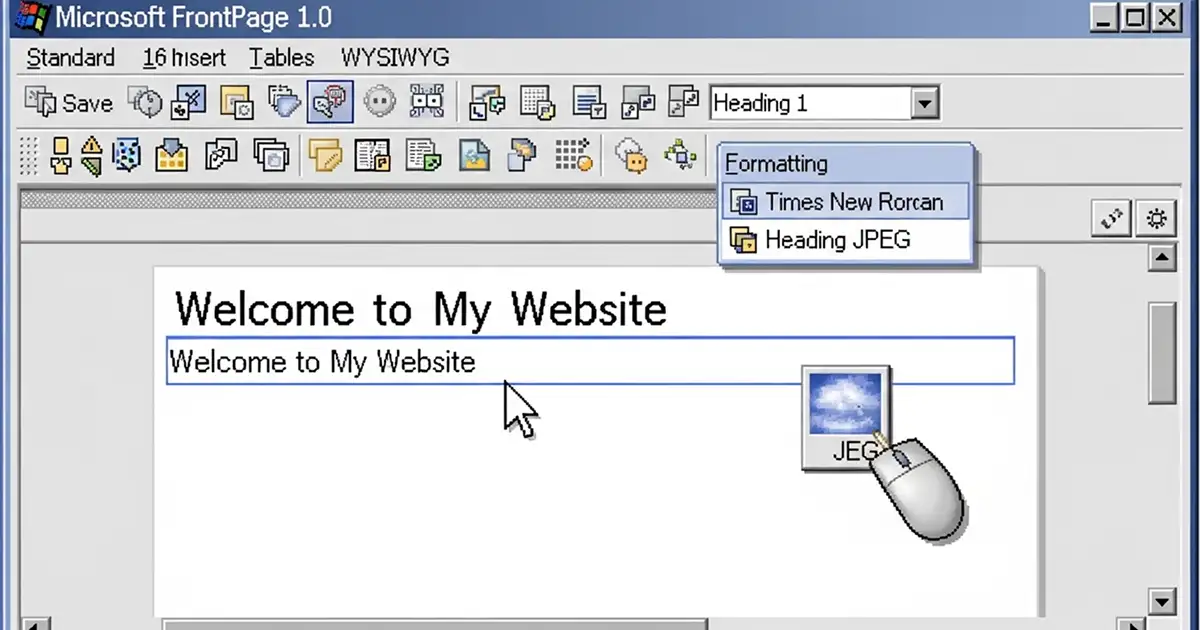
The result? Vermeer FrontPage 1.0, launched on October 2, 1995. It was the first serious web builder that let you design pages visually, the same way you'd format a Word document.
It won industry awards almost immediately. Fidelity and Merrill Lynch were among its early adopters. And within a few months, both Microsoft and Netscape were circling the company like hawks.
How FrontPage Became the Web Builder Everyone Used
Here's where things get interesting.
Microsoft bought Vermeer for $133 million in January 1996: worth roughly $273 million in today's money. But this wasn't just a product acquisition. It was a tactical move in the "browser wars" between Microsoft and Netscape. Microsoft wanted to control the tools used to build the web, making sure those sites looked best in Internet Explorer and worked smoothest on its own servers.
And the distribution strategy? Genius, frankly. Microsoft FrontPage 1.1 was bundled with Windows NT 4.0 Server almost immediately. Then it got folded into Office 97. Suddenly, every office manager, school teacher, and church volunteer with a PC had access to a web builder without paying a cent extra.
| FrontPage Version | Year | Key Feature |
|---|---|---|
| Vermeer FrontPage 1.0 | 1995 | First WYSIWYG web builder |
| Microsoft FrontPage 1.1 | 1996 | Bundled with Windows NT 4.0 |
| FrontPage 97 | 1996 | Integrated into Office 97 |
| FrontPage 98 | 1997 | Better frames, early DHTML |
| FrontPage 2000 | 1999 | Merged editor and site manager |
| FrontPage 2003 | 2003 | XML/XSLT, data-driven sites |
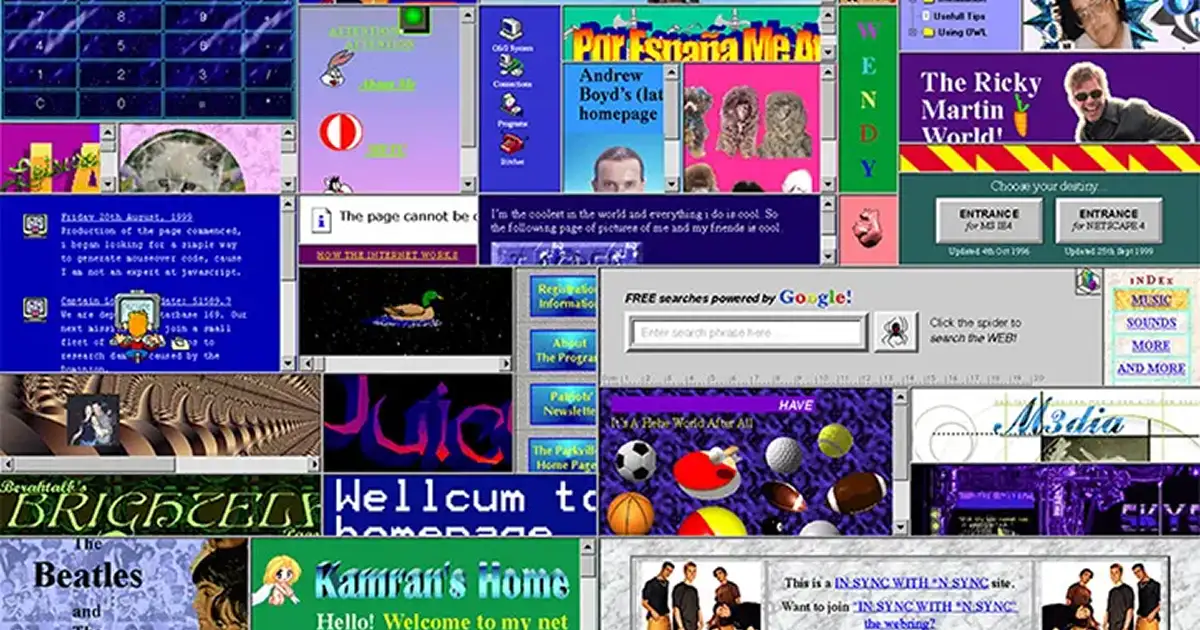
The cultural impact was massive. Platforms like GeoCities, which launched in 1994 and offered free hosting to millions, became the stomping ground for FrontPage-built sites. Blinking GIFs, MIDI background music, neon text on black backgrounds, the whole chaotic, beautiful mess of the early web was largely FrontPage's fault (in the best possible way).
The Technical Stuff (And Why It Got Messy)
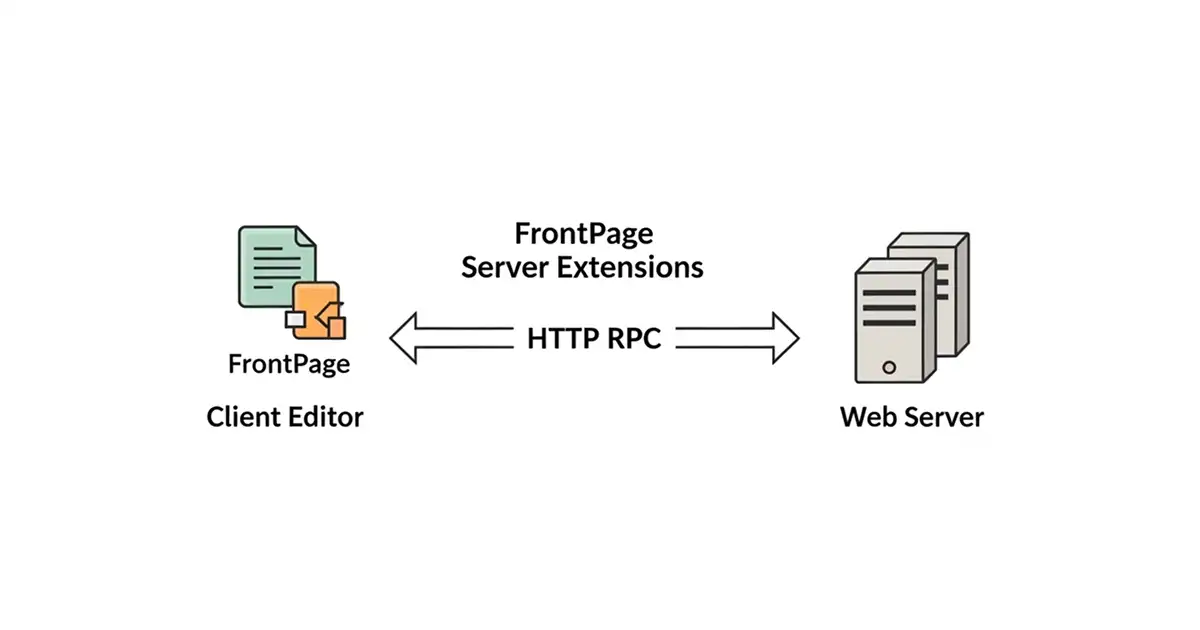
FrontPage's WYSIWYG magic came with a hidden price: the FrontPage Server Extensions (FPSE). These were server-side plugins that powered interactive features like contact forms, site search, and hit counters: things that would normally require custom coding in Perl or CGI.
The problem? FPSE had to be installed on your web server, and it created some serious security headaches. CVE-2000-0114 exposed anonymous account names to remote attackers via RPC. Other vulnerabilities allowed denial-of-service attacks or privilege elevation. Professional server administrators basically had a collective meltdown every few months.
| Vulnerability | Nature of Threat |
|---|---|
| Anonymous Account Disclosure (CVE-2000-0114) | Remote attackers could expose account names |
| SmartHTML Buffer Overflow | Potential privilege elevation in FPSE 2002 |
| DoS via shtml.exe | Crafted requests could crash the server |
Microsoft eventually had to disable certain FPSE components entirely to stop the bleeding. The whole thing was, as Vice put it, "janky": a word that would follow FrontPage for the rest of its life.
Why Professionals Eventually Walked Away
Here's the honest truth: FrontPage was a bit like letting autocorrect write your legal contracts. Great for speed, terrbile for precision.
Professional developers absolutely roasted the code it generated. The HTML was bloated, stuffed with redundant tags, and mostly optimised for Internet Explorer 6. Open that site in Firefox or early Safari? Good luck.
From Stack Overflow discussions to agency blog posts, the developer community was brutal:
- The code was widely called "garbage" that was hard to maintain manually
- Sites looked fine in IE but were broken in other browsers
- Search engines struggled to index the cluttered markup
- It actively discouraged developers from learning proper HTML
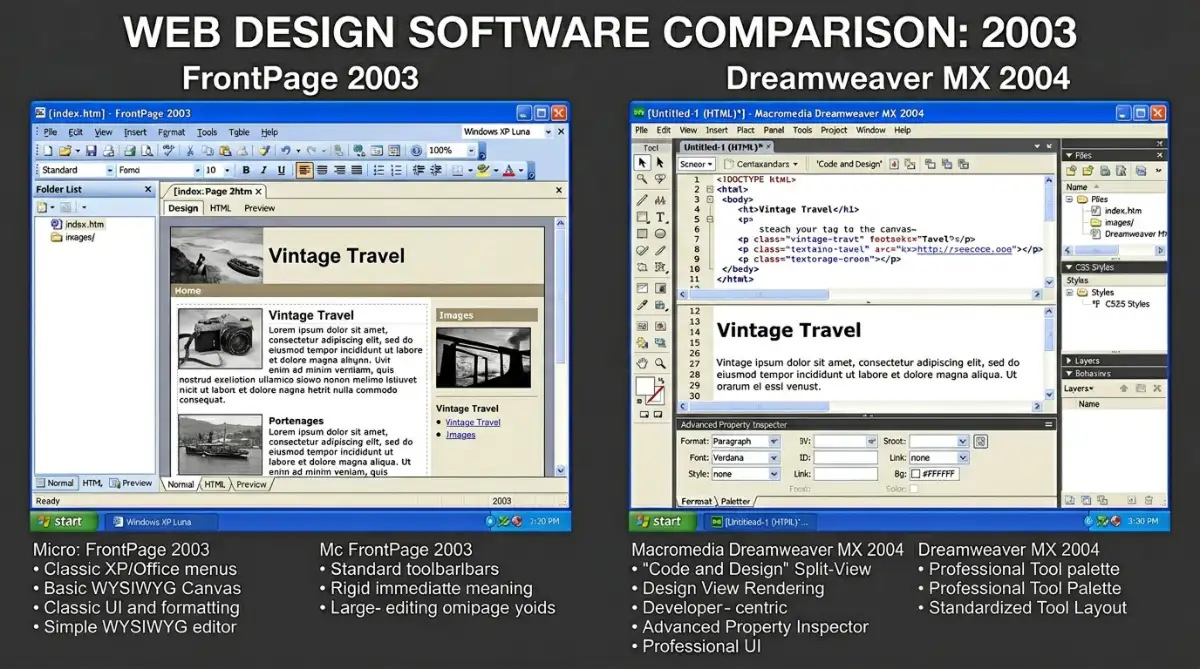
Meanwhile, Macromedia Dreamweaver launched in 1997 with a "Roundtrip HTML" philosophy that kept your hand-written code untouched by the visual editor. Professionals were willing to pay hundreds of dollars for that respect. FrontPage, even when bundled for free, lost the professional market almost entirely.
By 2006, Microsoft quietly killed the FrontPage brand and replaced it with Expression Web and SharePoint Designer. Expression Web was genuinely good: standards-compliant, platform-agnostic, even handled PHP properly. But internal politics at Microsoft shifted toward Silverlight and Windows 8 apps, and Expression Web was abandoned in 2012. That left a void that Squarespace, Wix and others eventually filled.
FrontPage's Real Legacy: The No-Code Web Builder Movement
Here's what I find genuinely fascinating about FrontPage's story: it was right about everything important, just twenty years to early.
The idea that an entrepreneur, a small business owner, or a solopreneur should be able to build a polished, data-driven website through a visual interface: without knowing a single line of code: is exactly what Charles Ferguson proposed in 1994. The market just wasn't ready to support it properly yet.
Today, no-code platforms like Squarespace, Wix, and Webflow generate billions in revenue doing precisely what FrontPage attempted. The web builder category is now one of the fastest-growing segments in SaaS.
And FrontPage's actual code? Parts of it never really died. The FrontPage RPC protocols are still embedded in the foundations of Microsoft SharePoint, quietly powering enterprise intranets around the world. The vti directories that FrontPage stamped on every server it touched are still occasionally found today, little digital fossils of the 1990s web.
FrontPage also taught the industry something that couldn't be untaught: the "mere mortals": the non-technical business owners, the entrepreneurs with ideas but no coding skills: were the largest and most underserved market in tech. Every modern web builder owes that insight to a little Cambridge startup that just wanted to pave some roads.
Key Takeaways
1. FrontPage democratized the web before it was cool to do so. Launched in 1995 and acquired by Microsoft for $133 million in 1996, it gave millions of non-technical people their first real web builder: years before anyone else thought to try.
2. Its biggest strengths became its biggest weaknesses. The proprietary server extensions and IE-optimized code that made FrontPage easy to use also made it a security liability and a professional embarrassment. Lock-in is a double-edged sword.
3. The no-code movement is FrontPage's true legacy. Every Wix template you drag around, every Squarespace block you drop into place: that's Vermeer's original vision, finally executed at scale. FrontPage didn't fail; it just arrived a couple of decades too early.
The web builder that built a generation didn't survive. But the generation it built? They went on to shape the entire internet.
FAQ
1. What was Microsoft FrontPage used for? FrontPage was a WYSIWYG web builder that let non-technical users design and publish websites visually, without writing HTML code. It was popular from 1995 through the mid-2000s.
2. Why did Microsoft discontinue FrontPage? Microsoft discontinued FrontPage in 2006 because the brand was too associated with bloated, IE-specific code. It was replaced by Expression Web and SharePoint Designer.
3. How does FrontPage compare to today's web builders like Wix or Squarespace? Modern web builders are cloud-based, standards-compliant, and mobile-responsive. FrontPage was desktop-based and generated messy HTML, but it pioneered the same visual editing concept.
4. Was FrontPage responsible for the 90s web aesthetic? Largely yes. FrontPage's ease of use empowered millions of GeoCities users to create sites with blinking GIFs, MIDI music, and tiled backgrounds: the signature look of 1990s amateur web design.
5. Is any FrontPage technology still in use today? Yes. FrontPage RPC protocols remain embedded in Microsoft SharePoint, and the vti server directory structure it created can still occasionally be found on legacy servers.
Start building without code
Browse thousands of no-code templates for Webflow, Framer, Bubble, Lovable, Replit and more.
Explore Templates