GeoCities, Angelfire, and the Webring That Launched in 1996
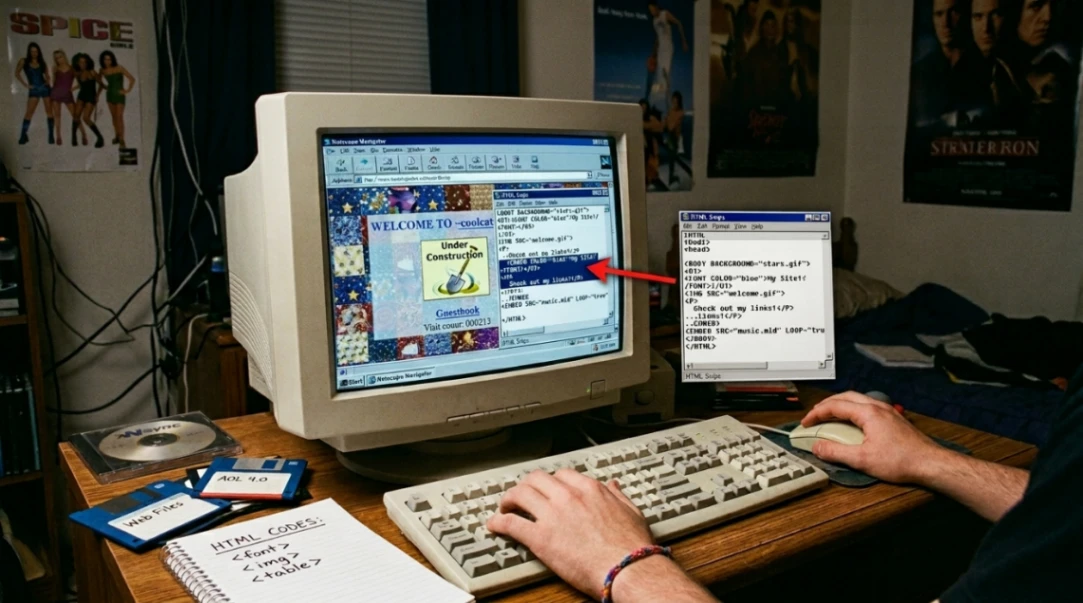
GeoCities launched its free web hosting service in mid-1995, giving everyday users a no-code way to build personal pages without writing a single line of original code. The platform grew to become the third-most visited website on the internet by 1999. Copy-pasting HTML snippets was the original drag-and-drop.
Table of Contents:
- Introduction: The Original No-Code Builders
- What GeoCities and Angelfire Actually Were
- How "No-Code" Worked in the 1990s
- The Aesthetic That Wasn't an Accident
- Webrings: Community Discovery Before the Algorithm
- What Modern No-Code Lost Along the Way
- Conclusion: Three Key Takeaways
- FAQ
Introduction: The Original No-Code Builders
Here's a fun fact that might change how you think about no-code tools.
The no-code movement didn't start with Bubble or Webflow. It started in 1995, with a blinking cursor, a 2 MB storage limit, and a teenager copy-pasting JavaScript into a Netscape browser.
I find it genuinely fascinating that the same desire driving entrepreneurs to tools like Webflow today, that desire to just build the thing without a CS degree, is exactly what powered an entire generation of "Homesteaders" on GeoCities and Angelfire.
And honestly? They were onto something.
What GeoCities and Angelfire Actually Were
GeoCities was founded in November 1994 by David Bohnett and John Rezner under the name Beverly Hills Internet. Their vision was surprisingly human: give every person a "front porch" on the internet.
By mid-1995, they were offering free hosting with 2 MB of storage. By December 1995, they were registering thousands of new users daily and clocking over six million monthly page views. By 1999, GeoCities was the third-most visited website on the web, sitting just behind AOL and Yahoo!.
Angelfire launched in 1996 with a completely different origin (it started as a medical transcription company, which is chaotic and I love it). It was eventually acquired by Lycos in 1998 alongside Tripod.com, helping Lycos reach one in every two internet users at its peak. Mental Floss has a brilliant deep-dive into just how dominant GeoCities was at its height, and the numbers are genuinely staggering.
| Platform | Launch Year | Initial Storage | Parent Company (Later) |
|---|---|---|---|
| GeoCities | 1994 | 2 MB | Yahoo! ($3.6B, 1999) |
| Angelfire | 1996 | Varied | Lycos (1998) |
| Tripod | 1995 | 11 MB | Lycos ($58M, 1998) |
These weren't just hosting platforms. They were the first large-scale experiment in user-generated content.
How "No-Code" Worked in the 1990s
Okay so here's where it gets really interesting for anyone building products today.
The no-code experience of the 1990s wasn't a drag-and-drop canvas. It was something more raw and honestly more empowering in some ways.
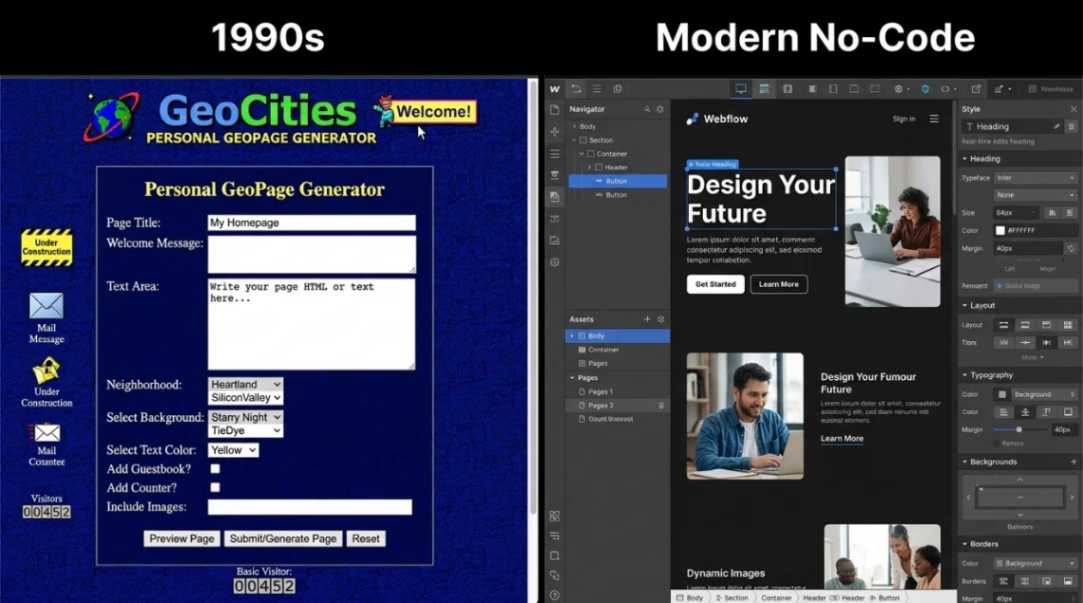
GeoCities offered a tool called the Personal GeoPage Generator - a simple form where you'd fill in your site title, welcome message, and favorite hobby, and it would spit out a functional HTML page. Zero coding required.
But the real magic happened next. Users would:
- Visit a site they liked
- Hit "View Source" in Netscape Navigator
- Find the block of code doing the cool thing
- Copy it. Paste it. Tweak the text. Done.
Repositories like "The JavaScript Source" and "Dynamic Drive" became essential toolkits for amateur webmasters. Sites like Lissa Explains It All, started in 1997 by an 11-year-old named Alyssa Daniels, were pulling 500,000 monthly visitors by teaching HTML to beginners in plain english.
That's no-code literacy through modification, not creation. And it worked really, really well.
It's worth noting that GeoCities and Angelfire weren't operating in a vacuum either. Around the same time, dedicated web building tools were emerging and competing for the same audience. The battle between Dreamweaver and FrontPage was essentially the first real no-code war, pulling power users away from raw copy-paste toward visual editors. And Microsoft FrontPage was quietly building a whole generation of web creators on the desktop side of things.
If you want a broader view of how no-code has evolved from those copy-paste days to today, Softr's timeline of no-code history lays it out really clearly.
The Aesthetic That Wasn't an Accident
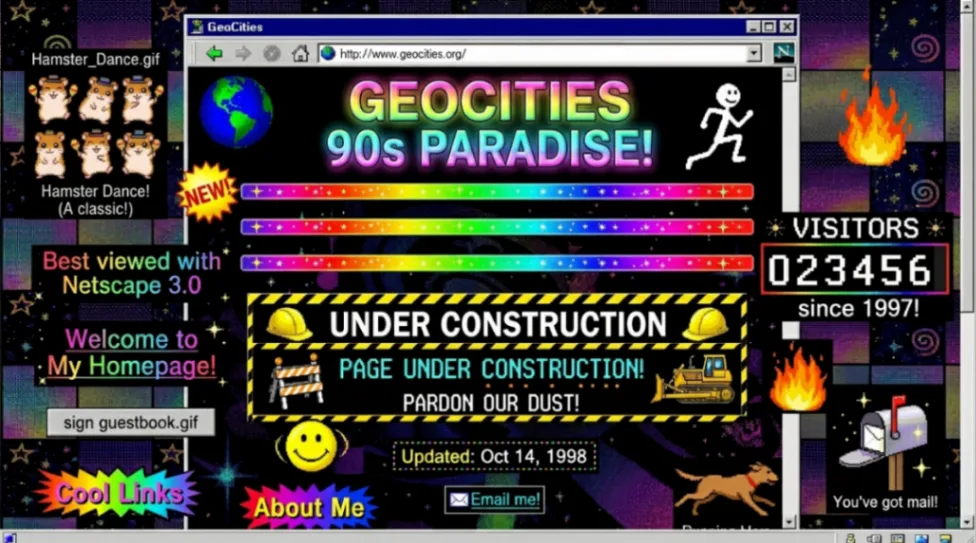
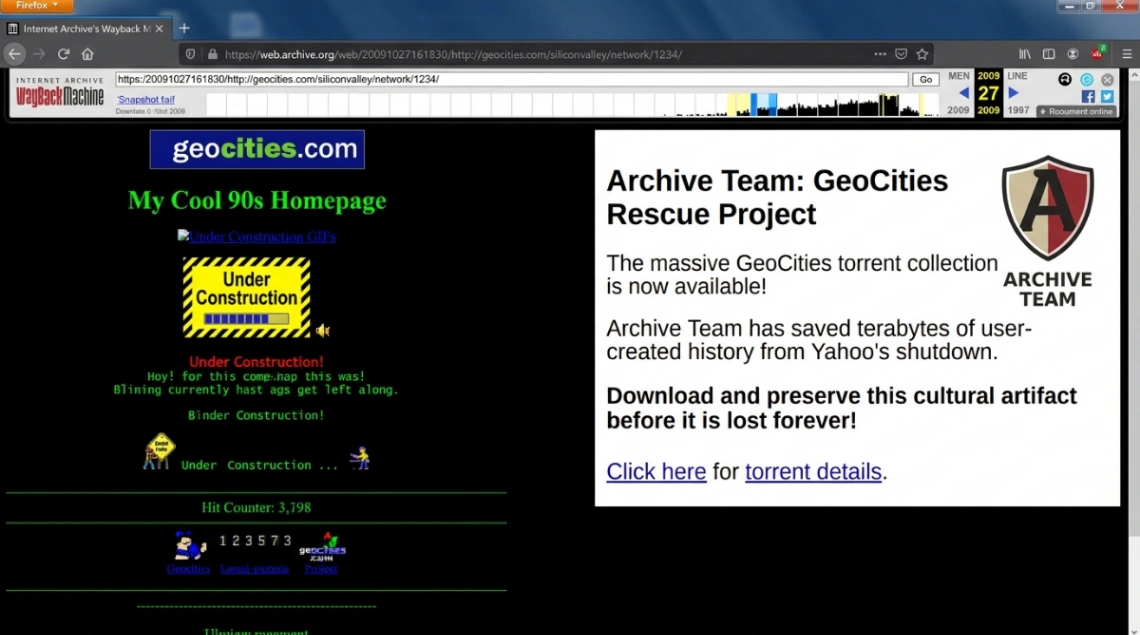
People love to mock the "ugly web" of the 90s. Tiled backgrounds. Neon Comic Sans. That little GIF of a guy digging under an "Under Construction" sign.
But here's the thing: that aesthetic wasn't a failure of taste. It was a direct result of technical constraints.
- Dial-up speeds meant only small, compressed GIFs could load reliably
- 256-color monitors forced designers into the "web-safe" color palette, which happened to be extremely vibrant
- No CSS for layout meant everything was built with
<table>tags - 640x480 screen resolutions meant tiled backgrounds were actually practical
As Brajeshwar's excellent retrospective on building ugly first puts it, the GeoCities pioneers weren't bad designers. They were just people using every tool available to express themselves, and that scrappy willingness to just ship is something modern builders have largely lost.
The "Under Construction" GIF wasn't embarrassing either. Researcher Olia Lialina, who led the One Terabyte of Kilobyte Age archival project, found that these signs represented something deeper: a "perpetual state of becoming." The web was alive. It was always being worked on. That energy is something modern polished-from-launch sites genuinely lack.
It's also worth remembering that some early tools were trying to solve this exact tension between messiness and polish. WebMagic in 1995 was one of the first attempts at a true WYSIWYG web builder, trying to bring some order to the chaos before most people even knew what WYSIWYG meant.
| 1990s Element | Why It Existed | Modern Equivalent |
|---|---|---|
| "Under Construction" GIF | Signal of active work | "Coming Soon" landing page |
| Visitor Counter | Social proof / basic analytics | View counts and likes |
| Tiled Background | Filling low-res screen space | Full-width hero images |
| Webring Badge | Community-driven discovery | "Related Communities" sidebar |
Webrings: Community Discovery Before the Algorithm
Before Google sorted everything for us, people found content through webrings.
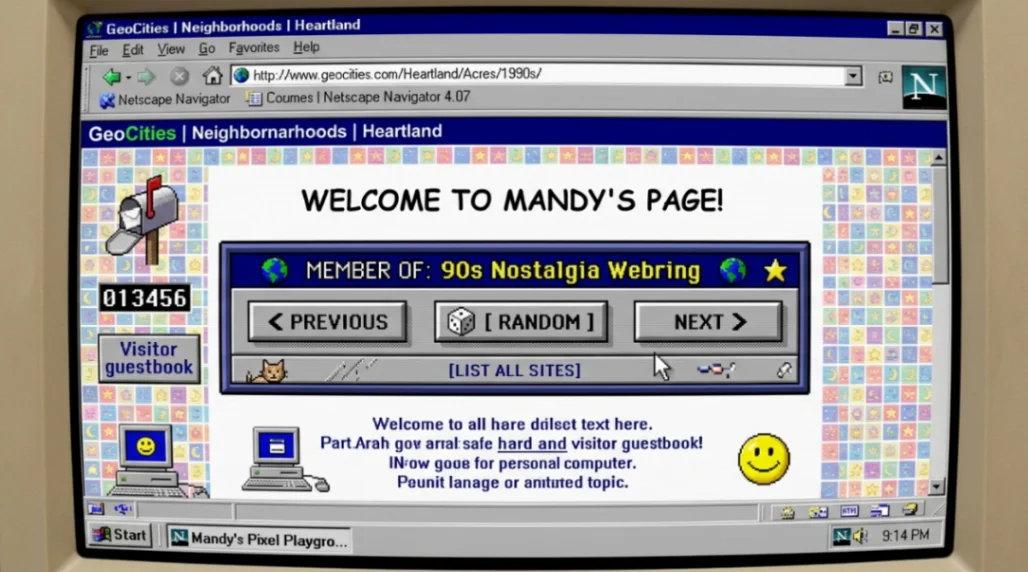
A webring was a circular chain of websites built around a shared theme. You'd click "Next" to visit the next site in the ring, and eventually loop back to where you started. It sounds simple, and it was, but it was brilliantly social. Being in a ring was like getting an endorsement from your neighbours.
WebRing.org was founded in 1995. At their peak, there were hundreds of thousands of rings covering everything from anime shrines to paranormal research to specific video game mods. This piece on webrings in a post-social internet makes a compelling case that we actually need this kind of decentralised discovery more than ever right now.
The model collapsed when Yahoo! acquired WebRing in 1999 after buying GeoCities and started stripping Ringmasters of their control, redirecting traffic back to Yahoo!'s portal instead. By 2001, the whole thing had basically died.
Sound familiar? The story of a corporate acquisition hollowing out a community-first product is one we've seen play out many times since. Researchers at the Institute of Network Cultures have written extensively about how this shift from locality-based community to algorithmic feeds fundamentally changed how we relate to each other online.
What Modern No-Code Lost Along the Way
Modern no-code tools are objectively more powerfull. You can build a responsive, SEO-optimized, e-commerce-ready site in days. The technical "growing pains" of the 90s, broken layouts, missing mobile responsiveness, table-based spaghetti code, are mostly solved.
But something got traded away in the process.
When GeoCities users copy-pasted code, they could see how the web worked. They could peek under the hood of any site they liked. That transparency built a generation of self-taught developers and digital creators.
Modern visual builders output minified, opaque code. You build inside a walled garden. You're managing a profile inside someone else's platform rather than building a home on the open web.
There were actually earlier tools that tried to bridge this gap before the walled gardens took over. ADF (Actual Drawing Foundation) was one of those forgotten attempts at giving users visual control without completely hiding the underlying structure. Most people have never heard of it, and that forgetting is kind of the point.
The 2009 shutdown of GeoCities is a cautionary tale worth sitting with. On October 26, 2009, an estimated 7 to 38 million websites went offline in a single day when Yahoo! pulled the plug, destroying roughly 190 million hours of human work. The "Archive Team" managed to mirror approximately 900 GB of data before the deletion, and researchers have since used that archive to document just how rich and culturally significant that lost content actually was.
If your whole business lives inside a platform someone else controls, that history is worth keeping in mind.
Ready to skip the copy-paste era and launch something polished today? Start exploring launch-ready no-code templates here!
Conclusion: Three Key Takeaways
1. No-code has always been about lowering barriers, not eliminating craft. From the Personal GeoPage Generator to Webflow, the goal has never changed. Let more people build. The tools get prettier, but the mission stays the same.
2. Participation beats perfection. The homesteaders of GeoCities launched "ugly-first" because shipping mattered more than polish. Today's entrepreneurs dealing with analysis paralysis from too many templates and design systems could honestly learn something from that energy.
3. Platform dependence is a real risk. The GeoCities shutdown wiped out decades of digital culture overnight. Whatever you build on someone else's infrastructure, make sure you have your data. Always.
The weirdest part of studying this history is realising how cyclical it all is. Every generation discovers that the tools should get out of the way and let people make things. The 90s homesteaders figured that out with 2 MB of storage and a copy-paste workflow. Imagine what you can do with what you have now.
FAQ
What was the original no-code movement on the internet? GeoCities launched in 1994-1995, offering free web hosting where users built pages using form generators and copy-pasted HTML. It was the first large-scale no-code publishing platform, reaching 19 million unique monthly visitors by 1999.
How did GeoCities and Angelfire differ from modern no-code tools? Both platforms provided server space and basic templates, but users customized pages by manually editing HTML. Modern no-code tools use visual drag-and-drop editors that hide the underlying code entirely.
Why did GeoCities shut down? Yahoo! acquired GeoCities for $3.6 billion in 1999 but failed to monetize 38 million personal pages. In April 2009, Yahoo! announced the closure, and the platform went offline permanently on October 26, 2009.
What were webrings and why do they matter? Webrings were circular chains of themed websites that let users navigate between related sites. Founded in 1995, they were the primary discovery mechanism before search engines and an early model of community-driven content curation.
Is there a modern equivalent to GeoCities? Neocities launched in 2013 as a direct spiritual successor, offering free hosting with a deliberate nod to the old-web aesthetic. Platforms like Webflow and Squarespace serve similar democratization goals but with significantly more polished tooling.
Start building without code
Browse thousands of no-code templates for Webflow, Framer, Bubble, Lovable, Replit and more.
Explore Templates