Why 2023's AI Apps Were Thin Wrappers Built to Die
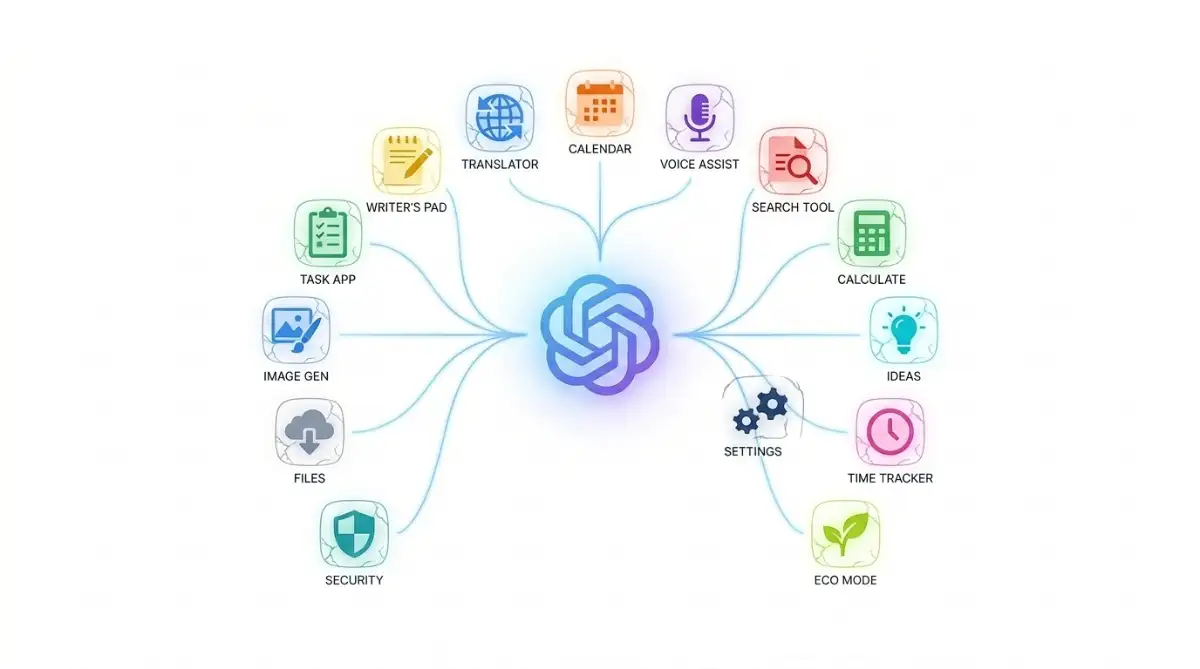
The 2023 wrapper era saw thousands of AI apps launch as thin interfaces over foundation models like GPT-4. Most consisted of little more than a prompt template and a UI skin, and many became obsolete when OpenAI absorbed their features at DevDay in November 2023. The survivors built proprietary data, deep workflow integrations, and lean cost structures.
Table of Contents:
- Key Takeaways
- Introduction
- What Exactly Was an AI Wrapper?
- Why Did Early AI Apps All Ship in a Weekend?
- Why Did Jasper's $1.5 Billion Bet on AI Apps Unravel?
- How Did Solo Builders Beat the Venture-Backed AI Apps?
- What Actually Happened at OpenAI DevDay 2023?
- What Separated Thin Skins From Real Moats?
- Honest Tradeoffs
- FAQ
Key Takeaways
- Jasper hit a $1.5 billion valuation packaging GPT-3 prompts, then watched a single product launch erase the entire business case. The timing is more brutal than you think.
- Three bootstrapped wrappers with one or two employees stayed profitable while a 1,000-person unicorn shed more than half its revenue, and the reason wasn't luck. It was a specific set of structural choices.
- OpenAI's DevDay on November 6, 2023 deleted an entire middleware category in one keynote. What it absorbed, and what it couldn't, draws the line between thin and thick wrappers.
Introduction
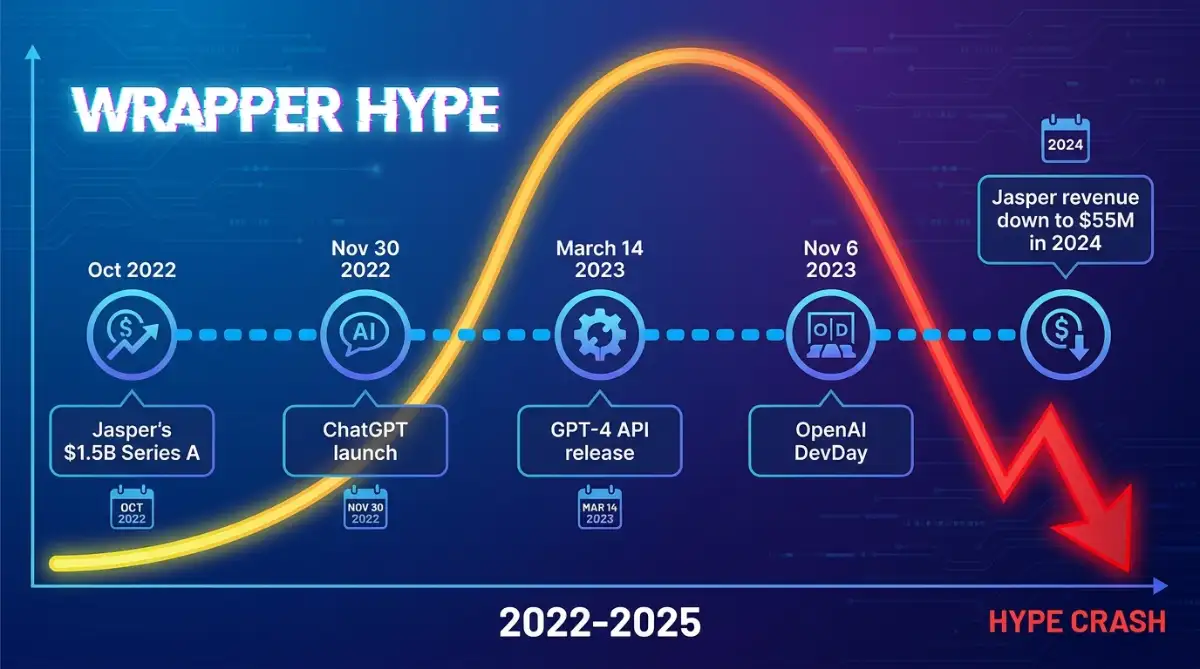
In October 2022, Jasper AI raised $125 million at a $1.5 billion valuation. Within two years its revenue had fallen by more than half and the billion-dollar story had unraveled. If you're a solo builder or indie hacker who lived through 2023, you remember why: that was the year anyone could ship AI apps in a weekend, and seemingly everyone did.
Most of those products were "wrappers," thin layers of interface and prompt engineering sitting on top of GPT-4 or Claude. Critics sneered at them. Investors panicked about them. And a handful of two-person teams quietly got rich building them while unicorns burned.
This is the story of the wrapper era: what these products actually were, why most died, and exactly why a few didn't.
What Exactly Was an AI Wrapper?
An AI wrapper is an application built on top of a foundation model like GPT-4, Claude, or Gemini that turns the model's general intelligence into one specific, accessible task. In 2023 that usually meant a prompt template, a styled interface, and an OpenAI API key doing all the real work underneath.
The value wasn't fake, though. Raw LLM access in early 2023 demanded knowledge of tokenization, temperature settings, and API key management, and outputs drifted unpredictably in structure. A restaurant owner or freelance copywriter didn't want any of that. They wanted one button that summarized a legal PDF or drafted a promo email.
A wrapper's job was translation: turning raw machine intelligence into a button a normal business owner could click without ever reading API documentation.
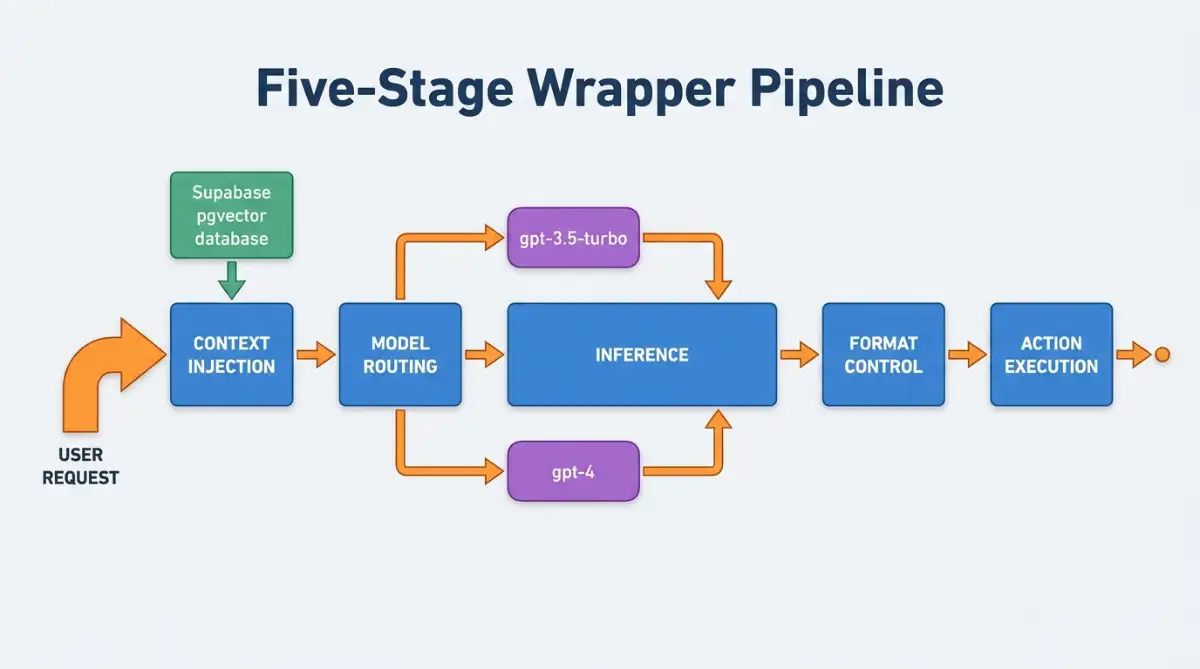
A production wrapper ran a five-stage pipeline behind that button:
- Context injection: validating input and pulling relevant documents from a vector database (RAG)
- Model routing: sending cheap tasks to gpt-3.5-turbo, hard ones to GPT-4
- Inference: the actual API call
- Format control: forcing messy output into JSON or clean text
- Action execution: triggering emails, database updates, or code runs
Why Did Early AI Apps All Ship in a Weekend?
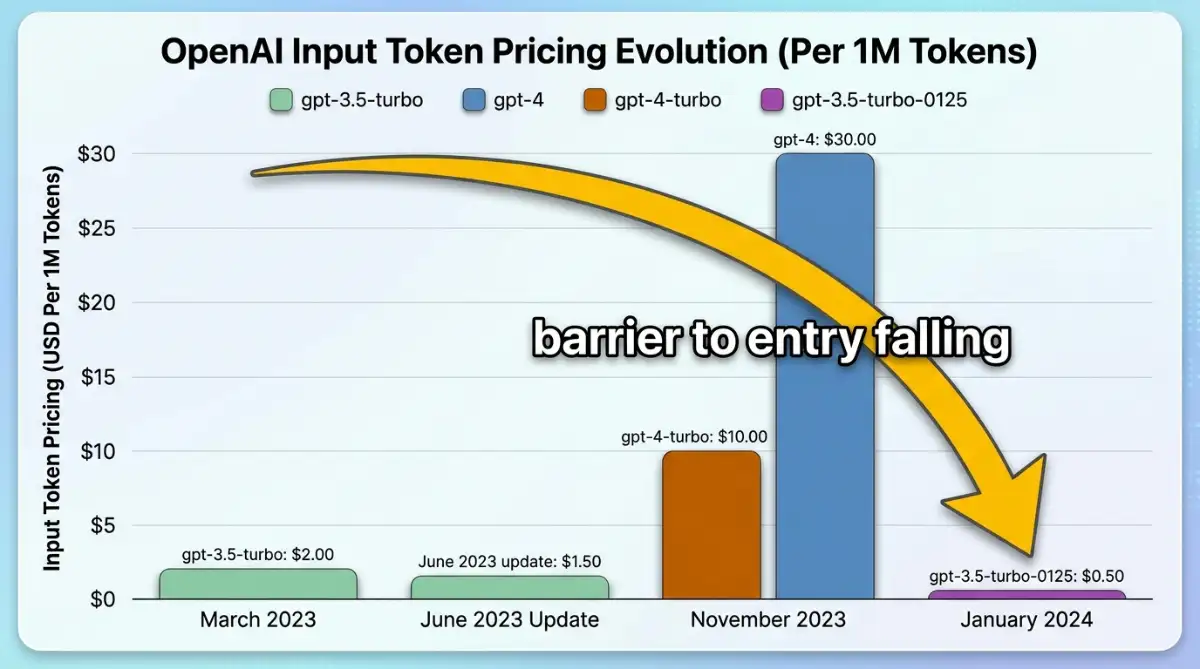
Because in 2023 the marginal cost of building software collapsed toward zero. OpenAI's API releases handed solo developers GPT-4-class intelligence for dollars per million tokens, and a standardized stack (Next.js, LangChain, Supabase, Vercel) meant a working product could go from idea to deployed in days, not months.
The price drops were relentless. The gpt-3.5-turbo endpoint launched on March 1, 2023 at $2.00 per million input tokens. GPT-4 followed on March 14. June 13 brought function calling and a 25% input price cut. By DevDay in November, gpt-4-turbo cost $10.00 per million input tokens, a 3x reduction, with a 128K context window.
| Stack layer | 2023 default | What it did |
|---|---|---|
| Frontend | React / Next.js + Tailwind | Chat UI, deployed on Vercel |
| Orchestration | LangChain / LlamaIndex | Prompt chaining, document loading |
| Vector storage | Supabase (pgvector) | Semantic search over embeddings |
| Automation | n8n | Webhook workflows into CRMs |
| Hosting | Vercel / Cloudflare | Serverless edge functions |
Cheap tokens cut your costs, but they cut your copycat's costs too. I'd argue this was the era's defining trap: every advantage you rented from OpenAI, your competitor could rent tomorrow. Half of Product Hunt in 2023 was the same ChatGPT prompt wearing a different Tailwind theme.
Why Did Jasper's $1.5 Billion Bet on AI Apps Unravel?
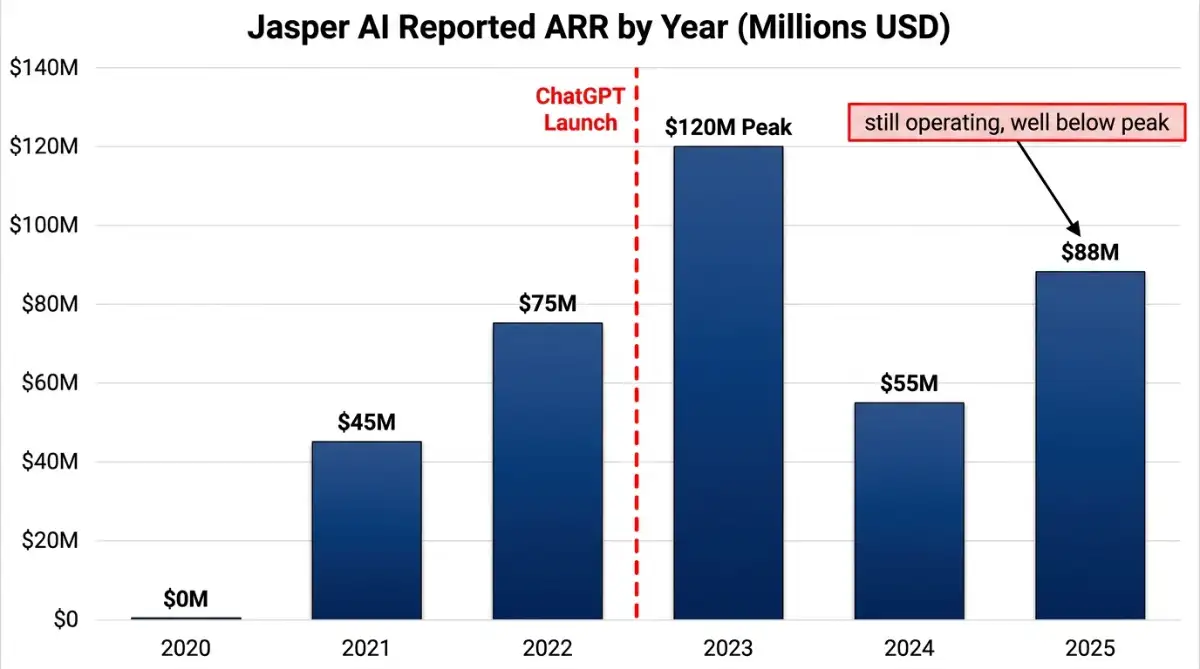
Jasper proved that revenue without a moat is just borrowed time. Founded in 2020 by Dave Rogenmoser in Austin, it packaged GPT-3 prompt templates into a document workspace for copywriters, scaled to a $120 million revenue run rate, then lost more than half of it when its own supplier commoditized the product.
The growth was real: $45 million in revenue in 2021, $75 million in 2022, and according to Sacra, a $1.5 billion Series A valuation in October 2022 at roughly a 20x ARR multiple. Then ChatGPT launched on November 30, 2022 and gave away Jasper's core capability for free.
Jasper raised $125 million at a $1.5 billion valuation, and five weeks later ChatGPT made its core product free.
The decay was visible in the traffic. According to ElectroIQ, Jasper's monthly visits fell from 8.7 million in March 2023 to 6.1 million by May 2023. Revenue dropped to an estimated $55 million by 2024, layoffs followed, and an enterprise pivot struggled to regain altitude.
Jasper survives today, but in diminished form: per GetLatka, it reported $88 million ARR in 2025, well below its peak and a world away from the trajectory that justified a $1.5 billion price tag. What gets me about this story is that Jasper hit its revenue peak ($120 million run rate in November 2023) a full year after the thing that broke it had already launched. Momentum masked the wound.
How Did Solo Builders Beat the Venture-Backed AI Apps?
While Jasper bled revenue, three tiny teams built profitable wrappers by keeping costs near zero, charging from day one, and picking problems where the wrapper itself accumulated value. Photo AI, PDF.ai, and ChatPDF never raised a dollar, and all three stayed profitable while the unicorn shrank.
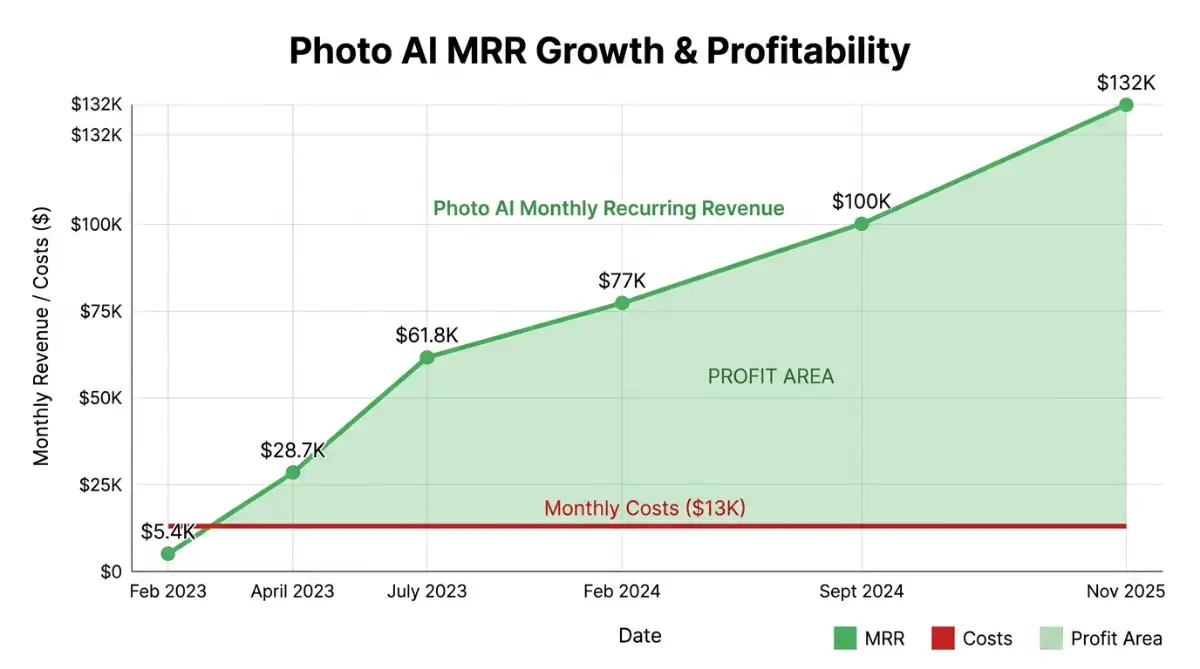
Pieter Levels launched Photo AI in February 2023 after his earlier Avatar AI ($150,000 in week one) got steamrolled by the venture-backed Lensa AI, which did $30 million in a single month. According to Indie Hackers, Photo AI grew from roughly $5.4K MRR in week one to over $132K MRR by November 2025, on about $13,000 per month in infrastructure, an 87%+ margin. No free tier, ever. That single pricing decision filtered out junk traffic and validated demand instantly.
Damon Chen took a different route: he paid $10,000 for the PDF.ai domain in June 2023 and let SEO do the selling. By September 2023 the site crossed 1,000,000 monthly visitors, 35% from organic search. According to GetLatka, PDF.ai reached $591.7K ARR by October 2024, and Berlin's two-person ChatPDF hit $440K ARR by September 2025.
| Metric | Jasper AI | Photo AI | PDF.ai | ChatPDF |
|---|---|---|---|---|
| Funding | $131M+ | $0 | $0 | $0 |
| Peak ARR | $120M (2023) | ~$1.6M (2025) | $591.7K (2024) | $440K (2025) |
| Team size | 1,000 | 1 | 1 | 2 |
| Margin | Compressed | 87%+ | 70%+ | 80%+ |
| Outcome | Revenue down >50% from peak | Profitable | Profitable | Profitable |
This is the maker movement playbook applied to AI: stay small, charge early, own a distribution channel nobody can sherlock.
What Actually Happened at OpenAI DevDay 2023?
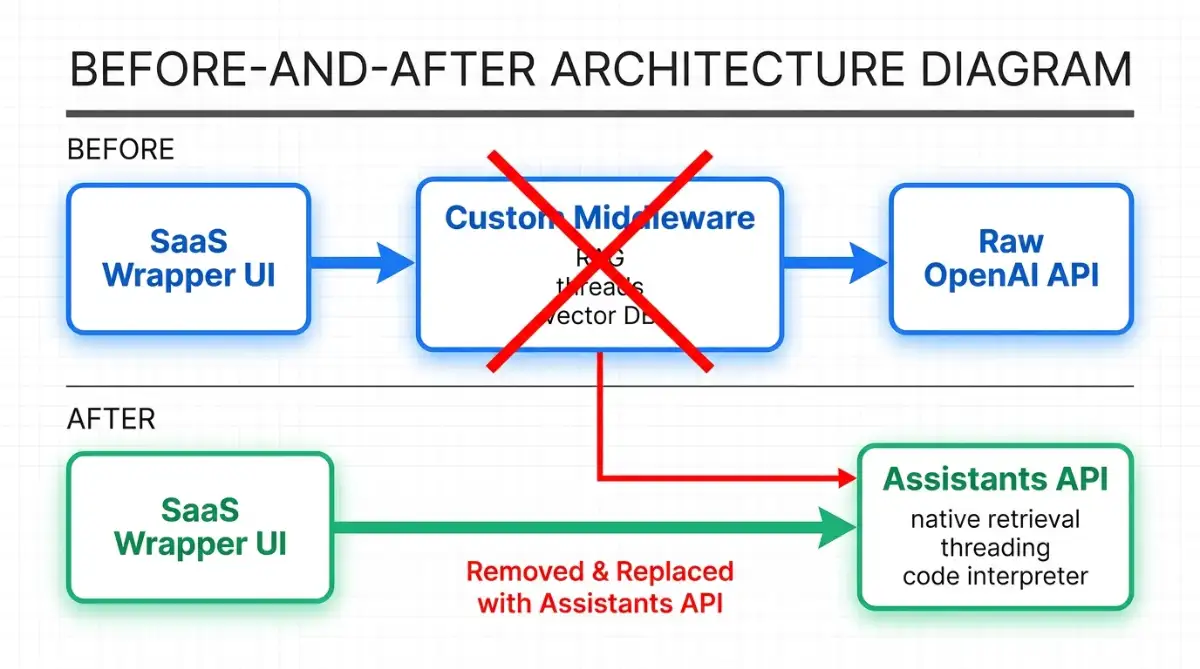
On November 6, 2023, OpenAI sherlocked half its own developer ecosystem in a single keynote. "Sherlocking" is when a platform natively absorbs a third-party app's utility, and DevDay did it at scale: the Assistants API replaced custom RAG pipelines, chat-history databases, and PDF-chunking middleware with one API call.
Before that morning, wrapper teams spent most of their engineering hours on plumbing: vector indexing, conversation threading, document parsing. After it, the Assistants API handled threading, retrieval, and sandboxed code execution natively. Custom GPTs went further, letting non-technical users build a personalized chatbot by uploading documents and typing instructions, with the GPT Store routing around third-party landing pages entirely.
OpenAI didn't out-compete the wrapper startups. It absorbed their entire middleware layer in one keynote, and charged less for it.
The pattern echoes the ChatGPT moment of November 2022, and it kept compounding: later releases like AgentKit added visual agent builders and prebuilt chat components, pushing the "thin" threshold even higher. If your product was a styled interface around a document-parsing prompt, you were now competing with your own supplier's free tier.
What Separated Thin Skins From Real Moats?
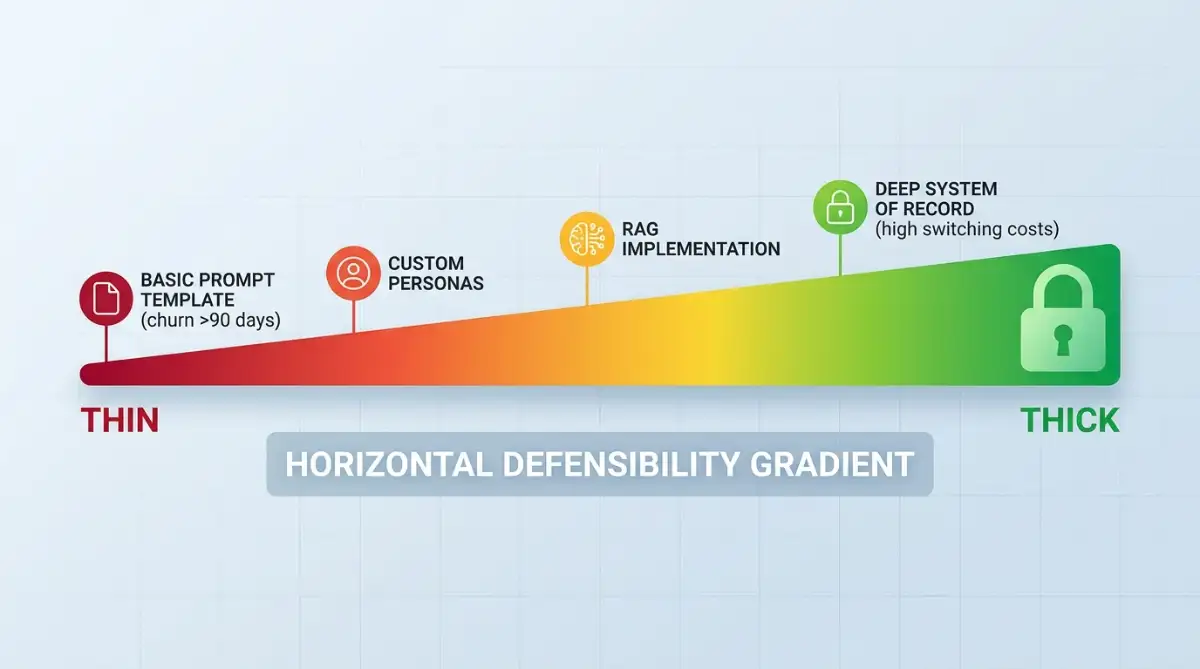
Defensibility, not technology. By late 2023, builders and investors were sorting products along a spectrum: basic prompt templates at the thin end, deep systems of record at the thick end. Thin wrappers shipped in days and reportedly churned most users within 90 days [unverified]. Thick ones became painful to remove.
The thick-wrapper playbook rested on three moats:
- Data moat: capture every user correction as a labeled training signal, building a proprietary dataset no competitor can buy
- Behavioral moat: a flywheel where usage improves accuracy, which improves retention, which generates more usage
- Workflow moat: integrate so deeply into Slack, calendars, and accounting systems that ripping the tool out hurts more than the subscription costs
The deeper shift was economic: software stopped being a tool and started being labor. A $20,000 agentic voice receptionist made sense because it replaced a salary, not a software line item, even when the underlying compute cost pennies. That logic now powers everything from no-code builders with AI features to full vibe coding workflows, the same automation thread that runs back to Zapier's 2012 origins.
In an era where foundation models are a commodity, the asset is the context graph: the accumulated decisions, corrections, and history that no rival can clone.
Honest Tradeoffs
The standard "wrappers are doomed" narrative breaks in at least three places, and it's worth being honest about each.
First, the insult never made technical sense. Every SaaS product is a wrapper around something: AWS, Stripe, Postgres. PDF.ai and ChatPDF are unambiguously wrappers and remain profitable years after DevDay supposedly killed their category. Being a wrapper was never the problem. Being a thin one was.
Second, the solo-builder gospel carries heavy survivorship bias. Pieter Levels is a famous edge case with a massive existing audience; his Avatar AI still got crushed by Lensa's $30 million month despite going viral first. For an indie hacker without his distribution, "charge from day one" is good advice, not a guarantee.
Third, the data underneath the era is mushier than the discourse admits. The widely repeated claim that thin wrappers lose most users inside 90 days circulates without a rigorous public source [unverified]. Even the popular "Jasper is dead" narrative is wrong: the company still reported $88 million in ARR in 2025, per GetLatka, and remains operational today, just at a fraction of the trajectory its $1.5 billion valuation assumed.
Finally, experts genuinely disagree on whether moats matter before scale. One camp holds that momentum is worthless without structural defensibility; the other argues momentum is precisely what buys you the time to build it. The Jasper and Photo AI stories support both readings, which should make anyone suspicious of confident takes. Mine included.
Start exploring launch-ready no-code templates here!
FAQ
What is an AI wrapper?
An AI wrapper is an app built on top of a foundation model like GPT-4 or Claude that packages the model's intelligence into a specific task, such as chatting with PDFs or generating photos. It handles prompts, formatting, and errors so users never touch the raw API.
Are AI wrapper apps profitable?
They can be, especially bootstrapped ones. Photo AI ran 87%+ margins on roughly $13,000 in monthly costs, and PDF.ai reached $591.7K ARR according to GetLatka. Venture-backed wrappers struggled more because high burn rates collided with commoditized features.
What does "sherlocking" mean in software?
Sherlocking is when a platform provider builds a third-party app's core feature directly into its own product, making the app redundant. OpenAI's DevDay 2023 is the canonical AI example: the Assistants API absorbed the RAG and chat-history middleware many startups sold.
Is building an AI wrapper still worth it in 2026?
Yes, if the wrapper accumulates something the model provider can't replicate: proprietary data, deep workflow integrations, or a strong distribution channel like SEO. A thin prompt-plus-interface product remains as vulnerable today as it was in 2023.
What's the difference between a thin and thick wrapper?
A thin wrapper is a prompt template with a UI skin, replicable in days and exposed to every platform update. A thick wrapper owns proprietary data, feedback loops, and system-of-record integrations that raise switching costs and compound with use.
Start building without code
Browse thousands of no-code templates for Webflow, Framer, Bubble, Lovable, Replit and more.
Explore Templates