The ChatGPT Moment (Nov 2022): The Day Stack Overflow Died
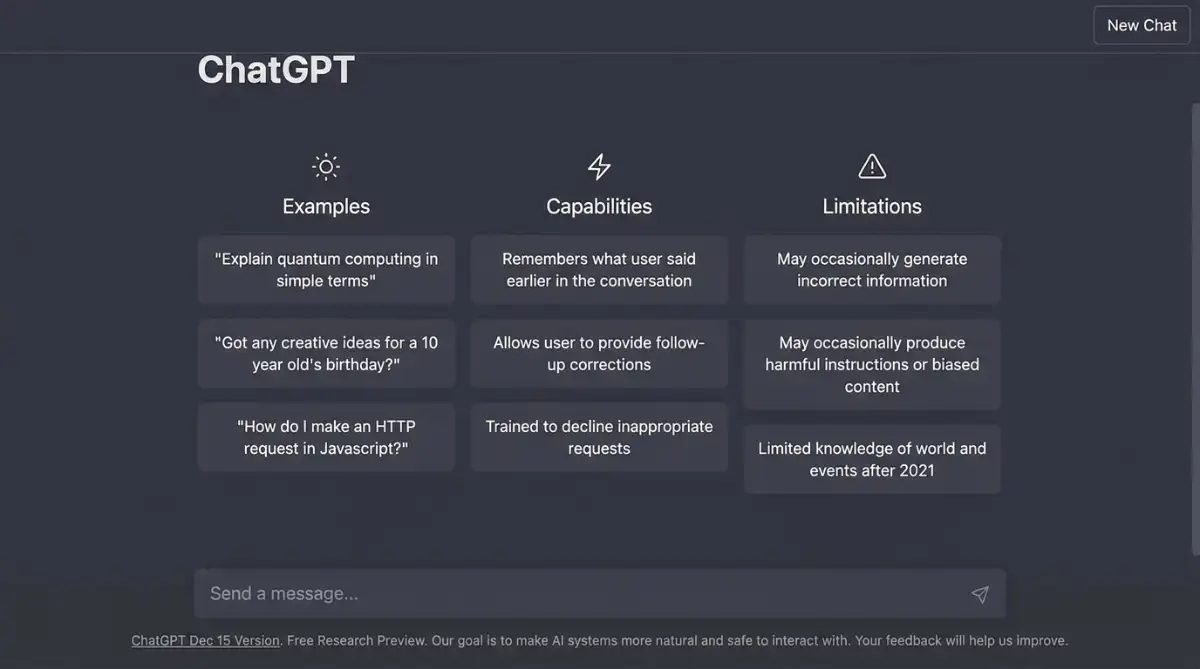
ChatGPT launched on November 30, 2022 as a free research preview and became the fastest-adopted consumer application in internet history. Its instant, conversational answers replaced search-and-forum workflows almost overnight, collapsing the web's largest programming community and kicking off the era of building software by conversation.
Table of Contents:
- Key Takeaways
- Introduction
- What Was the ChatGPT Moment of November 2022?
- Why Did ChatGPT Win Builders Over So Fast?
- What Did the ChatGPT Launch Do to Stack Overflow?
- How Did the Web Fight Back Against ChatGPT Content?
- How Did ChatGPT Force Its Own Training Source to Reinvent Itself?
- What Does the ChatGPT Trust Gap Mean for No-Code Builders?
- Honest Tradeoffs
- FAQ
Key Takeaways
- A "low-key research preview" shipped on November 30, 2022 became the fastest-adopted consumer app ever, and the casualty list started with the web's biggest programming forum.
- The launch didn't just steal traffic; it triggered an answer ban, a nine-week volunteer strike, and over $1 billion in write-downs at one company alone.
- The ChatGPT era's defining paradox is already here: record daily usage paired with collapsing trust, and that gap decides who gets to build software now.
Introduction
On the evening of November 30, 2022, OpenAI quietly shipped what its team internally called a low-key research preview. If you're a no-code builder or vibe coder who ships products by describing them in plain English, that evening is your origin story. ChatGPT didn't arrive with a Super Bowl ad or a keynote; it arrived as a free chat box, and within days it had rewired how humans ask computers for help.
The clearest proof of how seismic that moment was? The near-instant collapse of Stack Overflow, the forum that had answered the world's programming questions for fifteen years. This is the anatomy of that moment: the record-breaking launch, the casualty, the backlash, and what it means for everyone building without code today.
What Was the ChatGPT Moment of November 2022?
The ChatGPT moment was the fastest mass adoption of any consumer technology in internet history. OpenAI released the chatbot as a free web preview on November 30, 2022, and within a single week, conversational coding became normal, according to AI educator Louis Bouchard. No signup friction, no learning curve, just a text box that answered.
The growth numbers still look fake:
- 1 million users in 5 days, announced by OpenAI CEO Sam Altman on December 5, 2022
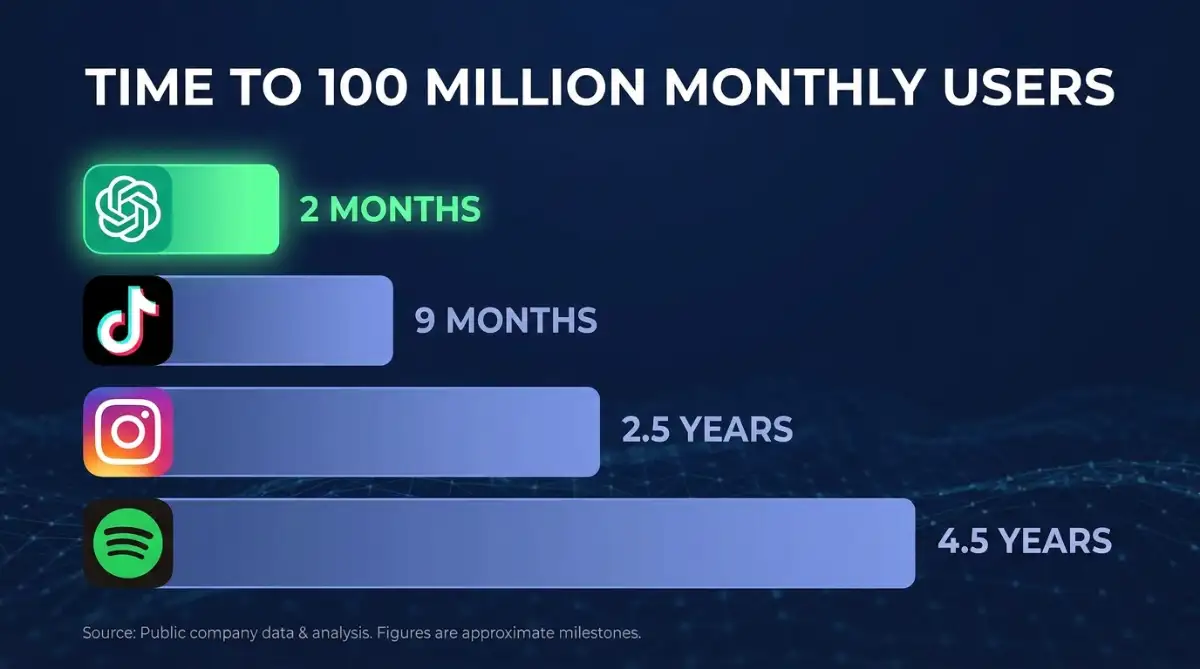
- 100 million monthly active users by January 2023, roughly 60 days after launch, per a UBS study reported by Reuters
- For comparison, TikTok needed 9 months and Instagram 2.5 years to reach the same milestone, per Sensor Tower data
The irony is brutal in hindsight. Just one year earlier, in December 2021, Stack Overflow's co-founder was still describing his forum as permanent infrastructure.
"Every programmer in the world is gonna use Stack Overflow now... like your compiler or your editor." (Joel Spolsky, Stack Overflow co-founder, The Stack Overflow Podcast, December 2021)
Eleven months later, ChatGPT made that prediction obsolete.
Why Did ChatGPT Win Builders Over So Fast?
ChatGPT won because it removed every ounce of friction and judgment from getting help. You pasted broken code, a cryptic error, or a plain-English question, and got an instant, customized answer with zero waiting and zero downvotes. The incumbent way of getting answers had spent years adding exactly the friction ChatGPT deleted.
Consider what asking a question used to involve. Stack Overflow, the dominant answer destination since 2008, had developed a culture nicknamed the "Gauntlet of Snark": aggressive duplicate closures, condescending comments, and hostility toward beginners. According to research cited on Wikipedia, 49% of new users faced hurdles like having questions closed without understanding why.
ChatGPT didn't win by being smarter than fifteen years of human answers. It won by being available at 2 a.m., infinitely patient, and incapable of calling your question stupid.
The adoption was sharply generational. According to AllStacks, 71% of engineers with under five years of experience rapidly adopted generative AI tools, versus 49% of twenty-year veterans. The beginners the old system had alienated became ChatGPT's earliest power users.
What Did the ChatGPT Launch Do to Stack Overflow?
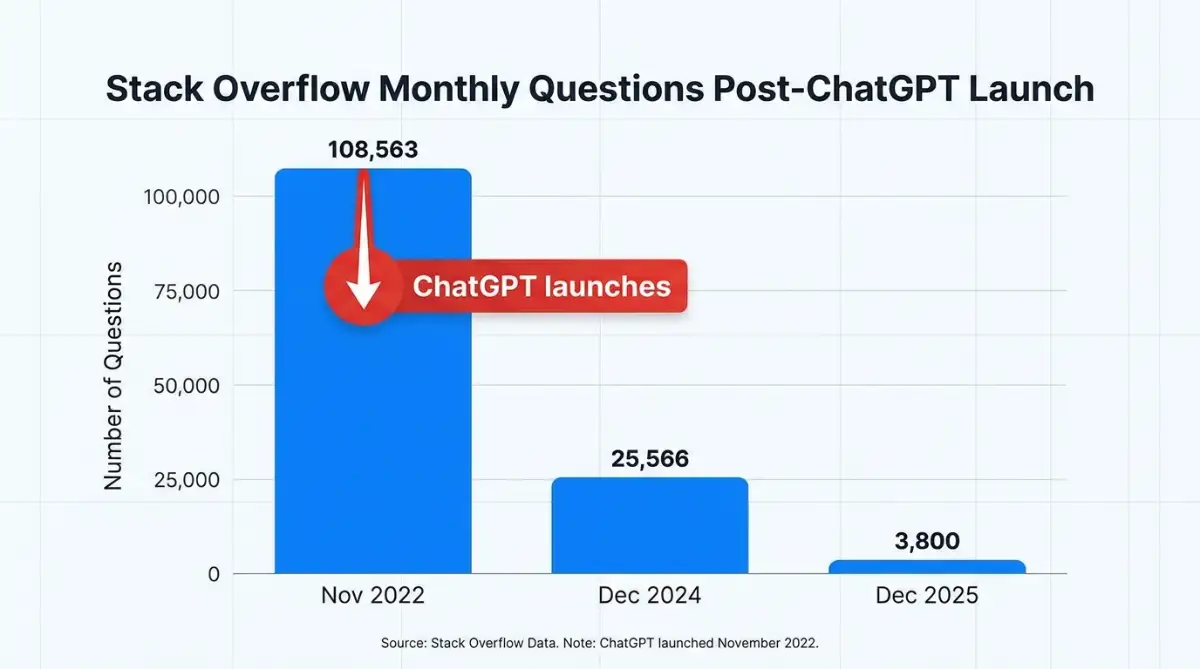
It triggered the fastest traffic reversal a major web platform has ever experienced. Within six months of the launch, posting activity on Stack Overflow dropped about 25% versus counterfactual baselines, according to causal modeling published in PNAS Nexus. Three years on, the forum was effectively dormant.
| Metric | Before ChatGPT | After ChatGPT | Source |
|---|---|---|---|
| Monthly questions | 108,563 (Nov 2022) | ~3,800 (Dec 2025) | Stack Exchange Data Explorer |
| Decline from 2014 peak | 200,000+/month | 98.1% drop | Stack Exchange Data Explorer |
| Python tag votes | 90,000/month (2020) | 10,000 (Aug 2025) | ByteIota |
| Monthly visits | 110M+ | 10-12M weekly | SimilarWeb |
The financial shockwave hit Prosus NV, which had bought Stack Overflow for roughly $1.8 billion in June 2021, eighteen months before the launch. According to Moneyweb, Prosus wrote down $246 million in March 2023, another $560 million later that year, and $372 million more in March 2024. Over $1.17 billion in value, erased by a free chat box.
The founders, for what it's worth, had cashed out at the perfect moment. Whether that was foresight or the luckiest exit timing in software history is a bar argument I'd happily take either side of.
How Did the Web Fight Back Against ChatGPT Content?
The first organized resistance to AI-generated content anywhere on the internet happened within days of the launch. ChatGPT was confidently wrong at scale, per Louis Bouchard, producing plausible but broken code, and users immediately weaponized it to farm reputation points, forcing platforms to invent AI-content policy from scratch.
The escalation came in three acts:
- December 2022: Stack Overflow's moderators enacted the internet's first major ban on ChatGPT-generated answers, days after launch
- March 2023: CEO Prashanth Chandrasekar quietly disabled the platform's public data dumps on Archive.org, preparing to charge AI companies for the training data ChatGPT had consumed for free
- June 2023: Volunteer moderators launched a nine-week strike, the first labor action of the AI era, after management ordered them to stop using AI-detection tools
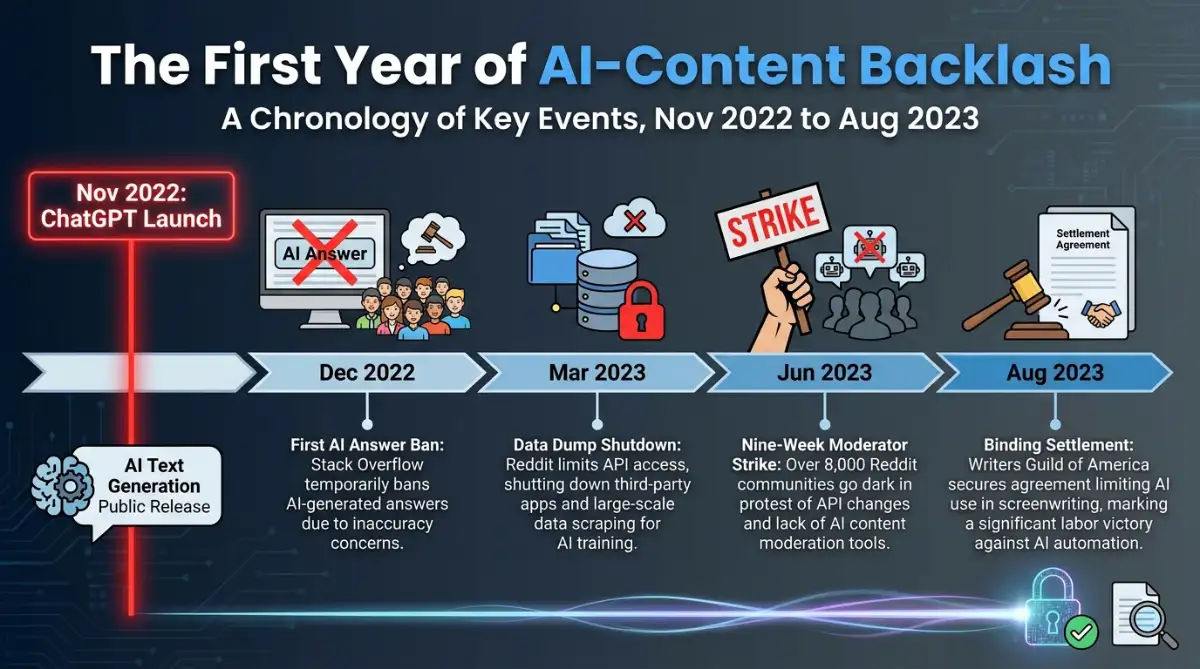
The August 2, 2023 settlement, documented on Meta Stack Exchange, created the first negotiated rulebook for AI content: "strong" and "weak" heuristics for detecting it, a mandatory 7-business-day review period for new policies, and a formal violation process requiring 90% moderator consensus. Every platform now wrestling with AI slop is rerunning this playbook, whether it knows it or not.
How Did ChatGPT Force Its Own Training Source to Reinvent Itself?
Here's the loop nobody at OpenAI sketched on a whiteboard: ChatGPT trained on Stack Overflow's archive, gutted Stack Overflow's traffic, and then Stack Overflow started selling that same archive back to OpenAI. The company that ChatGPT nearly killed survived by becoming a supplier to the thing that killed it.
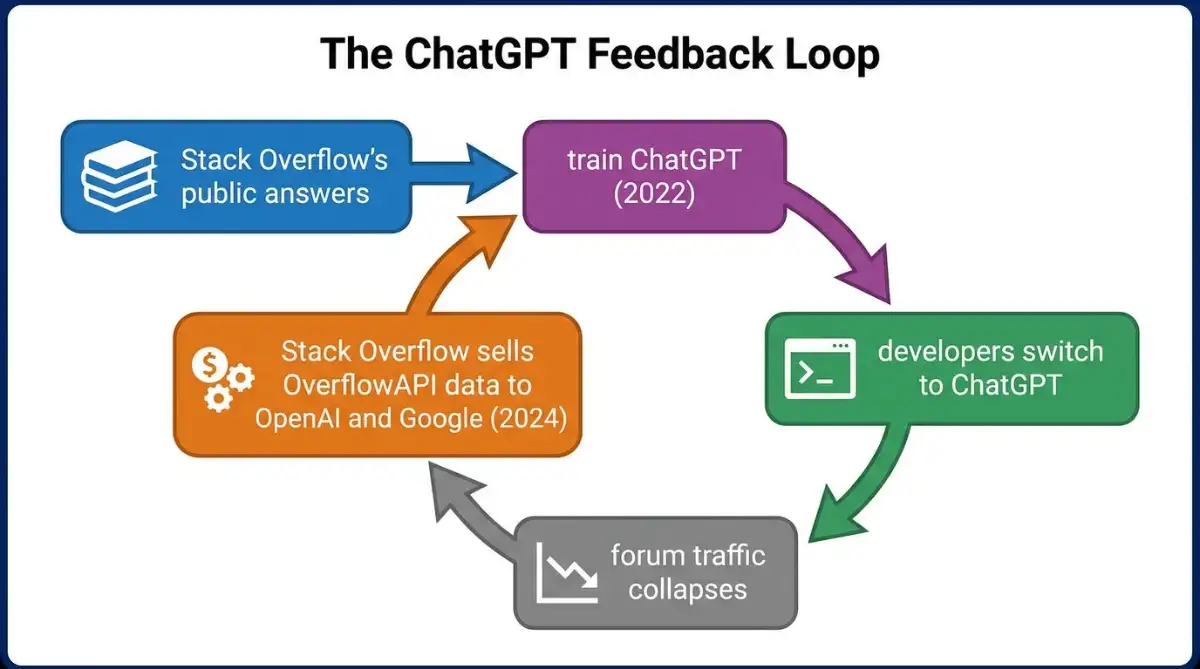
The reinvention came in three products:
- OverflowAPI (February 2024): Paid data pipelines selling structured Q&A, vote counts, and edit histories to LLM builders, with Google Cloud and OpenAI signing licensing deals, per VentureBeat
- Stack Internal (November 2025): A private knowledge layer on Microsoft Azure that grounds corporate AI copilots in verified internal answers
- Stack Overflow for Agents (June 10, 2026): An API-first exchange where autonomous coding agents, ChatGPT's descendants, query verified answers before generating code, per the official announcement
Contributors who built the original archive for free were not thrilled to see it monetized for AI training, calling the move "attribution-washing," per i-programmer.
"I did it for free for other people who did it for free for me. OpenAI never did anything for me for free." (@ben, longtime contributor, via ByteIota, November 2025)
What Does the ChatGPT Trust Gap Mean for No-Code Builders?
Three years into the ChatGPT era, the defining tension is this: usage keeps climbing while trust keeps falling. According to the 2025 Stack Overflow Developer Survey of 49,009 respondents (via ADTmag), daily AI usage hit 84%, up from 76% in 2024, while trust in AI accuracy fell from 40% to 29%.
The frustration is specific. About 66% of developers cite "almost right, but not quite" AI answers as a daily annoyance, and 45.2% say debugging AI-generated code takes longer than writing it by hand. Only 3% report high trust in AI outputs.
"The growing lack of trust in AI tools stood out to us as the key data point in this year's survey." (Prashanth Chandrasekar, Stack Overflow CEO, via the Stack Overflow Blog, February 2026)
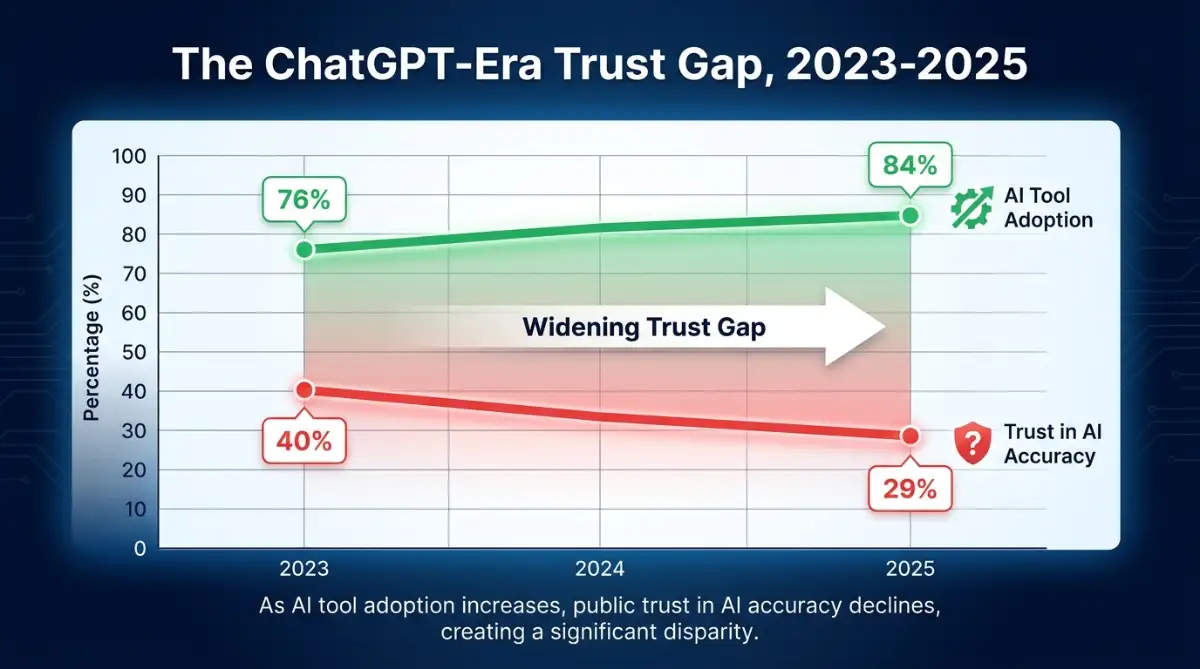
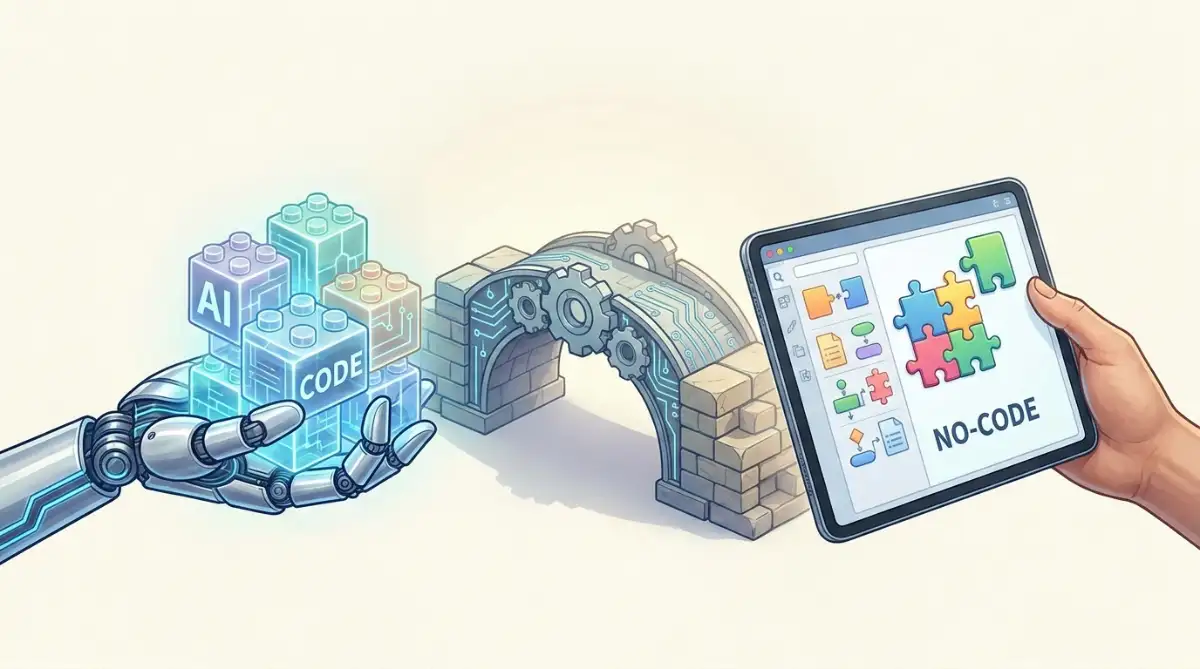
If you build through vibe coding, this gap matters more for you than for a senior engineer, because you can't always spot the "almost right" failure mode yourself. I'd argue the real lesson of the ChatGPT moment isn't that human knowledge became worthless; it's that verification became the scarce resource. That's exactly why a visual no-code builder with tested templates, or a low-code platform with guardrails, often beats raw AI-generated code for non-technical makers: someone already did the verifying.
Honest Tradeoffs
The clean "ChatGPT changed everything overnight" story has cracks worth naming. First, the launch gets more credit than it deserves for the forum's death. Stack Overflow's user numbers were softening by 2020, and a culture that drove away half its newcomers was bleeding out long before November 2022. ChatGPT accelerated a decline; it didn't invent one.
Second, the ChatGPT moment carries a hidden cost the whole industry now pays. Research published in PNAS Nexus warns that private AI chats are never added back to the shared pool of online knowledge, creating a risk of model stagnation. Every answer the chatbot gives instead of a public forum is an answer the next model can't train on. The tool that ate the commons is also eating its own future food supply.
Third, the speed gain is partly an illusion. Survey data shows 45.2% of developers say verifying AI output now costs more than writing code did. ChatGPT moved the bottleneck from "finding an answer" to "checking the answer." Friction migrated; it didn't vanish.
Finally, experts genuinely disagree on where this ends. Some see AI agents and verified knowledge bases merging into a self-correcting system; others, per Medium's analysis, expect the pre-ChatGPT human archives to be retired as static sacred texts. Nobody making confident predictions here deserves your full trust, including me.
Start exploring launch-ready no-code templates here!
FAQ
What exactly was the "ChatGPT moment"? It refers to the period immediately after OpenAI released ChatGPT on November 30, 2022, when conversational AI went from research curiosity to mass-market tool in days. Within a week, asking an AI for code or answers became a normal workflow, per AI educator Louis Bouchard.
How fast did ChatGPT actually grow? ChatGPT reached 1 million users in five days, per Sam Altman, and an estimated 100 million monthly active users by January 2023, per a UBS study reported by Reuters. That made it the fastest-growing consumer application in internet history at the time.
Did ChatGPT really kill Stack Overflow? It delivered the decisive blow, but not the only one. Monthly questions fell roughly 98% from peak per Stack Exchange Data Explorer, yet the forum's hostile culture had been shrinking its user base since around 2020. ChatGPT accelerated an existing decline.
Was ChatGPT free at launch, and what does it cost now? It launched as a completely free research preview, which fueled the record adoption. OpenAI later added paid premium tiers around $20 per month, while the basic chat experience has remained freely accessible.
Is ChatGPT-generated code safe for non-programmers to use? It works for prototypes, but treat it with caution: 66% of developers report AI code that's "almost right, but not quite," per the 2025 Stack Overflow survey. Non-technical builders often get safer results from pre-verified templates and visual builders than from raw generated code.
Start building without code
Browse thousands of no-code templates for Webflow, Framer, Bubble, Lovable, Replit and more.
Explore Templates