No Code Frontend vs Backend: Two Halves of an App
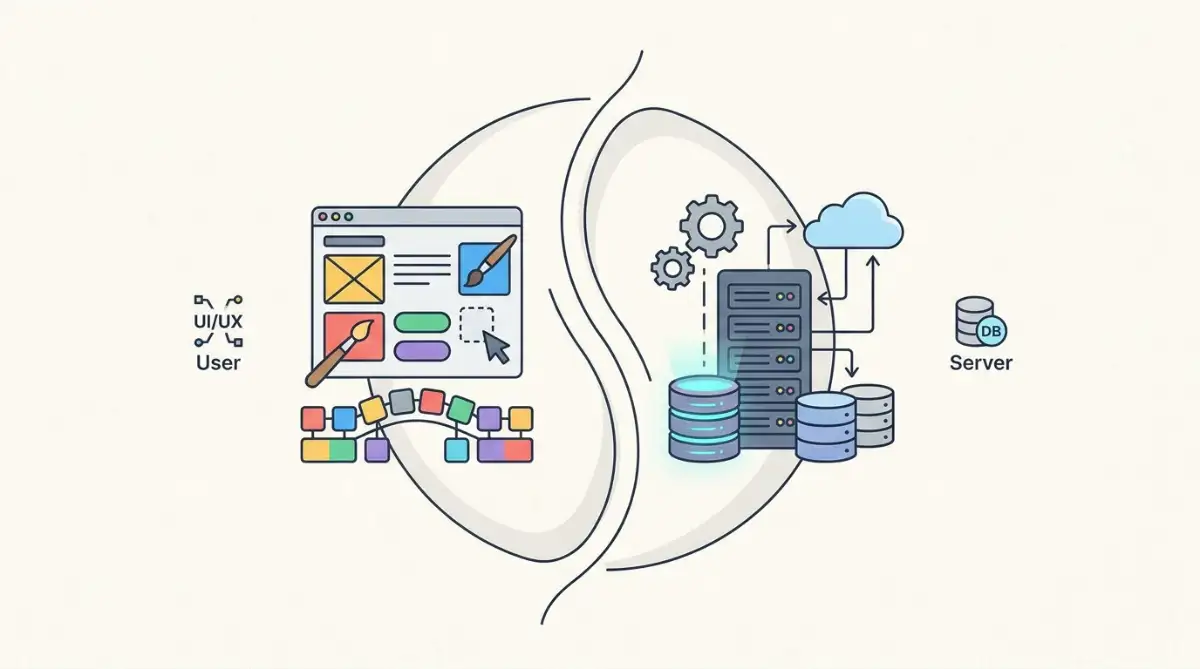
Frontend software runs on the visitor's device and paints screens, captures clicks, and holds short-lived UI state. Backend software runs on servers you control and owns business rules, durable records, identity checks, and queued work. Visual builders expose both as canvases and hosted services, so the network boundary still exists even when nobody writes Node.js.
Table of Contents:
- Key Takeaways
- Introduction
- How Did the Browser Stop Being a Dumb Terminal?
- What Does the Client Half Run That the Server Cannot?
- How Do REST, GraphQL, and WebSockets Carry the Handshake?
- Why Does Backend Pay Still Matter for Boutique Retailers?
- What Happens When No Code Frontend vs Backend Boundaries Leak?
- Where Does No Code Frontend vs Backend Collapse in a Builder?
- Decision Framework
- FAQ
Key Takeaways
- Knight Capital's $440 million morning was a missing eighth SMARS node, which is why a prettier storefront would not have stopped Power Peg from firing live NYSE orders.
- Stack Overflow's 4.3 percent frontend share versus 14.2 percent backend is a labor map, and U.S. pay still prices complexity on the server side of the wire.
- Next.js CVE-2024-34351 was a Host-header confession, because Server Actions can still fetch the AWS instance-metadata address if those relative redirects stay naive on self-hosted apps.
Introduction
Boutique retailers and freelance course creators do not lose orders because the type scale is ugly. They lose them when no code frontend vs backend is treated as one canvas, and the stock count never leaves a spreadsheet.
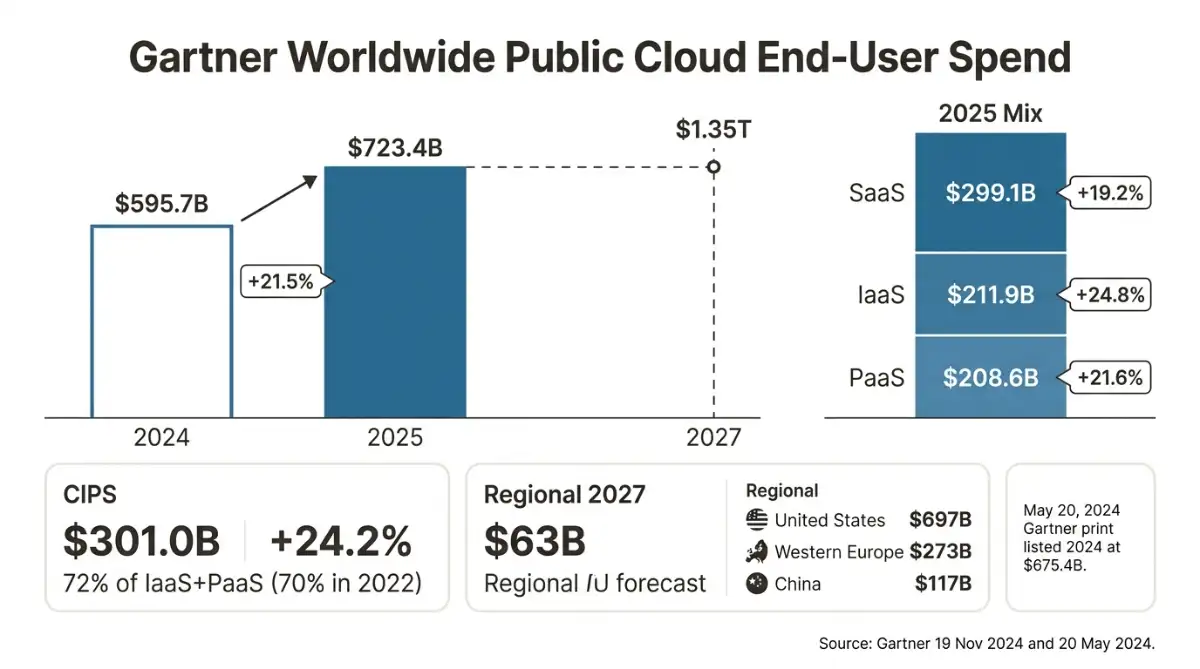
According to Gartner, worldwide end-user spending on public cloud services is forecast to reach $723.4 billion in 2025, a 21.5 percent increase over $595.7 billion in 2024. That bill is mostly the half your visitor never sees.
Get the split wrong and you either publish a shopfront that cannot take money, or you paste secrets into the JavaScript bundle. The trail runs through CERN in 1989, Node.js in 2009, Stack Overflow's 2025 role split, Knight Capital's $440 million morning, and CVE-2024-34351 in Next.js.
How Did the Browser Stop Being a Dumb Terminal?
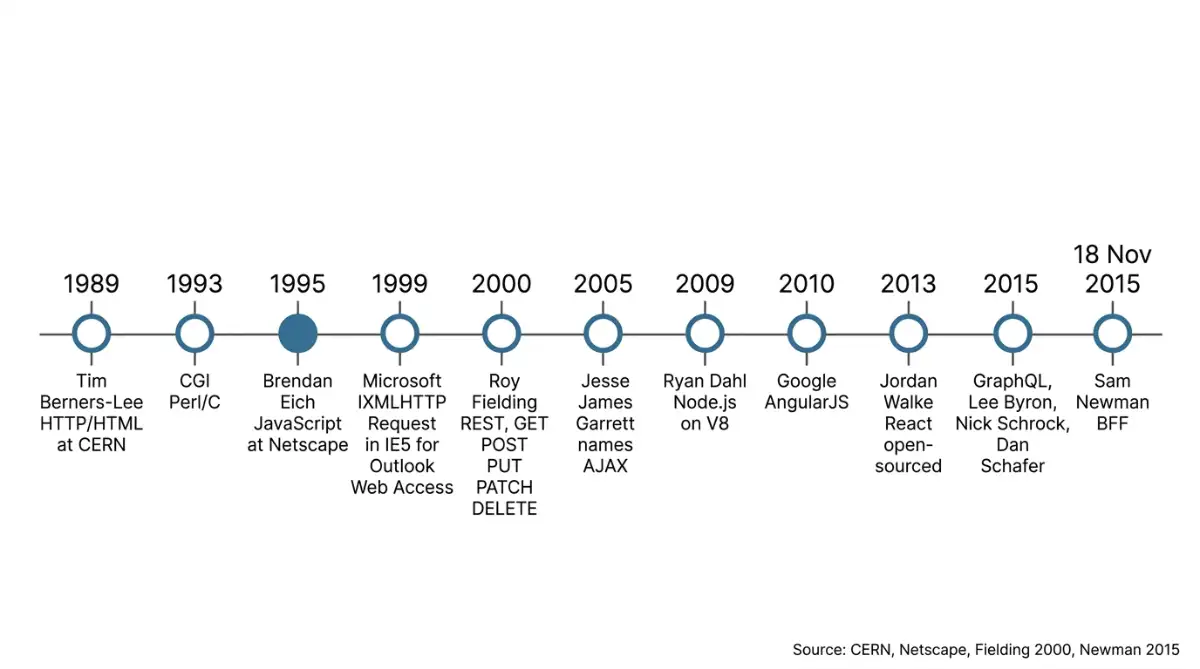
The split is younger than the mainframe and older than React. Tim Berners-Lee wrote HTTP and HTML at CERN in 1989 so research documents could move across workstations. CGI in 1993 let servers run Perl or C and return HTML. Until JavaScript arrived at Netscape in 1995, the browser printed markup.
Microsoft shipped IXMLHTTPRequest in Internet Explorer 5 in 1999 for Outlook Web Access. Jesse James Garrett named AJAX in 2005, after Roy Fielding's 2000 dissertation defined REST over GET, POST, PUT, PATCH, and DELETE.
Ryan Dahl released Node.js in 2009, pulling Google's V8 out of Chrome. Google's AngularJS in 2010 and Facebook's React (Jordan Walke, open-sourced in 2013) then moved routing and state into the client.
- 1989: Berners-Lee, HTTP and HTML at CERN
- 1995: Brendan Eich, JavaScript at Netscape
- 2009-2013: Node.js, AngularJS, React
- 2015: GraphQL
Sam Newman wrote in November 2015:
With the advent and success of the web, the de facto way of delivering user interfaces has shifted from thick-client applications to interfaces delivered via the web.
AJAX taught the browser to fetch JSON without throwing the page away, and that did not retire the server.
What Does the Client Half Run That the Server Cannot?
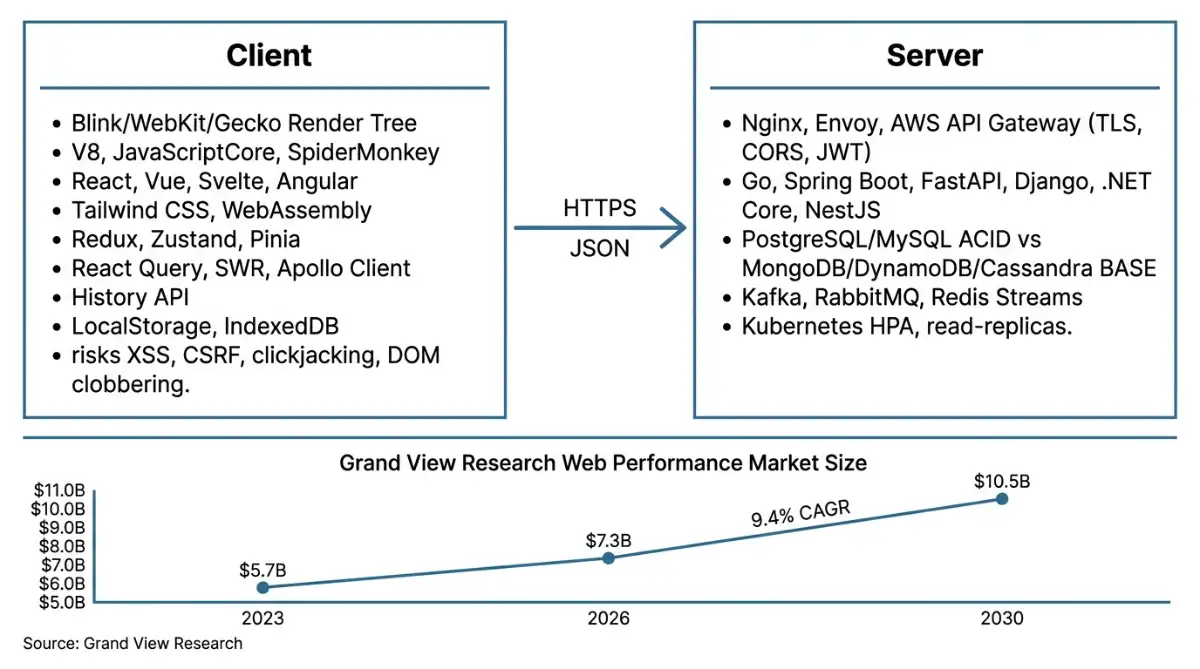
On the device, Blink, WebKit, and Gecko turn HTML and CSS into a Render Tree, while V8, JavaScriptCore, or SpiderMonkey run scripts under memory and battery limits. Across the network, Nginx, Envoy, or AWS API Gateway terminate TLS, then Go, Spring Boot, FastAPI, or NestJS enforce rules a visitor must not rewrite.
Client state sits in three buckets:
- Local UI state: modals, draft fields, open drawers
- Shared caches: Redux, Zustand, Pinia
- Server-cache libraries: React Query, SWR, Apollo Client
That is also why UI vs UX fights erupt on the canvas: the pixels are local, the invariants are not. A client-side router uses the History API. SSR sends HTML first, then hydrates listeners onto nodes that already exist.
According to Grand View Research, the global web performance market (monitoring, CDNs, client optimization) was $5.7 billion in 2023, heading toward $7.3 billion in 2026 and $10.5 billion by 2030 at a 9.4 percent CAGR. CDNs exist because static bundles scale across phones. The persistence layer does not: PostgreSQL and MySQL chase ACID, while MongoDB, DynamoDB, and Cassandra lean BASE, and Kafka, RabbitMQ, or Redis Streams pull heavy work off the request thread.
| Dimension | Client half | Server half |
|---|---|---|
| Runtime | Chrome, Safari, iOS, Android, Electron, Tauri | Cloud VMs, Kubernetes, AWS Lambda, Cloudflare Workers |
| Job | Render, gestures, routing, a11y, local cache | Business rules, transactions, identity, queues |
| Languages | HTML5, CSS3, JavaScript, TypeScript, React, Vue, Svelte | Go, Python, Java, C#, Rust, Node.js, SQL |
| Failure mode | XSS, CSRF, clickjacking, secrets in the bundle | Injection, SSRF, BOLA, DDoS, RCE |
| State | Volatile unless LocalStorage or IndexedDB | Durable WAL, replicas, distributed cache |
A canvas can paint a button, but only the durable store should be allowed to move the money.
How Do REST, GraphQL, and WebSockets Carry the Handshake?
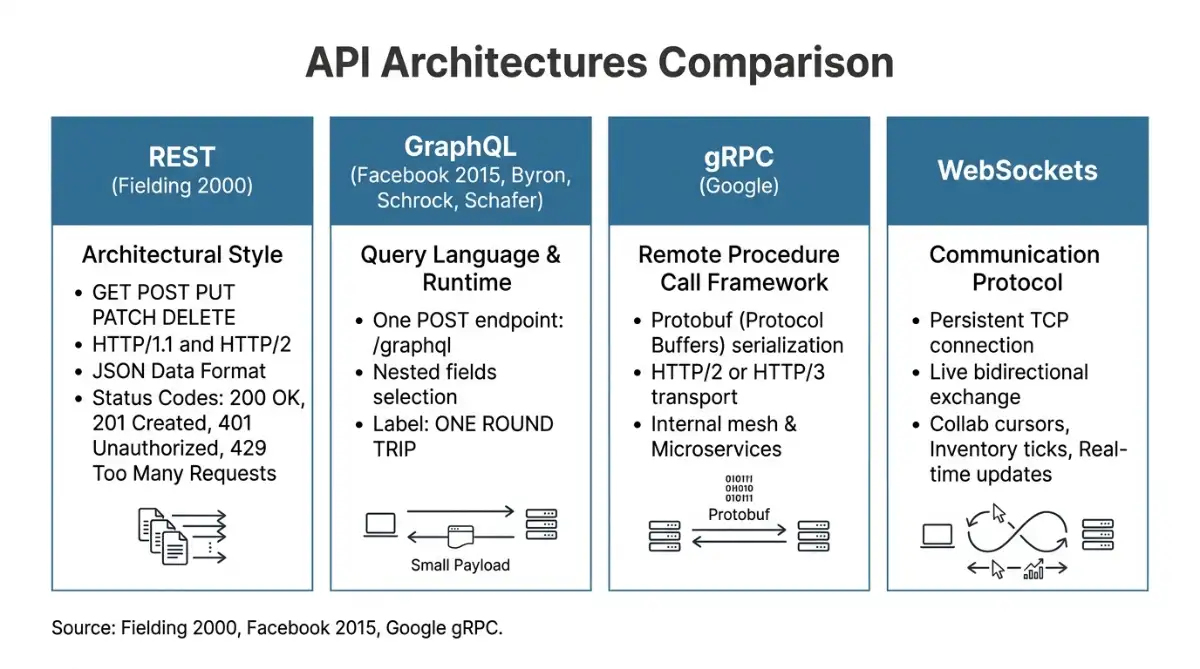
Four application-layer protocols carry almost every handshake: REST rides HTTP with JSON, GraphQL (Facebook, 2015) lets the client name fields, gRPC ships Protobuf over HTTP/2, and WebSockets keep a full-duplex TCP pipe open for live boards. They are how a canvas asks a database for a row without pretending the two processes share memory.
Visual API canvases wrap the same contracts: a URI, a method, headers, a JSON body, a status code. REST is still the default because it reused the web.
Pick by the shape of the question:
- REST: CRUD resources, caching, wide tooling, boring JSON
- GraphQL: one round trip, explicit schema, less payload bloat on phones
- gRPC: Protobuf, HTTP/2 or HTTP/3, internal mesh, not a public marketing site
- WebSockets: bids, collab cursors, live inventory ticks
CORS headers on the gateway decide which foreign origins may call. JWT checks belong there too, not in a React effect the visitor can edit.
GraphQL exists because REST payloads grew faster than mobile radios could afford to download.
Why Does Backend Pay Still Matter for Boutique Retailers?
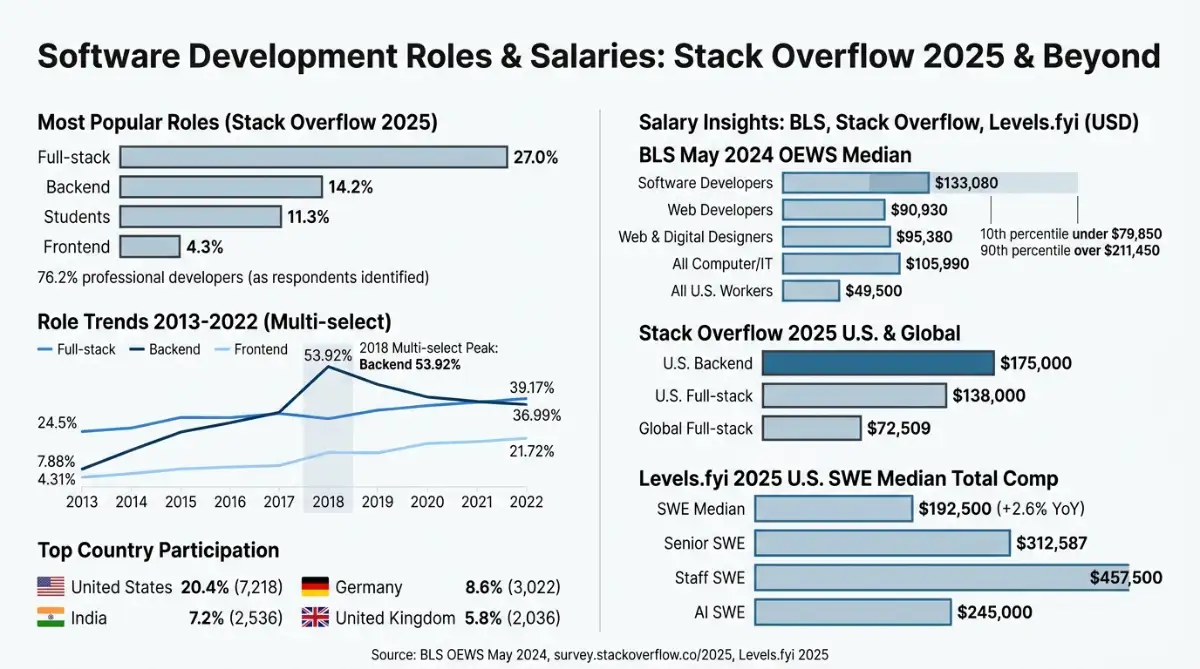
Pay still follows the half that can lose money in production. According to the U.S. Bureau of Labor Statistics, software developers posted a May 2024 median of $133,080, while web developers sat at $90,930. Boutique retailers feel that gap as a contractor invoice, not a job title.
According to the 2025 Stack Overflow Developer Survey, 27.0 percent of practitioners identify as full-stack, 14.2 percent as backend, and 4.3 percent as frontend. In the United States the same survey put backend median pay at $175,000 against $138,000 for full-stack. Levels.fyi and Stack Overflow proxies place typical frontend bands near $125,000 to $140,000.
Melvin Conway stated in 1967 that product shape copies org shape. Horizontal teams (interface vs logic vs database) produced REST payloads that did not match screens. Vertical product teams, and Newman's BFF adapters, were the reply.
What the invoices actually buy:
- Client craft: design systems, Core Web Vitals, React or Vue, accessibility
- Server craft: isolation, indexes, RBAC/ABAC, queues, Kafka-shaped work
- Full-stack: TypeScript across Node.js and the browser, faster features, thinner specialization
The market still pays more for the half that can lose $440 million before lunch.
What Happens When No Code Frontend vs Backend Boundaries Leak?
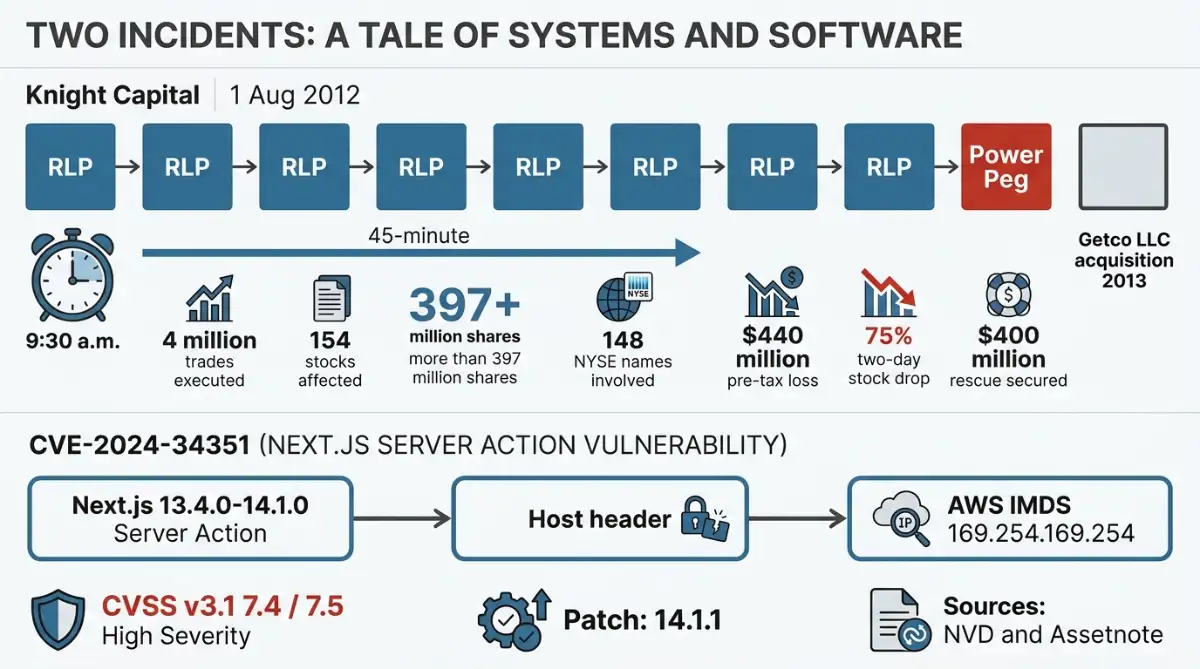
Leaks at the boundary are not theoretical. On August 1, 2012, Knight Capital pushed new SMARS routing code to seven of eight production servers and left Power Peg alive on the eighth. Forty-five minutes later the firm had a $440 million pre-tax trading loss.
The reused flag turned a test function into live child orders: 4 million trades, 154 stocks, more than 397 million shares, and 148 NYSE names disrupted. The stock fell 75 percent in two days. A $400 million rescue diluted holders, and Getco bought the firm in 2013.
- A manual deploy that missed one of eight SMARS nodes
- A configuration flag that still armed dead Power Peg code
- No real-time circuit breaker on the order pipeline
Assetnote disclosed CVE-2024-34351 in May 2024 in Next.js 13.4.0 through 14.1.0. A Server Action redirect trusted the Host header and could fetch 169.254.169.254. Vercel patched it in 14.1.1, which is why token hygiene still starts on the server.
SPA bundles wreck LCP and INP on a phone.
A Host header that picks the redirect target turns a Server Action into a proxy on the private network.
Where Does No Code Frontend vs Backend Collapse in a Builder?
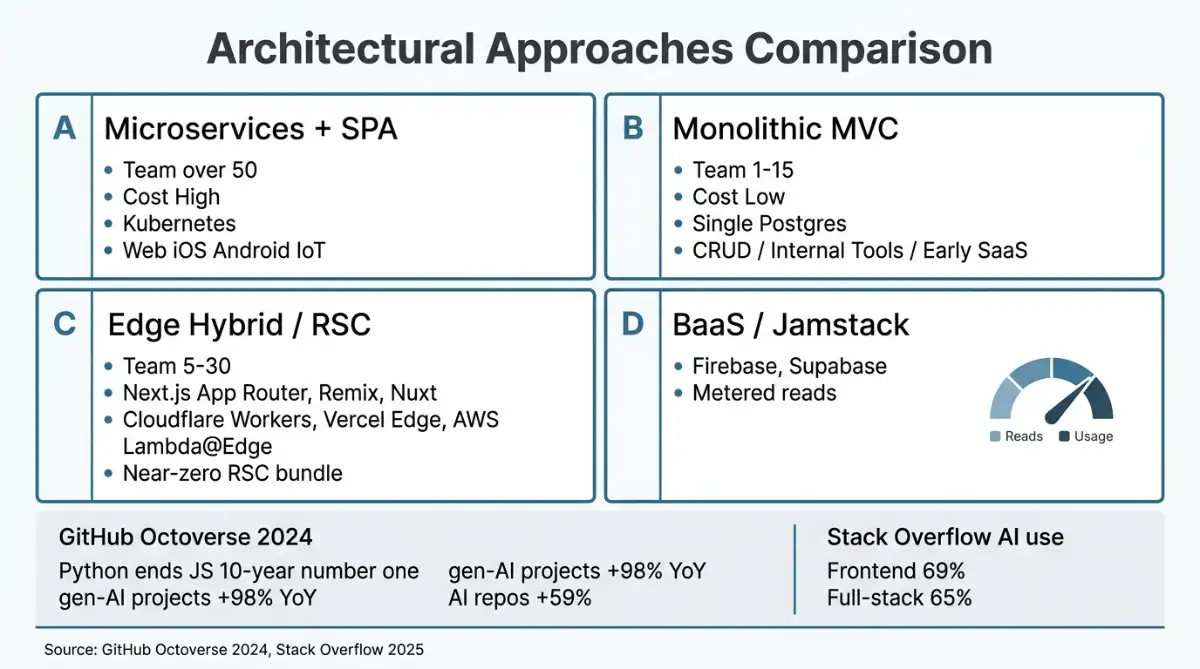
Firebase and Supabase give freelance course creators auth, a database, and realtime sync without a NestJS repo. React Server Components in Next.js, Remix, and Nuxt keep database drivers out of the JavaScript bundle. Cloudflare Workers, Vercel Edge Runtime, and AWS Lambda@Edge run session checks next to the shopper.
A Webflow-class canvas is still chrome plus someone else's origin. Bubble's visual workflows fold logic into the same editor. I still open DevTools when a workflow banner says success and the order row is empty.
BaaS tradeoffs:
- Auth and rows without an API repo
- Query semantics you cannot fork
- Read bills that jump on a public list page
According to GitHub's Octoverse 2024, Python passed JavaScript as the most-used language on the platform, with generative AI projects up 98 percent year over year. Stack Overflow found frontend developers using AI tools at 69 percent, ahead of full-stack at 65 percent.
Sid Nag, Vice President Analyst at Gartner, November 19, 2024:
The use of AI technologies in IT and business operations is unabatedly accelerating the role of cloud computing in supporting business operations and outcomes.
Firebase does not delete the backend. It rents you someone else's, with a meter on every read.
Decision Framework
Choose the split by failure radius, not by what the template gallery implies. Boutique retailers and freelance course creators should name the surfaces, the secrets, and the transaction before they name the tool.
- Count the clients. One marketing site can live as a canvas plus forms. iOS, Android, web, and a partner API sharing prices need one policy engine behind all of them.
- Ask who can keep a secret. Payment keys, JWT signing, and role checks belong off the bundle. If a browser download can mint an admin session, you do not have authorization.
- Separate paint from commits. Layout and motion are client work, while inventory decrements, refunds, and seat grants are transactions. RSC and BaaS can fetch without retiring indexes, isolation, or workers.
- Match team size to topology. Under about 15 people, a modular monolith or BaaS wins on calendar time. Past 50 to 100 engineers, independent deploys start to matter, and high traffic alone is not a microservice mandate.
- Price the meter. Firebase and Supabase look cheap until a public catalog page fans out reads. Owned PostgreSQL looks expensive until the same page is a CDN-backed query.
I would not split a shop into twelve services because a conference talk said scale. I would split when two apps must share a payment invariant I refuse to keep in React state.
| Situation | Ship this |
|---|---|
| One web storefront, standard checkout, small team | Canvas plus hosted commerce or BaaS, secrets on the server |
| Web plus native apps, shared catalog rules | Dedicated API (BFF per client if payloads diverge) |
| Internal CRUD, one database, one team | Modular monolith, skip the mesh |
| Heavy Python jobs beside a light marketing site | Split compute, keep identity consistent |
| "We microserviced the repo but still ship lockstep" | Stop. That is a distributed monolith. |
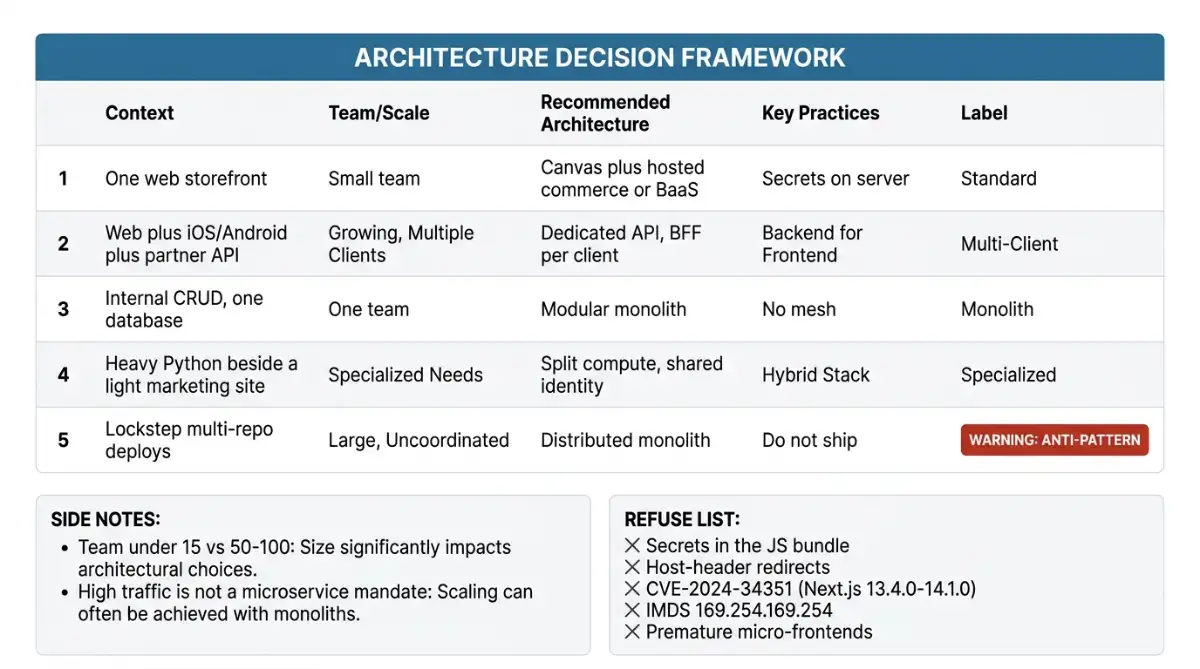
Anti-patterns to refuse on the call:
- Credentials or database queries compiled into the client bundle
- Host headers trusted for server-side redirects (the CVE-2024-34351 class)
- Micro-frontends before the org can pay for duplicate runtimes and CSS collisions
Start exploring launch-ready no-code templates here!
FAQ
What is frontend vs backend for a website?
The frontend is the HTML, CSS, and JavaScript that Chrome, Safari, or an iOS app execute on the visitor's hardware. The backend is the API gateway, business logic, and database that never ship inside that bundle, even if you never open a terminal.
Does a visual website builder include a backend?
Most builders ship a canvas plus hosted routing, forms, and CMS records, which is a backend you cannot fork. Firebase and Supabase go further with authentication and a database API, still bounded by vendor query rules and a usage meter.
Should a small shop use REST or GraphQL?
REST is the default for a public catalog because caches, status codes, and tooling are everywhere. GraphQL is worth it when a phone UI needs nested fields in one round trip and you can maintain the schema, not as a fashion upgrade on a five-page brochure.
What do frontend and backend developers earn?
The U.S. Bureau of Labor Statistics listed a May 2024 median of $90,930 for web developers and $133,080 for software developers. The 2025 Stack Overflow Developer Survey put U.S. backend median pay at $175,000, compared with $138,000 for full-stack roles.
Is Firebase or Supabase a real backend?
Yes. They are Backend-as-a-Service products with a hosted database, authentication, and often real-time sync. You still own access rules, indexes, and the bill when a public list page multiplies reads, and they do not replace workers for slow, messy jobs.
Start building without code
Browse thousands of no-code templates for Webflow, Framer, Bubble, Lovable, Replit and more.
Explore Templates