The OG SaaS Builder That Changed the Web Forever

Homestead.com, launched in June 1998, was the first cloud-based SaaS builder to let users design websites entirely in a browser with no downloads, no FTP, and no coding required. It scaled to 2 million users within 16 months and was later acquired by Intuit for $170 million in 2007. Today, the brand has been absorbed into Network Solutions under Newfold Digital.
Table of Contents
- What Was Homestead.com and Why Did It Matter?
- The Tech Behind the First SaaS Builder
- How Homestead Evolved Its Business Model
- The Intuit Acquisition and What Came After
- Why Homestead Eventually Fell Behind
- Key Takeaways
- FAQ
What Was Homestead.com and Why Did It Matter?
Before drag-and-drop was a thing, building a website meant wrestling with Microsoft FrontPage, memorising FTP commands, and praying your layout didn't fall apart in Netscape.
Then in June 1998, Homestead.com showed up and honestly, it changed everything.
Founded in October 1997 by Justin Kitch, Thai Bui, and David Wu in Menlo Park, California, Homestead launched as the first truly browser-based SaaS builder. No software to install. No local files to manage. Just open a browser, drag some elements around, and publish your site. For small business owners and non-profits with zero coding knowledge, this was borderline magic.
The results spoke for themselves. Within just 16 months of launching, Homestead had already hit 2 million registered members. That kind of growth validated something important: there was a massive, underserved market of people who needed a professional online presence but couldn't afford a developer or figure out HTML.
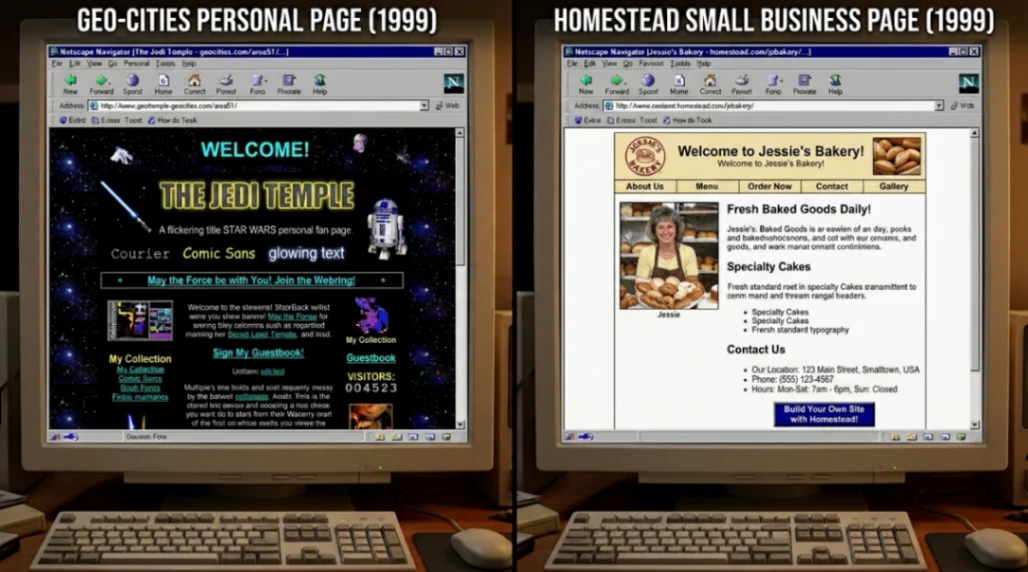
While platforms like GeoCities and Angelfire were catering to hobbyists and fan pages with blinking text and chaotic layouts, Homestead deliberately went after the "serious" user: the small retailer, the consultant, the community organization that needed their website to actually work as a business tool.
That positioning? Genuinely smart.
The Tech Behind the First SaaS Builder
Here's where it gets genuinely interesting from a tech history perspective.
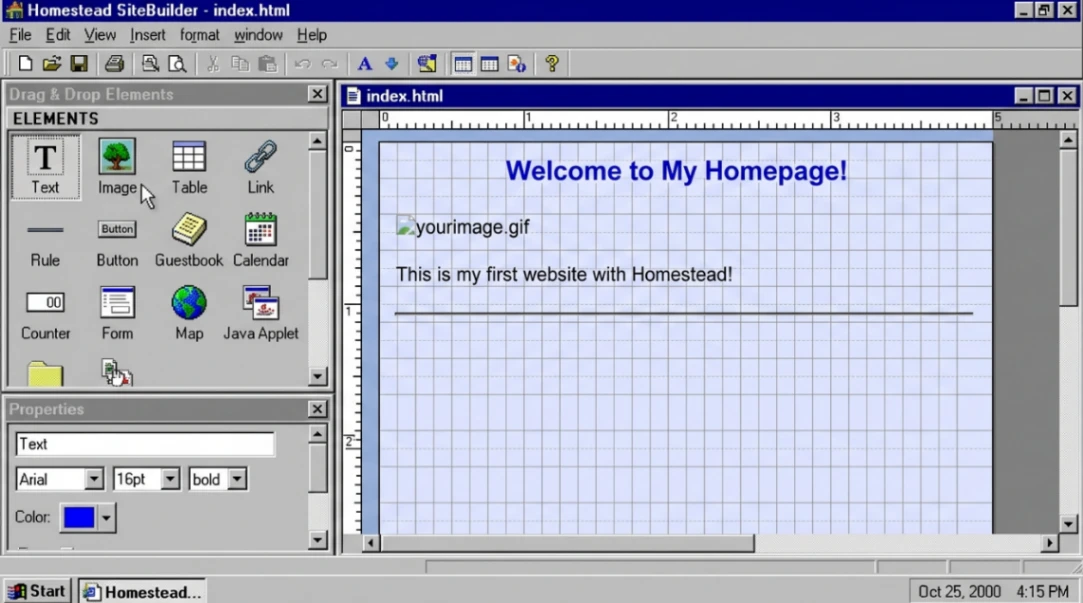
In the late 90s, building a website with WYSIWYG tools still meant working with desktop software. Homestead's SiteBuilder was different. It ran directly inside the browser using Java applets, which at the time was kind of like smuggling a full design studio into a web page.
Here's what made it genuinely cloud-like (years before "cloud" was even a buzzword):
- Zero-installation editor — the whole thing ran in your browser
- Remote file state — your website existed only on Homestead's servers, not on your hard drive
- Real-time syncing — saving in the editor meant updating the live server instantly
- Integrated ecosystem — domain, hosting, design tools, and widgets all in one place
The platform also pioneered something we now take for granted: a widget/plugin ecosystem. Homestead called them "Elements" — pre-built drag-and-drop components like contact forms, news tickers, guestbooks, and even stock quote trackers powered by third-party content partners. It was essentially an app marketplace for web design, circa 1998.
Compare that to what Netscape Composer or early WYSIWYG tools were doing at the time — relying on nested HTML tables and "spacer GIFs" — and you can see why Homestead felt like a leap forward.
How Homestead Evolved Its Business Model
Like a lot of dot-com companies, Homestead started out free — supported by advertising, riding the wave of the late 90s internet boom. But when that bubble burst, many competitors vanished. Homestead didn't.
Why? Because they made the pivot to paid subscriptions work.
By 2001, founder Justin Kitch described the shift from "free" to "fee" as the company "growing up." They introduced tiered plans that gave small businesses a clear upgrade path:
| Plan | Target User | Key Features | Price (Historical) |
|---|---|---|---|
| Starter | Individuals / Micro-sites | 1 site, 5 pages, limited storage | ~$5.99–$7.99/mo |
| Business | Established SMBs | 3 sites, custom domain, email support | ~$20.99–$22.99/mo |
| Business Plus | Growing enterprises | Unlimited pages, multiple domains | ~$60.99–$62.99/mo |
The "Homestead Professional" tier at around $29.99/month bundled in e-commerce tools and advanced marketing features — genuinely useful stuff that justified the cost for small businesses trying to compete online.
In 2003, Homestead also launched PhotoSite — a specialised hosting product for amateur photographers wanting a slicker way to share their work than email attachments. They sold it to United Online in March 2005 to refocus on their core SMB market. Smart call.
The Intuit Acquisition and What Came After
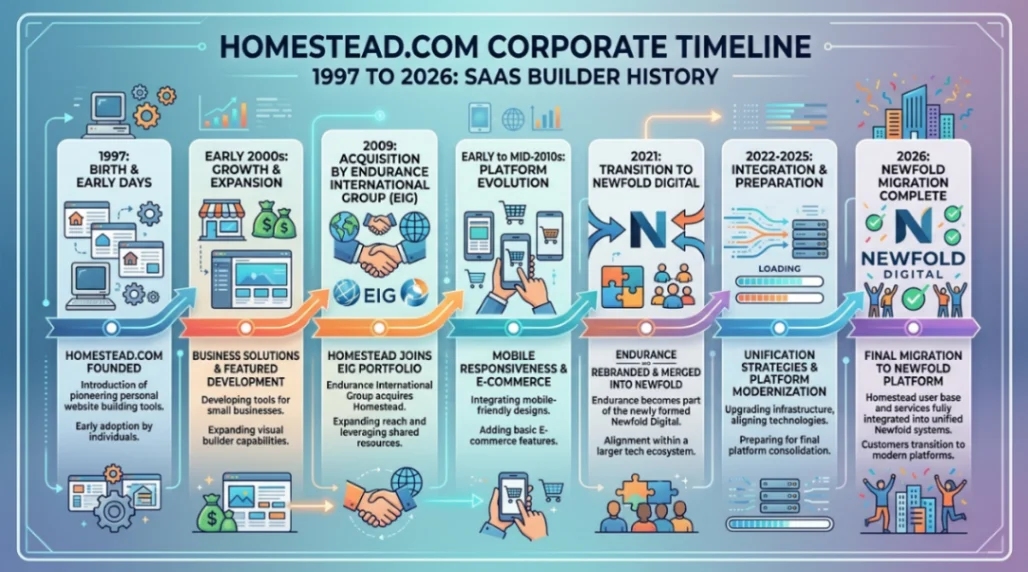
The biggest moment in Homestead's corporate story came in December 2007 when Intuit acquired the company for approximately $170 million in cash.
For Intuit, the company behind QuickBooks and Quicken this wasn't really about hosting. It was about solving what Brad Smith, then-SVP of Intuit's Small Business Group, called the problem of "winning on the Web." Intuit owned the back-office (accounting, payroll, tax prep), but their millions of small business customers also needed a front-office: a professional website.
Homestead delivered that. It offered what the press release called a "best-of-both-worlds" solution, personalised setup assistance combined with ongoing DIY management. You can read more about the acquisition details at Intuit's original investor announcement.
After the acquisition, Homestead was rebranded as "Intuit Websites" and integrated into the broader ecosystem. By fiscal year 2012, the Intuit Websites business was generating around $76 million in annual revenue.
But then Wix (founded 2006) and Squarespace (founded 2003) started picking up serious momentum with modern HTML5 builders. Intuit's core competency was financial software, not competing in a rapidly evolving design platform market. So in August 2012, they sold the whole thing to Endurance International Group (EIG).
Why Homestead Eventually Fell Behind
This is the part of the story that's a bit of a cautionary tale.
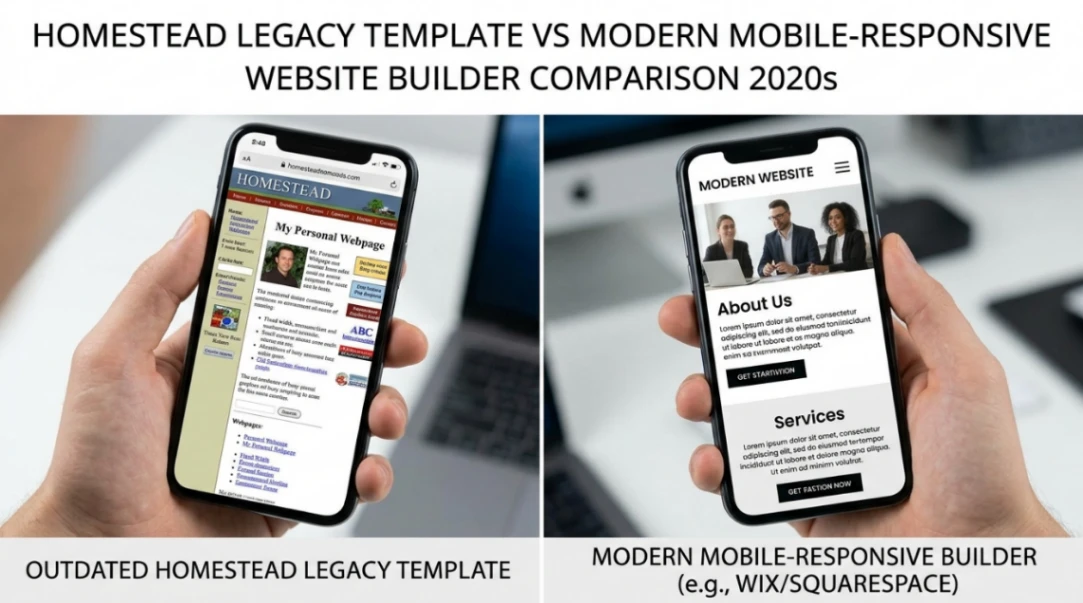
The Java-based SiteBuilder that was revolutionary in 1998 became a serious liability by the 2010s. Modern browsers started deprecating Java support for security reasons. Windows 7 and newer operating systems broke the old interface. And while competitors were building native mobile-responsive tools, Homestead's starter plans were still capped at 5 pages and 25MB of storage.
Let's look at how it stacked up against the competition in the late 2010s:
| Metric | Homestead | Weebly / Squarespace |
|---|---|---|
| Storage (Entry Plan) | 25MB | Unlimited / 500MB+ |
| Mobile Design | Non-responsive | Native responsive |
| Editor Technology | Legacy Java | HTML5 drag-and-drop |
| SEO Tools | Basic metadata only | Integrated / advanced |
Reviewers who once called Homestead a "Best of the Web" pick were now describing it as the "grandpa of do-it-yourself website builders." Ouch.
After EIG merged with Web.com in 2021 to form Newfold Digital, the rationalisation of legacy brands began. Starting in late 2025, Homestead users started recieving notifications that "Homestead is becoming Network Solutions." The Weblisting Service was shut down on January 15, 2026. The brand that once defined the small business web was effectively being retired.
Newfold itself is in a tough spot, S&P Global Ratings noted recently that despite an upgraded outlook, the company's capital structure remains "unsustainable," and it has reportedly lost over 1 million subscribers (roughly 17% of its base) since 2023.
If you're currently on a legacy platform and rethinking your options, it's worth exploring what modern no-code tools can do. The Adobe GoLive story and the Dreamweaver vs FrontPage era show you're not alone in navigating this kind of shift.
Start exploring launch-ready no-code templates here!
Key Takeaways
Homestead.com's story is more than just tech history, it's a masterclass in what works, and what doesn't, in the SaaS builder space.
Here's what I think every entrepreneur and digital professional can take away from it:
- First-mover advantage is real, but it has an expiry date. Homestead built the first true cloud-based SaaS builder in 1998, scaled to 2 million users fast, and got acquired for $170M. But technical debt eventually caught up.
- Business model pivots matter. Surviving the dot-com crash by moving from free to fee-based subscriptions was the move that kept Homestead alive when competitors disappeared.
- Modern users expect mobile-first, HTML5 design. Any platform still running legacy Java or Flash-era architecture in 2025 is fighting an uphill battle — and users will notice.
The web has come a long way since Homestead's Java applet days. But every drag-and-drop builder you use today, every SaaS builder that lets you launch a site without touching code owes something to what Justin Kitch and his team figured out in 1998.
That's a legacy worth knowing about.
FAQ
What was Homestead.com?
Homestead.com was a browser-based SaaS builder launched in June 1998 that let users create websites without coding or downloading software. It's widely considered the first cloud-based website builder.
Who founded Homestead Technologies?
Justin Kitch, Thai Bui, and David Wu founded Homestead Technologies in October 1997 in Menlo Park, California, during the height of the dot-com boom.
Why did Intuit acquire Homestead?
Intuit bought Homestead in December 2007 for around $170 million to give its small business customers (QuickBooks/Quicken users) an easy way to build a professional web presence, solving the "front-office" problem.
Is Homestead.com still available in 2026?
The Homestead brand is effectively being retired. Since late 2025, users have been migrated to Network Solutions, another brand under the Newfold Digital umbrella.
What replaced Homestead as a SaaS builder?
Modern alternatives include Wix, Squarespace, and Webflow, which offer HTML5-based, mobile-responsive design with far more flexibility. No-code template platforms have also grown significantly in this space.
Start building without code
Browse thousands of no-code templates for Webflow, Framer, Bubble, Lovable, Replit and more.
Explore Templates