What Is an MVP? How to Launch Fast and Fail Cheap

An MVP (Minimum Viable Product) is the smallest functional version of a product released to early adopters to test whether real demand exists before committing serious money. The term was coined by Frank Robinson in 2001 and popularized by Eric Ries in The Lean Startup (2011).
Table of Contents:
- Key Takeaways
- Introduction
- What Is an MVP, Really?
- Why Do Startups That Skip Validation Keep Dying?
- What Did the Best MVP Launches Actually Look Like?
- How Much Does an MVP Cost in 2026?
- How Is AI Rewriting the MVP Playbook?
- Where Does the MVP Framework Break Down?
- FAQ
Key Takeaways
- Dropbox got 75,000 waitlist signups from a three-minute video, and the reason it worked reveals what most builders misunderstand about validation.
- The gap between a $15,000 MVP and a $750,000 one isn't ambition. It's who's paying, and that changes everything about how you should build.
- Email signups feel like proof of demand, but the data on what actually predicts paying customers points somewhere far less comfortable.
Introduction
Roughly 90% of tech startups fail, and according to CB Insights, 42% to 43% of them die for the same preventable reason: nobody wanted the thing. An MVP is how solo builders and bootstrapping indie makers avoid joining that statistic, and if you're about to sink your savings into a product idea, understanding the MVP process might be the highest-leverage hour you spend this year.
I've watched people spend six months polishing an app that got 12 signups. I've also watched someone validate a business with a two-page website in a weekend. The difference wasn't talent. It was sequence.
Here's how to test your idea for the price of a nice dinner instead of a used car.
What Is an MVP, Really?
An MVP, or Minimum Viable Product, is the smallest working version of your product that lets you learn whether customers actually want it. Frank Robinson coined the term in 2001, and Eric Ries turned it into the backbone of the Lean Startup movement a decade later. It's a learning tool first, a product second.
"The minimum viable product is that version of a new product which allows a team to collect the maximum amount of validated learning about customers with the least effort." — Eric Ries, The Lean Startup (2011)
Robinson's original framing was mathematical: MVP = ROI ÷ Risk, where risk scales with build time. More features means more risk, not more value. That's the part people get backwards.
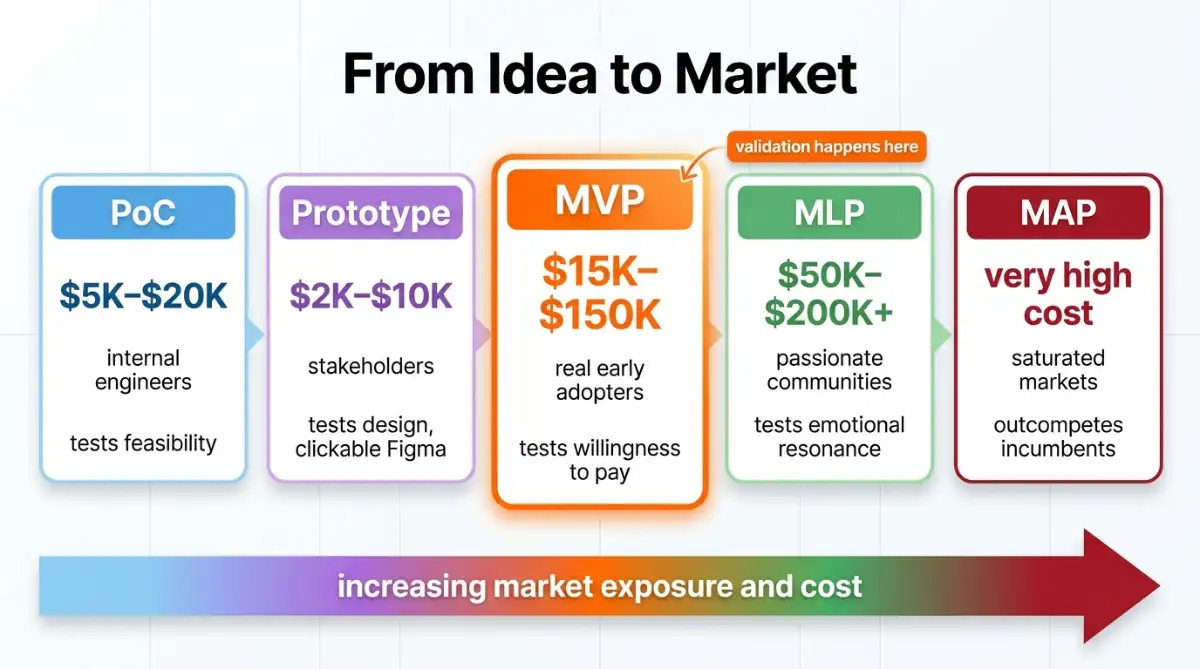
An MVP is one artifact on a spectrum, and confusing it with its neighbors burns money:
| Artifact | Purpose | Audience | Typical Cost |
|---|---|---|---|
| Proof of Concept | Test technical feasibility | Internal engineers | $5,000–$20,000 |
| Prototype | Test design and flows | Stakeholders, testers | $2,000–$10,000 |
| MVP | Test market demand and willingness to pay | Real early adopters | $15,000–$150,000 |
| Minimum Lovable Product | Build emotional resonance | Passionate communities | $50,000–$200,000+ |
The MVP is the only one that generates transactional data from strangers. That's its entire job.
Why Do Startups That Skip Validation Keep Dying?
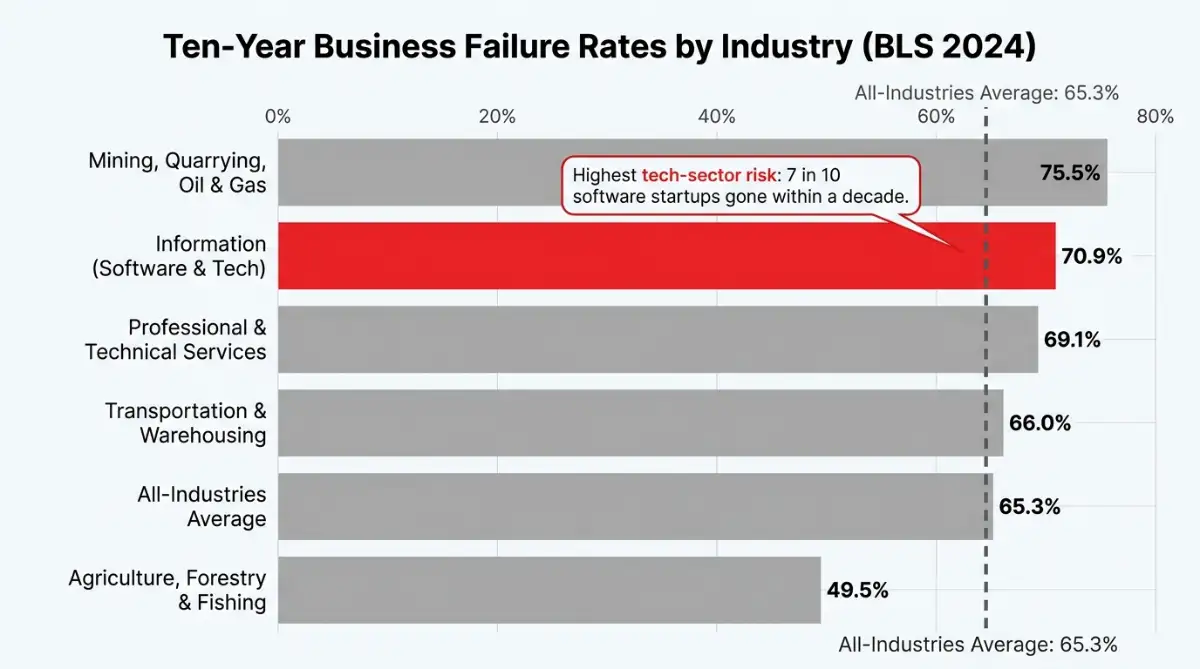
Startups that skip validation fail at brutal rates because they spend capital answering the wrong question. Bureau of Labor Statistics data from 2024 shows the Information sector (software and tech) has a 70.9% ten-year failure rate, the worst of any measured industry. The MVP exists specifically to attack that number.
The mechanics of startup death are well documented:
- According to Carta, startup shutdowns rose 25.6% in 2024 to 966 closures, and 74% happened at pre-seed or seed stage.
- According to CB Insights, the median failed startup raised $11 million and shut down 22 months after its last fundraise.
- 70% of failed companies cited "ran out of money" as the cause, but that's the symptom. The disease was building something without confirming a market existed.
The same CB Insights analysis found startups that test pricing before launch are twice as likely to hit profitability within two years. Meanwhile, teams spending over 50% of budget on product and under 10% on distribution fail at four times the rate of balanced teams.
Running out of money is how startups die, but building unwanted products is why.
What Did the Best MVP Launches Actually Look Like?
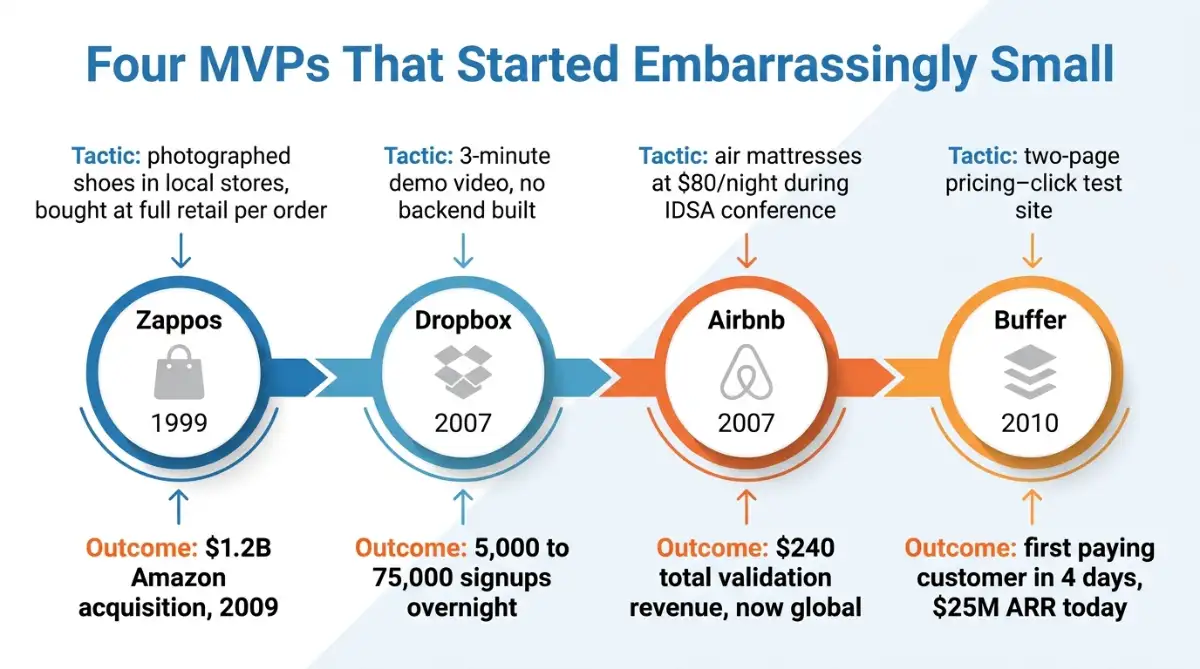
The most famous MVP launches were embarrassingly manual, and that was the point. Zappos, Dropbox, Buffer, and Airbnb all validated demand with duct tape and hustle before writing serious code. Each one tested a single scary assumption for almost nothing.
The pattern across the classics:
- Zappos (1999): Nick Swinmurn photographed shoes at local stores, posted them on Shoesite.com, and bought inventory at full retail only when orders arrived. Amazon acquired the company for $1.2 billion in 2009.
- Dropbox (2007): Drew Houston made a three-minute demo video instead of building the sync backend. The waitlist jumped from 5,000 to 75,000 signups overnight.
- Airbnb (2007): Brian Chesky and Joe Gebbia rented air mattresses in their living room for $80 a night. Total validation revenue: $240.
- Buffer (2010): Joel Gascoigne launched a two-page site that tracked clicks on "Plans and Pricing" before the product existed. First paying customer arrived four days after shipping a minimal version. Buffer now reports $25 million ARR on its open dashboard.
Y Combinator rejected Buffer at $280 in monthly revenue. By late 2011 it had 800 paying customers and a $3.5 million valuation.
None of these required engineering brilliance. They required the humility to test before building, something the fake door landing page approach still delivers today. If you want the mechanics of that play, this guide to landing pages for solopreneurs covers it.
How Much Does an MVP Cost in 2026?
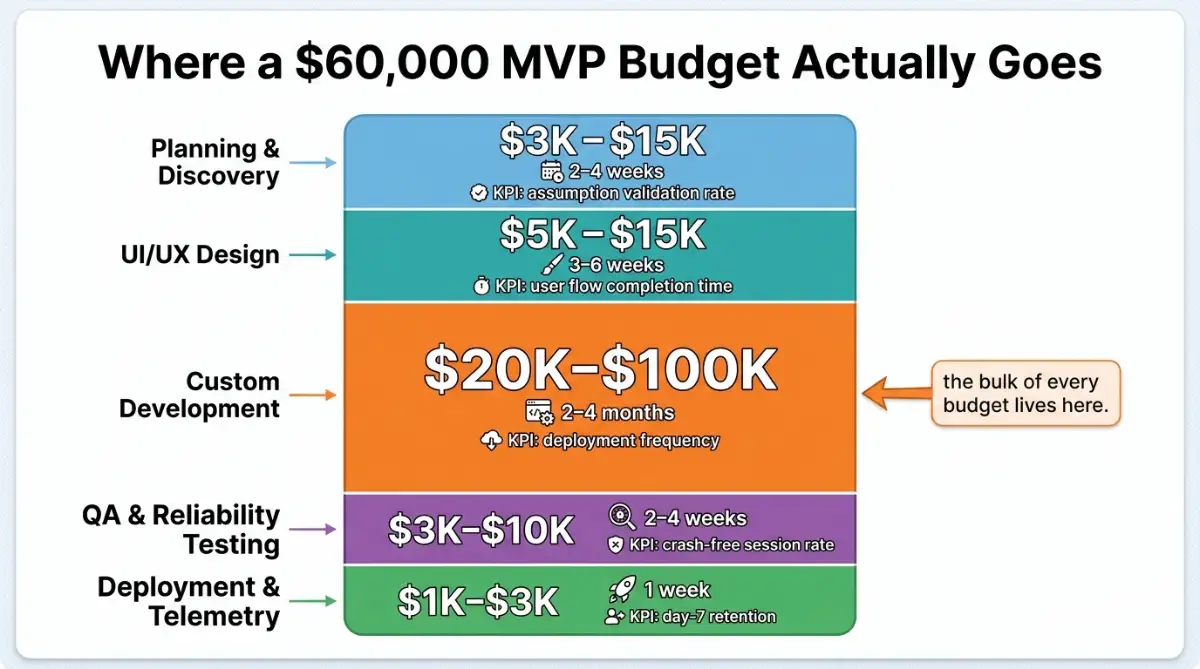
A custom software MVP in 2026 runs $30,000 to $120,000 and ships in three to six months, but that's the agency-built baseline. Solo builders using templates, APIs, and no-code frameworks report a median spend of just $15,000, and AI tooling is dragging that floor lower every quarter.
Budget scales with who's funding you, not with what the product needs:
| Stage | Median Budget | Timeline | Typical Scope |
|---|---|---|---|
| Solo bootstrapper | $15,000 | 4–8 weeks | Micro-SaaS, API wrappers, template frontends |
| Bootstrapped team | $60,000 | 2–4 months | Niche B2B SaaS, marketplaces |
| Pre-seed venture | $225,000 | 3–6 months | Proprietary AI systems, secure platforms |
| Seed-funded venture | $300,000–$750,000 | 4–8 months | Multi-tenant enterprise SaaS, fintech |
The line items add up fast in custom builds. A basic Stripe Checkout integration takes a day and costs $300 to $500, while custom multi-role billing with escrow runs $10,000 to $25,000 and over four weeks. Firebase or Supabase auth costs $500 to $1,500; enterprise SSO with biometrics jumps to $5,000 to $12,000.
Every feature you cut from version one is money you keep for version two.
This is exactly why the no-code route deserves a serious look before you hire developers. The honest math is laid out in this 2026 cost and scaling guide to whether no-code is worth it, and if you're wondering whether template-built products generate real income, there's documented revenue proof from no-code apps.
How Is AI Rewriting the MVP Playbook?
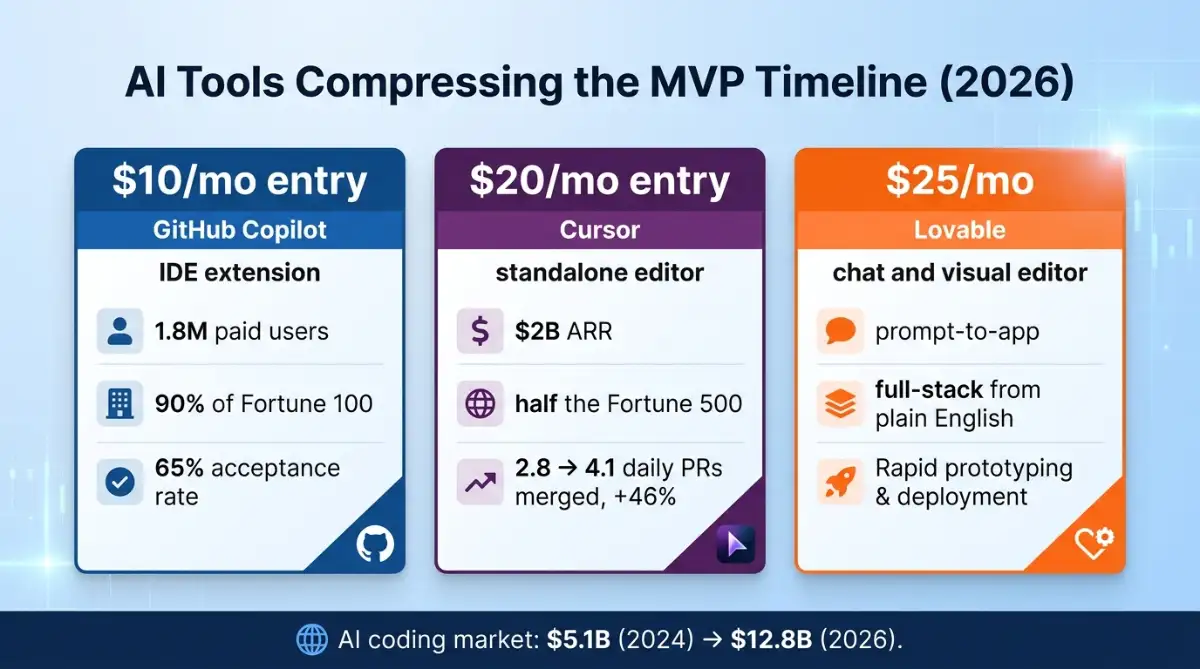
AI coding tools have compressed routine development work by 35% to 45%, letting builders ship functional prototypes in under a week. The AI coding market hit roughly $12.8 billion in 2026, up from $5.1 billion in 2024, and 90% of professional developers now use these tools daily.
The competitive landscape among AI coding tools has sorted into tiers:
- GitHub Copilot: 1.8 million paid users, present in 90% of Fortune 100 companies, 65% code acceptance rate. $10/month entry.
- Cursor: Crossed $2 billion ARR by early 2026, used by more than half the Fortune 500. Its users went from merging 2.8 pull requests daily in Q4 2025 to 4.1 by February 2026, a 46% throughput jump.
- Lovable and Replit Agent: Prompt-to-app tools starting at $25/month that generate full-stack apps from plain English.
That last category matters most for non-technical builders. Describing your app in natural language and watching it materialize is now a legitimate validation path, one covered in depth in this guide to vibe coding for non-tech founders. Visual builders remain the other door in, and understanding how no-code builders work in 2026 helps you pick the right one for your test.
My honest take: the tooling is no longer the bottleneck. Knowing which assumption to test is.
Where Does the MVP Framework Break Down?
The MVP has real failure modes, and pretending otherwise is how people get burned. The three big ones: public validation invites copycats, unpolished launches damage trust, and the most common "validation" signals are false positives that predict nothing about revenue.
The uncomfortable specifics:
- Copycats move fast. Peer-reviewed research on crowdfunding imitation documents the pattern: when the KAISR inflatable lounge went viral on Indiegogo, a Canadian entrepreneur launched "The Cozy Bag" clone and captured Amazon market share before KAISR finished its first production run.
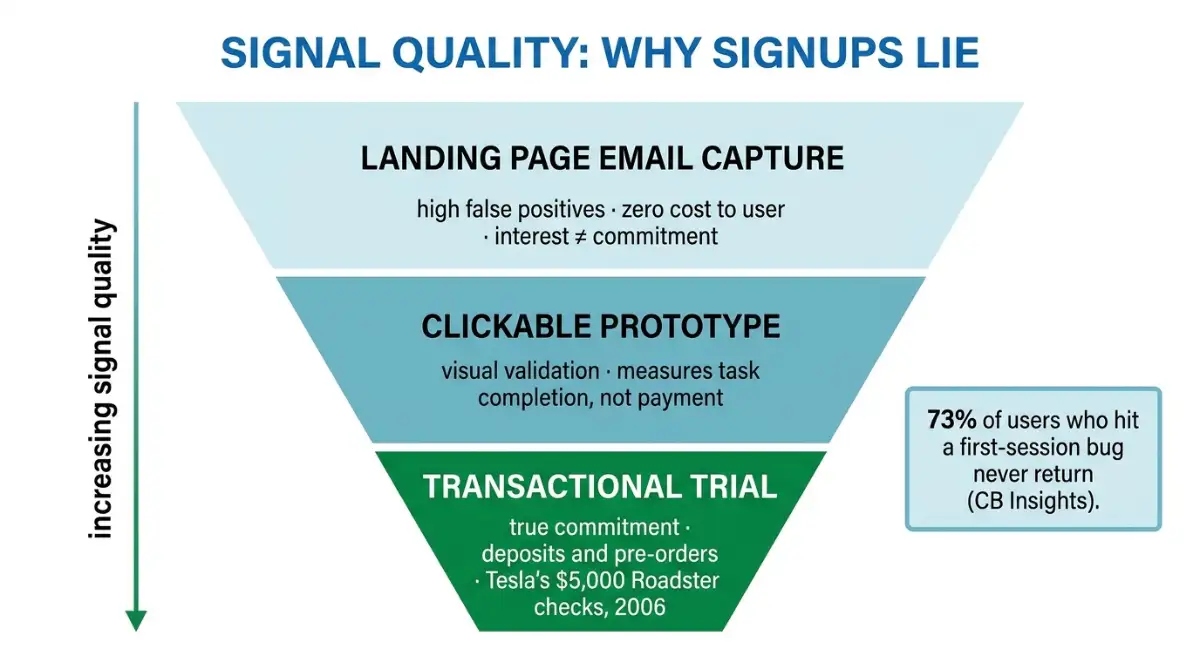
- First impressions are ruthless. Users who hit a critical bug in their first session have a 73% probability of never returning, per CB Insights.
- Signups lie. An email address costs a user nothing. Real validation needs skin in the game: deposits, pre-orders, or sustained usage. Tesla asked for $5,000 pre-order checks on the 2006 Roadster for exactly this reason.
And here's my "it depends" moment: some builders shouldn't ship an MVP at all. MedTech (HIPAA compliance runs $18,000 to $40,000+) and fintech (PCI-DSS runs $25,000 to $115,000+) operate in zero-error environments where a buggy launch creates legal liability, not learning. Those teams belong in internal proofs of concept.
Even giants get this wrong. Quibi raised $1.75 billion, skipped demand validation, and shut down in six months.
Start exploring launch-ready no-code templates here!
FAQ
What does MVP stand for in business?
MVP stands for Minimum Viable Product, the smallest functional version of a product released to early adopters to test real demand. Frank Robinson coined the term in 2001, and Eric Ries popularized it in his 2011 book The Lean Startup.
How is an MVP different from a prototype?
A prototype tests design and navigation with internal stakeholders, usually as a clickable Figma mockup costing $2,000 to $10,000. An MVP is working software released to actual customers to measure usage and willingness to pay, typically costing $15,000 or more.
How much does it cost to build an MVP in 2026?
Custom-built MVPs run $30,000 to $120,000 through agencies, while solo builders using templates and no-code tools report a median spend of $15,000. Seed-funded companies routinely spend $300,000 to $750,000 on enterprise-grade builds.
How long should an MVP take to launch?
Solo builders using no-code or AI tools can ship in four to eight weeks, and prompt-to-app platforms enable functional prototypes in under a week. Traditional custom development takes three to six months from planning through deployment.
Can you build an MVP without knowing how to code?
Yes. Prompt-to-app tools like Lovable and Replit Agent generate full-stack applications from plain-language instructions, and visual no-code builders handle the rest. Groupon's original MVP was literally a WordPress blog with manually emailed PDF coupons.
Start building without code
Browse thousands of no-code templates for Webflow, Framer, Bubble, Lovable, Replit and more.
Explore Templates