ThemeForest and No-Code Web Design History

ThemeForest, launched by Envato in August 2008, is a two-sided marketplace where designers sell pre-built website templates, primarily for WordPress. It pioneered the "fill-in-the-blank" web design model, compressing custom web design costs from thousands of dollars to under $60. As of 2026, its parent company Shutterstock is transitioning away from marketplace sales toward subscription and AI-driven asset generation.
Key Takeaways
- ThemeForest didn't just sell themes. It restructured who could afford a professional website and who could make a living building them, and those two things came with a hidden cost.
- The "fill-in-the-blank" model created a generation of profitable freelancers, but it also baked in a technical trap called theme lock-in that still affects millions of sites.
- Shutterstock's 2024 acquisition and the July 2026 end of exclusive authorship signal that the classic marketplace model is being deliberately wound down in favor of subscriptions and AI.
Table of Contents
- Key Takeaways
- Introduction
- From Flash Files to a $250 Million Exit: The Envato Origin Story
- How ThemeForest Rewired the Economics of Freelance Web Design
- The Technical Debt Nobody Warned You About
- Security, GPL, and the Controversies That Defined an Era
- Honest Tradeoffs: What the Template Economy Gets Wrong
- What Happens to ThemeForest Now
- FAQ
Introduction
The average ThemeForest WordPress theme costs $59. For that price, in the mid-2000s, a restaurant owner or a yoga instructor could get a site that looked like it cost ten times as much. That was the promise, and for a while, it delivered. But the story of ThemeForest isn't just a pricing story. It's the history of how the no-code website builder category got its first commercial engine, and what it cost the web to run it. For any freelancer, small agency owner, or non-technical builder trying to understand why modern tools are built the way they are, this history is genuinely worth knowing.
From Flash Files to a $250 Million Exit: The Envato Origin Story
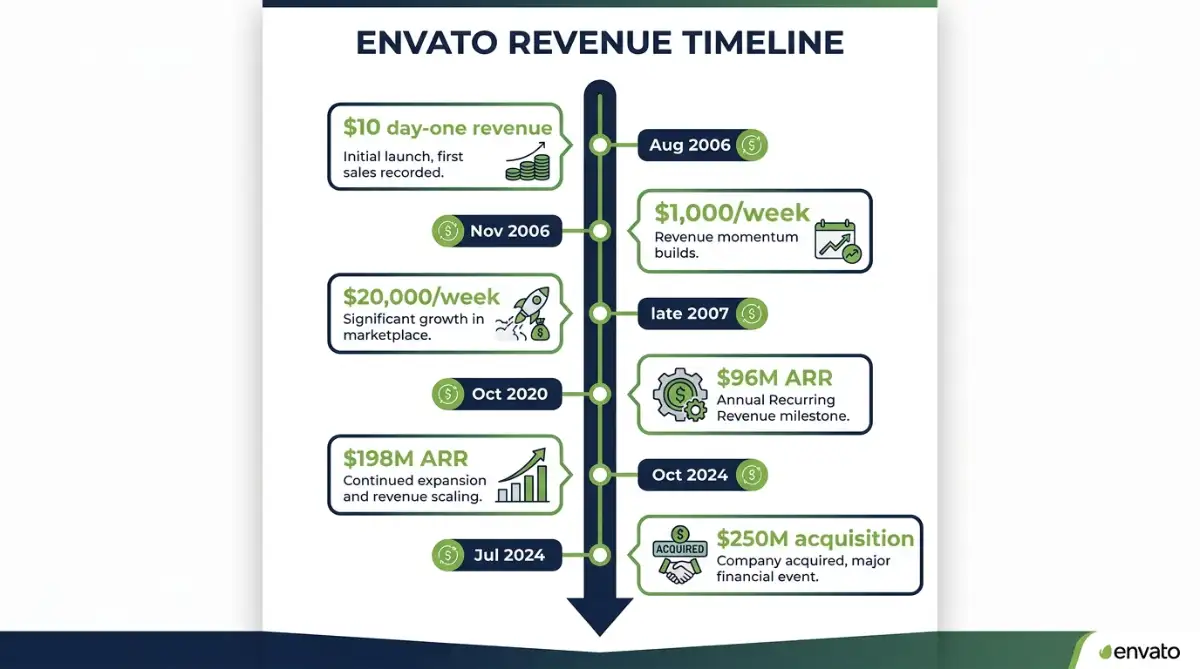
Envato started as a bootstrapped Flash file marketplace in Melbourne in 2006, grew to a $198 million ARR business without ever taking venture capital, and sold to Shutterstock in July 2024 for $250 million. The arc from $10 on day one to a nine-figure exit is one of the more unlikely origin stories in the no-code web design industry.
Collis Ta'eed (then 27) and Cyan Ta'eed (then 25) founded the company under the name FlashDen, drawing directly on Collis's side income of roughly $400 per month selling Adobe Flash files on iStockPhoto. The launch was entirely self-funded. The founders pooled approximately $40,000 in savings, hired a single contract developer named Ryan to build the backend, and Collis mapped the interface using a Moleskine notebook.
The first day brought in one sale and $10 in revenue. What followed was a two-year grind: close to $100,000 in credit card debt, instant noodles, and a basement apartment in Cyan's parents' home. Three months in, a $10,000 free-credit promotion spiked traffic enough to generate $1,000 per week. Within 15 months, according to SaaS Club's profile of the company, that weekly figure had grown 20-fold to $20,000, putting annual run rate above $1 million.
The defining product arrived in August 2008: ThemeForest, a marketplace dedicated to website templates. The first theme listed was a WordPress template called "Our Community" by Malaysian developer Kai Loon. The timing was nearly perfect. WordPress was transitioning from a blogging engine into a full content management system, and ThemeForest captured the commercial design layer on top of it. By September 2014, according to Alexa web analytics, ThemeForest had become the 90th most visited website in the world.
How ThemeForest Rewired the Economics of Freelance Web Design
ThemeForest compressed the cost of a professional website from several thousand dollars to a $45–$59 theme purchase, creating both a new consumer market and an entirely new freelance profession built on the gap between those two numbers. For small agency owners and independent web designers, it was the first viable no-code website builder business model.
The effect on the freelance economy was immediate. A new class of web professionals emerged: people who would buy a premium theme, configure it for a local client (a plumber, a restaurant, a law firm), and bill $1,500 to $5,000 for the work. The underlying theme cost $59. The margin was extraordinary, and the skill barrier was low enough that nearly anyone technically curious could clear it.
According to Freemius's analysis of ThemeForest's marketplace metrics:
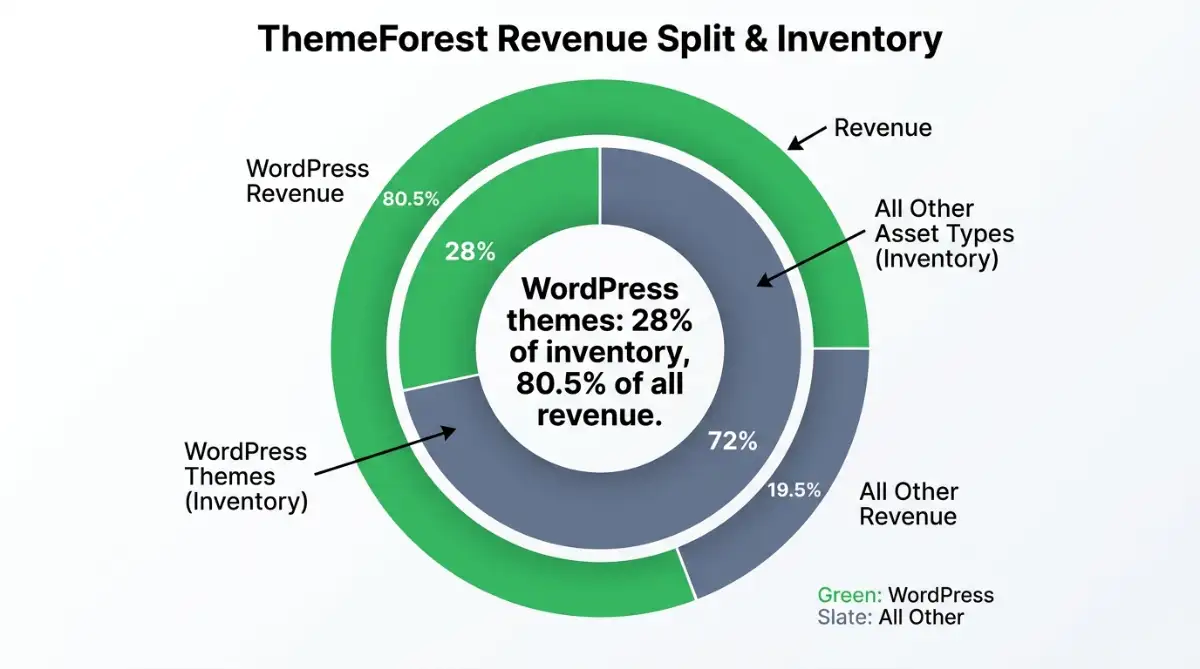
- WordPress themes represent only 28% of total inventory on the platform
- Yet they account for 80.5% of all historical transaction volume, generating $286 million of a total $355 million
- The average WordPress theme generates approximately $17,355 in gross annual sales during its first six years on the market
The concentration at the top is striking. Only 0.5% of themes have crossed 10,000 sales. Only three themes in the platform's entire history have crossed 100,000 sales. The most extreme outlier is Avada by ThemeFusion, launched in August 2012 by Luke Beck and Muhammad Haris. According to Envato's Author Hub announcement, Avada officially reached one million individual sales on January 1, 2025, making it the top-selling paid web design theme ever created, generating $100,000 in monthly revenue within a single year of launch.
The most popular price points are $59 (33% of themes), $49 (26.1%), $44 (14.6%), and $39 (7.4%). That's a strikingly tight band for an economy that generated over $350 million in cumulative transaction volume. For context on why it scaled so fast: according to WPZOOM's May 2026 report, WordPress powers 42.2% of all websites globally, representing a 59.6% share of the CMS market. ThemeForest built its commercial layer directly on top of that installed base.
The Technical Debt Nobody Warned You About
ThemeForest gave freelancers and small agency owners a fast, affordable path to professional-looking websites, but the multipurpose theme architecture it incentivized created structural technical problems that took years to fully surface. The no-code website builder convenience came with a hidden price paid in code quality.
To stand out in a crowded marketplace, theme developers built "multipurpose" themes that could serve a photography studio, a gym, a startup, and a restaurant from a single product. To deliver that range, they bundled visual configuration engines, custom post types, and layout tools directly into the theme layer. WordPress has a clear architectural rule: themes handle presentation, plugins handle functionality. Multipurpose ThemeForest themes ignored it entirely.
This created theme lock-in. Once a site was built on one of these themes, deactivating it would strip out all custom shortcodes, turn layout elements into raw unformatted text, and cause custom post types to disappear from the CMS. Switching themes wasn't a design change. It was effectively destroying the site.
According to Justin Tadlock's widely cited analysis of shortcode practices in WordPress themes, the pursuit of demo-ready templates led to extreme payload sizes across the board. Three specific failures defined the era:
- Shortcode madness: theme developers replaced standard HTML with proprietary shortcodes like
[button]or[row]. Removing the theme left those strings as literal unrendered text across every page. - Non-standard frameworks: poorly coded themes forced developers to edit core files directly, bypassing the standard hooks and filters approach used by extensible frameworks like Genesis.
- Bundled commercial plugins: themes packaged premium plugins like Slider Revolution directly in the ZIP download, bypassing the WordPress.org plugin update pipeline entirely, which turned every security patch into a race condition.
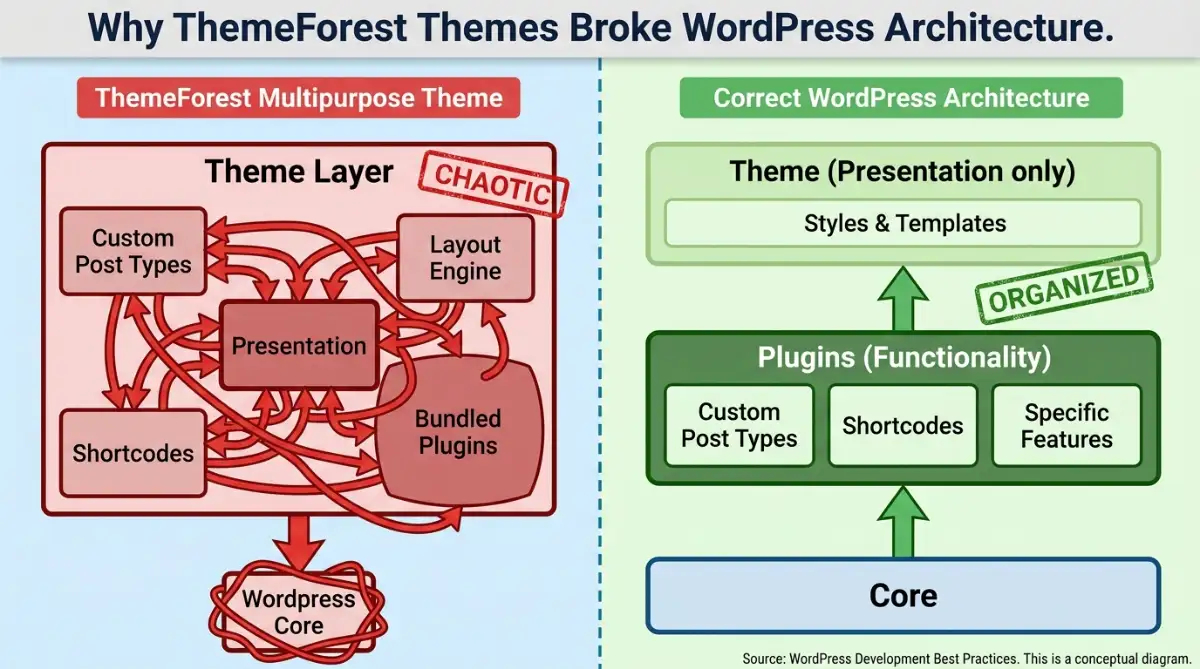
The evolution from WordPress plugins to complex page builders like Visual Composer tells a parallel story. The deeper no-code tools got embedded into WordPress's presentation layer, the harder they became to remove cleanly. ThemeForest accelerated that dynamic at scale, and millions of small business sites are still running on those legacy structures today.
Security, GPL, and the Controversies That Defined an Era
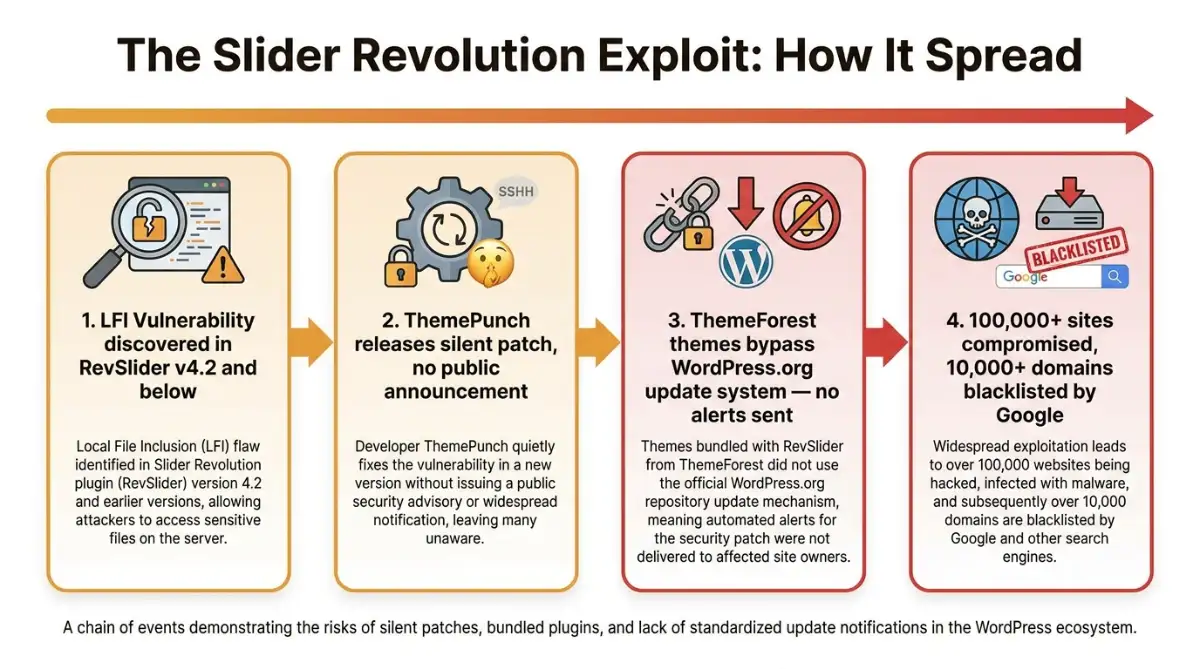
The bundled-plugin architecture wasn't just a maintenance headache for freelancers and agency owners. In September 2014, it became the mechanism for one of the largest coordinated WordPress security compromises ever recorded, exposing the structural risk baked into the ThemeForest ecosystem.
A critical Local File Inclusion vulnerability in Slider Revolution (RevSlider), versions 4.2 and below, allowed unauthenticated remote attackers to pull wp-config.php directly from a server via a public URL parameter. That file stores raw, unencrypted database credentials. With those credentials, attackers could create admin accounts and upload malicious scripts at will. The developer, ThemePunch, released a silent patch without public announcement. But because ThemeForest themes bundled the plugin in their ZIP packages rather than through WordPress.org's update system, millions of site owners received no automatic notification. According to Bitdefender's security report on the incident, over 100,000 WordPress sites were compromised and Google blacklisted more than 10,000 domains tied to the resulting "SoakSoak" Russian malware campaign.
Slider Revolution vulnerabilities have continued to surface. CVE-2025-9217 documented an arbitrary file read flaw in versions up to 6.7.36, and CVE-2026-6728 identified a sensitive information exposure vulnerability in versions up to 7.0.9, according to FreshySites's security reporting.
The GPL licensing dispute was a separate but equally defining controversy. In July 2009, the Software Freedom Law Center delivered a formal legal opinion stating that while CSS, JavaScript, and image files in a WordPress theme are separate works, the PHP code relies directly on WordPress core functions and must inherit the GPL. Envato historically allowed authors to apply proprietary licenses to the non-PHP elements of their themes. WordPress co-founder Matt Mullenweg characterized this as a direct violation of the GPL's spirit, and in 2013 banned Envato authors from presenting at official WordCamp events. The move divided the community and pushed many top commercial theme shops to adopt full 100% GPL licensing to maintain standing in the broader open-source ecosystem.
Honest Tradeoffs: What the Template Economy Gets Wrong
The ThemeForest narrative is usually framed as pure democratization: design got cheaper, more people could build websites, a new freelance profession was born. For small agency owners, non-technical builders, and freelancers who built careers on it, that part is real. What gets left out of that story is worth naming directly.
The marketplace's revenue concentration is quietly extreme. According to Freemius's data, 86.9% of themes have sold fewer than 1,000 licenses and 36.56% have sold fewer than 100. The promise of passive theme income was real for a tiny sliver of creators. For the vast majority, it was a long tail that generated almost nothing. The ThemeForest search algorithm remained biased toward legacy bestsellers like Avada, The7, and BeTheme, making it structurally difficult for newer, cleaner-code alternatives to gain visibility.
- The concentration problem: Only 0.5% of themes crossed 10,000 sales. Three themes in the platform's history crossed 100,000. One theme (Avada) crossed one million.
- The arbitrage problem: The freelance model depended on a gap between a $59 theme and a $3,000 client bill. That gap existed because clients couldn't see what they were buying. As no-code website builders became more accessible and clients more sophisticated, the gap narrowed.
- The quality incentive problem: The ThemeForest review and ranking system rewarded sales velocity and demo impressiveness, not code quality. It created a race to add features, not a race to write clean, maintainable code.
I find it genuinely hard to call ThemeForest a net negative because the access it created was real. But it also created a generation of websites that are extraordinarily expensive to migrate off, and that cost landed on the clients, not the theme developers who built the lock-in.
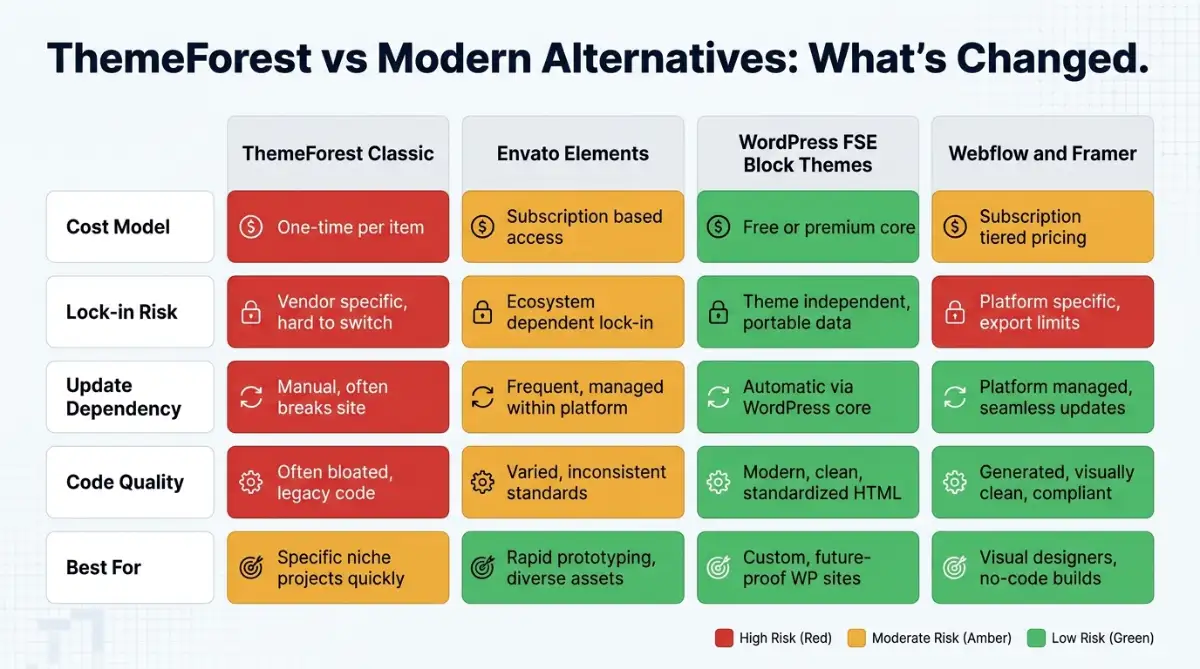
Tools like Framer or Webflow offer genuine design flexibility without the lock-in architecture ThemeForest themes introduced. Block-first WordPress development through Full Site Editing eliminates shortcode dependency entirely. Those are structurally better outcomes for anyone building a site today.
Start exploring launch-ready no-code templates here!
What Happens to ThemeForest Now
The classic ThemeForest marketplace model is being deliberately unwound, and the July 2026 exclusivity change is the clearest signal yet that Shutterstock sees the transaction-based template economy as a legacy business rather than a growth engine. For freelancers and agency owners who built workflows around it, the shift has real practical consequences.
On May 2, 2024, Shutterstock agreed to acquire Envato for $245 million in cash, closing in July 2024 at a final aggregate consideration of $250 million. The deal expanded Shutterstock's subscriber base by 650,000 users to reach 1.15 million, and according to Shutterstock's Q3 2024 earnings, contributed to a 14% increase in content revenue to $203.7 million. Before the acquisition, Envato had grown from $96 million ARR in October 2020 to $198 million ARR by October 2024, according to GetLatka's financial tracking, returning over $1.3 billion in cumulative earnings to its author community since 2006.
On May 12, 2026, Envato announced the termination of its Exclusive Author model effective July 1, 2026, moving all marketplace creators to a flat 50% revenue share. Previously, exclusive high-volume authors earned up to 87.5% of their item sales. For elite authors who structured entire businesses around that incentive, the income drop is substantial and immediate.
The technical direction is equally clear. WordPress's native Full Site Editing workflow uses clean theme.json configuration files and block-based layouts with no proprietary shortcodes. Users can switch block themes without corrupting content, which directly resolves the lock-in problem ThemeForest multipurpose themes created. Shutterstock is simultaneously leveraging Envato's template catalog to train proprietary AI generation models, signaling that the future they're betting on is generated assets, not curated marketplace inventory.
The history of Visual Composer and WPBakery is a useful parallel: commercial page builders built ecosystems on WordPress, generated enormous revenue, then watched native tooling absorb their core value proposition. ThemeForest is following the same arc. It built the first commercial layer on top of the no-code web. It's just no longer the most important one.
FAQ
What is ThemeForest and how does it work? ThemeForest is a two-sided digital marketplace, owned by Shutterstock via its Envato acquisition, where independent developers sell website templates and CMS themes. Buyers purchase a one-off license, typically between $39 and $59 for WordPress themes, and download a ZIP package containing the complete theme and any bundled plugins.
Is ThemeForest still worth using for a small business website? It depends on your priorities. ThemeForest offers a large catalog of polished, demo-ready templates at low upfront cost, which suits non-technical builders on tight budgets. The tradeoff is a real risk of theme lock-in, bundled plugin vulnerabilities, and code bloat that can hurt page speed and long-term maintainability.
What caused the Slider Revolution security vulnerability?
Slider Revolution contained a Local File Inclusion flaw in versions 4.2 and below that let unauthenticated attackers download the WordPress wp-config.php file through a public URL. Because ThemeForest themes bundled the plugin directly rather than routing updates through WordPress.org, many sites never received the security patch automatically, leaving them exposed.
How is Envato Elements different from ThemeForest? ThemeForest is a one-off purchase marketplace: you pay per theme. Envato Elements is a subscription product starting at $16.50 per month that provides unlimited downloads across a broad catalog of themes, graphics, videos, and other creative assets. Authors on Elements are paid via a usage-share model, not a per-sale commission.
What replaced ThemeForest-style themes in modern WordPress?
WordPress's Full Site Editing (FSE) system, built on the Gutenberg block editor, lets developers control headers, footers, templates, and global styles natively without proprietary page builders. Block themes use a clean theme.json configuration with no shortcode dependencies, meaning users can switch themes without corrupting their content, directly solving the lock-in problem ThemeForest multipurpose themes created.
Start building without code
Browse thousands of no-code templates for Webflow, Framer, Bubble, Lovable, Replit and more.
Explore Templates