When Was Notion Founded? The Kyoto Rebuild to $11B Story
Notion was co-founded in San Francisco in 2013 by Ivan Zhao and Simon Last. After a failed first product nearly killed the company in 2015, the two founders rebuilt it from scratch in Kyoto, Japan, relaunching in 2016. By 2025, CNBC reported the company had crossed $500 million in annual recurring revenue, reached over 100 million users, and closed an employee tender that valued the company at $11 billion.
Table of Contents
- Key Takeaways
- Introduction
- How Did Notion Nearly Die Before It Ever Launched?
- What Made Notion's "Everything Is a Block" Architecture So Different?
- How Did Notion Reach 100 Million Users Without a Traditional Marketing Team?
- How Did Notion's Funding History Reach an $11 Billion Valuation?
- What Is Notion AI and How Did It Become the Company's Biggest Bet?
- Can Notion Actually Work as a Website Builder?
- Honest Tradeoffs
- FAQ
Key Takeaways
- Notion's near-death had nothing to do with competition. The failure that nearly killed it was an architectural mistake the founders made on day one, fixed only after an emergency move to Japan.
- The feature that made Notion wasn't the one that launched it. Understanding which update was actually the inflection point changes how the whole growth story reads.
- Notion AI launched before most people knew AI was coming. What happened to the company's revenue in the two years after suggests that head start mattered more than anyone expected.
Introduction
If you're a solo founder or small-team operator who has ever tried to replace five different tools with one workspace, you've probably landed on Notion. What most users never think about is how close the company came to disappearing before it found its footing.
The story behind Notion isn't a clean startup arc. It involves a failed first product, an emergency relocation to Japan, a single Postgres database almost taking down the entire company, and a slow-burn community that eventually became one of the most studied product-led growth cases in software. This article walks through every major chapter, from the Kyoto rebuild to Notion's aggressive push into AI agents in 2026.
How Did Notion Nearly Die Before It Ever Launched?
Notion's first product, built on WebKit and CouchDB, was an app-building tool for non-coders. It confused most users, crashed constantly, and drained the team's runway. By 2015, Ivan Zhao and Simon Last had laid off their team, moved to Kyoto, Japan, and were rebuilding the entire product from scratch on a $150,000 loan from Zhao's mother.
The core mistake was a fundamental misread of what people actually wanted. In a Notion founders interview, Zhao described the original version as something "more for nerdy tech crowds," built around the assumption that people wanted to build apps. They didn't. They wanted familiar formats, notes and documents, wrapped around something more powerful underneath.
"The culture values such exquisite craftsmanship. It embodies all the things I wanted Notion to be." Ivan Zhao, on choosing Kyoto as the place to rebuild.
Kyoto wasn't just a cost decision, though living costs there ran about half of San Francisco. Zhao cited Japan's craftsmanship philosophy as a genuine design influence, a detail documented in depth in the Figma blog's account of the rebuild. He and Last reportedly worked 18-hour days during that period.
Here is how the early timeline actually played out:
- 2013: Notion Labs founded in San Francisco by Ivan Zhao, Simon Last, Chris Prucha, Jessica Lam, and Toby Schachman
- 2015: Team laid off; Zhao and Last move to Kyoto and rebuild the product from scratch
- March 2016: Notion 1.0 relaunches and reaches #1 Product of the Day, Week, and Month on Product Hunt
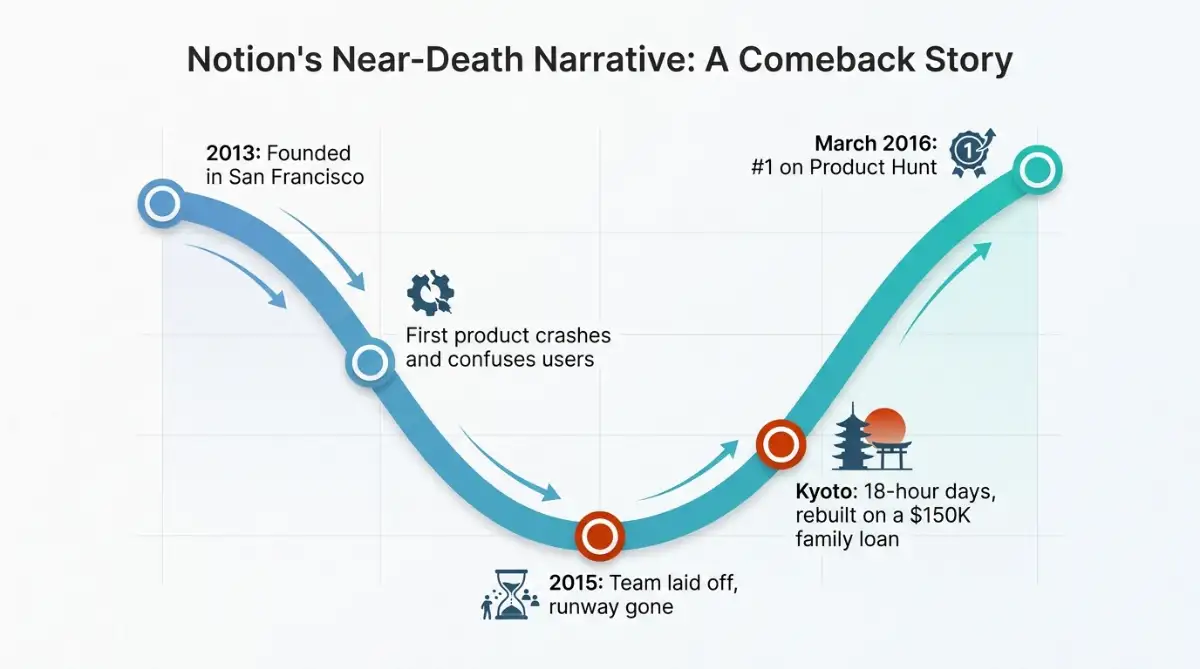
Zhao and Last didn't pivot the product. They burned it down, moved to Japan, and rebuilt it correctly on a family loan, a founding story most of Notion's 100 million users have never heard.
What Made Notion's "Everything Is a Block" Architecture So Different?
Notion's core innovation was deceptively simple: every piece of content is a modular block. Text, images, to-do items, databases, and code snippets are all draggable, nestable, and transformable into each other. No other mainstream tool at the time treated documents this way, and it is still what separates Notion from the tools people most often compare it to.
The inspiration came from older, deeper sources. Zhao has cited Douglas Engelbart's 1962 paper "Augmenting Human Intellect" and 1980s software like HyperCard as early philosophical influences. He also pointed to WordPress's 2003 democratization of web publishing as the model Notion wanted to follow for knowledge work. The ambition was always platform-level, not just app-level.
Zhao framed competitors like Google Docs and Quip as "multiplayer WordPerfect" and criticized the broader SaaS world for trapping knowledge in disconnected silos. Notion drew on the same philosophy that makes no-code tools powerful in the first place: giving people real capability without requiring them to write a line of code.
What I find most interesting about this approach isn't the technical architecture but how it solved a human organizational problem. Zhao had studied cognitive science, and the block system reads less like an engineering decision and more like a theory about how people actually think and store knowledge.
| Tool | Core Format | Native Database | Block-Based |
|---|---|---|---|
| Notion | Docs + Databases | Yes | Yes |
| Google Docs | Documents only | No | No |
| Confluence | Wiki pages | No | Partial |
| Airtable | Spreadsheet/DB | Yes | No |
| Coda | Docs + tables | Yes | Partial |
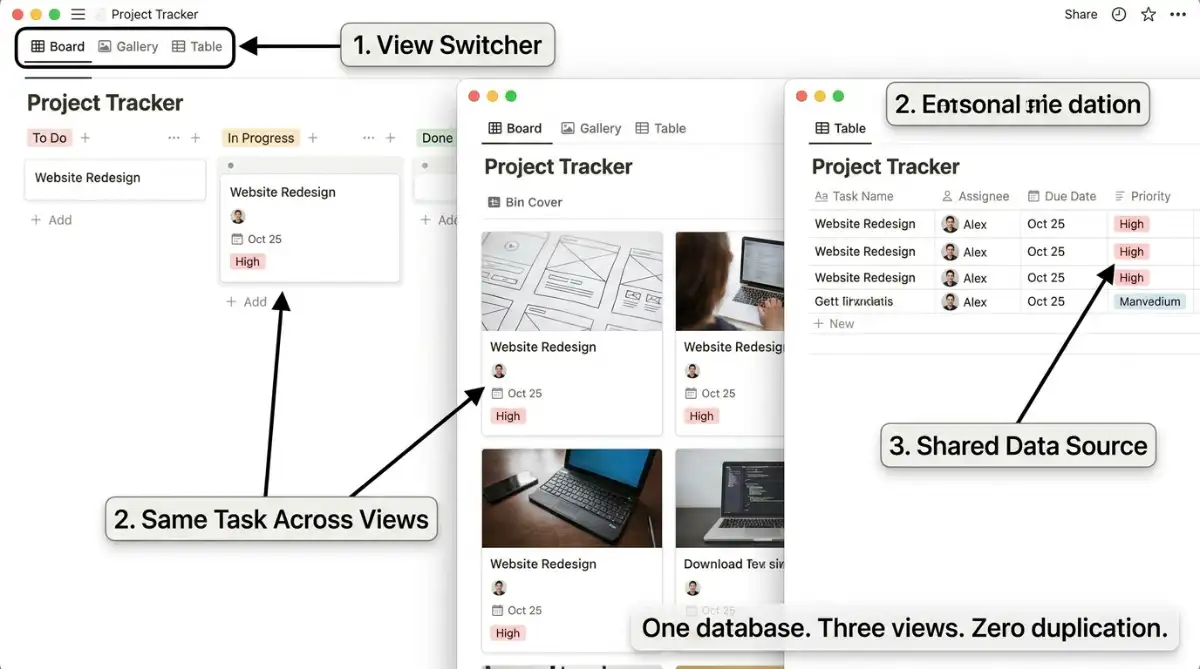
The block system also made Notion unusually easy to template. Users could build CRM trackers, content calendars, and reading lists and share them publicly. The block metaphor turned ordinary users into product evangelists before Notion had a formal marketing function. That dynamic is what made the next phase of growth possible.
How Did Notion Reach 100 Million Users Without a Traditional Marketing Team?
Notion's growth came from community, not campaigns. When Notion 1.0 launched in March 2016, investor Naval Ravikant tweeted to his large following at midnight, timed to when Product Hunt's daily rankings reset, driving enough votes to push the product to the top slot. The pattern of organic amplification from enthusiastic early adopters over paid acquisition was set from day one.
Notion 2.0 in March 2018 was the actual growth inflection. Adding databases, Kanban boards, tables, and calendars transformed the product into what Zhao called "the all-in-one workspace." The company had fewer than 10 employees at the time.
Key growth milestones from the research:
- September 2019: 1 million users (roughly a 12-person team)
- April 2020: COVID-19 drives a surge in remote work adoption
- Early 2021: A wave of "How I use Notion" TikTok videos crashes the servers
- October 2021: 20 million users at Series C close
- 2025: Over 100 million users reported by CNBC
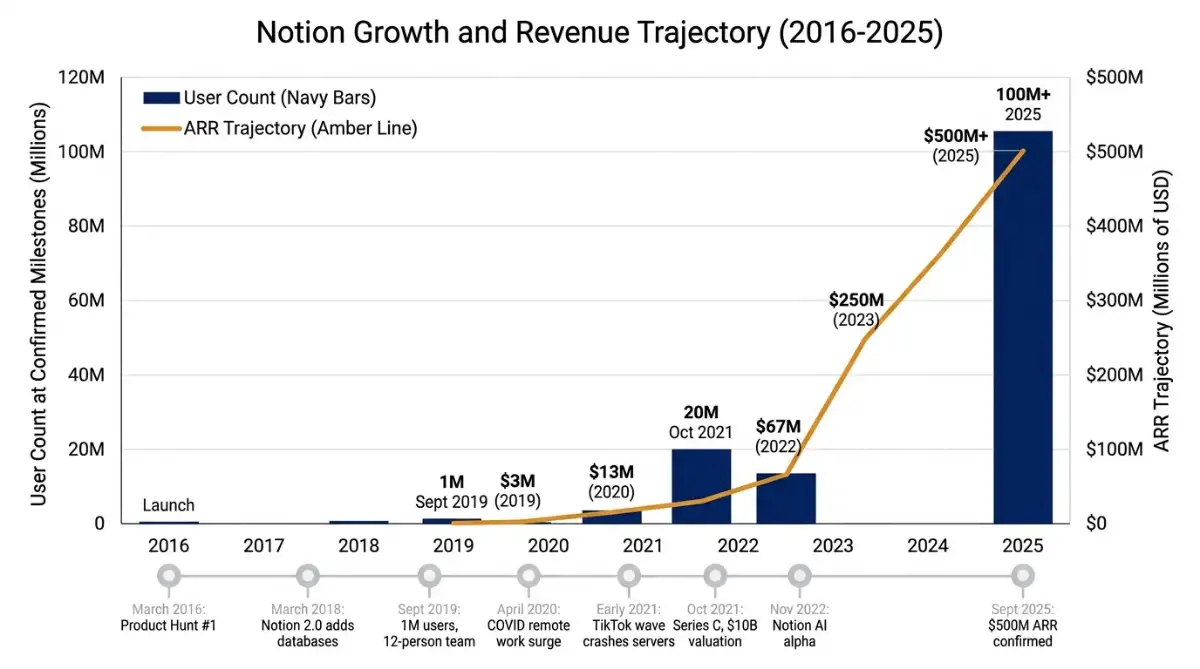
Notion hit one million users with a 12-person team, without a traditional marketing function, and before the TikTok wave had made it a household name.
The irony of the 2021 viral moment: the entire product ran on a single Postgres database, repeatedly upgraded to larger machines until no larger machines existed. The team froze feature development for months to fix the infrastructure before it failed completely. The maker movement had found its favorite tool at the worst possible technical moment.
By the time CNBC reported over 100 million users in 2025, Notion had grown to roughly 1,000 employees, still without the scale of performance marketing operation you'd expect from a business at that revenue level.
How Did Notion's Funding History Reach an $11 Billion Valuation?
Notion's funding story is notable less for the round sizes than for how unusual the terms were. The company raised roughly $2 million in seed funding around 2013, then stayed off the fundraising circuit for years, turning profitable before raising again. Ivan Zhao and Simon Last retained approximately 30% ownership throughout, with no VC representatives sitting on the board.
The key rounds, in sequence:
- ~$10M "angel round" (2019): Led by Daniel Gross and Elad Gil at an $800 million valuation. Notion explicitly refused to call it a Series A.
- $50M Series B (April 2020): Led by Index Ventures, 36 hours after Zhao started the process. Valued at $2 billion, per TechCrunch. Notion became a unicorn.
- $275M Series C (October 2021): Led by Coatue Management and Sequoia Capital at a $10 billion valuation. According to reporting at the time, Sequoia's Pat Grady called the price "very painful" but committed after about 30 minutes reviewing the numbers.
- $11B tender offer (January 2026): GIC, Singapore's sovereign wealth fund, joined Sequoia and Index in a roughly $270 million secondary purchase from employees, per Notion's own blog post announcing the transaction.
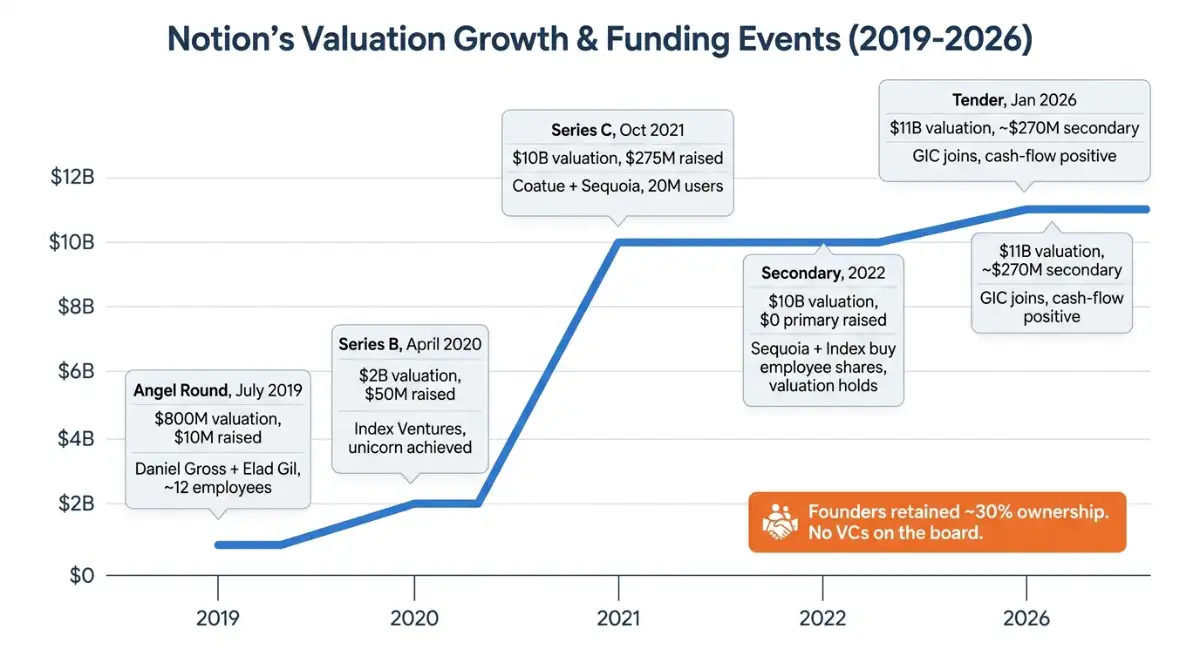
According to CNBC reporting in September 2025, Notion holds more cash on hand than the entire $330 million it has raised in primary funding to date. The company is cash-flow positive. Zhao retained meaningful founder control through three rounds at scale, which is genuinely unusual for a company at this size.
What Is Notion AI and How Did It Become the Company's Biggest Bet?
Notion AI entered private alpha on November 16, 2022, two weeks before ChatGPT launched publicly. The timing was not accidental. Co-founder Simon Last had been experimenting with DALL-E in early 2021, and both founders received early GPT-4 access in fall 2022. Zhao described his first reaction to GPT-4 as genuine shock at what the model could apparently reason through.
The Notion AI waitlist hit one million signups in five weeks. General availability came in February 2023, to tens of millions of existing users. Per Notion's own blog, the most popular early command was simply "Improve Writing." By late 2023, Notion added a Q&A feature that searched across an entire workspace, which addressed the tool's most persistent practical pain point: finding things you'd already written.
The product has evolved quickly since then:
- March 2024: Anthropic's Claude models added alongside OpenAI's
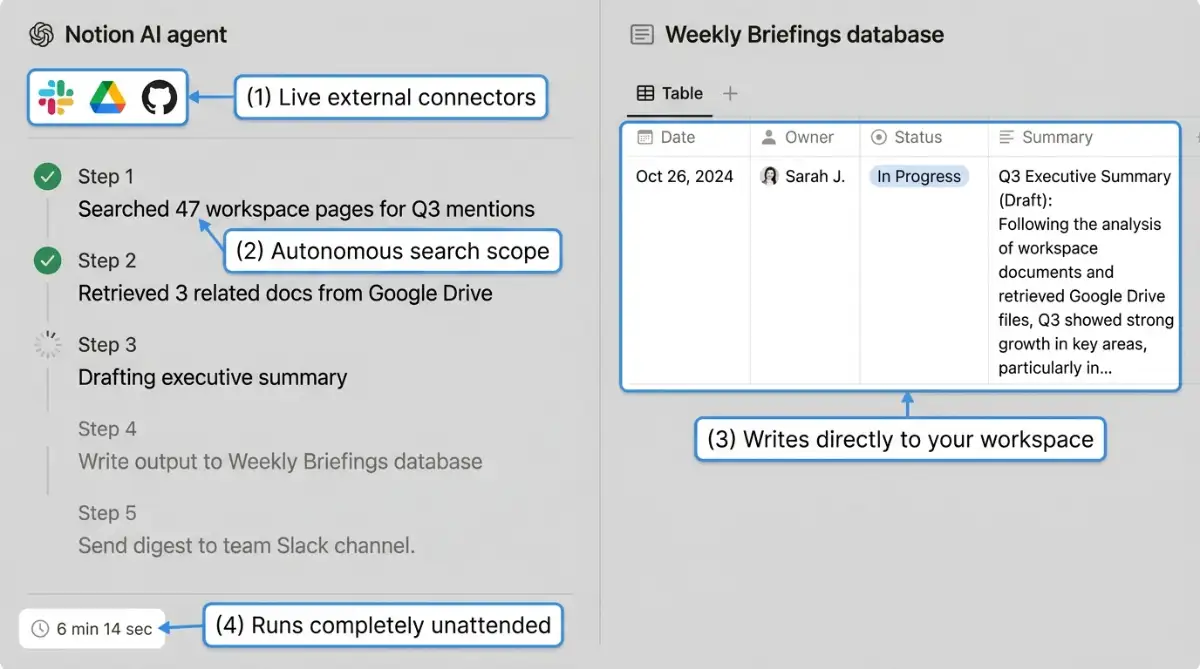
- September 2025: Notion 3.0 launches AI Agents, rebuilt around GPT-5, capable of 20-plus minutes of autonomous multi-step work across hundreds of pages
- February 2026: Custom Agents launch in public beta, running on schedules and triggers at $10 per 1,000 Notion Credits
- May 2026: The Notion Developer Platform adds Workers, Salesforce and Zendesk database sync, and an External Agent API connecting to Claude Code, Cursor, and Codex
According to COO Akshay Kothari's comments to CNBC in September 2025, AI adoption went from 10-20% of customers paying for the AI add-on to over 50% in roughly 12 months. Forbes reported in December 2025 that more than half of Notion's approximately $600 million ARR came from AI-enabled customers.
Notion's AI attach rate crossing 50% in under two years is one of the fastest enterprise AI adoption figures any single-product company has publicly reported.
The May 2025 pricing change bundled AI into the Business plan at $20 per user per month and removed cheaper standalone options for new subscribers. It drew real pushback: one Swiss tech CEO publicly called it "a ransom." That tension between aggressive enterprise monetization and a community built on affordable access is one Notion has not fully resolved.
Can Notion Actually Work as a Website Builder?
For simple use cases like personal pages, job boards, help centers, and portfolios, Notion Sites (launched June 2024) is a functional option. It supports custom domains, light and dark themes, favicons, SEO metadata, and Google Analytics integration. For anything more demanding, it hits real limits quickly.
There is no custom CSS, no JavaScript injection, no password protection for individual pages, and limited per-page SEO controls. Notion Sites competes in the same space as third-party tools like Super, Bullet, Potion, and Simple.ink, all of which were built specifically because Notion's native publish feature wasn't enough for most real sites. Zhao was transparent about this at launch, as TechCrunch's coverage noted, framing Notion Sites as a "quick website" tool and leaving power features to third parties. Before committing to it, it's worth thinking through what a website actually needs to do at a functional level.
For solo founders and small teams who need something live in a few hours, Notion Sites gets the job done. For a multi-page marketing site with contact forms, conversion tracking, and any real layout customization, you'll need a dedicated builder.
What Notion Sites does and doesn't do:
- Custom domain: Yes
- SEO metadata per page: Basic (title, description)
- Light/dark theme toggle: Yes
- Google Analytics: Yes
- Custom CSS/JavaScript: No
- Password-protected pages: No
- Contact forms: No
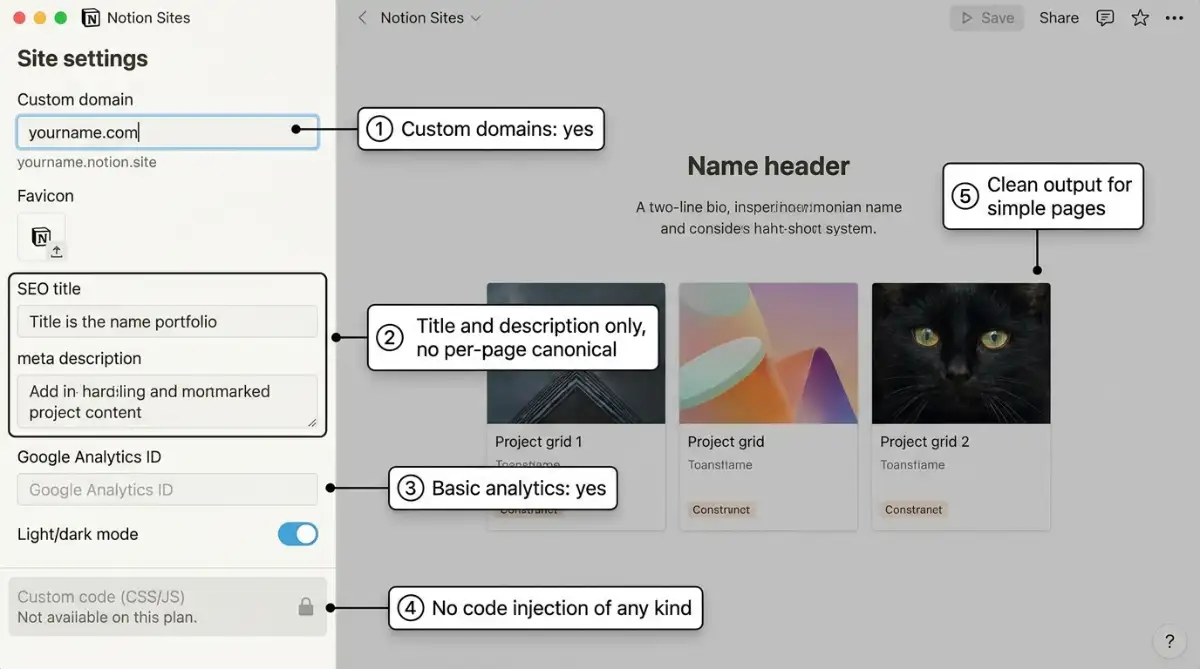
Notion Sites is better understood as a publishing layer than a true website builder, and that distinction matters for anyone planning to put real content on it.
Start exploring launch-ready no-code templates here!
Honest Tradeoffs
The Notion story is genuinely impressive, but a few places in the narrative deserve more skepticism than they usually get.
The block architecture that makes Notion feel flexible is also the thing that almost destroyed the company at scale. Maintaining a database where every paragraph is a discrete record creates infrastructure complexity that Notion wasn't ready for. Running on a single Postgres instance until 2020 wasn't a scrappy move, it was a near-disaster that froze feature development for months at the exact moment the product was going viral.
The community-led growth model is brilliant at the bottom of the market and increasingly under pressure at the top. Notion built its identity on being the anti-corporate tool: affordable, flexible, and shaped by its users. The May 2025 pricing overhaul broke that covenant for a vocal portion of the user base. That's a legitimate call for a company targeting enterprise. It's also a signal that the product is no longer primarily designed around the solo founder and student who made it famous.
The AI momentum is real. More than half of ARR from AI-enabled customers in under two years is an extraordinary number. But autonomous agents operating across sensitive business data, with credit-based billing that can scale unpredictably, introduces a new category of risk that Notion's traditionally non-technical audience isn't used to managing.
From where I sit, the most underrated factor in the whole story is the IPO timing. Bloomberg has reported a possible 2026 debut, but no date is confirmed. At roughly 18x ARR with the $11 billion valuation, Notion is already priced like a public company. If the AI attach rate stalls or enterprise churn to Microsoft Copilot or Google Gemini accelerates, those numbers get harder to defend. That's not a reason to dismiss the company's trajectory. It is a reason to watch the next 18 months closely.
FAQ
Is Notion free to use? Notion has a free plan with generous limits for individuals, including unlimited pages and up to 10 guests. Paid plans start at $10 per user per month (Plus) billed annually. As of May 2025, meaningful AI features require the Business plan at $20 per user per month for new subscribers.
What makes Notion different from Google Docs? Notion treats every line of content as a modular block, so a paragraph can be converted into a database row, a to-do item, or a Kanban card without switching apps. Google Docs is a linear word processor. Notion is closer to a flexible workspace that happens to include a document editor inside it.
Can Notion replace a website builder? For simple pages like portfolios, help centers, and internal docs, Notion Sites (launched June 2024) can get something live quickly with a custom domain and basic SEO. For multi-page marketing sites requiring forms, custom layouts, or JavaScript-dependent features, you will need a dedicated builder.
Is Notion good for small businesses? It works well for small teams that want shared docs, project tracking, and a company wiki in one place without the overhead of Confluence. The main consideration for new accounts is AI pricing: getting the most capable AI features now requires the Business plan at $20 per user per month billed annually.
What happened with Notion's $10 billion valuation from 2021? Notion reached a $10 billion valuation in October 2021. A secondary tender offer in 2022 held the same mark. By January 2026, a new tender offer involving Singapore's sovereign wealth fund GIC, Sequoia, and Index closed at $11 billion, according to Notion's own blog post announcing the transaction.
Start building without code
Browse thousands of no-code templates for Webflow, Framer, Bubble, Lovable, Replit and more.
Explore Templates