The 20-Year CMS Battle Between Joomla and Drupal

Joomla and Drupal have battled for non-technical content managers since 2005, when Joomla forked from Mambo to challenge Drupal's developer-first approach. Drupal won the enterprise market through granular control, while Joomla captured mid-sized organizations with its editor-friendly dashboard. Both now serve distinct niches in the 2026 CMS landscape.
Table of Contents
- The Short Version of a Long Rivalry
- 2000-2007: Two Very Different Origin Stories
- 2008-2015: The Modernization Arms Race
- The Editor vs Developer Divide That Defined Everything
- How WordPress Changed the Battlefield
- Deal-Breaker Questions From the CMS Wars
- Where the Battle Stands in 2026
- Key Takeaways
- FAQ
The Short Version of a Long Rivalry
The Joomla vs Drupal battle started in August 2005, when a community rebellion forked Mambo into Joomla to challenge Drupal's developer-centric CMS dominance. For 20 years, these two platforms have fought for the loyalty of non-technical content managers, and neither fully won. Drupal captured enterprise and government while Joomla claimed mid-sized organizations who wanted editor-friendly tools without WordPress limitations.
I've been watching this rivalry play out since my first awful Joomla 1.5 install in 2008, and the story is way more interesting than most "which CMS is better" articles let on. It's really a tale about what happens when two open-source communities make opposite bets about who their users are.
2000-2007: Two Very Different Origin Stories
Drupal was born in a Belgian university dorm room in 2000, when Dries Buytaert built what was basically a message board for friends. From day one, it was a Content Management Framework rather than a finished CMS, which is a fancy way of saying "bring your own developer." According to Octahedroid's history of Drupal, the project's 2000-2005 era cemented its reputation as a heavyweight tool that needed a technical team to wield effectively.
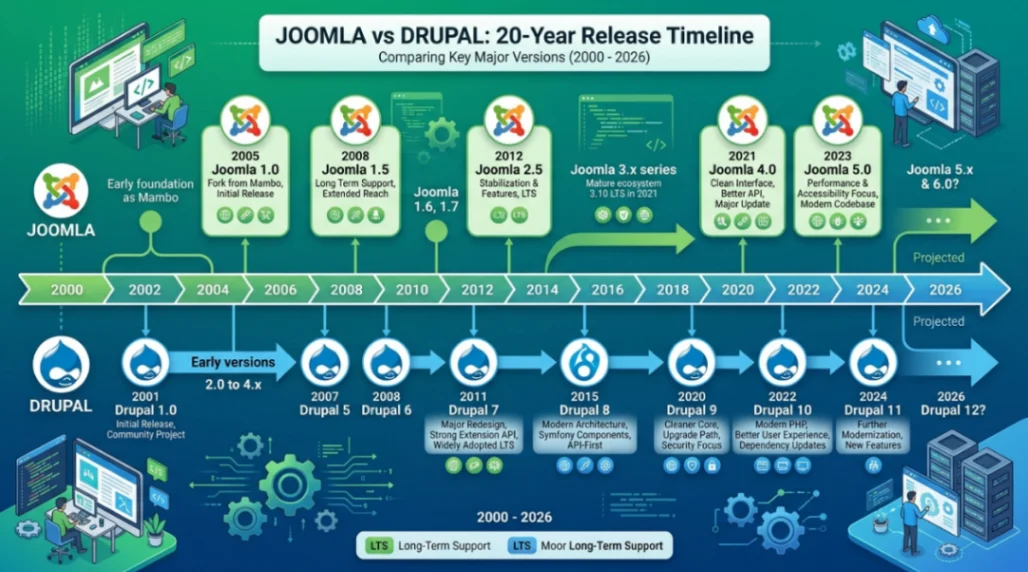
Joomla's origin is spicier. Its predecessor Mambo had already become a darling of non-technical users by 2004, with Linux Format naming it "Best Free Software" that same year. Then Miro International tried to form a foundation that the dev team felt violated their original agreements, triggering a mass exodus. In August 2005, the developers forked Mambo and launched Joomla 1.0 the following month. The name comes from the Swahili word jumla, meaning "all together," which tells you everything about the community-driven ethos.
This era wasn't just about CMSes either. The early 2000s web was a chaotic playground, and the Geocities and Angelfire story shows just how hungry non-technical users were for anything that let them publish without learning HTML. Meanwhile, the Dreamweaver vs FrontPage no-code war was playing out with the same editor-vs-developer tension that would define Joomla and Drupal.
2008-2015: The Modernization Arms Race
The years between 2008 and 2015 were when both platforms tried to fix their biggest weaknesses, and the results were fascinating to watch. Drupal 7, released in 2011, introduced a graphical installer and streamlined custom content types, clearly aimed at marketing teams who'd been complaining for years. But even that friendlier Drupal still demanded PHP knowledge for anything meaningful, and the community's strict refusal to allow "core hacking" meant spaghetti code that killed earlier WYSIWYG tools never got a foothold in Drupal.
Joomla took a different tack and focused on design and stability. Joomla 3 in 2012 became the first major CMS to be responsive by default, embedding Bootstrap directly into its core. That one decision gave Joomla a huge lead with non-technical managers who suddenly could edit their sites from an iPad without the backend looking broken.
| Year | Drupal Milestone | Joomla Milestone |
|---|---|---|
| 2008 | Drupal 6: improved menu and logging | Joomla 1.5: long-term stability |
| 2011 | Drupal 7: graphical installer | Joomla 1.6: nested categories and ACL |
| 2012 | Enterprise scalability push | Joomla 3: responsive by default |
| 2015 | Drupal 8: Symfony adoption | Joomla 3.x: refined extensions |
The content organization philosophy also diverged sharply during this period. Joomla's "Categories" system let editors organize content the way they'd organize filing cabinets. Drupal's "Taxonomy" system was technically more powerful but required training most non-developers didn't want to do.
The Editor vs Developer Divide That Defined Everything
Every chapter of the Joomla vs Drupal story comes back to the same fundamental divide: Joomla was built for editors, Drupal was built for developers. According to historical analysis by ServerMania and Atiba's 2026 comparison, this split shaped every design decision from admin panels to extension ecosystems.
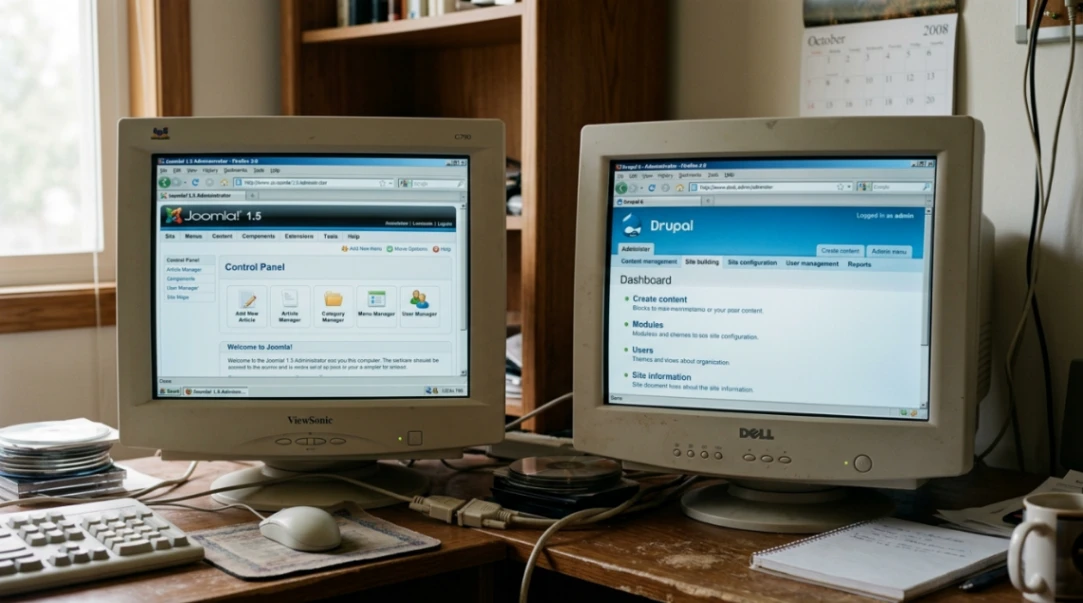
Joomla's administrative dashboard has always been icon-driven and visual, which is why non-technical users typically become productive within a day or two. Drupal's admin interface was historically minimalist to a fault, and until Drupal 8 introduced in-place editing, basic layout tweaks required developer intervention. Drupal 11's Layout Builder and CKEditor 5 finally closed most of the gap, but it took 20 years.
| Historical Feature | Drupal Approach | Joomla Approach |
|---|---|---|
| Admin UI | Minimalist, text-heavy | Icon-driven, visual |
| Extension Install | Composer and command line | One-click "Install from Web" |
| Extension Ecosystem | 52,000+ granular modules | 8,000+ complete solutions |
| Content Structure | Taxonomy (vocabularies) | Categories (nested) |
| Onboarding Time | 1-2 weeks | 1-2 days |
The ecosystem philosophies tell the same story. Drupal offers 52,000+ modules meant to be assembled like bricks, while Joomla offers 8,000+ extensions designed as complete solutions. A Joomla membership extension gives you a working portal. A Drupal membership feature requires Views, Pathauto, Metatag, and friends.
How WordPress Changed the Battlefield
Here's the plot twist nobody saw coming in 2005: WordPress quietly walked off with most of the prize. What started as blogging software grew into the platform that made no-code real in 2003 and now holds roughly 60% of the CMS market in 2026. Joomla and Drupal spent two decades fighting each other while WordPress ate both their lunches.
According to LitExtension's 2026 CMS comparison, the result is that the Joomla vs Drupal rivalry became a battle for niches rather than dominance. Drupal retreated into the enterprise DXP (Digital Experience Platform) space, becoming the standard for governments, universities, and global banks that need granular permissions and headless API delivery. Joomla positioned itself as the "smart compromise" for mid-sized organizations needing more than WordPress without Drupal's complexity.
Deal-Breaker Questions From the CMS Wars
Two decades of history answered most of the questions non-technical teams still ask today:
- Did Drupal ever become friendly for non-developers? Partially. Drupal 11's Recipes and Project Browser help, but the developer dependency never fully disappeared.
- Has Joomla kept pace? Yes, with AVIF support, Schema.org integration, and the Task Scheduler in Joomla 5 handling tasks that used to need server access.
- Which platform historically ships faster? Joomla, almost every time, for non-technical teams.
- What did each sacrifice? Drupal sacrificed ease of use for architectural power. Joomla sacrificed some enterprise features for editorial simplicity.
- Is the rivalry still relevant? More niche than before, but yes. Both platforms still outperform WordPress in specific scenarios.
Where the Battle Stands in 2026
The 2026 version of this rivalry looks very different from the 2005 version, but the underlying divide is identical. Drupal 11, released in August 2024, introduced Recipes (pre-configured module sets), AI assistants for admin tasks, and the Project Browser to simplify module discovery. It's the most non-technical friendly Drupal has ever been, which still isn't saying that much compared to Joomla.
Joomla 5 and the upcoming Joomla 6 focused on Guided Tours, a visual Task Scheduler, and Schema.org integration so editors can manage rich snippets without writing code. According to Hostinger's CMS analysis, Joomla remains significantly more approachable for non-technical teams in 2026, while Drupal holds its lead for complex multi-site enterprises.
Start exploring launch-ready no-code templates here!
Key Takeaways
- The rivalry started with a 2005 fork: Joomla's birth from Mambo was a community rebellion against proprietary control, and that editor-first DNA shaped every design decision since.
- Neither platform fully "won" the non-technical manager: Drupal captured enterprise and government through granular power, while Joomla kept mid-sized organizations with visual simplicity. WordPress quietly took the rest.
- The editor-vs-developer divide persists in 2026: Despite Drupal 11's Recipes and Joomla 5's AI-assisted features, the fundamental philosophical split between the two platforms is basically unchanged after 20 years.
Looking back at 20 years of the CMS wars, the most interesting lesson is that neither platform ever truly changed its soul. They just got better at serving the users who were always going to love them anyway, which is probably the most honest form of competition open source has ever produced.
FAQ
When did the Joomla vs Drupal rivalry start? The rivalry started in August 2005 when Joomla forked from Mambo, creating an immediate competitor to Drupal's developer-focused CMS. Before that, Drupal had been the dominant open-source CMS since 2000.
Why did Joomla fork from Mambo? The Mambo development team felt Miro International's proposed foundation structure violated their original agreements. Rather than continue under new governance, the team left and launched Joomla 1.0 in September 2005.
Which CMS came first, Joomla or Drupal? Drupal came first by five years, launched in 2000 by Dries Buytaert as a message board framework. Joomla arrived in August 2005 as a fork of the earlier Mambo CMS.
Did Drupal ever beat Joomla for non-technical users? No, not really. Drupal closed the gap with Drupal 7, 8, and 11, but Joomla has consistently remained easier for non-technical content managers throughout the 20-year rivalry.
Is the Joomla vs Drupal battle still relevant in 2026? Yes, but in niches. Drupal dominates enterprise and government CMS projects, while Joomla serves mid-sized organizations and NGOs. WordPress captured the general market, leaving both platforms to specialize.
Start building without code
Browse thousands of no-code templates for Webflow, Framer, Bubble, Lovable, Replit and more.
Explore Templates