Early Web Design and the Under Construction GIF
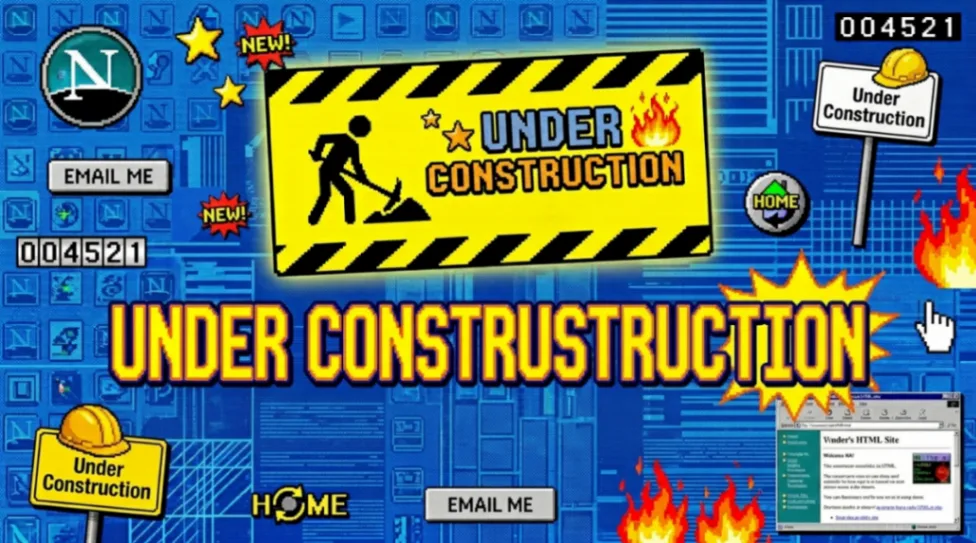
The "Under Construction" GIF was a looping animation used on early websites in the 1990s to signal that a page was still being built. Developed using the GIF 89a format released in 1989, it became the defining visual symbol of Web 1.0 era design. Today it is studied as digital folk art, preserved by the Internet Archive, and celebrated in modern Webcore and Vaporwave aesthetics.
Table of Contents
- Introduction: The Flickering Icon That Defined an Era
- How the GIF Format Made It All Possible
- GeoCities and the Homesteader Philosophy
- What the "Under Construction" Sign Actually Meant
- From Construction GIFs to "Beta" Labels: The Web Grew Up
- Preserving the Past: The GifCities Archive
- The Webcore Revival: Why We Miss the Ugly Web
- Key Takeaways
- FAQ
Introduction: The Flickering Icon That Defined an Era
If you were online in the mid-to-late 1990s, you remember it. A tiny pixelated worker, jackhammer in hand, shoveling away in an infinite loop. Beside it, the words "Under Construction" in some truly unhinged font color.
That little animation was everwhere. And honestly? It was kind of perfect for its time.
The "Under Construction" GIF was not just a decorative quirk of early web design. It was a socio-technical response to a genuinely primitive internet, a philosophy about what a website even was, and a symbol of human creativity operating without guardrails.
As the web approaches 2026, this tiny flickering artifact has gone from laughed-at relic to a serious subject of media archaeology, digital preservation, and even architectural research. Let's dig into how that happened.
How the GIF Format Made It All Possible
Before we talk about blinking construction workers, we need to talk about the technology that made them possible.
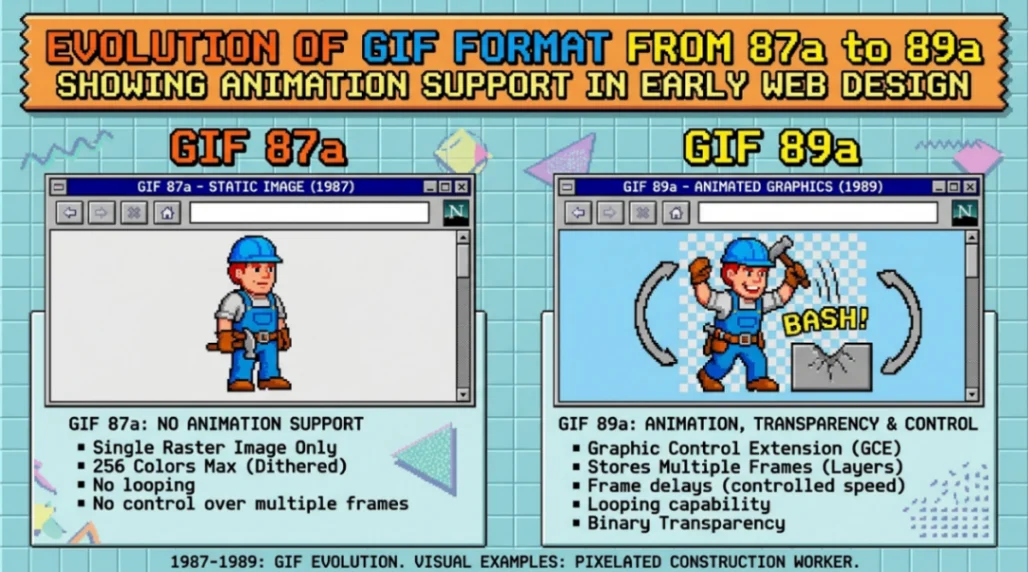
The Graphics Interchange Format, better known as GIF, was developed by a team at CompuServe led by Steve Wilhite and released on June 15, 1987. The goal was simple but ambitious: create a format that could share images across incompatible systems like Apple IIGS, Atari ST, and Commodore 64 machines, without eating up precious bandwidth.
The secret weapon was the Lempel-Ziv-Welch (LZW) compression algorithm. It worked by identifying recurring pixel patterns and assigning them shorter codes, letting images "squeak through" 1200 or 2400 baud modems. The result was 8-bit images limited to 256 colors but actually downloadable in a reasonable timeframe.
Here is where it gets interesting for web design history. The real turning point was the 1989 update, GIF 89a.
| Feature | GIF 87a (1987) | GIF 89a (1989) |
|---|---|---|
| Primary Goal | Platform-independent image exchange | Support for animation and interactivity |
| Animation | Multiple images in one stream | Explicit animation delay and looping control |
| Transparency | Not supported | One-color background transparency |
| Metadata | Limited | Application-specific metadata tags |
GIF 89a added two things that changed everything for web design:
- Transparency freed GIFs from rigid rectangular boxes, letting them blend into tiled page backgrounds
- Animation delays allowed multiple frames to loop endlessly, creating the illusion of permanent motion
Then in 1993, NCSA Mosaic arrived. Developed by Marc Andreessen, Mosaic was the first browser to display images inline with text, making GIFs a native part of the web experience rather than a separate download. By 1995, Netscape Navigator 2.0b4 added infinite looping support, and the "Under Construction" subgenre officially had a home.
This is also the era that gave us tools like Netscape Composer and early WYSIWYG builders, which made it possible for everyday people, not just coders, to start putting pages on the web.
GeoCities and the Homesteader Philosophy
The "Under Construction" GIF did not just live anywhere. It flourished on GeoCities.
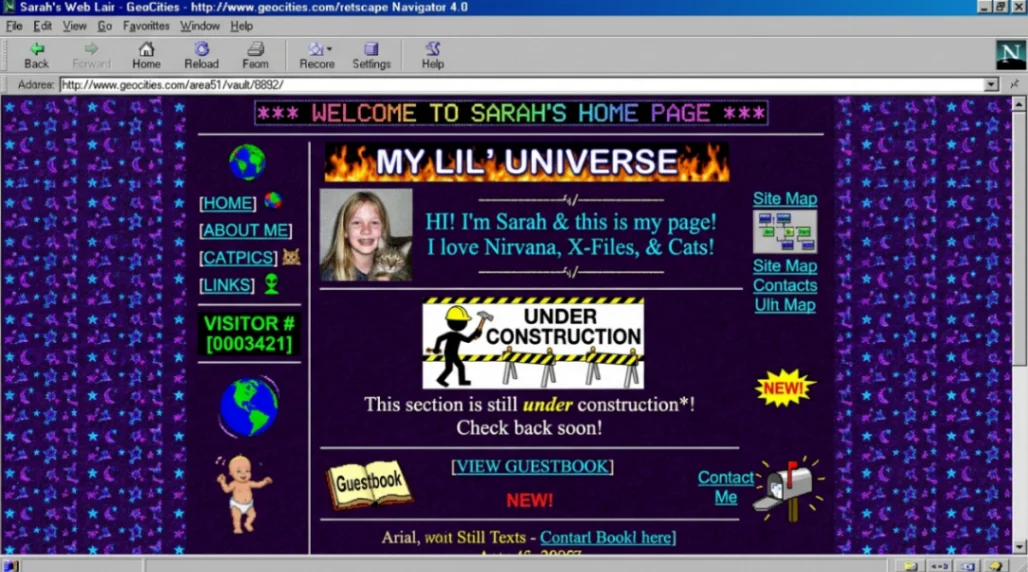
Founded in 1994, GeoCities organized its users into themed "neighborhoods": SiliconValley for tech folks, Hollywood for entertainment fans, Area51 for paranormal enthusiasts. By 1999, it had become the third-most visited site on the entire web.
Users were called "Homesteaders," a term that captured the frontier philosophy perfectly. The web was treated as open territory, and anyone could stake their claim. There were no design systems. No gatekeepers. No standardized layouts.
What you got instead was pure, unfiltered self-expression:
- Tiled backgrounds in patterns that would make your eyes water
- Rainbow-colored Comic Sans text at four different font sizes
- Animated GIFs stacked on top of animated GIFs
- And yes, one or five "Under Construction" banners
If you want a deeper dive into how platforms like GeoCities and Angelfire shaped the no-code movement, the full story is worth reading. It is genuinely wilder than you'd expect.
What the "Under Construction" Sign Actually Meant
Here is the part that I find genuinely facinating: the "Under Construction" GIF was not a sign of failure. It was a philosophy.
For Homesteaders, putting up a construction banner meant your site was alive, being maintained, and growing. Think of it as a "be right back" note stuck to the door of your digital home. The site was a living project, not a finished product.
The imagery itself had layers of meaning:
| Construction Motif | Visual Element | Symbolic Meaning |
|---|---|---|
| The Worker | Pixelated figure with jackhammer | Humanizes code; suggests digital content requires real labor |
| The Barrier | Traffic cones, striped barricades | Marks sections not yet ready for public viewing |
| The Sign | Yellow triangles, "Pardon Our Dust" banners | Apologetic tone; acknowledges the friction of a new medium |
| The Tool | Swinging hammers, flickering paintbrushes | Celebrates the "maker" culture of hand-coded HTML |
This was, as researchers now describe it, a form of "digital folk art." Millions of people using a shared visual vocabulary to say: "I'm here. I'm building. Come back soon."
Of course, as more sites were abandoned without ever being "finished," the meaning slowly shifted. What once signaled active creation started to signal neglect. By the early 2000s, the "Under Construction" GIF had become a punchline.
The tools that powered these early builds, from Microsoft FrontPage to Adobe GoLive to Dreamweaver, were also evolving fast during this period, slowly pushing construction GIFs toward the exit.
From Construction GIFs to "Beta" Labels: The Web Grew Up
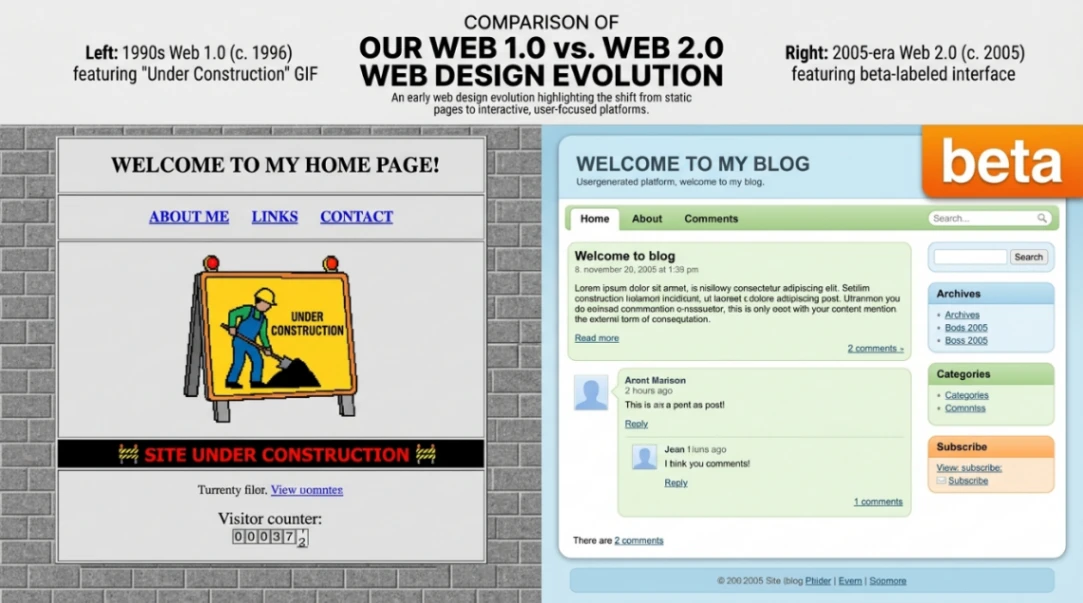
The shift from Web 1.0 to Web 2.0 in the early 2000s killed the "Under Construction" GIF more quietly than you might expect.
As platforms like Facebook rose to dominance, they brought a sleek, homogeneous aesthetic with them. The individual "homesteader" building their own corner of the web was replaced by a user filling out a profile form. The "maker" was replaced by the "content creator."
| Metric | Web 1.0 "Under Construction" | Web 2.0 "Beta" Label |
|---|---|---|
| Metaphor | Physical infrastructure, manual labor | Software lifecycle, quality assurance |
| Visual Complexity | High (multi-frame animation, multiple colors) | Low (minimalist text, angled banners) |
| Philosophy | "A site is a home always being improved" | "A service is a product being tested" |
| Communication Style | Amateur, peer-to-peer | Corporate, service provider-to-user |
The "Beta" label was cleaner. More professional. It said the same thing (we're still working on it) but in the language of software development rather than the language of a neighborhood handyman.
As one commenter noted on Hacker News, the eventual realization "clicked" that web pages are always dynamic, making explicit construction graphics unnecessary. The human trace in web development was quietly erased.
The table layout era was ending, CSS was taking over, and there simply was not much room left for a pixelated jackhammer operator.
Preserving the Past: The GifCities Archive
In 2009, Yahoo announced it was shutting down GeoCities. And in internet terms, that was kind of like burning down the Library of Alexandria while everyone watched.
The Archive Team, led by Jason Scott, scrambled to download nearly one terabyte of data before the servers went dark. That archive became the foundation for what researchers now call "digital archaeology."
Then in 2016, the Internet Archive launched GifCities, a search engine indexing over 4.5 million GIFs pulled from the GeoCities archive. By 2025, the platform had upgraded to semantic search powered by the CLIP-ViT L/14 model, allowing researchers to search by visual pattern, not just filename.
| Preservation Milestone | Year | Impact |
|---|---|---|
| GeoCities Shutdown | 2009 | Prompted first comprehensive archive of amateur web design |
| GifCities Launch | 2016 | Democratized access to millions of "Under Construction" variations |
| Semantic Search Update | 2025 | Enabled machine learning analysis of 8-bit animation frames |
| Public Domain Remix | 2026 | Encouraged artists to recontextualize GIFs into modern media |
This preservation work is described as a "service to democracy," keeping ephemeral internet history alive for future researchers. It bridges the Wild West of the 90s with the increasingly controlled digital landscapes of today.
The Webcore Revival: Why We Miss the Ugly Web
Something strange happened in the late 2010s. People started missing the bad old web on purpose.
The Webcore and Vaporwave aesthetics emerged as movements that romanticize 90s graphic design, reinterpreting its chaotic functionalism through a contemporary lens. And right at the center of that revival? "Under Construction" GIFs.
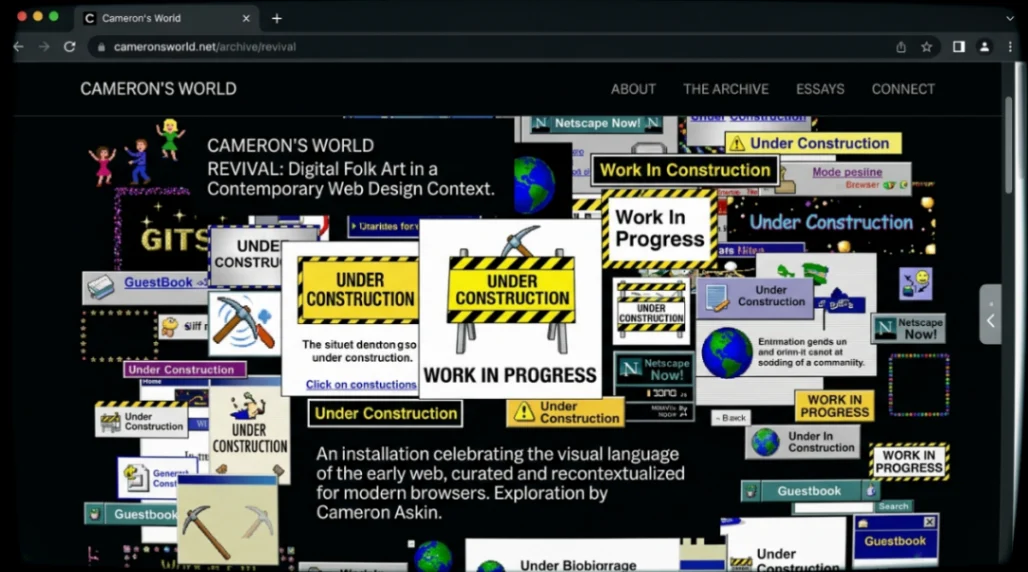
One of the most significant projects is Cameron's World, created by New Zealand designer Cameron Askin in 2015. Askin excavated thousands of texts and images from archived GeoCities pages to build an immersive, long-scrolling experience that uses "Under Construction" banners as literal structural elements.
The deeper reason for the revival is not just nostalgia. It is grief for something specific: a version of the internet that was built for people, not corporations. Before the "real name web" of Facebook and LinkedIn made self-branding mandatory, you could be weird online without consequences.
By 2026, this nostalgia is colliding with something new. As AI floods the modern web with polished, algorithmically generated content, developers are actively building DIY sites that mirror the hand-coded aesthetic of the early web. Modern tools like the HTML5 <picture> element and prefers-reduced-motion media query are being used to recreate the "Under Construction" look without sacrificing accessibility.
The Adobe Flash era that followed the GIF era tried to bring more sophistication to the web. But there is a growing argument that something human was lost in that transition.
Start exploring launch-ready no-code templates here!
Key Takeaways
The "Under Construction" GIF is a lot more then a 90s curiosity. Here is what its history actually tells us:
-
Technical constraints shaped culture. The GIF format was born from bandwidth scarcity and platform incompatibility. Those limitations produced a specific visual aesthetic that defined an entire era of web design. The 1989 GIF 89a update, which added animation and transparency, was the direct technical ancestor of every blinking construction banner you ever saw.
-
The web was once a place of genuine human-made identity. GeoCities, Angelfire, and Tripod gave millions of people their first digital homes. The "Under Construction" GIF was not a sign of failure; it was a sign of participation. It said "I am here, I am building, come back." That spirit is worth remembering as AI-generated content increasingly dominates the web.
-
What gets discarded eventually becomes heritage. The GifCities archive at the Internet Archive has preserved over 4.5 million GIFs and is now being used for machine-learning research and architectural heritage studies. The Webcore revival proves that authenticity, even clunky, pixelated authenticity, has real cultural staying power.
The internet's roots were messy, human, and gloriously unfinished. In an age of polished platforms designed to hide their own construction, that is a genuinely radical thing to remember.
FAQ
What was the "Under Construction" GIF used for in early web design? It was a looping animation placed on early websites to signal that a page or section was still being built. It served as both a practical placeholder and a symbol of active, ongoing site development.
When was the GIF format invented, and who created it? The GIF format was created by Steve Wilhite and his team at CompuServe, released on June 15, 1987. The 1989 update (GIF 89a) added animation and transparency support.
Why did the "Under Construction" GIF disappear from web design? The transition from Web 1.0 to Web 2.0 in the early 2000s replaced it with minimalist "Beta" labels. As professional design systems and CSS frameworks took over, explicit construction graphics became unnecessary.
Where can I find original "Under Construction" GIFs from the 1990s? The Internet Archive's GifCities search engine indexes over 4.5 million GIFs from the GeoCities archive. As of 2025, it supports semantic visual search powered by the CLIP-ViT L/14 model.
Why are "Under Construction" GIFs making a comeback in 2024-2026? The Webcore and Vaporwave aesthetic movements have reclaimed 90s web design as a symbol of human-made, unfiltered creativity. As AI dominates modern web content, many developers are deliberately reviving hand-coded, retro aesthetics as a form of digital resistance.
Start building without code
Browse thousands of no-code templates for Webflow, Framer, Bubble, Lovable, Replit and more.
Explore Templates