Adobe GoLive The Forgotten Web Builder Rival
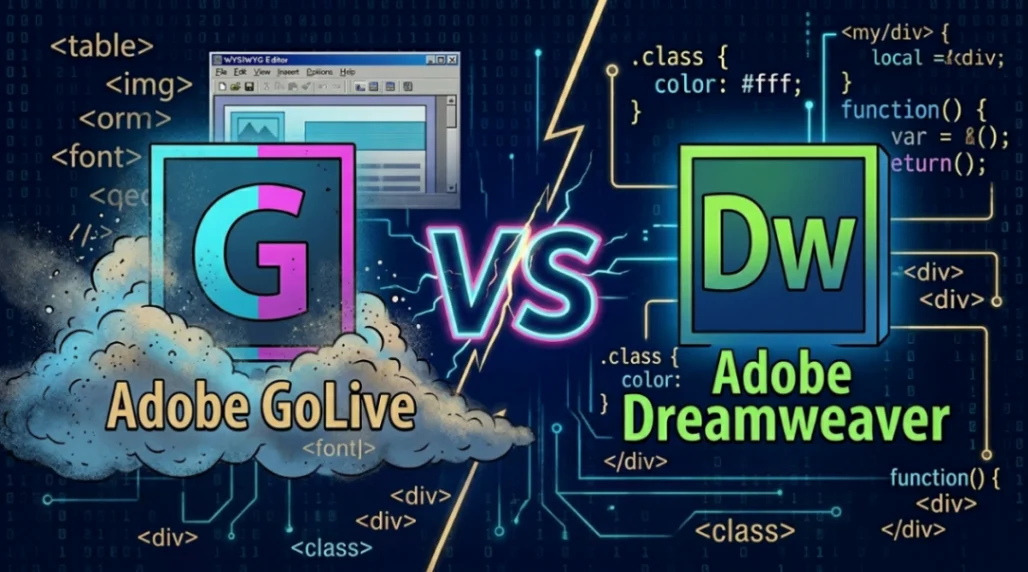
Adobe GoLive was a professional visual web design tool originally developed as CyberStudio by GoLive Systems in Hamburg, Germany. Acquired by Adobe in 1999 for $31.5 million, it competed directly with Macromedia Dreamweaver until Adobe's 2005 Macromedia merger sealed its fate. It was officially discontinued in April 2008.
Table of Contents:
- What Was Adobe GoLive?
- The Hamburg Origins: A Builder Born Outside Silicon Valley
- GoLive vs Dreamweaver: How Did They Actually Compare?
- Smart Objects and Suite Integration: Where GoLive Shone
- Why Adobe Killed GoLive in 2008
- The Spiritual Successors: Who Carries GoLive's DNA Today?
- Key Takeaways
- FAQ
What Was Adobe GoLive? (And Why You Probably Forgot It)
If you've spent any time digging into the history of early web builders, you've probably come accross Dreamweaver at least a dozen times. But Adobe GoLive? That one tends to get skipped over.
Here's the thing though: GoLive was genuinely impressive for its time. It wasn't some half-baked side project. It was Adobe's flagship web authoring tool for nearly a decade, and it pushed visual web design further than most people give it credit for.
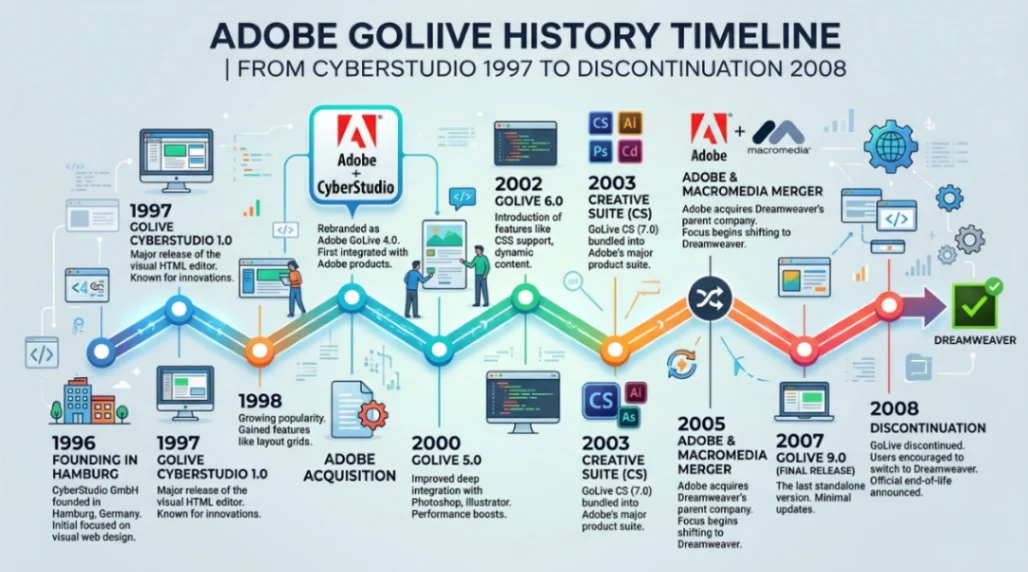
It started life as GoLive CyberStudio, announced at Macworld Expo in San Francisco on January 8, 1997. Adobe acquired it from GoLive Systems in January 1999 for approximately $31.5 million, folded it into the Creative Suite, and positioned it as the web design home for Photoshop and Illustrator users.
Sound familiar? It should. The same "design-first" philosophy that drives modern no-code builders today is almost exactly what GoLive was chasing back then.
The Hamburg Origins: A Builder Born Outside Silicon Valley
Most people assume big software came out of California. GoLive's story starts in Hamburg, Germany, which is already kind of a cool detail.
In 1996, a group of developers who had previously built the PrimeBase database system founded GoNet Communication GmbH in Hamburg. Their background in data management gave them a pretty unique edge when it came to building site-management tools that actually made logical sense.
They set up a US subsidiary in Menlo Park, California, and by 1997 they'd rebranded to GoLive Systems and announced CyberStudio to the world.
The early version was Mac-only, which was a deliberate choice. The graphic design and desktop publishing (DTP) world ran on Apple hardware back then, and GoLive wanted that audience. Think ad agencies, print studios, creative shops migrating to the web for the first time.
When Adobe took over in 1999, one of the first moves was porting it to Windows with GoLive 4.0 in May 1999. Smart move. The tool went from a niche Mac editor to a serious cross-platform competitor almost overnight.
You can see a similar pattern with how early no-code builders like GeoCities and Angelfire grew by targeting specific, underserved audiences before going broad.
GoLive vs Dreamweaver: How Did They Actually Compare?
This is where things get genuinely interesting. The GoLive vs Dreamweaver debate wasn't just a preference thing. It reflected two completely different philosophies about what a web builder should be.
GoLive was built for designers. Dreamweaver was built for developers.
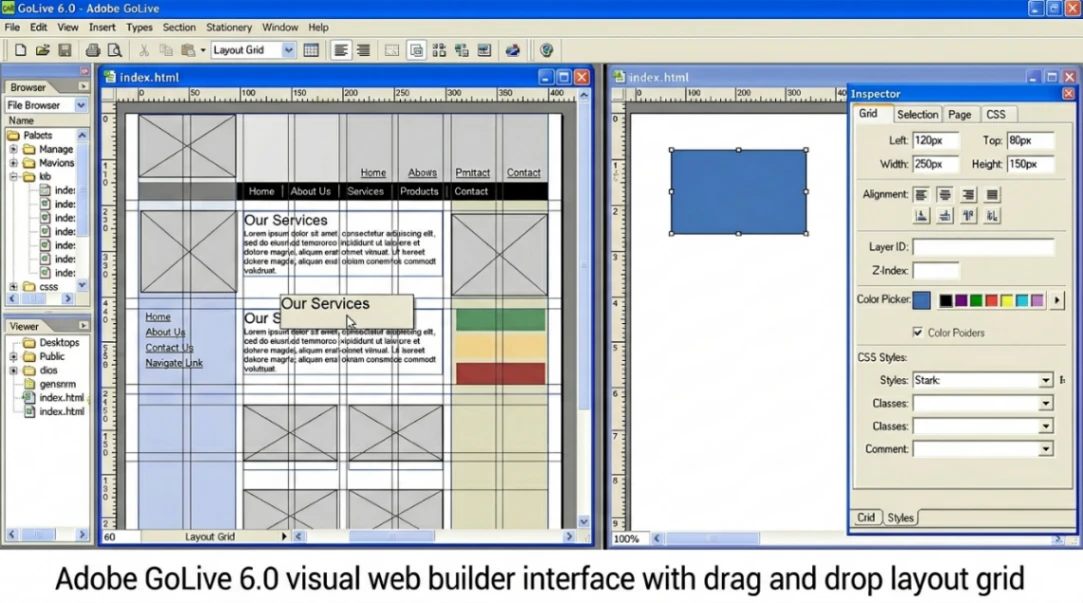
GoLive's signature feature was the Layout Grid, a drag-and-drop canvas that let you position elements with pixel-level precision. Think of it like bringing QuarkXPress or Adobe PageMaker workflows straight into the browser. Designers loved it because it worked like print software. Developers hated it because it generated deeply nested HTML tables to achieve that precision, which critics called "bloated code."
Dreamweaver, by contrast, leaned into the code. It offered real-time code hinting, flow-based HTML, and tighter standards compliance. It was messier visually but cleaner technically.
Here's a quick comparison circa 2002:
| Feature | Adobe GoLive 6.0 | Dreamweaver MX |
|---|---|---|
| UI Model | Modeless Inspector palette | Property Inspector + Modal Dialogs |
| Layout Approach | Layout Grid (table-based) | Flow-based HTML / Early CSS |
| Site Maps | Interactive SVG/PDF export | Static JPEG/PICT only |
| Media Handling | Native QuickTime editor | Required external extensions |
| Asset Management | Smart Objects (PSD/AI tracking) | Library Items (internal only) |
| Mobile Support | WAP / i-mode authoring | Limited |
GoLive also introduced "Palette Stashing", letting users dock floating palettes to the monitor edges. That feature became standard across the whole Adobe Creative Suite. Not bad for a "forgotten" tool.
The Dreamweaver vs FrontPage rivalry covered a similar philosophical split in early web builders, and honestly GoLive sat right in the middle of that whole debate.
Smart Objects and Suite Integration: Where GoLive Really Shone
If there's one thing GoLive genuinely nailed, it was workflow integration with the rest of the Adobe toolkit.
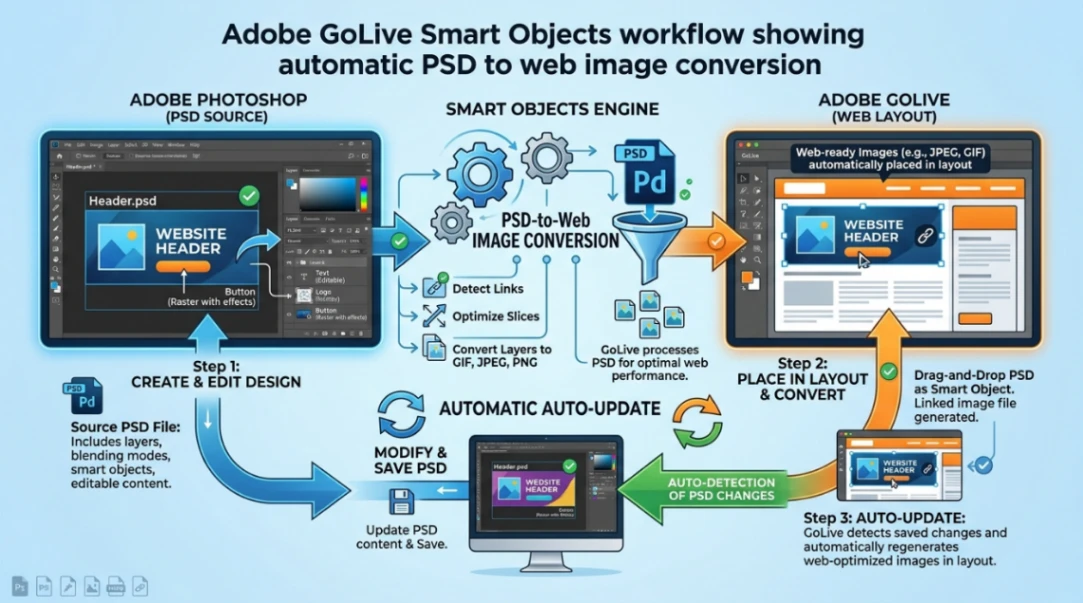
Smart Objects, introduced in version 5.0 and refined in 6.0, were kind of remarkable for the era. You could drop a native Photoshop .PSD or Illustrator .AI file directly onto your web page canvas. GoLive would automatically convert it to JPEG, GIF, or PNG for the web.
The clever part? It tracked the original file. Update the PSD in Photoshop, and GoLive would detect the change and re-export the web version automatically. No manual re-saving. No hunting for the right file version. This saved designers an enormous amount of time in an era where every asset had to be manually prepped for web export.
GoLive CS2 (version 8.0) went even further with CSS Block Objects, pre-built layout schemes you could customise via the Inspector. This was a direct response to the industry shifting away from tables toward CSS. The Layout Grid was rebuilt entirely to output clean, standards-compliant CSS instead of nested table hacks.
That's not a small tweak. That was a fundamental architectural rewrite to keep the visual builder relevant.
GoLive 6.0 also had a built-in QuickTime movie editor and native WAP/i-mode mobile preview tools, years before anyone was seriously talking about mobile-first design. It's genuinly impressive in retrospect.
Why Adobe Killed GoLive in 2008
On April 18, 2005, Adobe announced it was acquiring Macromedia for $3.4 billion. That single deal is what ended GoLive.
Suddenly Adobe owned both GoLive and Dreamweaver. Two web builders. Overlapping audiences. One had to go.
The numbers made the decision pretty simple. At the time of the merger, only about 20% of GoLive sales were standalone purchases. The rest came bundled inside the Creative Suite. Dreamweaver, on the other hand, dominated standalone sales and was widely considered the industry standard by third-party reviewers.
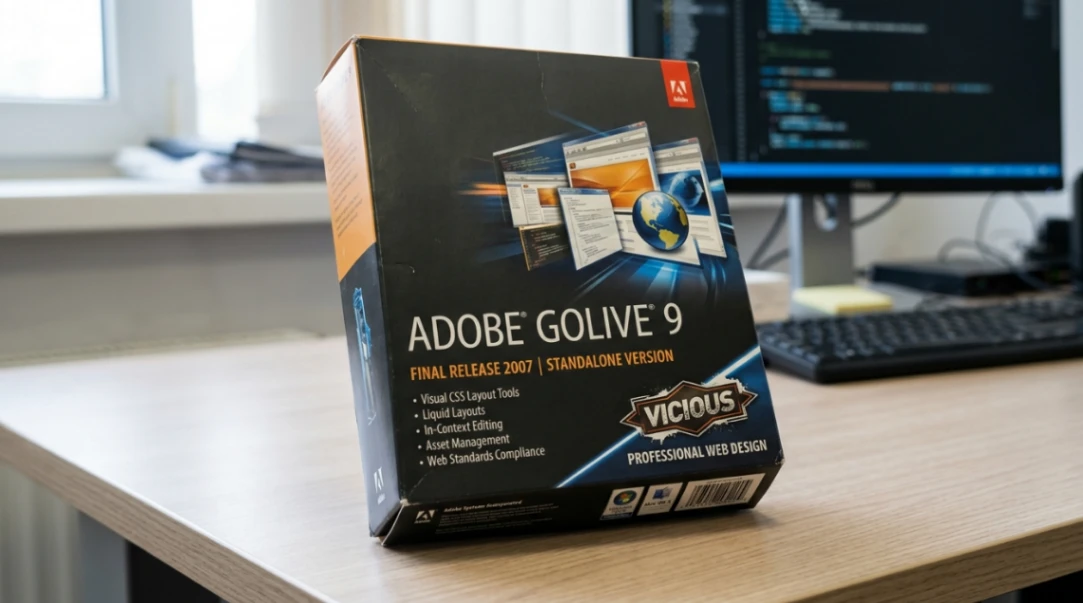
Adobe officially ended development and sales of GoLive on April 28, 2008. Existing users were offered a $199 upgrade path to Dreamweaver CS3 and access to migration tutorials through Lynda.com.
The migration itself was a mess for many users. GoLive used its own .site file structure, "Components" for global updates, and special <csobj> tags that Dreamweaver simply didn't understand. The "GoLive Migration Kit" Adobe released was widely criticised for breaking complex sites built in older versions. Many professionals ended up rebuilding their sites from scratch.
Microsoft FrontPage went through a similar quiet death around the same era, as the browser wars and standards movement reshuffled everything.
The Spiritual Successors: Who Carries GoLive's DNA Today?
GoLive didn't die cleanly. Its ideas just scattered.
Adobe tried to revive the philosophy with Adobe Muse in 2012, explicitly marketed as "InDesign for the web." Designers could build responsive sites through a layout-first interface. Sound familiar? It ran until 2018 before Adobe shut that down too.
Today, the tools that actually deliver what GoLive promised are outside Adobe entirely. Webflow and Framer are the closest spiritual successors. Both use visual canvas-based builders but output clean, modern CSS Grid and Flexbox code rather than the nested table hacks that dogged GoLive's reputation.
The "pixel-perfect without bloated code" problem that GoLive couldn't fully solve? Modern builders cracked it by building on top of CSS architecture that simply didn't exist in 1997.
Here's how the visual web design era maps out:
| Era | Representative Tools | Defining Trait |
|---|---|---|
| 1995-1999 | Netscape Composer, FrontPage | Word processor-style builders |
| 1997-2005 | Adobe GoLive / CyberStudio | DTP-to-Web layout with pixel control |
| 2005-2012 | Dreamweaver CS3-CS6 | Code standards and developer focus |
| 2012-2018 | Adobe Muse | Design-first responsive builder |
| 2018-Present | Webflow, Framer, Figma | Visual editing on CSS Grid foundations |
The idea that a designer should be able to build a site visually without writing code? GoLive was fighting for that back in 1997. It just got there before the web was ready.
Start exploring launch-ready no-code templates here!
Key Takeaways
Adobe GoLive is one of those products that gets written off as simply "the tool that lost to Dreamweaver," but that framing undersells its actual contribution to how we think about web builders today.
It pioneered the contextual inspector, Smart Objects, visual site mapping, and drag-and-drop asset management, all features that are now completely standard in tools like Figma, Adobe XD, and Webflow.
It was also remarkably forward-thinking about mobile. WAP and i-mode preview tools in 2002 is not something most people remember, but it mattered.
Ultimately, GoLive lost not because it was inferior, but because it served designers in an industry that was rapidly shifting power toward developers. The 2005 Macromedia merger was the final word on that.
If you're curious about the broader history of how visual builders evolved, the stories of Actual Drawing ADF, WebMagic 1995, and Microsoft FrontPage all connect to the same larger thread. GoLive is just one piece of it.
FAQ
What was Adobe GoLive originally called? Adobe GoLive was originally called GoLive CyberStudio, developed by GoLive Systems in Hamburg, Germany. It was rebranded after Adobe acquired the company in January 1999 for approximately $31.5 million.
Why did Adobe discontinue GoLive? Adobe discontinued GoLive on April 28, 2008, after its 2005 acquisition of Macromedia gave it ownership of both GoLive and Dreamweaver. Dreamweaver dominated standalone sales and developer adoption, making GoLive redundant.
Was GoLive better than Dreamweaver? GoLive offered superior workflow integration with Photoshop and Illustrator via Smart Objects, and a more intuitive drag-and-drop interface for designers. Dreamweaver was stronger for developers due to cleaner code output and better standards compliance.
What replaced Adobe GoLive? Adobe offered existing users a $199 upgrade to Dreamweaver CS3. Adobe later released Adobe Muse in 2012 as a design-focused alternative, though that was also discontinued in 2018. Modern equivalents include Webflow and Framer.
What is a Smart Object in Adobe GoLive? Smart Objects were files, such as native Photoshop PSD or Illustrator AI documents, placed directly into a GoLive layout. GoLive auto-converted them to web formats and tracked the source file, updating the web version automatically whenever the original was edited.
Start building without code
Browse thousands of no-code templates for Webflow, Framer, Bubble, Lovable, Replit and more.
Explore Templates