Adobe Flash: The Beautiful Ancestor of Modern Web Tools
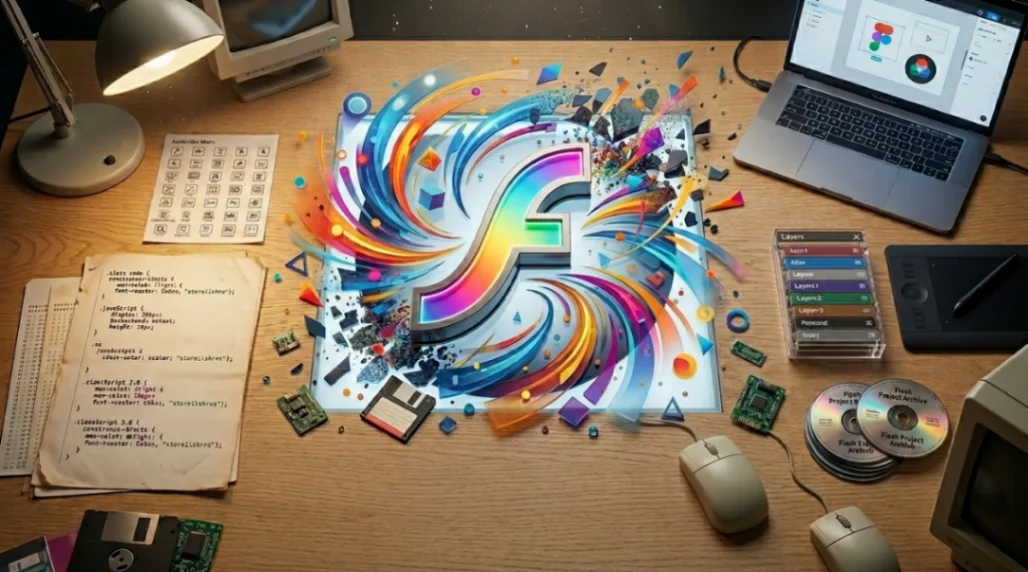
Adobe Flash was a vector-based multimedia platform that powered interactive web experiences from 1996 to 2020. Originally developed by FutureWave Software as FutureSplash Animator, it was acquired by Macromedia in 1996 and later by Adobe in 2005. Its retirement was driven by security vulnerabilities, poor mobile performance, and the rise of open web standards like HTML5.
Table of Contents
- From SmartSketch to Flash: The Origin Story
- The Golden Era of Flash Design
- Why Adobe Flash Died: The Real Technical Reasons
- The Preservation Movement Saving Flash History
- Flash's Legacy in Modern Tools Like Figma and Rive
- Key Takeaways
- FAQ
If you spent any time online in the early 2000s, you remember Adobe Flash. The loading bar. The skip intro button. The wild, animated websites that felt like you'd stepped inside a sci-fi movie. Flash wasn't just software. It was the beating heart of an entire era of web creativity, and honestly? We kind of miss it.
But Flash's story is more than nostalgia. It's a masterclass in how even the most dominant technology can collapse when the world moves in a different direction.
From SmartSketch to Flash: The Origin Story
Before Adobe Flash was a household name, it started as something much smaller. Back in 1993, Jonathan Gay co-founded FutureWave Software and built a vector drawing tool called SmartSketch, originally designed for pen-based computers running PenPoint OS. If you want the full deep-dive, the Adobe Flash Wikipedia page is a surprisingly great read.
When the pen-computing market flopped, the team did something smart. They pivoted to the web.
By adding a basic timeline and frame-by-frame animation to the SmartSketch engine, FutureWave released FutureSplash Animator in May 1996. Within months, big players like Disney Online and Microsoft's MSN portal were already using it to build "TV-like" interactive experiences the web had never seen before.
Then in December 1996, Macromedia came knocking and acquired FutureWave, rebranding the product as Flash 1.0. The History of the Web has a great breakdown of how this acquisition reshaped the entire web design landscape.
| Era | Company | Product Name | Key Milestone |
|---|---|---|---|
| 1993–1995 | FutureWave Software | SmartSketch | Built for PenPoint OS; vector-based drawing |
| 1995–1996 | FutureWave Software | FutureSplash Animator | Added animation timeline |
| 1996–2005 | Macromedia, Inc. | Macromedia Flash | Acquisition in Dec 1996 |
| 2005–2020 | Adobe Systems | Adobe Flash | Peak ubiquity, then retirement |
The introduction of ActionScript 1.0 in Flash 5 (2000) was a turning point. Based on ECMAScript (the same standard behind JavaScript), it turned Flash from an animation player into a full-blown front-end development platform. Designers and developers suddenly had one tool that could do both. It was like discovering your Swiss army knife also made espresso.
This era also parallels the early no-code web building experiments of the 90s, where ordinary people were just beginning to discover they could build things on the web without being engineers.
The Golden Era of Flash Design
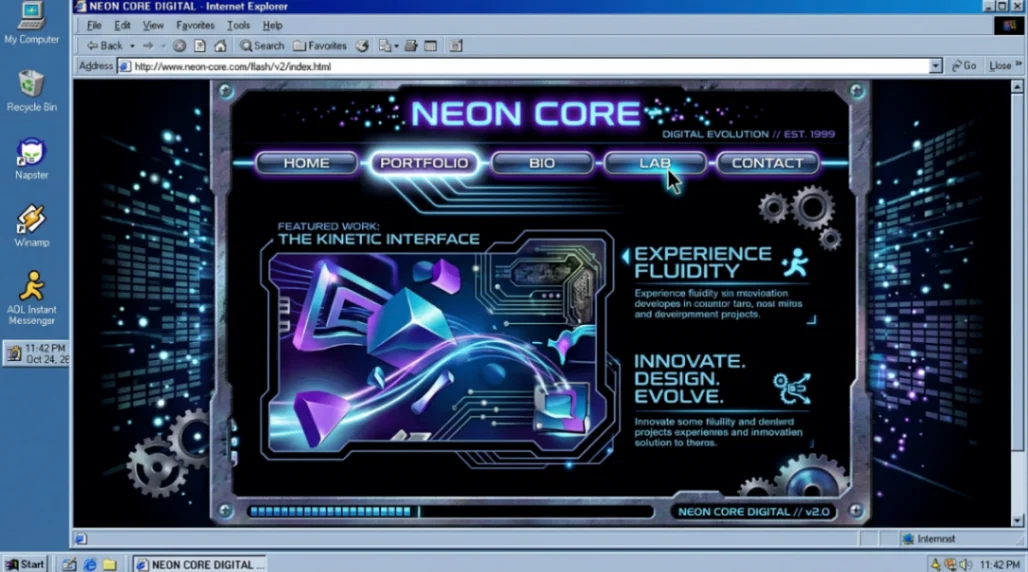
The early-to-mid 2000s were Flash's heyday. Websites weren't documents anymore. They were experiences.
At the center of this movement was 2Advanced Studios, led by Eric Jordan. Their 2001 V3 "Expedition" redesign became a benchmark for the entire industry, featuring metallic textures, cinematic transitions, and soundscapes that responded to your mouse in real time. Web Designer Depot did a brilliant retrospective on 2Advanced that's worth reading if you weren't there to experience it live. Visiting 2Advanced.com wasn't browsing. It was an event.
Other pioneers included:
- Gabocorp (launched 1997) — established the "Flash Intro" trend with motion-based landing pages
- Praystation by Joshua Davis — algorithm-driven generative art where code created visuals, not manual keyframing
- MonoCrafts by Yugo Nakamura — fluid motion physics and minimalist menus that were years ahead of their time
Flash also democratized creativity in a massive way. Platforms like Newgrounds became launchpads for indie animators and game developers, many of them teenagers working from home. Creators like Edmund McMillen, who later made The Binding of Isaac, got their start here.
Flash's vector-based scalability and small file sizes made it pefect for the dial-up era. Games like The Helicopter Game and animations like Frog In A Blender became genuine internet cultural moments. By the mid-2000s, Flash was so ubiquitous that most users didn't even think of it as separate software. It was just... the internet. Cybercultural captures this feeling perfectly if you want a proper nostalgia trip.
This creative explosion shares DNA with the broader story of early web building tools. If you're curious about the wider context, the table layout era offers a fascinating look at how the web's design constraints shaped everything that followed.
Why Adobe Flash Died: The Real Technical Reasons
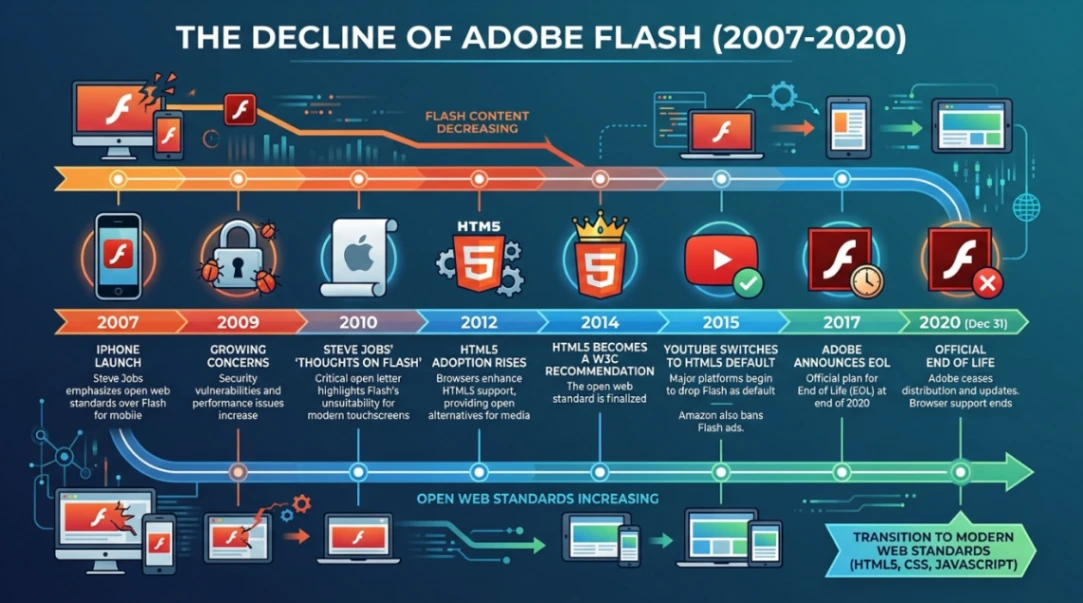
Flash's fall wasn't sudden. It was a slow bleed caused by a combination of technical debt and a strategic exclusion from the most important new platform of the era: the iPhone.
In 2007, Apple launched the iPhone without Flash support. Adobe tried to port Flash to iOS, but Apple's own engineers described the results as "abysmal." Then on April 29, 2010, Steve Jobs dropped his now-legendary open letter, "Thoughts on Flash", outlining six reasons why Apple wouldn't allow Flash on its mobile devices.
His core arguments were brutal and largely valid:
- Flash relied on software-based video decoding, draining battery life by up to five hours
- It was built for "PCs and mice," not multi-touch interfaces
- Flash was a closed, proprietary system blocking Apple's control of its own platform
- Security vulnerabilities were rampant — by 2009, Symantec had flagged Flash as having one of the worst security records in the industry
Adobe's CEO called the letter an "extraordinary attack" and a "smokescreen." But the damage was done. Developers who wanted to reach mobile audiences started shifting to HTML5, and Flash never recovered.
The ratification of HTML5 in 2014 was the final nail. Native browser support for <video>, <audio>, and <canvas> replaced everything Flash had once done exclusively, with no plugin required and far better performance.
In July 2017, Adobe officially announced Flash would be retired by end of 2020. On December 31, 2020, the plug was pulled for good.
The Preservation Movement Saving Flash History
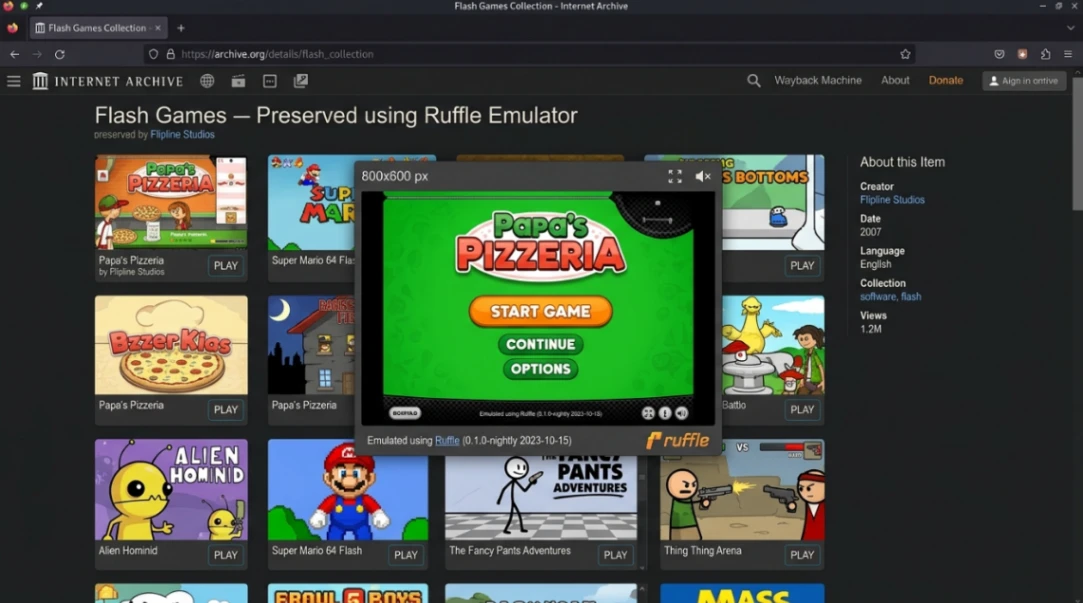
When Flash died, thousands of games, animations, and art projects were at serious risk of disappearing forever. A dedicated community of digital archivists stepped up.
Ruffle is an open-source Flash Player emulator written in Rust. Using WebAssembly, it lets Flash content run in modern browsers with no plugin and none of the original security risks. In November 2020, the Internet Archive deployed Ruffle to emulate over 1,000 Flash items, keeping them alive for the public. The Internet Archive's blog post on Flash preservation is a genuinely moving read.
Then there's the Flashpoint Archive (formerly BlueMaxima's Flashpoint), which as of 2024 contains over 200,000 applications. It uses a custom launcher and proxy system to run legacy Flash files offline, even when they were originally designed to call external servers. The Next Web covered Flashpoint's mission and why someone had to do it.
| Preservation Initiative | Technology | Scale |
|---|---|---|
| Ruffle | Rust / WebAssembly | In-browser emulation; integrated into Internet Archive |
| Flashpoint Archive | Desktop Launcher / Proxy | 200,000+ items across 126 web technologies |
| Newgrounds | Native Ruffle Integration | Original community uploads preserved in-place |
These efforts are genuinely heroic. Without them, an entire chapter of internet culture would simply vanish.
Flash's Legacy in Modern Tools Like Figma and Rive
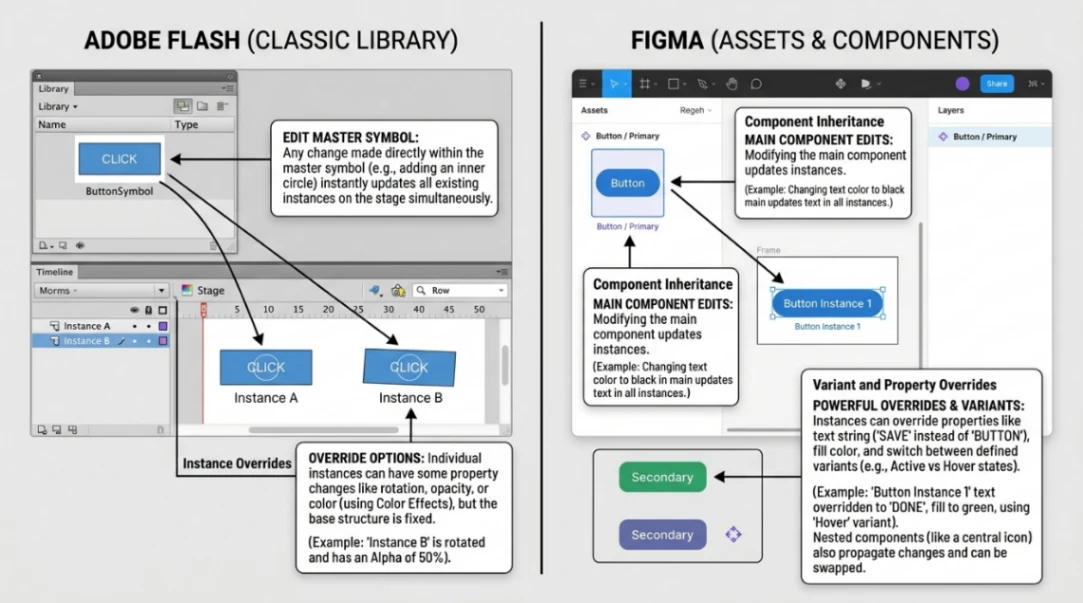
Here's the thing about Flash — it never really died. It just... reincarnated.
Figma's Components are a direct descendant of Flash's Symbol library. The ability to create a master object that updates across thousands of instances? Flash pioneered that. Figma's Smart Animate feature also mirrors Flash's motion tweening, interpolating properties like scale, rotation, and opacity between frames.
Rive is perhaps Flash's most direct spiritual successor. Founded by engineers who actually worked on Flash and Adobe Animate, Rive merges design, animation, and code into a single file without any of the plugin-era baggage. Abduzeedo put it best: Rive is the interactive animation engine Flash fans deserve. Its "State Machine" handles interactive logic — think buttons, hover states, real-time data responses — natively on iOS, Android, and the web. In 2024, 2Advanced Studios rebuilt their iconic V3 website using Rive and React JS, closing a beautiful loop between the golden era and today.
| Modern Tool | Flash Legacy | Modern Implementation |
|---|---|---|
| Rive | Unified design/code + vector animation | State Machine logic; GPU-accelerated (120 fps) |
| Figma | Symbols/Library paradigm | Component-based design systems; Smart Animate |
| Lottie | Small file size vector animation | JSON-based exports from After Effects |
And the story isn't entirely finished. In February 2026, Adobe initially announced it would discontinue Adobe Animate entirely — the last surviving branch of the Flash family tree. The professional animation community, including creators from shows like Star Trek: Lower Decks and Smiling Friends, reacted with fury. Two days later, Adobe reversed course, placing Animate into "Maintenance Mode": still available, still supported for security updates, but no new features ever again. PCMag covered the full reversal story and the community reaction in detail.
It's a bittersweet ending. The toolchain that built a generation of web culture is now officially frozen in amber. Critics are calling it "indefensible" to keep charging a monthly subscription for software that's no longer being developed. Some have pushed Adobe to open-source it or offer a perpetual license. So far, Adobe hasn't budged.
The parallel to tools like Dreamweaver vs FrontPage is hard to ignore — dominant platforms eventually face the same question: adapt or fade.
Start exploring launch-ready no-code templates here!
Key Takeaways
-
Adobe Flash built the interactive web as we know it. From FutureSplash Animator in 1996 to its retirement in 2020, Flash was the engine behind an entire era of web creativity — from corporate splash pages to indie Newgrounds games that launched real careers.
-
Its downfall was structural, not accidental. Security vulnerabilities, CPU inefficiency, poor mobile performance, and Steve Jobs' 2010 open letter combined to make Flash's decline inevitable once HTML5 offered a native alternative.
-
Flash's DNA is everywhere in modern design. Figma's component system, Rive's animation engine, and even the idea of a unified design-and-code environment all trace directly back to what Flash pioneered. The plugin is gone. The philosophy absolutely isn't.
The real lesson Flash teaches us? The tools that shape culture don't disappear — they evolve. And the designers who understand that history are always better positioned to build what comes next.
FAQ
What was Adobe Flash originally called? Before Adobe Flash, it was FutureSplash Animator, released in May 1996 by FutureWave Software. Macromedia acquired it in December 1996 and rebranded it as Macromedia Flash 1.0.
Why did Apple ban Adobe Flash on the iPhone? Steve Jobs cited six reasons in his 2010 open letter: Flash was proprietary, insecure, CPU-intensive, incompatible with touch interfaces, and relied on software-based video decoding that drained battery life significantly.
When did Adobe officially end Flash support? Adobe officially ended Flash Player support on December 31, 2020, coordinated with browser vendors removing plugin support entirely. An Adobe kill switch also blocked Flash content from running after the EOL date.
Can you still play old Flash games today? Yes. The Flashpoint Archive preserves over 200,000 Flash applications, and the Ruffle emulator (integrated into the Internet Archive) lets you run .swf files natively in modern browsers without any plugin.
What replaced Adobe Flash in modern web design?
HTML5 (ratified in 2014) replaced Flash's core functions with native <video>, <audio>, and <canvas> tags. For animation specifically, tools like Rive and Lottie now handle what Flash once did, without the security and performance issues.
Start building without code
Browse thousands of no-code templates for Webflow, Framer, Bubble, Lovable, Replit and more.
Explore Templates