How the Biggest Shopify Stores Scaled to Millions
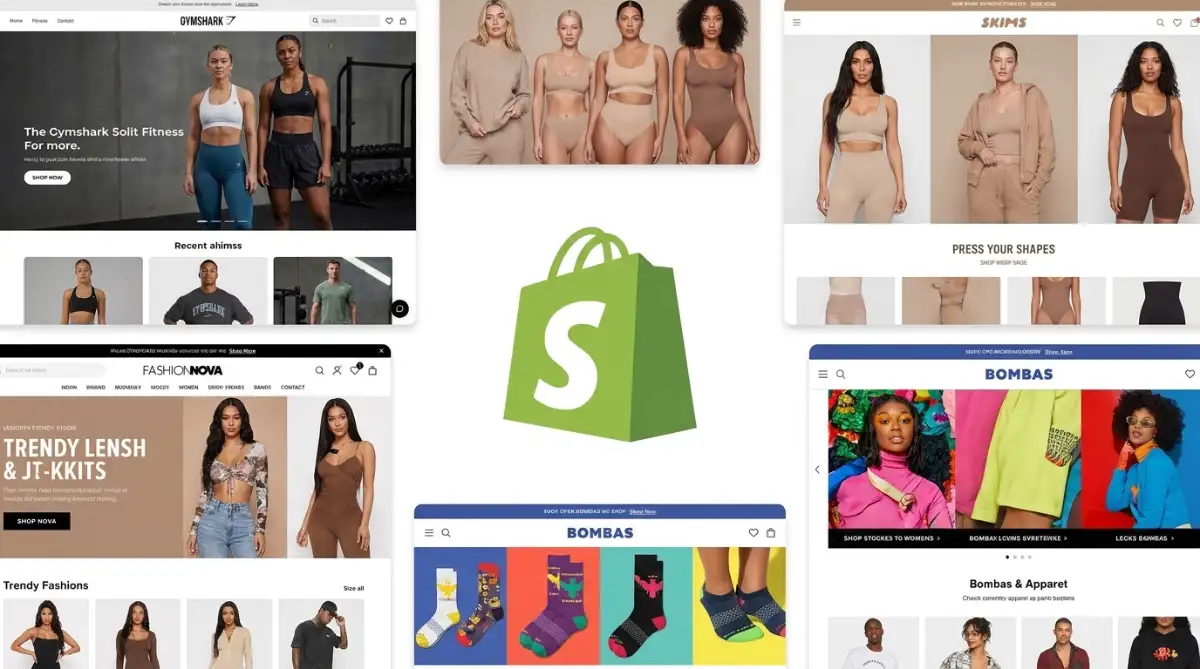
Five of the most successful Shopify stores (Gymshark, SKIMS, Fashion Nova, Bombas, and Kylie Cosmetics) each grew into nine and ten-figure brands on Shopify Plus. Most moved to Shopify only after their original platforms collapsed under heavy traffic, then used managed checkout and database sharding to absorb drop-day spikes.
Table of Contents:
- Key Takeaways
- Introduction
- Why Do the Biggest Shopify Stores Almost Always Start Somewhere Else?
- How Did Gymshark Turn a $100,000 Black Friday Crash Into a Comeback?
- Why Can SKIMS and Kylie Cosmetics Survive Drops That Would Crash a Normal Site?
- What Lets Fashion Nova Launch Up to 900 New Styles a Week?
- How Does Bombas Save $108,000 a Year on the Same Platform?
- What Do All the Best Shopify Stores Actually Have in Common?
- FAQ
Key Takeaways
- Gymshark's move to Shopify wasn't a clever growth strategy, it was triage after a single Black Friday crash burned six figures in a matter of hours.
- The brands clearing a billion dollars in sales all share one unglamorous trait, and it has nothing to do with marketing budgets or celebrity founders.
- Kylie Cosmetics quietly inverted the old startup sequence of build first and sell later, and the infrastructure underneath made that reversal possible at scale.
Introduction
In 2015, a fitness apparel brand run out of a garage in Solihull watched its biggest sales day of the year fall over, losing more than $100,000 in roughly eight hours. That brand was Gymshark, and its crash is the kind of story every direct-to-consumer brand builder should study before committing to an e-commerce platform. The most valuable Shopify stores almost never launch on Shopify.
They start on something cheaper, hit a wall, and migrate once the cost of going down dwarfs the cost of the platform itself. This piece walks through five brands (Gymshark, SKIMS, Fashion Nova, Bombas, and Kylie Cosmetics) that made exactly that jump, and what their revenue, their failures, and their migrations reveal about scaling a consumer brand from kitchen-table money to millions.
Why Do the Biggest Shopify Stores Almost Always Start Somewhere Else?
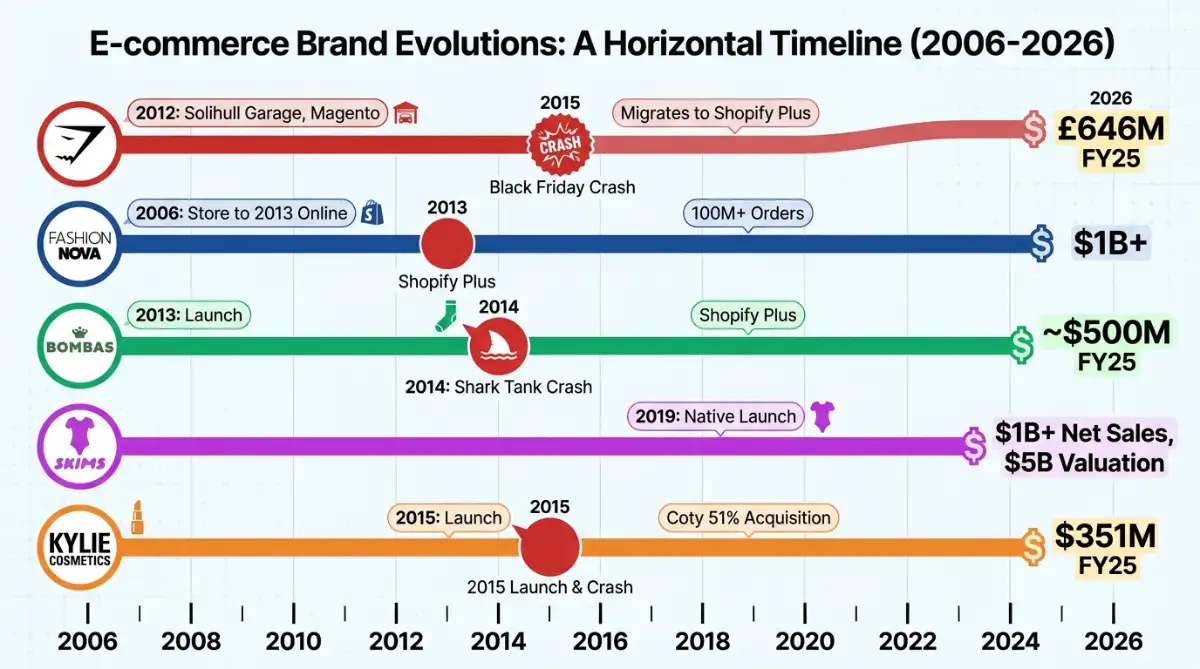
The biggest Shopify stores rarely begin on Shopify. Brands like Gymshark and Bombas launched on self-hosted or legacy setups, then migrated to Shopify Plus only after their original infrastructure buckled under real traffic. The pattern repeats with almost boring consistency: pick the cheap option, break in public, then move to managed infrastructure.
That sequence matters because it reframes the whole "best platform" question. A brand doing $5,000 a month genuinely does not need Shopify Plus. The migration usually happens at the exact moment downtime starts costing more than the subscription ever could. This is also the moment most teams discover that running their own checkout, payments, and database scaling was never the actual business.
Here is the shared arc across the five brands in this piece, the kind of pattern you also see in how Shopify removed the technical barriers for non-developers:
| Brand | Founder(s) and Year | Migration Catalyst | Reported Peak Revenue |
|---|---|---|---|
| Gymshark | Ben Francis (2012, Solihull garage) | 2015 Black Friday Magento crash | £646M FY25 sales |
| SKIMS | Kim Kardashian and Jens Grede (2019) | Drop-based traffic spikes | $1B+ net sales (2025) |
| Fashion Nova | Richard Saghian (2013 online) | 500 to 900 new styles weekly | $1B+ annual revenue |
| Bombas | David Heath and Randy Goldberg (2013) | 2014 Shark Tank site crash | $500M projected FY25 |
| Kylie Cosmetics | Kylie Jenner (2015) | Social drop strategy | $351M FY25 sales |
The lesson sitting underneath this table is simple: the platform decision is rarely made on day one, it is forced on you by the first day your store actually wins.
How Did Gymshark Turn a $100,000 Black Friday Crash Into a Comeback?
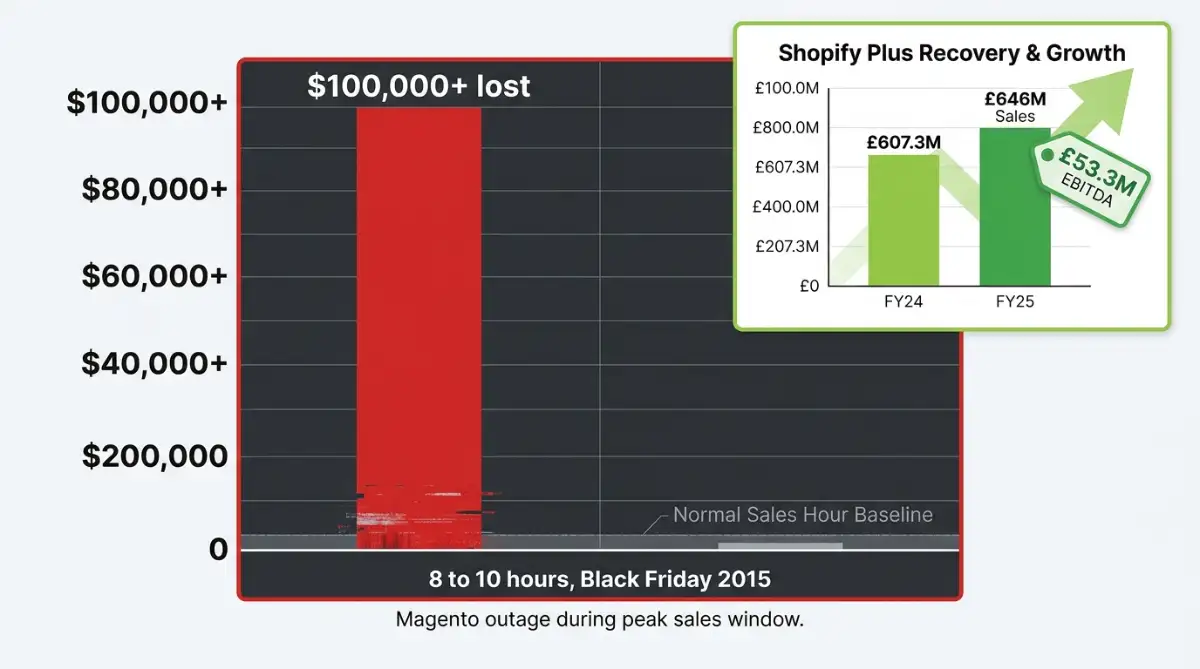
Gymshark's defining moment was a failure. On Black Friday 2015, the brand's Magento store crashed for roughly eight to ten hours during its peak sales window, and founder Ben Francis later put the cost at more than $100,000 in lost orders. That outage, not a pitch deck, is what pushed the company toward Shopify Plus.
Ben Francis started Gymshark in 2012, screen-printing gym wear out of a garage in Solihull. By the time the brand outgrew its self-hosted setup, the math was brutal: every minute of downtime on a flagship sales day was money that would never come back. The move to Shopify Plus let a lean team stop firefighting servers and focus on product and community instead.
"It's a good thing we went onto Magento, because otherwise we'd probably take a lot of what Shopify Plus does for granted." (Ben Francis, Founder and CEO of Gymshark)
What the migration unlocked, beyond uptime:
- A headless frontend built on Hydrogen, Shopify's React-based framework, for full design control.
- Checkout scripting that could handle launch-day surges without manual intervention.
- A reported £646 million in FY25 sales, with £53.3 million in EBITDA and a £37 million cash position, according to Gymshark's FY25 results.
The brand that nearly lost a holiday weekend to a crash now runs one of the largest fitness storefronts on the platform.
Why Can SKIMS and Kylie Cosmetics Survive Drops That Would Crash a Normal Site?
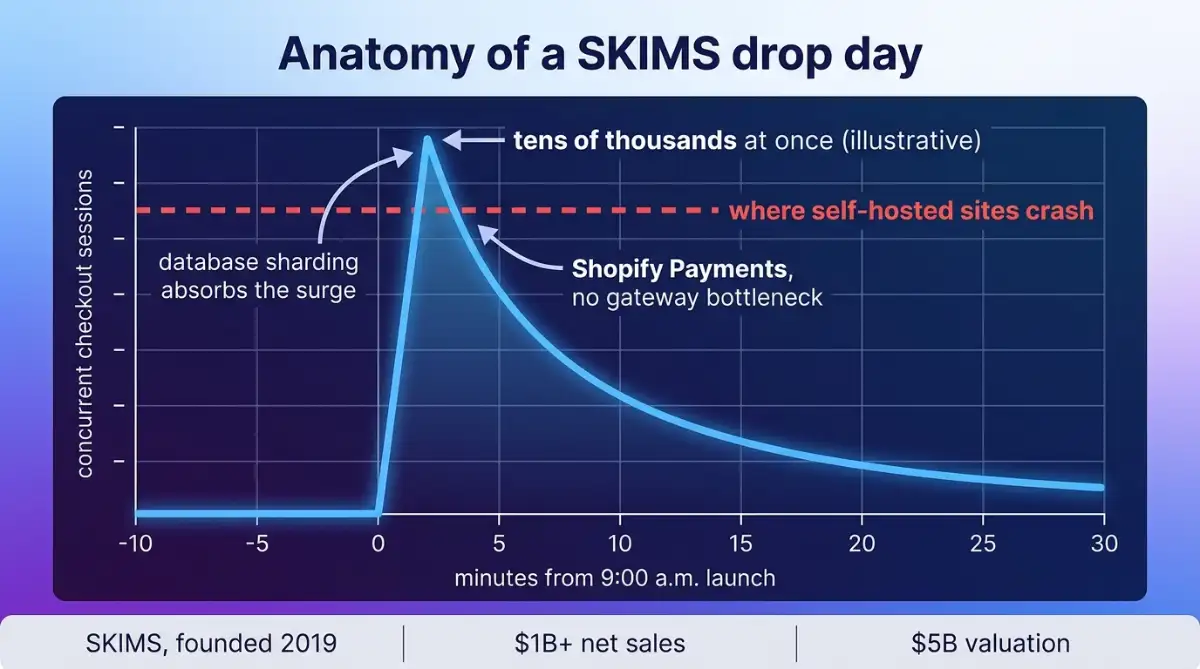
Drop culture is a stress test most websites fail. SKIMS and Kylie Cosmetics built their entire model on limited releases that send tens of thousands of buyers to checkout in the same minute. Standard hosting treats that spike as an attack. Shopify's managed infrastructure treats it as Tuesday.
SKIMS, launched in 2019 by Kim Kardashian and Jens Grede, needed scale for high-volume drops from the start, and leaned on Shopify Markets for localized cross-border selling. According to Sacra, SKIMS crossed $1 billion in net sales in 2025 and was valued at $5.0 billion that November. Kylie Cosmetics, founded by Kylie Jenner in 2015, ran the same social-drop playbook; ECDB estimates roughly $351 million in FY25 sales, with Coty holding a 51% stake.
What actually keeps these stores standing during a drop:
- High-capacity, sandboxed checkout that scales horizontally instead of falling over.
- Shopify Payments handling card processing natively, no third-party gateway bottleneck.
- Database sharding distributing load so one viral moment doesn't sink the whole store.
Both brands prove a point worth repeating: the hard part of a celebrity drop isn't the marketing, it's surviving your own success at 9:00 a.m. sharp.
What Lets Fashion Nova Launch Up to 900 New Styles a Week?
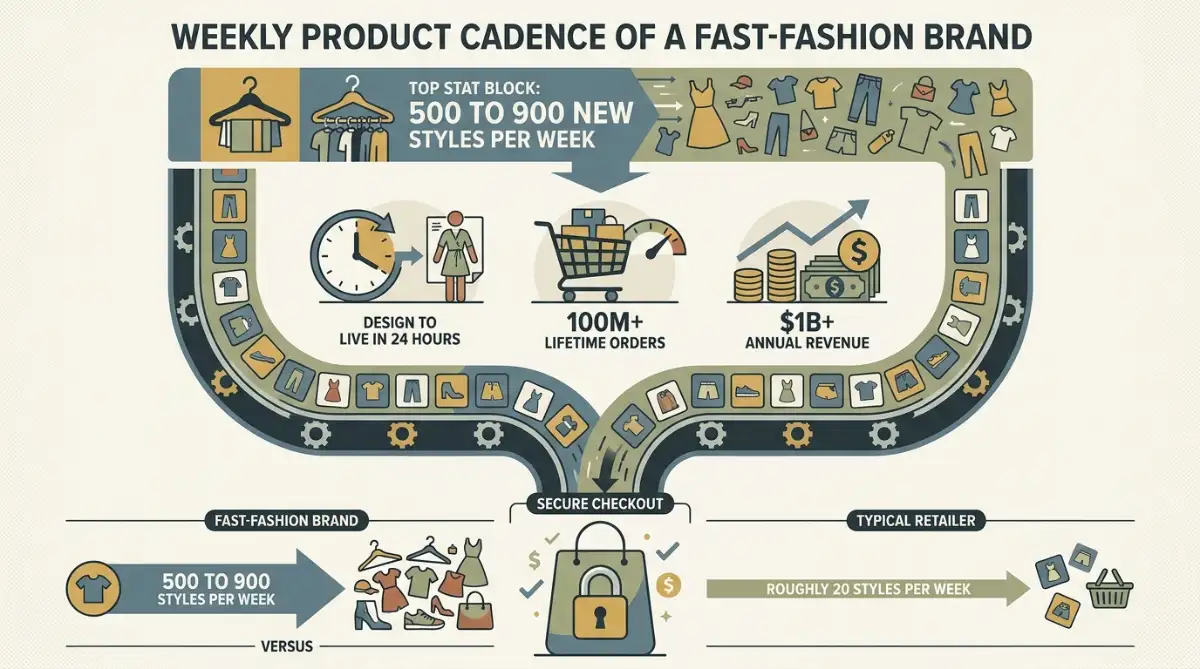
Fashion Nova's model is volume at a pace that would break most catalogs. The brand reportedly pushes 500 to 900 new styles every week, a throughput that demands relentless inventory updates, fast page rendering, and a checkout that never blinks. Few platforms are built for that cadence.
Richard Saghian opened Fashion Nova as a brick-and-mortar operation in 2006, then took it online in 2013 as fast fashion moved to social media. The high-velocity inventory cycle is the whole business, so the infrastructure has to keep up with constant SKU churn rather than a static product line. Shopify Plus checkout scripting and high-throughput database sharding are what make that possible without a large engineering org.
The operational demands of a 900-style week look like this:
- Constant product creation and retirement without slowing the storefront.
- Stable checkout under sustained, not just spiky, high traffic.
- Inventory accuracy across thousands of active listings at once.
Most platforms choke on this exact workload. A self-hosted store with a heavy plugin stack slows down as the catalog balloons, and every new product is one more thing to break. Shopify pushes that complexity down to the platform tier, so adding hundreds of styles a week is a content task rather than an engineering project.
According to SimiCart's analysis, Fashion Nova generates more than $1 billion in annual revenue and surpassed 100 million lifetime orders in 2025. For a brand whose competitive edge is speed, the platform's job is to disappear, and that quiet reliability is exactly the kind of return that the question of whether these tools actually generate real revenue keeps coming back to.
How Does Bombas Save $108,000 a Year on the Same Platform?
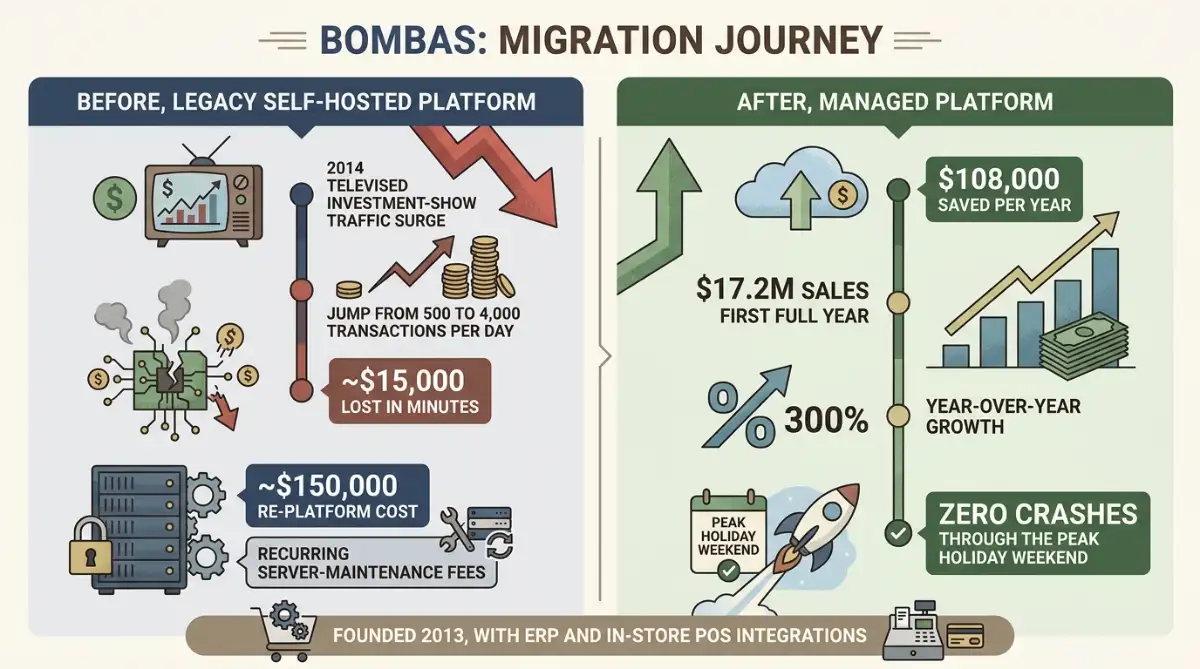
Bombas shows that the case for Shopify isn't only about uptime, it's also about cost. The sock and apparel brand reports saving roughly $108,000 a year in platform costs after migrating, according to Shopify's own case study, while gaining the stability it badly needed.
David Heath and Randy Goldberg founded Bombas in 2013 with a one-for-one donation model. The turning point was 2014, when a Shark Tank airing drove a traffic surge that crashed the site and cost an estimated $150,000 in lost orders. Like Gymshark, the failure made the decision for them. On Shopify, the brand integrated NetSuite ERP, deployed Leap for physical retail point of sale, and layered in automated AI chat, all while trimming platform overhead.
A rough sense of the tradeoff:
| Dimension | Before migration | After Shopify |
|---|---|---|
| Site stability on traffic spikes | Crashed during Shark Tank | Handled natively |
| Annual platform cost | Higher legacy spend | ~$108,000/yr saved |
| Retail and ERP integration | Fragmented | NetSuite + Leap POS unified |
According to its reported figures, Bombas is on track for around $500 million in FY25 revenue. The brand became a six-figure platform saving rather than a cost center, which is the opposite of how most teams expect "enterprise" software to behave.
What Do All the Best Shopify Stores Actually Have in Common?
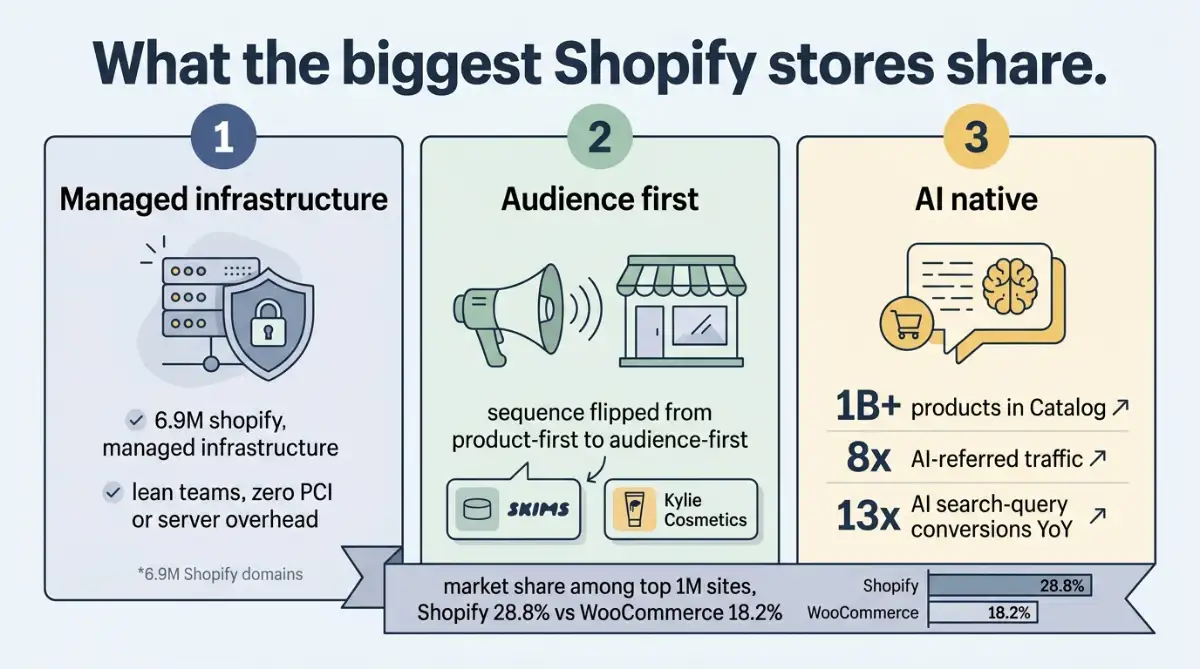
The thread connecting these Shopify stores isn't a celebrity founder or a viral product. It's that each one offloaded the unglamorous, breakable parts of commerce (servers, PCI compliance, checkout, payments) so a small team could spend its energy on the brand. That is the quiet advantage hiding behind the headline revenue numbers.
There's also a sequencing shift worth naming. Shopify President Harley Finkelstein describes entrepreneurship flipping from "product first, audience second" to "audience first, product second." Kylie Cosmetics and SKIMS are textbook cases: the audience existed before the product did, a pattern explored further in the maker movement and how solopreneurs took over. Modern payment rails matter here too, part of the same shift covered in the move away from traditional merchant accounts.
What these stores share:
- Lean teams on managed infrastructure, not large in-house platform engineering orgs.
- Audience built before scale, then converted through frictionless checkout.
- AI-native tooling, with Shopify's Catalog structuring over 1 billion products and reportedly driving an eightfold increase in AI-referred traffic, per Shopify's Q1 2026 figures.
"Shopify isn't here to beat anyone; we're here to arm the rebels." (Tobias Lütke, Co-Founder and CEO of Shopify)
According to BuiltWith, Shopify holds a 28.8% share of the top one million websites, ahead of WooCommerce at 18.2%, and that concentration among high-value stores is no accident. The brands that win big tend to land in the same place, and the no-code market's growth forecasts suggest that consolidation isn't slowing down.
The next chapter is already taking shape. In January 2026, Shopify and Google announced the Universal Commerce Protocol, an open standard that lets AI agents discover products and complete checkouts inside conversational interfaces like Gemini and ChatGPT. In a bullish scenario, Shopify projects that up to 25% of its transaction volume could run through AI agents by 2028. The brands in this piece won by betting on infrastructure that handled the last shift, and the same logic points them at the next one.
Start exploring launch-ready no-code Shopify templates here!
FAQ
What is Shopify Plus and how is it different from regular Shopify? Shopify Plus is the platform's enterprise tier, priced at roughly $2,300 per month on a three-year term versus $39 for Basic. It adds lower payment rates, advanced checkout scripting, and higher capacity, which is why high-volume brands like Gymshark and SKIMS run on it.
How much revenue do the top Shopify stores make? A lot. Gymshark reported £646 million in FY25 sales, SKIMS and Fashion Nova each cleared $1 billion, Bombas is projected near $500 million, and ECDB estimates Kylie Cosmetics at $351 million. These are among the platform's largest individual merchants.
Why do big brands migrate from Magento or WooCommerce to Shopify? Usually because their self-hosted setup failed under traffic. Gymshark and Bombas both migrated after public crashes cost six figures in lost orders. Managed infrastructure removes server maintenance, PCI compliance, and scaling work from lean teams.
Can a small brand realistically scale to millions on Shopify? Yes, and most of these brands started tiny. Gymshark began in a garage in 2012 and Bombas launched in 2013. The platform's appeal is that the same system carries you from your first sale to nine-figure revenue without a re-platform.
What is agentic commerce and the Universal Commerce Protocol? Agentic commerce is AI assistants discovering products and completing checkouts on a shopper's behalf. The Universal Commerce Protocol (UCP), co-developed by Shopify and Google in 2026, is an open standard letting those AI agents transact with Shopify stores directly inside chat interfaces.
Start building without code
Browse thousands of no-code templates for Webflow, Framer, Bubble, Lovable, Replit and more.
Explore Templates