Google AI Studio: The Quiet Code Generation Play
Google AI Studio is Google's browser-based workbench for building with the Gemini API. It combines prompt testing, parameter tuning, multimodal input, and one-click code export into a single free environment. It replaced MakerSuite as Google's official prototyping surface for developers.
Table of Contents:
- Key Takeaways
- Introduction
- Why Did Google AI Studio Launch a Week After Gemini?
- Why Should Indie Makers Care About a 60 RPM Free Tier?
- What Made Multimodal Prompting Different From Autocomplete?
- How Well Did Gemini Actually Write Code in 2023?
- What Does Google AI Studio's Free Tier Cost You in Privacy?
- How Did AI Studio Turn Into a Vibe Coding Platform?
- Frequently Asked Questions
Key Takeaways
- Google shipped its code generation entry as a prompt sandbox instead of an editor plugin, and that shape decision mattered more than the model inside it.
- The free tier looked like generosity. It was engineered as an enterprise acquisition funnel, and the data terms explain exactly why.
- Gemini 1.0 Ultra beat GPT-4 on HumanEval, then Google built a second private benchmark because it did not fully trust the first one.
Introduction
Everyone was watching the wrong launch in December 2023. While the internet argued about a Gemini demo video and whether it had been edited, Google AI Studio went live and handed indie makers and small product teams something more useful than a benchmark chart: free, high-volume model access with a button that turned a prompt into shippable code.
I have sat through a lot of AI launches since. Very few of them were distribution strategies wearing a product costume. This one was, and the shape it chose still describes how most small teams touch a model today.
Here is what actually shipped, what it cost developers in ways nobody read at the time, and which parts of the playbook are worth stealing.
Why Did Google AI Studio Launch a Week After Gemini?
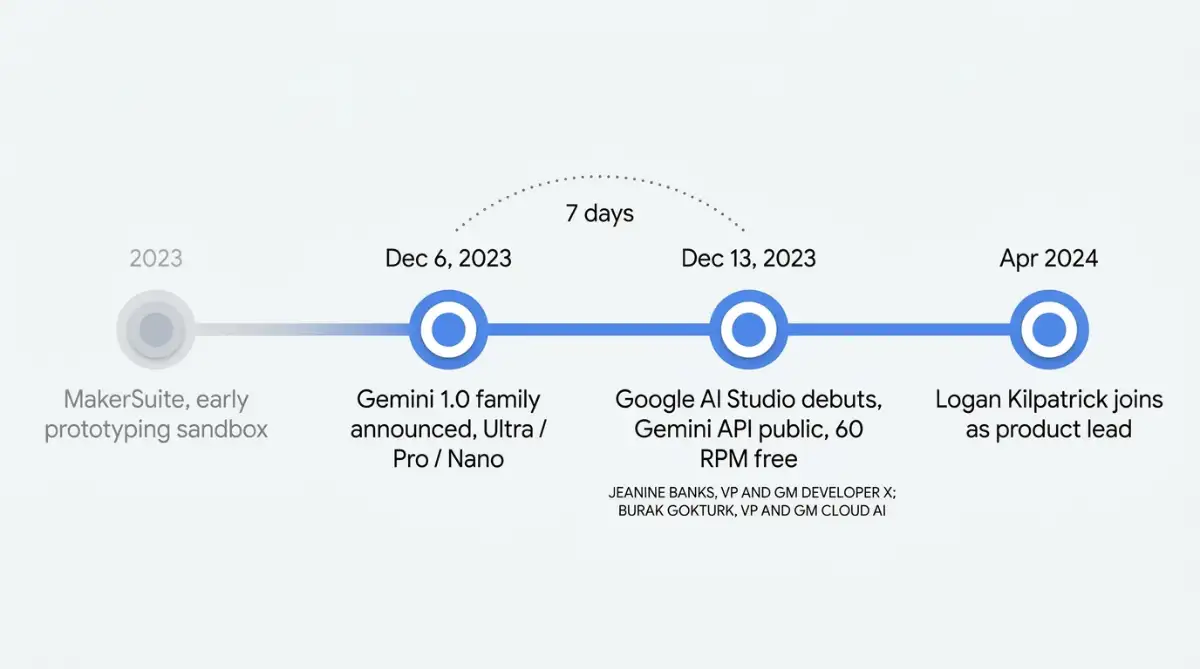
Google announced the Gemini 1.0 model family on December 6, 2023, then put the tooling in developers' hands on December 13. The studio arrived as an upgrade to MakerSuite, Google's earlier prototyping sandbox, rebuilt around the new model family and the newly public Gemini API. No extension, no install, no waitlist.
The strategic choice underneath is the interesting part. GitHub Copilot had spent two years teaching the industry that AI coding meant a plugin that finished your line inside an editor. Google went sideways and built a place to design the prompt itself, then walk out with the client code that calls it.
Google did not ship a coding assistant in 2023. It shipped the room where you design the assistant, then handed you the source on the way out.
The launch was steered by Jeanine Banks, Vice President and General Manager of Developer X, and Burak Gokturk, Vice President and General Manager of Cloud AI. Josh Woodward, Vice President of Google Labs, ran the demonstrations of the "Get Code" pipeline.
What was actually in the box on day one:
- A prompt canvas with temperature, Top-P, Top-K, output token limits, and adjustable safety thresholds
- Three prompting modes: chat, freeform, and structured input-output pairs for enforcing JSON or typed function output
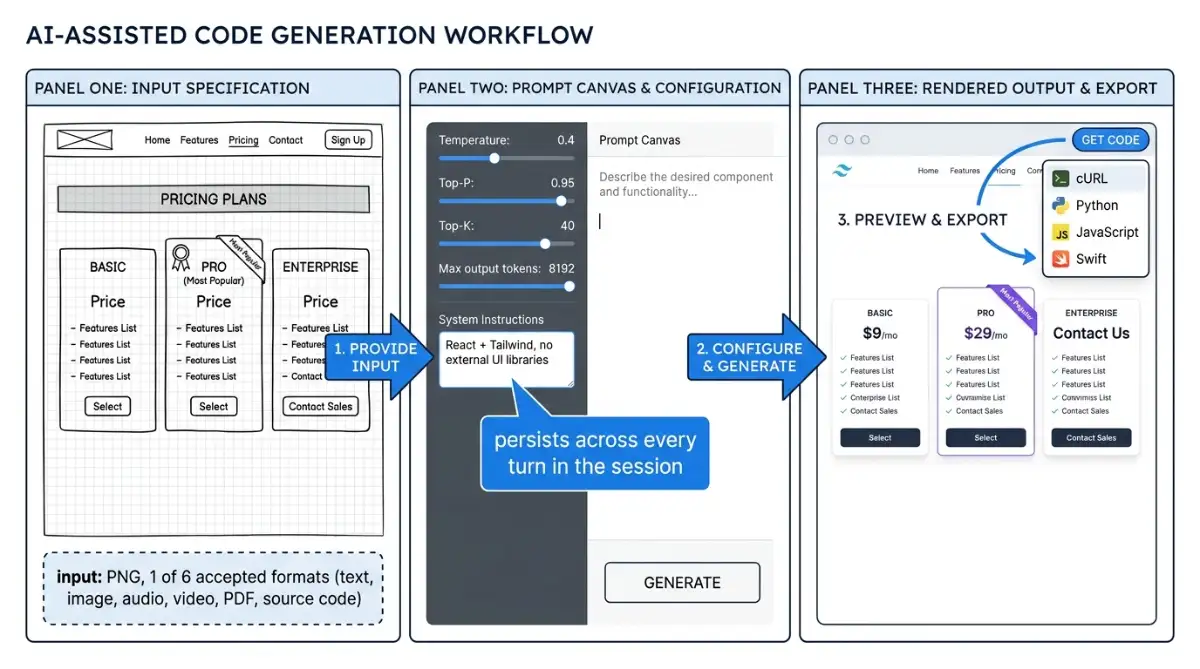
- System Instructions for locking target language, coding style, and operational boundaries across a session
- Get Code export into cURL, Python, JavaScript, and Swift
- Quickstart templates for Android Studio, Google Colab, and Project IDX
Why Should Indie Makers Care About a 60 RPM Free Tier?
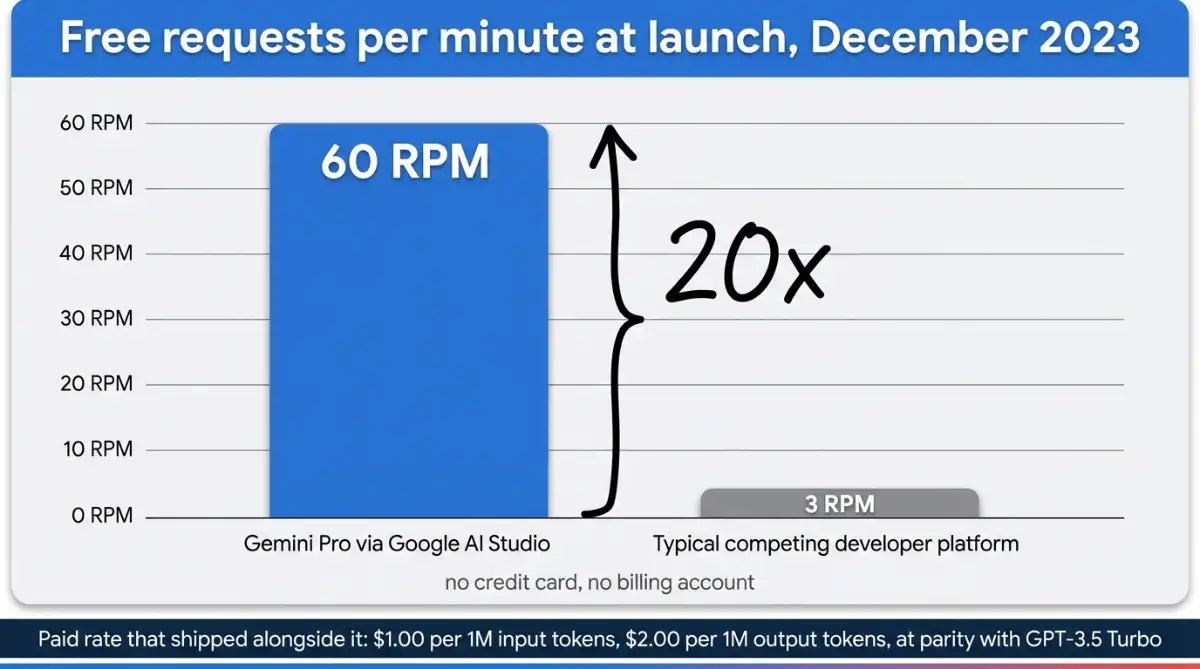
According to Google's developer launch post, Gemini Pro shipped with free access at up to 60 requests per minute, no credit card and no billing setup required, roughly twenty times the free allowance offered by competing developer platforms at the time. For a solo builder testing a multi-turn agent loop, that gap is the difference between building and waiting.
Then Google priced the paid tier at parity with older, weaker models. Gemini Pro launched at approximately $0.0010 per 1,000 input tokens and $0.0020 per 1,000 output tokens, matching GPT-3.5 Turbo's rates while shipping native multimodal input on top.
| Model | Free tier | Paid input (per 1M tokens) | Paid output (per 1M tokens) |
|---|---|---|---|
| Gemini 1.0 Pro (Dec 2023) | 60 RPM | $1.00 | $2.00 |
| Gemini 1.5 Flash | 15 RPM / 1,500 RPD | $0.075 under 128k, $0.15 above | $0.30 under 128k, $0.60 above |
| Gemini 1.5 Pro | Restricted daily quota | $1.25 under 128k, $2.50 above | $5.00 under 128k, $10.00 above |
| Gemini 2.0 Flash | 15 RPM / 1,500 RPD | $0.10 text and media, $0.70 audio | $0.40 |
The effect rippled outward. Rival providers widened their own free quotas and cut access pricing, which is how a generation of small teams ended up able to test an idea before committing a dollar to it.
That matters most at the stage where you are still proving the concept works at all, which is the whole logic behind launching a minimum viable product fast and cheap. Free inference collapsed the cost of being wrong.
What Made Multimodal Prompting Different From Autocomplete?
Most code generation tools in 2023 were text in, text out. The studio was built on Gemini's multimodal foundation, so it accepted text, images, audio, video, PDFs, and raw source files in the same prompt. That single architectural difference changed what a prompt could be.
It opened workflows that plain-text assistants could not touch:
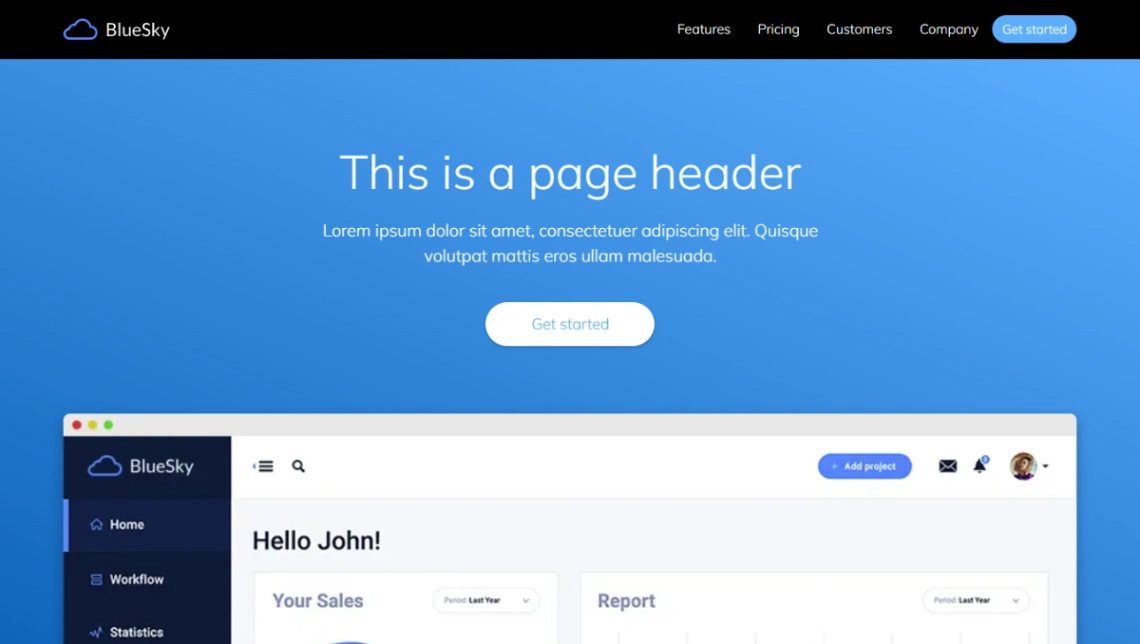
- Turning a low-fidelity wireframe or design mockup into functional frontend code
- Reading a system architecture diagram and drafting the database schema from it
- Ingesting an entire technical whitepaper and generating a working client implementation
The execution runtime backed this up with four capabilities that ran inside the canvas rather than in your terminal. Sandboxed Python execution ran generated code in an isolated serverless environment and returned real output, so you could verify algorithmic logic before deploying it. Grounding via Google Search pulled live web results into responses to cut hallucinated API syntax. URL and document context ingested web pages and uploaded files straight into the context window. Real-time streaming pushed live video and screen feeds into the canvas for interactive pair programming.
A wireframe became a valid prompt. That is the moment code generation stopped being autocomplete and started being translation between formats.
This is the lineage that the current crop of no-code AI app builders inherited, whether or not they credit it.
How Well Did Gemini Actually Write Code in 2023?
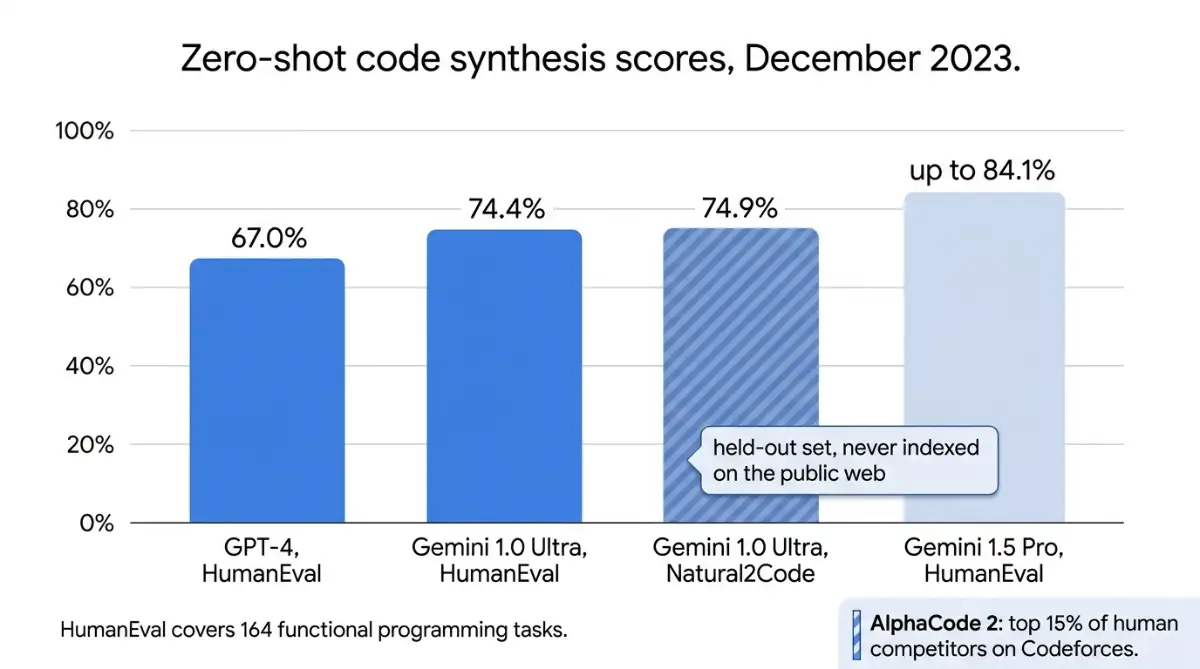
According to the Gemini technical report, the instruction-tuned Gemini 1.0 Ultra correctly implemented 74.4% of problems on HumanEval, the 164-task benchmark for Python synthesis, against GPT-4's reported 67.0% baseline. Google DeepMind's AlphaCode 2, built on fine-tuned Gemini architectures, placed in the top 15% of human competitors on Codeforces.
Here is the part I find more telling than the headline number. Google did not trust HumanEval, because benchmark problems leak into web-scale training data and inflate scores. So it built Natural2Code, a held-out internal dataset mirroring HumanEval's structure with examples that had never been indexed publicly. Gemini 1.0 Ultra scored 74.9% on it.
Building a private benchmark to check your public one is not marketing. It is an admission that the entire industry's scoreboard is compromised.
| Model | Role | Context window | HumanEval pass@1 | Best for |
|---|---|---|---|---|
| Gemini 1.0 Pro | Baseline scaling and API prototyping | 32,000 tokens | ~65% to 70% | Lightweight apps, basic scripts, chatbots |
| Gemini 1.0 Ultra | Enterprise reasoning and deep code analysis | 32,000 tokens | 74.4% zero-shot | Architecture design, algorithmic optimization |
| Gemini 1.5 Pro | Long-context multimodal reasoning | 1M to 2M tokens | 71.9% to 84.1% | Full-repo ingestion, multi-file refactoring |
| Gemini 1.5 Flash | High-throughput, low-latency | 1M tokens | ~70%+ | Code completion, unit test generation |
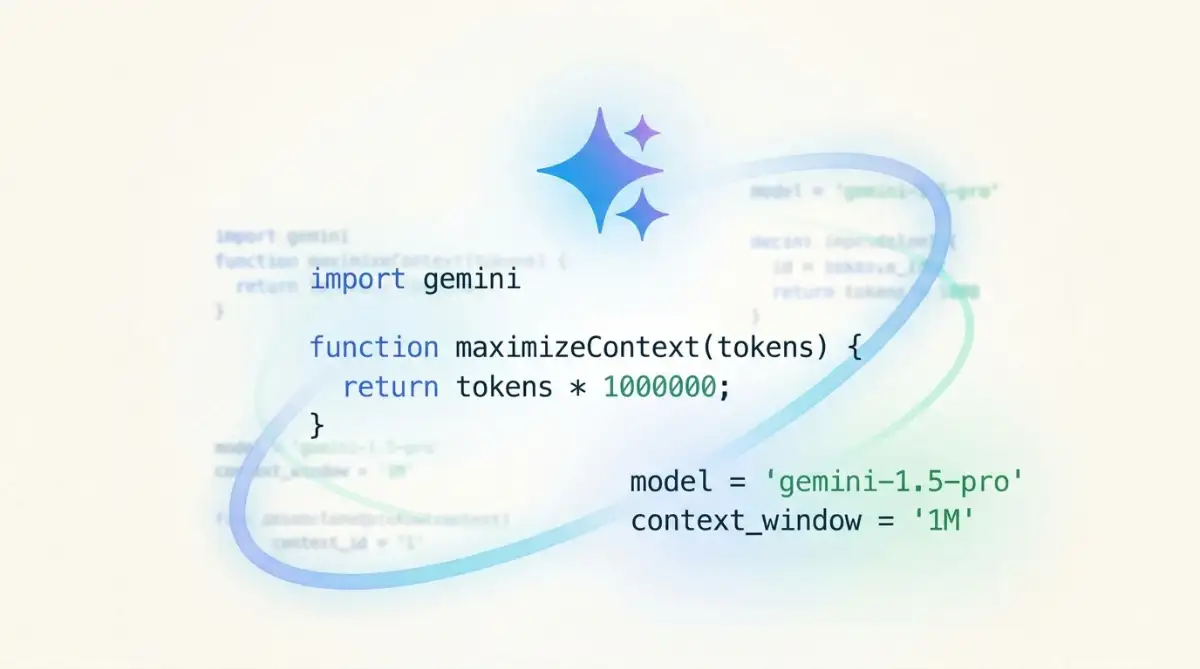
The Gemini 1.5 generation is where the practical shift landed. A context window of 1 to 2 million tokens meant the platform could parse and reason across repositories north of 100,000 lines in a single prompt execution, which is a different job from finishing a function.
What Does Google AI Studio's Free Tier Cost You in Privacy?
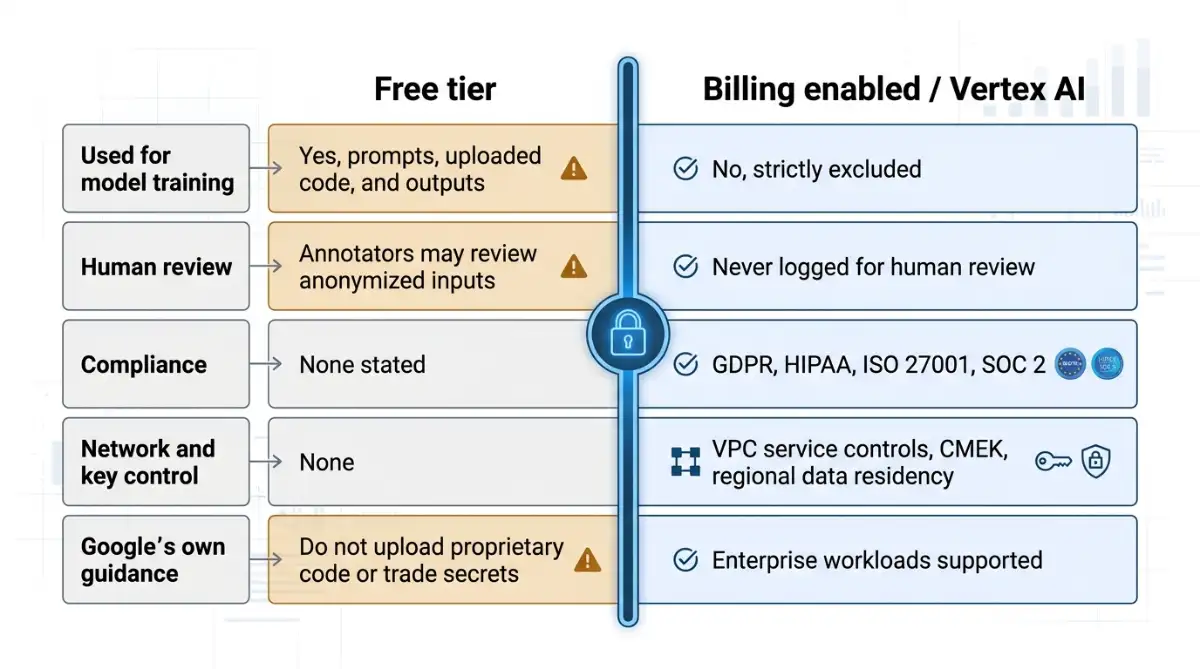
Nothing about the free tier was charitable, and the terms said so plainly. Under free tier conditions, Google may use submitted prompts, uploaded code files, and generated outputs to train and refine its foundation models. Human annotators may review anonymized inputs after they are disconnected from account IDs.
Google's own guidance was direct: do not upload proprietary codebases, trade secrets, or confidential data on the unpaid tier. That advice gets ignored constantly by teams treating a browser tab as a private scratchpad.
The switch flips the moment you enable billing. Google's Gemini API billing documentation states that linking a billing account and moving to a paid tier is what ensures prompts and responses are not used to improve Google products. Paid tier usage also falls under GDPR, HIPAA, ISO 27001, and SOC 2 frameworks.
Migrating the project into Vertex AI adds the enterprise layer on top:
- VPC service controls for private networking
- Customer-managed encryption keys (CMEK)
- Regional data residency controls
- Unified billing across Google Cloud infrastructure
That two-stage lifecycle, free sandbox first and governed cloud second, was the actual business model. Individual developers experiment at zero cost, and the ones who succeed arrive at Google Cloud already fluent in the stack.
If you are weighing what a hosted tool sees versus what it stores, the same questions apply across the category, which we broke down in this risk and reality check on no-code security.
How Did AI Studio Turn Into a Vibe Coding Platform?
In April 2024, Google DeepMind recruited Logan Kilpatrick, who had led developer relations at OpenAI as the company's first hire in that role, to run product for the studio and the Gemini API. Under that leadership the platform drifted well past prompt testing into building applications from plain description.
Three shifts defined the second act:
- Natural language to rendered app. Describe the thing, get a functional web application inside the interface, no local environment required.
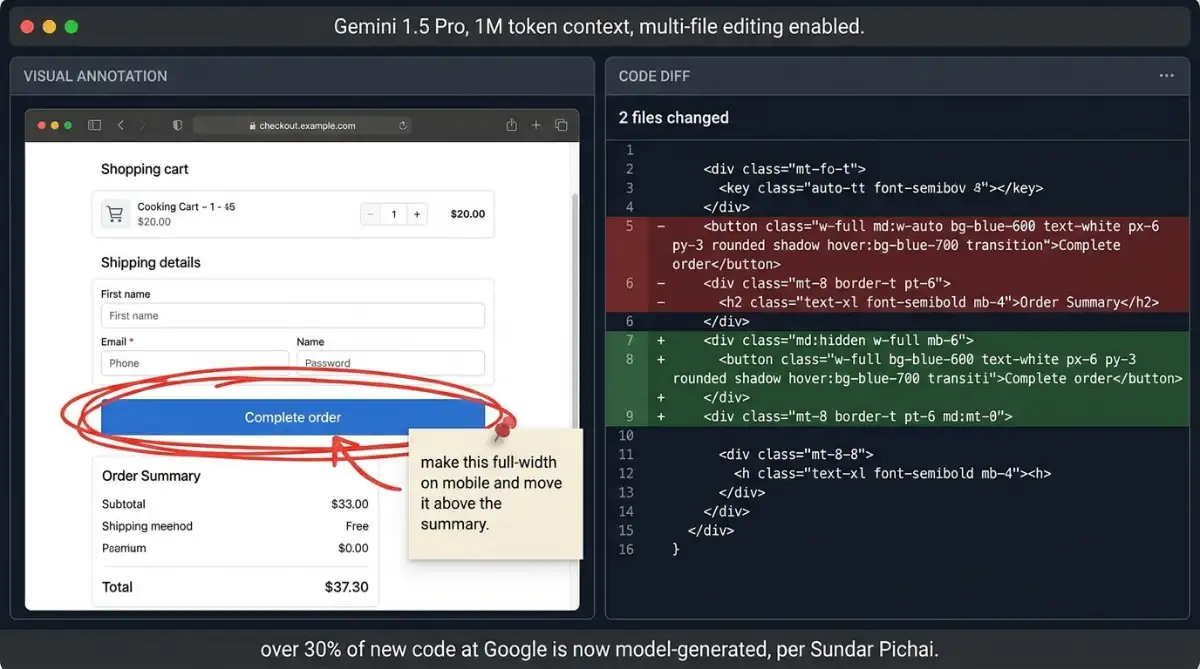
- Visual annotation mode. Upload a screenshot of a UI, mark up the component you want changed, and prompt the model to edit the underlying code.
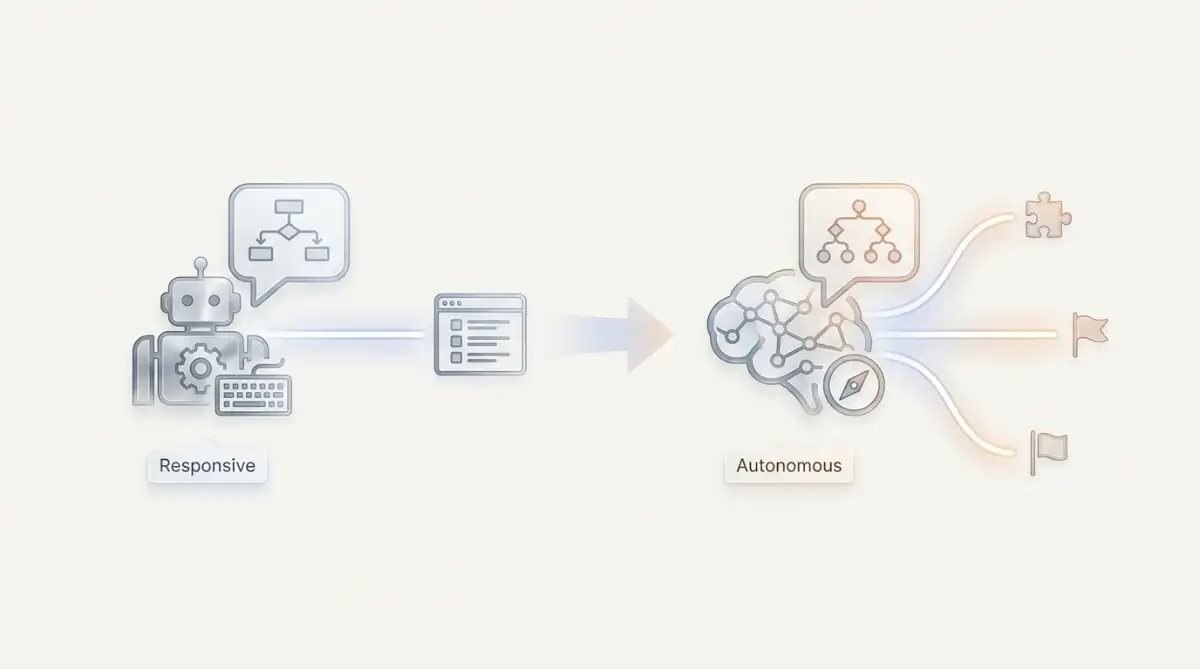
- Agent harnesses. Integration with unified harnesses such as Antigravity moved the platform from single-turn completion toward multi-step planning, multi-file editing, and environment execution.
This is vibe coding as a first-class workflow rather than a meme, and it puts the studio in direct conversation with the current generation of AI app builders that a solo maker might otherwise reach for first.
Internally, the numbers got loud. On Alphabet's April 2025 earnings call, CEO Sundar Pichai said AI systems had grown to generate over 30% of all new code across Google's internal repositories, up from 25% six months earlier, with engineers reviewing, testing, and approving the output. Google teams also dogfooded the long-context models to build and ship updates to the studio itself.
A tool that writes 30% of its own parent company's code is not a demo. It is infrastructure that happens to have a chat box.
The honest caveat: none of this makes the generated code good by default. Plenty of 2023's AI products were thin wrappers built to die, and faster generation mostly changed how quickly teams reached that conclusion.
Start exploring launch-ready vibe code and no-code templates here!
Frequently Asked Questions
Is Google AI Studio free to use?
Yes, there is a free tier that requires no credit card. At launch it allowed 60 requests per minute on Gemini Pro, with later models running on daily request caps instead. The tradeoff is that free tier prompts and outputs may be used for model training.
What is the difference between AI Studio and Vertex AI?
AI Studio is the lightweight browser sandbox for prototyping, aimed at individual developers and small teams. Vertex AI is the enterprise platform with VPC controls, customer-managed encryption keys, regional data residency, and SLA guarantees. Projects migrate from one to the other without rewriting the logic.
Can AI Studio build a complete application?
It can generate working web applications from natural language descriptions and export client code in cURL, Python, JavaScript, and Swift. Whether that output is production-ready depends entirely on the complexity of what you asked for and how carefully you reviewed it.
Which file types can the platform read in a prompt?
Gemini's multimodal architecture accepts text, images, audio, video, PDFs, and raw source code files in the same prompt. It can also ingest live web pages through URL context, which is how developers feed it current library documentation.
Do you need to know how to code to use it?
No, though it helps. Non-technical builders can describe an app in plain language and get rendered output, but reading the generated code is what separates a working prototype from something you can actually maintain and extend later.
Start building without code
Browse thousands of no-code templates for Webflow, Framer, Bubble, Lovable, Replit and more.
Explore Templates