Tumblr: The No-Code Pioneer Founders Should Study (2026)
Tumblr, launched in 2007 by David Karp, pioneered no-code micro-blogging through its Theme Garden, modular post types, and GUI-based customization. It let millions of non-technical users build customized sites years before "no-code" became an industry term, influencing block editors like WordPress Gutenberg.
Table of Contents
- The Two-Week Build That Beat WordPress to Micro-Blogging
- How Tumblr Quietly Invented the No-Code Playbook
- The Theme Garden: A Marketplace That Trained a Generation
- The $1.1B Lesson: When Corporate Owners Break What They Buy
- Tumblr in 2026: Niche, Battered, Still Standing
- Tumblr vs Modern No-Code Builders: What Survived
- Deal-Breaker Questions for Founders Studying Tumblr
- Key Takeaways
- FAQ
Introduction
In February 2007, two guys built Tumblr in fourteen days during a gap between consulting contracts. Within two weeks of launch, 75,000 people had signed up. That's not a typical startup curve, and it's not an accident. David Karp shipped a tool that solved a real, specific frustration: people wanted to post a quote, a GIF, a link, or a song without writing 800 words of "editorial consideration" first.
For non-technical founders and indie creators studying the history of no-code, Tumblr is the case study almost no one teaches properly. It predates Webflow by six years, predates Carrd by nine, and yet it shipped a customization model that millions of teenagers used to learn HTML by accident. Honestly, the platform's biggest contribution isn't its surviving 135 million users. It's the design philosophy it baked into every modern block editor you'll use this year. Here's what worked, what got destroyed, and what's worth stealing.
The Two-Week Build That Beat WordPress to Micro-Blogging
Tumblr happened because David Karp got tired of waiting. He'd been watching the "tumblelog" trend (short, mixed-media stream-of-consciousness posts) for over a year, expecting WordPress or TypePad to ship a native tool. They didn't. So Karp and lead developer Marco Arment built one in fourteen days and launched it from Karp's mother's apartment in New York.
The architectural decision that mattered was the dashboard: a chronological feed where you followed people and reblogged what you liked. This sounds obvious now. In 2007, when most blogs lived as isolated silos with RSS as the only connective tissue, it was genuinely new.
Two early bets shaped everything:
- No real-name policy. Pseudonymity drove self-disclosure rates higher than on Facebook or Twitter, especially for teenagers and marginalized communities figuring out their identity.
- Seven post types instead of one. Text, photo, quote, link, chat, audio, video. Each one had its own structured input, its own default styling, its own data shape.
That second decision is the one founders should circle. Tumblr didn't give users a blank textarea and hope they'd format something nice. It gave them a constrained input that produced a guaranteed-decent output. The "block editor" paradigm that defines WordPress in 2026 is a direct descendant of this idea.
How Tumblr Quietly Invented the No-Code Playbook
Tumblr was a no-code platform years before "no-code" existed as a category. It offered GUI customization for casual users and a full HTML/CSS editor for power users, all on free hosting with a built-in audience.
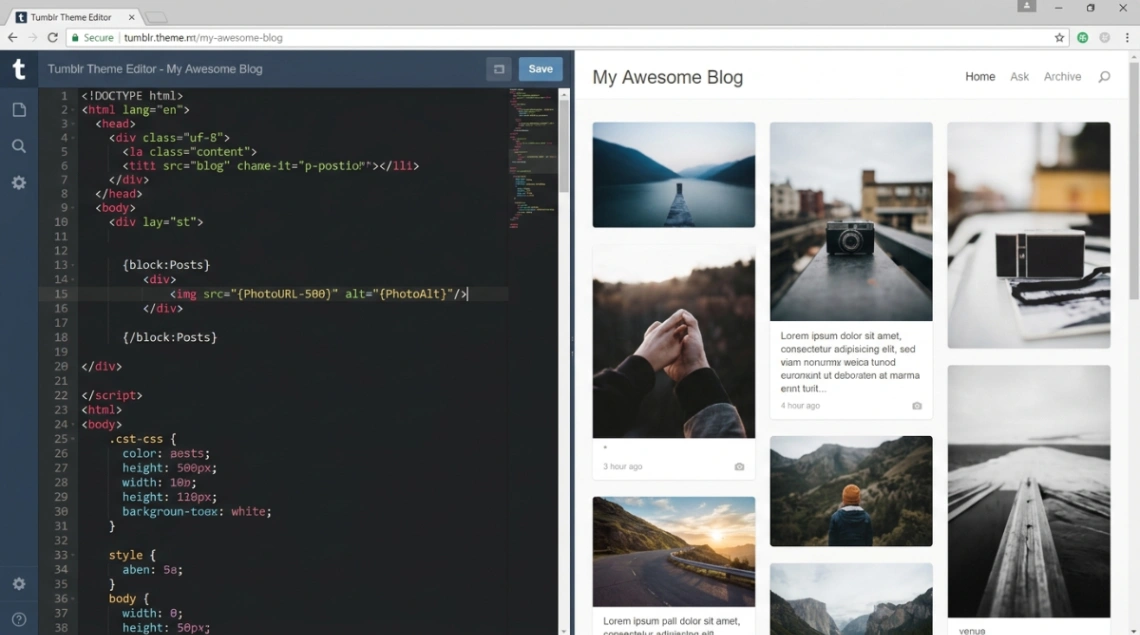
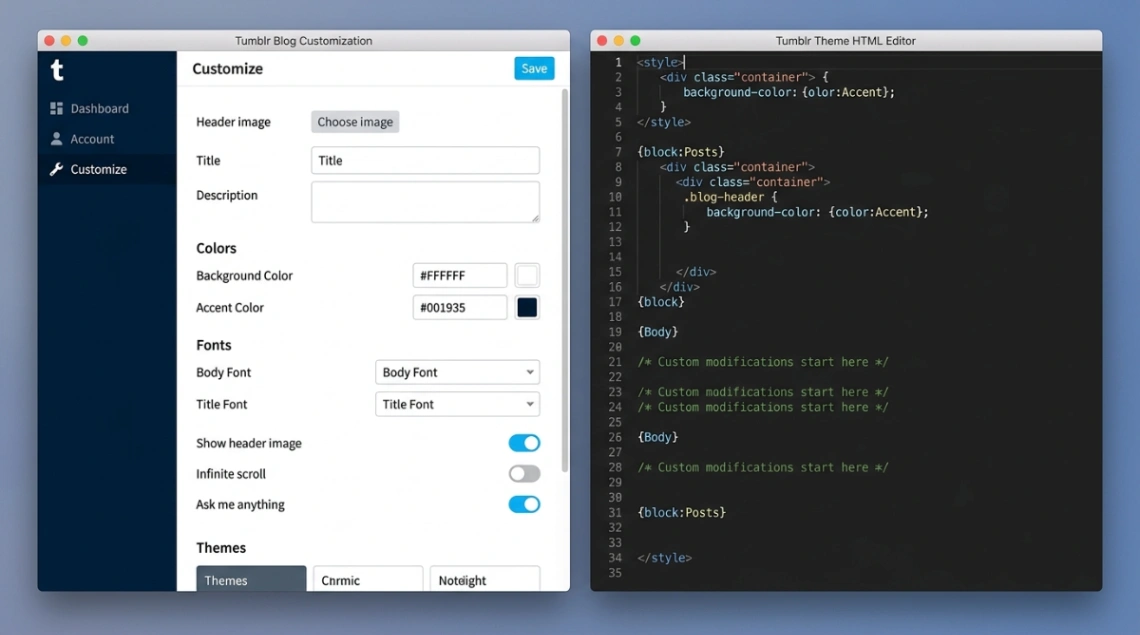
The genius was the dual-layer architecture. Casual users hit "Appearance Options" and changed colors, fonts, and layout toggles through a simple interface. Power users opened the Custom HTML editor and rewrote the theme entirely using Tumblr's variable system: {Title}, {Description}, {block:Posts}, {PhotoURL-500}. You could go from "I changed my background to lavender" to "I built a custom portfolio site" without ever leaving the platform.
I've watched this pattern get rediscovered roughly every three years since. Webflow charges $30+/month for what teenagers were doing on Tumblr for free in 2012. The mechanism that made it work was immediate visual feedback. You pasted CSS into the override box, hit save, and saw the change. That feedback loop is what most "drag-and-drop" builders still struggle to replicate today.
Tumblr also separated content from presentation in a way that the table-layout era of web building had completely failed to do. Your posts lived in a database. Themes pulled them out and rendered them. Switch themes at any moment, content stayed intact. That separation is fundamental to every modern CMS.
The Theme Garden: A Marketplace That Trained a Generation
The Theme Garden launched around 2009 and turned Tumblr into something stranger than a microblog: a design-centric ecosystem with a working creator economy.
Premium themes ran $9 to $49. To get listed, designers had to support all seven post types, meet aesthetic standards, and host assets on Tumblr's servers. That last rule kept the platform stable when third-party image hosts inevitably died.
What's interesting from a 2026 vantage point is the second-order effect. Designers used Tumblr as a portfolio engine, stripping themes down and rebuilding them as personal brand sites or job-application landers. A surprising number of working web designers today started by editing Tumblr themes as teenagers. The platform accidentally trained a generation in CSS, the DOM, and the basic rhythm of front-end work.
Here's the theme architecture in plain terms:
| Component | What It Does | Example |
|---|---|---|
| Meta Tags | Control GUI options users see | {color:Background}, {font:Body} |
| Standard Variables | Inject blog-wide data | {Title}, {Description}, {RSS} |
| Post Blocks | Loop through and render content | {block:Posts}, {block:Photo} |
| Post Data | Render content inside a post | {Body}, {PhotoURL-500}, {Quote} |
| Navigation | Pagination and social meta | {block:Pagination}, {NoteCount} |
If that table looks familiar, it's because it's roughly the schema every templating engine has used since. The lineage runs straight from Tumblr through the Dreamweaver-vs-FrontPage era of WYSIWYG tools into modern frameworks. Tumblr just made it accessible to a 14-year-old with a fandom blog.
The $1.1B Lesson: When Corporate Owners Break What They Buy
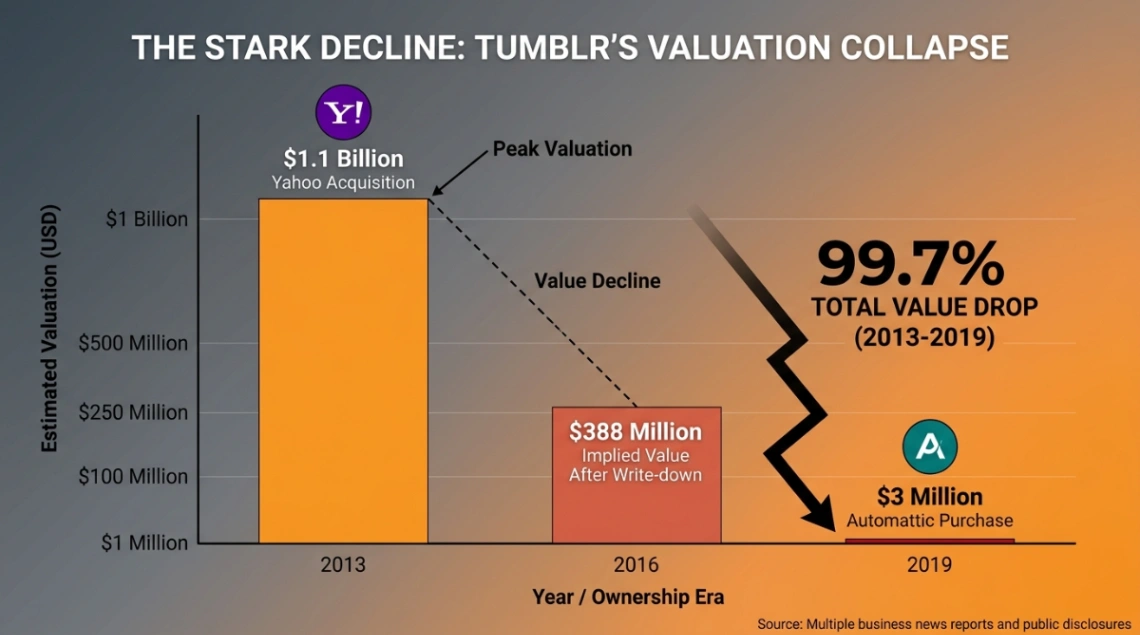
In May 2013, Yahoo bought Tumblr for $1.1 billion. By 2016, Yahoo had written down $712 million of that value. By August 2019, Automattic bought what was left for $3 million. That's a 99.7% drop in valuation in six years, and the lesson for any founder thinking about acquisition is uncomfortable.
The post-mortem is fairly clear:
- Cultural mismatch. Yahoo's corporate culture clashed with Tumblr's edgy, fandom-driven base. Leadership didn't understand the product they bought.
- Aggressive monetization. Karp had famously kept ads minimal. Yahoo pushed integration with their sales team, alienating users without attracting premium advertisers.
- The 2018 adult content ban. Following SESTA/FOSTA legislation and an App Store removal, Tumblr banned adult content site-wide. According to SimilarWeb, the platform lost 151 million monthly page views (a 29% drop) within two months. LGBTQ+ user engagement reportedly halved as automated flagging caught non-explicit queer content.
| Metric | Pre-Ban (Nov 2018) | Post-Ban (Feb 2019) | Change |
|---|---|---|---|
| Monthly Page Views | 521M | 369M | -29.1% |
| LGBTQ+ Engagement | High | Halved | -50.0% |
| Google Search Interest | 100 (peak) | 34 | -66.0% |
This is the part of the no-code history nobody loves discussing. A platform's value lives in its community, not its tech stack. Yahoo extracted revenue in ways that destroyed the cultural capital that made Tumblr worth buying in the first place. If you're a founder evaluating where to build, the ownership and incentives of your platform host matter more than the feature list.
Tumblr in 2026: Niche, Battered, Still Standing
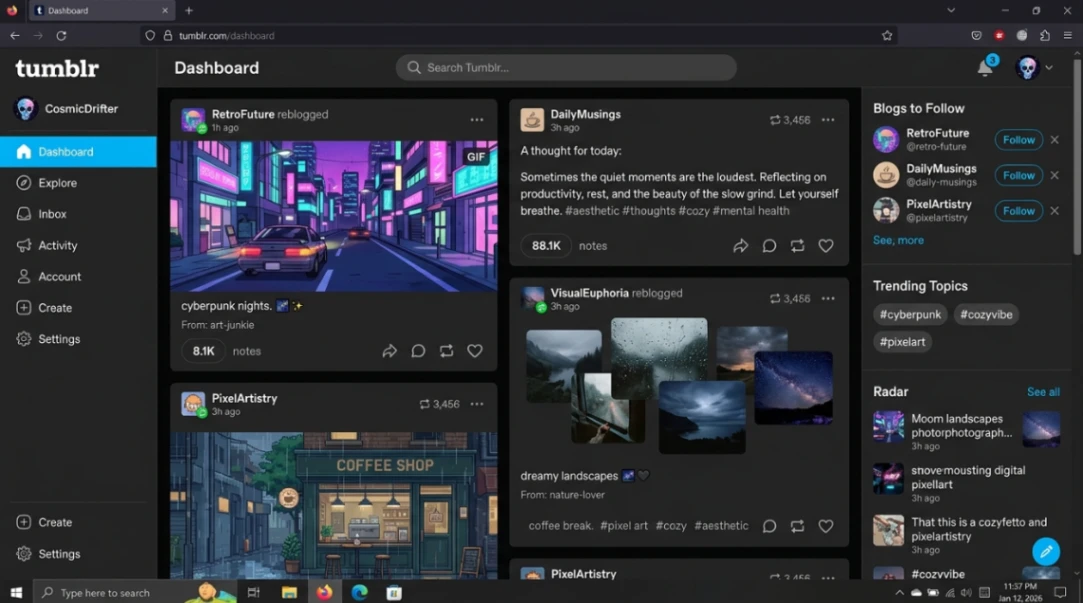
Tumblr in 2026 has roughly 135 million monthly active users and hosts over 626 million blogs (about 6 million more than 2025). Annual revenue sits in the $75M to $100M range, primarily from WordAds and premium features. Daily activity runs around 2,000 posts per second.
The platform is also losing money. At WordCamp Canada in 2025, Automattic CEO Matt Mullenweg called the Tumblr acquisition his "biggest failure or missed opportunity right now." The company estimated $30 million in annual losses on Tumblr in 2023, and an April 2025 workforce reduction hit the Tumblr division hard. The ambitious 2024 plan to migrate Tumblr's backend onto WordPress's infrastructure (involving 500+ million blogs, one of the largest migrations in internet history) has been indefinitely postponed.
Demographics tell the more interesting story. 70% of users are under 35, with the 18-24 cohort representing about 39% of traffic. Roughly 95% of dashboard content is reblogged rather than original, which is why Tumblr functions as a "discovery engine" more than a creation tool. Users curate; the platform surfaces.
The 2026 strategy reads as preservation, not growth: Fediverse integration via ActivityPub, AI data licensing partnerships (controversial, lucrative), and community stability for a Gen Z base that values the platform precisely because it's not algorithmic.
Tumblr vs Modern No-Code Builders: What Survived
Modern no-code tools owe Tumblr their structural DNA but not their use cases. Carrd replaced Tumblr for landing pages, Webflow for design-heavy sites, and Squarespace for small business presence. Tumblr held only the social-blog-with-customization niche.
Here's the honest comparison for someone choosing today:
| Feature | Tumblr | Carrd | Webflow | WordPress.com |
|---|---|---|---|---|
| Primary Use | Social micro-blogging | One-page landers | Pro design/CMS | Full-scale sites |
| No-Code Ease | 1-click themes | Drag-and-drop | Visual canvas | Block-based |
| Custom Code | Full HTML/CSS | Limited | Pro-tier code | Plugin ecosystem |
| Built-in Audience | Yes (dashboard) | None | None | Emerging Reader |
| Cost | Free, unlimited | $19/year | $14+/month | Free to tiered |
The big takeaway: every modern builder is better than Tumblr at one thing, but none of them combine free hosting, full HTML/CSS access, AND a native audience. That bundle was Tumblr's moat, and it's still the reason 135 million people haven't left. If you're picking between the current heavyweights like Wix and Framer, or weighing Framer against Webflow, Tumblr isn't the right answer for a business site. But it's still the right answer for a fandom, a zine, or an aesthetic portfolio.
Deal-Breaker Questions for Founders Studying Tumblr
Is Tumblr actually usable as a real website builder in 2026? Depends on what you're building. For a portfolio, fan project, or experimental zine: yes, and free hosting with custom HTML is genuinely competitive. For a business site that needs SEO, e-commerce, or commercial reliability: no. Tumblr's SEO has always been weak, and the platform's financial uncertainty under Automattic means betting your business on it carries real risk. Use it for creative side projects, not core infrastructure.
Can you still customize a Tumblr theme with full HTML/CSS in 2026? Yes. The Custom HTML editor and the variable/block system still work, and the Theme Garden still operates as an open-source-ish marketplace on GitHub. If you want to learn the basics of front-end work in a low-stakes way, editing a Tumblr theme is honestly still one of the best entry ramps available. It's how a lot of working designers started.
Does Tumblr's no-code legacy actually matter if I'm picking a builder today? More than you'd think. The block-based editing model in Gutenberg, Notion, Framer, and Webflow all owe structural debt to what Tumblr shipped in 2007. Understanding why Tumblr worked (constrained inputs, separation of content and presentation, immediate visual feedback) helps you evaluate which modern builder is well-designed and which is just dragging boxes.
Is Tumblr safe long-term given Automattic's financial struggles with it? Honestly, I'd be cautious. Mullenweg has publicly called it a failure, the migration is postponed, the team got cut, and the platform loses money annually. That doesn't mean it's shutting down (Automattic seems committed to the brand), but if you're planning a multi-year project, host it somewhere with a clearer business model. Use Tumblr for the things Tumblr is uniquely good at, and keep your serious work elsewhere.
Start exploring launch-ready no-code templates here!
Key Takeaways
- Constrained inputs beat blank canvases. Tumblr's seven post types produced better-looking content than freeform editors because users couldn't get the formatting wrong. Modern block editors borrowed this directly.
- A platform's moat is its community, not its features. Yahoo bought Tumblr's tech stack and ignored its culture. The $712M write-down is what that mistake costs.
- Free + customizable + built-in audience is a bundle no one has fully replicated. Carrd is cheaper to operate, Webflow is more powerful, WordPress is more durable. None combine all three the way Tumblr did.
The deeper lesson is that no-code isn't really about avoiding code. It's about lowering the cost of trying things. Tumblr lowered that cost more aggressively than almost any platform of its era, and the side effect was a generation of teenagers who learned CSS without realizing it. The current crop of AI-assisted builders is chasing the same goal through different mechanics, but the principle hasn't changed: give people a constrained, forgiving environment and they'll build things that surprise you. The platforms that forget this lose, regardless of how impressive their feature lists look.
FAQ
When did Tumblr launch and who founded it? Tumblr launched in February 2007. It was founded by David Karp, then 20, with lead developer Marco Arment. Karp built the first version in roughly fourteen days from his mother's New York apartment after waiting over a year for WordPress or TypePad to release a native short-form blogging tool.
How much did Yahoo pay for Tumblr, and how much did Automattic pay? Yahoo acquired Tumblr in May 2013 for $1.1 billion. After Yahoo wrote down $712 million of that value and Verizon inherited the platform, Automattic (WordPress.com's parent company) acquired Tumblr in August 2019 for a reported $3 million. That's a 99.7% drop in six years.
What is a "tumblelog"? A tumblelog is a short-form, stream-of-consciousness blog focused on mixed media (photos, quotes, links, GIFs) rather than long-form essays. The format predates Tumblr by a few years, but Tumblr was the first mainstream platform to make tumblelog-style posting accessible to non-technical users without manual coding.
How many users does Tumblr have in 2026? Tumblr has approximately 135 to 142 million monthly active users in 2026, hosting over 626 million blogs. Roughly 70% of users are under age 35, with the 18-24 demographic representing about 39% of traffic. Daily activity runs around 2,000 posts per second.
Is Tumblr free to use? Yes. Tumblr is free for unlimited blogs, posts, and full HTML/CSS theme customization. Premium themes in the Theme Garden range from $9 to $49 (one-time), and the platform sells optional premium features and an ad-free upgrade. There's no required paid tier to host a fully customized site.
Start building without code
Browse thousands of no-code templates for Webflow, Framer, Bubble, Lovable, Replit and more.
Explore Templates