Weebly Drag and Drop Builder: Still Right for Educators?
Weebly remains a usable site builder for student e-portfolios, but its dedicated education tier shut down on August 1, 2022, and parent company Block, Inc. has cut 40% of its workforce to focus on AI. Educators should weigh COPPA compliance and migration risk before committing a classroom to it.
Table of Contents
- How the Grid Builder Actually Works
- The Education Tier Shutdown
- Weebly vs Google Sites vs Wix for Schools
- Deal-Breakers for K-12 Educators
- Key Takeaways
- FAQ
Introduction
For about a decade, Weebly was the default answer when a teacher asked "how do I get my students publishing online without a CS degree?" That answer is messier now. The platform powers about 25 million active websites globally, but its market share has slipped to roughly 0.4% with a 15% year-over-year decline.
For K-12 and community college educators choosing tools for student e-portfolios, the question isn't whether Weebly can still do the job. It can. The question is whether it should, given that Block, Inc. shuttered the dedicated education tier in 2022 and just laid off 4,000 people to chase AI agents. This piece walks through what changed, what still works, and where the real red flags hide.
How the Drag and Drop Builder Actually Works
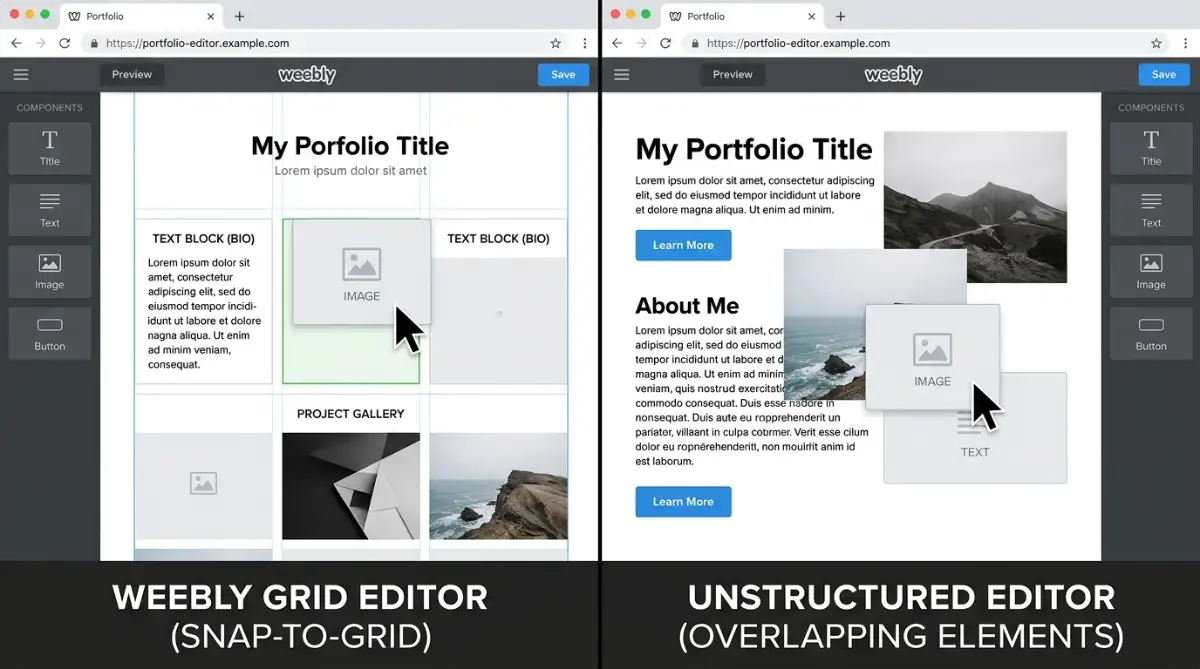
Weebly uses a structured grid system: every text box, image, or map snaps into rows and columns inside content blocks, rather than floating freely on the page. This is the single biggest reason teachers picked it over alternatives.
That snapping behavior is the point. When a 7th-grader drags a YouTube embed onto their portfolio, it can't end up half off the page or overlapping the navigation. The grid catches mistakes before they become tech-support tickets. Mobile responsiveness happens automatically too, because the platform collapses columns based on grid position rather than asking a kid to design a separate phone version.
The trade-off is real. You can't place an element by the pixel, which means asymmetrical or "designed" portfolios are off the table. I've seen art teachers run into this fast. If a student wants their photography site to feel like a curated magazine spread, the grid will fight them every step of the way. For a science fair write-up or a reading journal, that same rigidity is a feature.
The Education Tier Shutdown and What Replaced It
Weebly for Education was officially discontinued on August 1, 2022, converting teacher accounts to the standard free tier and removing the specialized student-management features classrooms relied on.
This matters more than the announcement made it sound. Before the shutdown, teachers had a centralized dashboard for managing dozens of student accounts, password-protected "walled garden" classroom sites, and bulk privacy controls. After August, all of that became manual. Lock down 30 student sites? You're doing it 30 times. Bulk-export portfolios at year end? There's no native tool.
This aligns with the broader Block story. Square acquired Weebly for about $365 million on June 4, 2018, and ever since, the original SaaS-builder DNA has been redirected toward serving Square's merchant base. Education simply isn't where the revenue is.
Weebly vs Google Sites vs Wix for Schools
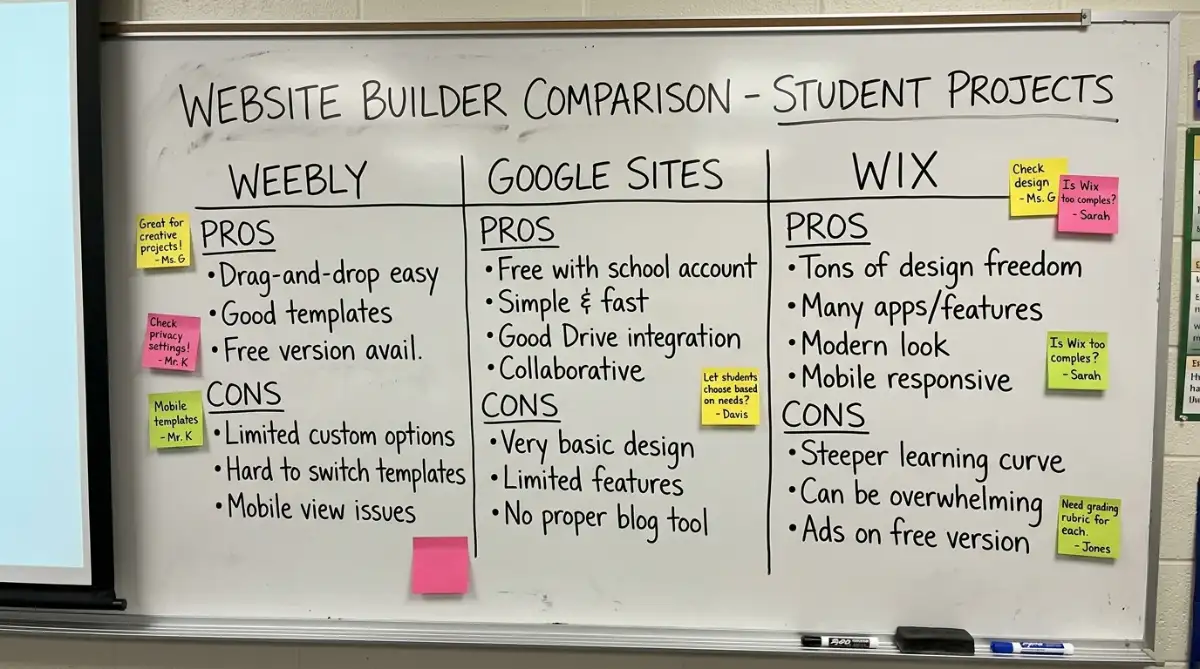
For school use specifically, the comparison narrows to three contenders, and each one wins on a different axis. Weebly wins on visual polish for student-facing portfolios; Google Sites wins on collaboration and cost; Wix wins on long-term flexibility.
| Platform | Best For | Cost | Education Fit |
|---|---|---|---|
| Weebly | Student e-portfolios with clean visuals | $10/mo paid, free tier available | Workable but no education tier |
| Google Sites | Internal classroom collaboration | Free with Workspace for Education | Strongest LMS integration |
| Wix | Schools planning long-term scale | $17/mo | More features, steeper curve |
| Squarespace | Design-focused capstone projects | $16/mo | Beautiful templates, higher floor |
Honestly? Most teachers I've talked to who left after the shutdown didn't go to a competitor. They went to Google Sites, because the district already paid for Workspace for Education and IT had already cleared it for student data. Weebly stayed the better-looking option but lost the "free and approved" advantage that made it dominant.
For context on how the broader no-code builder landscape has shifted toward AI generation, the calculus outside schools differs. Classrooms are weird; procurement, privacy, and parent-consent friction usually outweigh editor preferences.
Drag and Drop Builder Deal-Breakers for K-12 Educators
These are the questions that should determine whether you start a new class on this platform, not whether the editor "feels nice."
Is Weebly safe for student data under the new COPPA rules? The updated COPPA framework adds biometric and data-retention requirements with a hard compliance deadline of April 22, 2026. The platform hasn't published a clear public statement of how its consent and data-deletion workflows meet the new rules. Until your district's privacy officer confirms it in writing, treat this as unresolved. The FTC's $20 million Cognosphere settlement is a reminder that legacy platforms get fined too.
What broke when Weebly for Education shut down? Bulk student account management, classroom-wide privacy presets, and the centralized teacher dashboard. The site editor itself didn't change. A solo teacher with one class blog probably won't notice. A department head running portfolios across six sections will feel it within a week.
Can I migrate a class's worth of student sites elsewhere? Not easily. There's no automatic export tool that moves content to other builders. Migration means rebuilding each site by hand, which is a non-starter for archived student work.
Is the platform going to be supported in three years? Block cut its workforce from 10,000 to roughly 6,000 employees, and Jack Dorsey has said the company is rebuilding around AI agents like Goose and ManagerBot. Weebly is now an "onboarding tool" for Square commerce, not a strategic priority. Analysts describe a "managed decline."
Does the lack of AI matter for teaching digital literacy? Depends on your curriculum. If you're teaching kids to think about layout, hierarchy, and audience, a manual editor is arguably better than tools that auto-generate everything. If you're teaching them modern professional tools, this is a museum piece.
Start exploring launch-ready no-code templates here!
Key Takeaways
- The drag and drop builder still works fine for individual student portfolios, but the institutional features that made it the educator favorite (bulk management, walled-garden classrooms, centralized dashboards) have been gone since August 2022.
- The April 22, 2026 COPPA deadline is the most urgent practical concern; if your district hasn't confirmed compliance posture in writing, that's the conversation to have before next semester.
- Google Sites is the realistic default for most K-12 classrooms now, and Weebly's lasting value is narrower: a single teacher running a single portfolio class who values visual polish over admin tooling.
The deeper story isn't really about one product. The era of consumer site builders being designed for educators is over. Block's bet is that AI agents will handle the building, and education tech will consolidate into Workspace-style stacks bundled by districts. Weebly was the tool that taught a generation of students they could publish on the open web without permission. That generation has graduated. What replaces it is still being written.
FAQ
What is Weebly used for in schools? Weebly is used by teachers and students to build classroom blogs, student e-portfolios, and project showcase sites without writing code. It was historically the most popular site builder in K-12 education before its dedicated education tier was discontinued in 2022.
Is Weebly free for teachers? Yes, the standard free tier is available to teachers, but the dedicated "Weebly for Education" service with bulk student management and classroom privacy controls ended on August 1, 2022. Paid plans start around $10 per month.
Weebly vs Google Sites for student portfolios? Weebly produces better-looking portfolios with more design control. Google Sites integrates more cleanly with Workspace for Education and is free for districts. Most schools now choose Google Sites for compliance and cost reasons.
How many websites does Weebly host today? Approximately 25 million active websites globally as of 2024-2025, including about 37,495 active e-commerce stores as of Q2 2025. Its global share is around 0.4%, declining roughly 15% year-over-year.
Who owns Weebly? Block, Inc. (formerly Square) acquired Weebly on June 4, 2018, for approximately $365 million in cash and stock. Founder David Rusenko built the platform from a Penn State dorm room in 2006.
Start building without code
Browse thousands of no-code templates for Webflow, Framer, Bubble, Lovable, Replit and more.
Explore Templates