How IE vs Netscape Gave Us Modern Site Builders
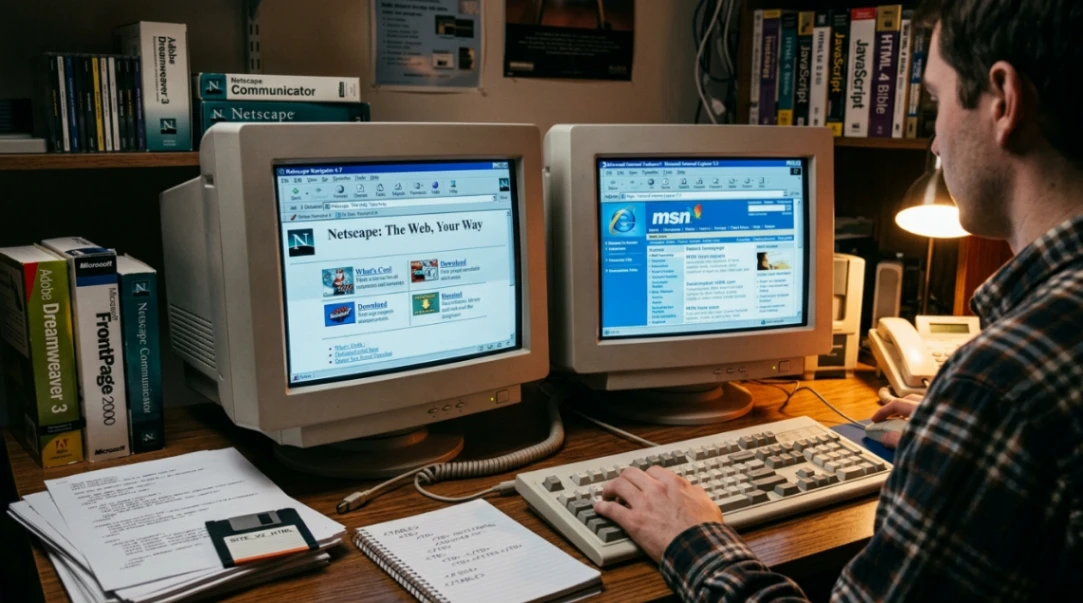
The browser wars between Netscape Navigator and Microsoft Internet Explorer (1995–2002) forced developers to build the first WYSIWYG site builders to manage cross-browser chaos. Tools like Microsoft FrontPage and Macromedia Dreamweaver were born directly out of this fragmentation. Their legacy lives on in every modern no-code platform you use today.
Table of Contents:
- Introduction: Why a Corporate Rivalry Built the Modern Web
- How Netscape and IE Created a Developer's Nightmare
- The First Site Builders: FrontPage vs. Dreamweaver
- The "Best Viewed In" Era and Its Weird Cultural Legacy
- From IE's Dark Ages to the No-Code Movement
- Key Takeaways
- FAQ
I've spent a lot of time digging into web history, and honestly, the browser wars story is one of those things that sounds like boring corporate drama until you realize it literally shaped every website you've ever visited. Let me walk you through how a rivalry between two software giants ended up creating the site builders we all rely on today.
How Netscape and IE Turned Web Development Into a Battlefield
It all started with NCSA Mosaic in 1993, a browser developed by Marc Andreessen and Eric Bina at the University of Illinois. Mosaic introduced the inline image tag, which let graphics appear alongside text for the first time. That single feature transformed the web from an academic text directory into something that actually looked like... a website.
Andreessen took that momentum and co-founded Netscape Communications. Their browser, Netscape Navigator, launched in late 1994 and rocketed to 80% market share by mid-1995. That dominance didn't go unnoticed.
Microsoft pivoted hard. Bill Gates' famous May 1995 "Internet Tidal Wave" memo triggered a full corporate pivot, and Internet Explorer 1.0 launched in August 1995. What followed was a textbook case of "Embrace, Extend, and Extinguish" (EEE):
- Embrace the open web standards
- Extend them with proprietary IE-only features
- Extinguish competitors by bundling IE free with Windows
By 1998, IE had overtaken Netscape. By 2002, IE owned a staggering 95% market share.
| Year | Netscape Share | IE Share | Key Event |
|---|---|---|---|
| 1995 | ~80% | <5% | Netscape's first-mover advantage |
| 1997 | 51% | 40% | IE 4.0 integrated into Windows |
| 1998 | <40% | >50% | DOJ Antitrust trial begins |
| 2002 | Negligible | 95% | Peak IE monopoly |
The mess this created for developers? Absolutely brutal. Netscape introduced JavaScript in 1995 for dynamic content. Microsoft responded with a reverse-engineered version called JScript, plus VBScript. Netscape added the infamous <blink> tag. Microsoft retaliated with <marquee>. Neither was a W3C standard. Both caused accessibility nightmares. Both became symbols of what happens when corporations priorize market share over the open web.
As G2's 30-year retrospective on the browser wars notes, the history is clear: no leader stays on top forever, and the tools developers used to survive each era were shaped directly by whatever chaos the reigning browser had caused.
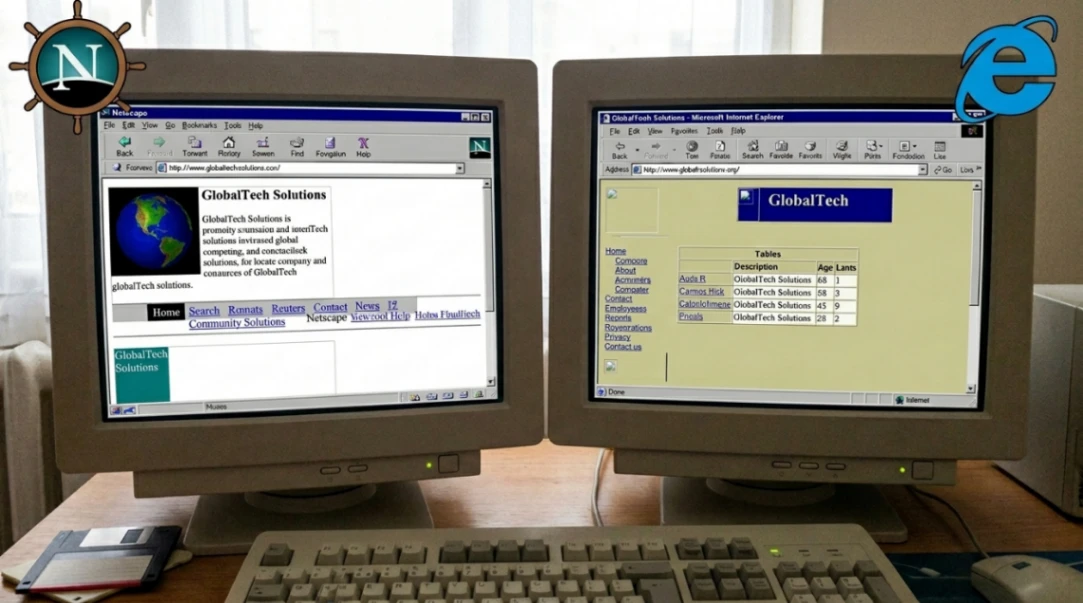
The First Site Builders: FrontPage vs. Dreamweaver
Here's where it gets really interesting for anyone who loves no-code history. The cross-browser chaos created a market for WYSIWYG (What You See Is What You Get) editors that could help non-technical users build websites without touching a single line of HTML.
Two tools dominated, and they couldn't have been more different.
Microsoft FrontPage: The Corporate Starter Kit
Microsoft aquired Vermeer Technologies in January 1996 to get its hands on FrontPage, then bundled it into Microsoft Office. The pitch was simple: build a website as easily as you'd write a Word doc.
According to Tedium's deep dive into FrontPage's history, Vermeer's original strategy was explicitly designed to create lock-in so neither users nor the industry could easily switch to a competitor. Sound familiar? It's the same playbook Microsoft used against Netscape.
The catch? FrontPage generated notoriously bloated HTML and was optimized almost exclusively for Internet Explorer. It relied on FrontPage Server Extensions (FPSE), proprietary server-side programs that enabled search, hit counters, and forums without needing custom scripts. But to use them, you had to:
- Host on a Windows server with FPSE installed
- Have visitors use Internet Explorer for interactive elements to work
Classic lock-in. You can read the full story of how FrontPage shaped a generation of web builders here.
Macromedia Dreamweaver: The Professional's Playground
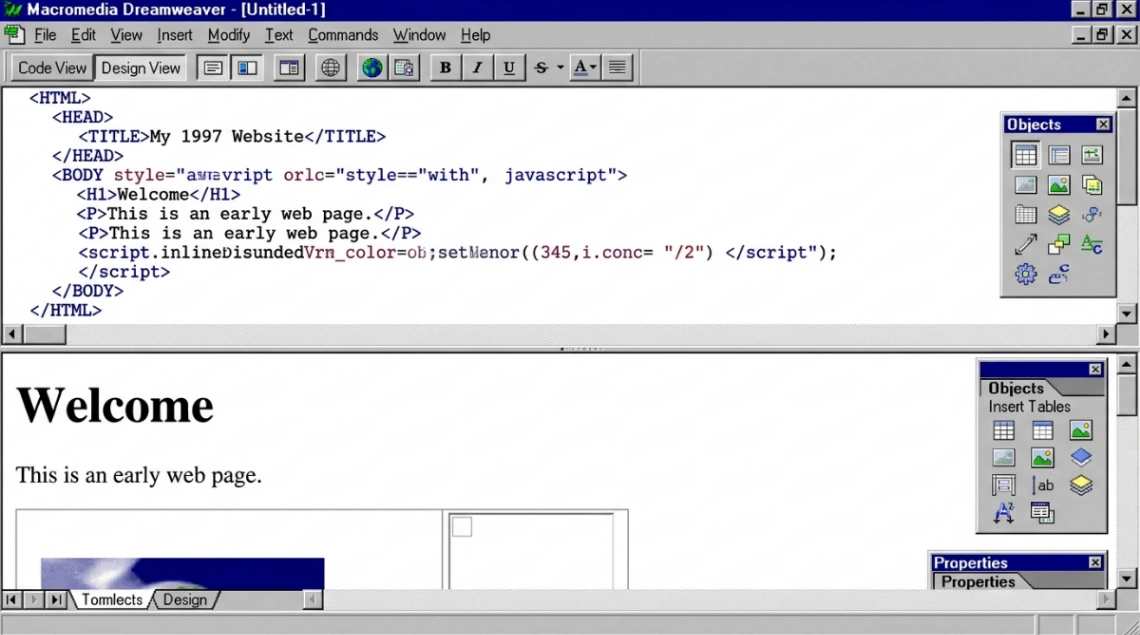
Dreamweaver launched in 1997 and took the opposite approach. Its "Roundtrip HTML" philosophy promised it would never mangle hand-written code, which was a huge deal for developers who were sick of FrontPage's automated bloat.
According to The Knowledge Academy's guide to Dreamweaver, it rapidly became a favourite among web designers due to its user-friendliness and adherence to a range of web standards, a stark contrast to FrontPage's IE-first approach.
Dreamweaver was also a pioneer in supporting Cascading Style Sheets (CSS), which was a nascent technology that would eventually become the backbone of modern web design. Its "split view" showing code and visual design simultaneously became a vital bridge that taught an entire generation of designers how HTML and CSS actually worked.
Want to dig into how these two tools went head-to-head? Check out our deep-dive on Dreamweaver vs. FrontPage: the first no-code war.
| Tool | Target Audience | Strategy | Legacy |
|---|---|---|---|
| MS FrontPage | Small businesses, non-tech users | Bundled with Office; proprietary extensions | Discontinued |
| Macromedia Dreamweaver | Agencies, pro designers | CSS support; standards focus | Still active under Adobe |
| Netscape Composer | Students, hobbyists | Free with Netscape Communicator | Evolved into open-source tools |
The "Best Viewed In" Era and Its Weird Cultural Legacy
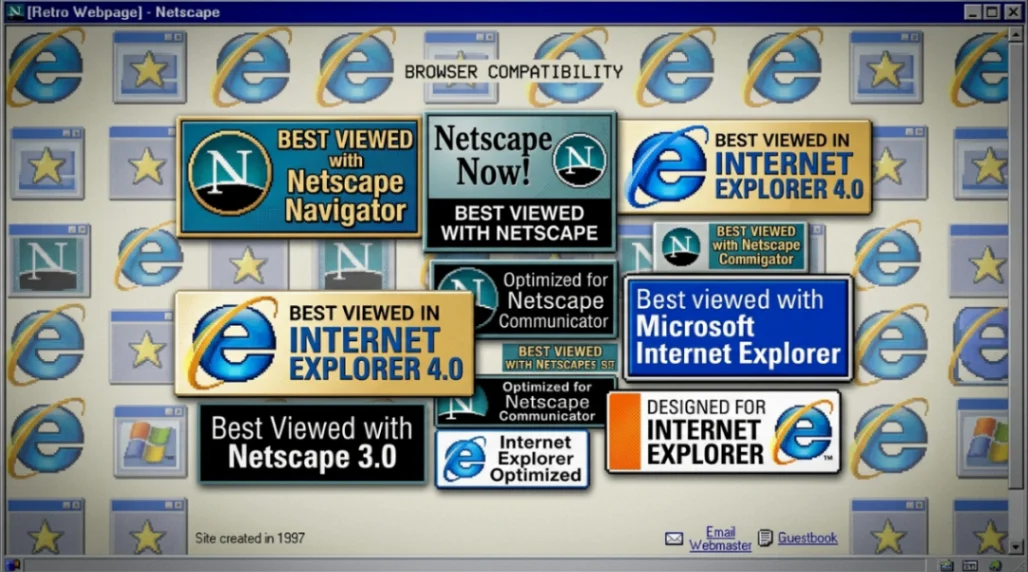
If you were online in the late 1990s, you remember those little badges on websites: "Best Viewed in Internet Explorer 4.0" or "Best Viewed in Netscape Navigator." These weren't just reccomendations. They were survival guides.
A site designed for Netscape might crash entirely in IE, and vice versa. As documented by Cybercultural's detailed account of the MTV browser deal, MTV.com displayed an IE badge on its homepage from July 1997 in exchange for being a default link in IE 4.0, and the details of that deal were later produced as evidence in the DOJ's antitrust trial against Microsoft. Imagine major brands today making exclusive deals with a browser. It sounds absurd now, but that was just Tuesday back then.
This era birthed the "webmaster," that uniquely 1990s hybrid of designer, developer, and server admin who held all the tribal knowledge needed to keep a site running across incompatible browsers. They often maintained multiple versions of the same page: a frames version for fast Netscape users, a text-only "decaf" version for everyone else.
The fragmentation was so bad it actually drove the creation of early web archives, because designers knew that sites built for specific browser versions would simply stop working. If you're curious about those quirky early personal web pages that thrived in this era, the story of GeoCities and Angelfire is a fascinating read.
In 1998, a grassroots coalition called the Web Standards Project (WaSP) formed to fight back. As The History of the Web's account of WaSP explains, the group realized the problem wasn't with the code. It was with browsers that refused to adhere to open W3C specifications. Their "Acid Tests" provided a visual way to check whether a browser rendered CSS correctly. It worked, eventually.
From IE's Dark Ages to the No-Code Movement We Know Today
After Netscape collapsed and was aquired by AOL, IE hit 95% market share by 2002. With no real competition, Microsoft disbanded most of the IE development team. What followed was a five-year stretch developers called the "Deep Freeze", a period where the web was essentially frozen at IE6's capabilities.
IE6 was a nightmare to build for. It lacked support for transparent PNGs. It had a broken box model. Developers needed hacks just to display basic layouts correctly, including the famous Tantek Çelik Box Model Hack, which exploited a CSS parser bug to serve different widths to different browsers. Wild times.
Then Firefox arrived in 2004. Then Chrome in 2008, with its V8 JavaScript engine that compiled JS directly to machine code. By 2012, Chrome was the global leader. Competition was back, and with it came a new wave of innovation in web building tools.
The evolution from those early site builders to modern no-code platforms is a direct line:
| Era | Paradigm | Key Tools | Developer Philosophy |
|---|---|---|---|
| 1995–2005 | WYSIWYG Page Builders | FrontPage, Dreamweaver | Abstracting code for non-programmers |
| 2005–2015 | CMS Proliferation | WordPress, Shopify, Squarespace | Democratizing content ownership |
| 2015–2024 | Modern No-Code | Webflow, Bubble, Wix | Visual programming without limits |
| 2024–Present | AI-Native Era | Framer, ChatGPT Atlas | Intent-based creation |
Modern no-code platforms like Webflow are the spiritual successor to Dreamweaver's visual-layer approach, built on clean, standards-compliant code rather than proprietary lock-in. That's the direct victory of the web standards movement playing out in your browser right now.
As of 2026, Google's Chromium engine powers roughly 75% of web traffic, which has led some developers to call Chrome "the new IE." As Mozilla's own policy blog argues, when innovation is built on a single dominant engine, it concentrates technical and economic power, narrowing choice and steering the web toward the priorities of a few large platforms rather than the public interest. History has a funny way of rhyming.
AI-native browsers like ChatGPT Atlas and Perplexity Comet are now transforming the browser from a passive viewer into an active research agent, which will once again reshape how site builders think about the web. As Netscape's rise and fall story on Medium reminds us, when you build something revolutionary on top of someone else's platform, you're ultimately at their mercy. A lesson every no-code builder should keep in mind.
Explore launch-ready no-code templates here!
Key Takeaways
-
The browser wars directly created site builders. The incompatibility between Netscape Navigator and Internet Explorer was so severe that it created a market for WYSIWYG tools. FrontPage and Dreamweaver were built to manage that chaos, not despite it.
-
Proprietary lock-in vs. open standards is the oldest story in the web. FrontPage's reliance on Windows servers and IE-specific features is a cautionary tale that still echoes in every platform that tries to wall off its users. The web standards movement eventually won, and modern no-code tools are built on that victory.
-
Competition drives everything. When IE hit 95% market share and Microsoft stopped developing it, the web stagnated for five years. Firefox and Chrome broke the monopoly. Today, the dominance of Chromium and the rise of AI browsers are the next chapter in this same story. The browser wars never really ended — they just got better dressed.
The web was forged in conflict, and honestly? That's what made it great. Every time one company gets too comfortable, a scrappy upstart shows up to break things open again.
FAQ
What were the browser wars? The browser wars were a competitive battle between Netscape Navigator and Microsoft Internet Explorer from roughly 1995 to 2002, during which both companies introduced incompatible proprietary features to gain market dominance.
How did the browser wars lead to the creation of site builders? The incompatibility between Netscape and IE made web development so complex that tools like Microsoft FrontPage and Macromedia Dreamweaver were built specifically to help non-technical users manage cross-browser HTML without writing code manually.
What was Microsoft FrontPage's biggest problem? FrontPage generated bloated HTML and required FrontPage Server Extensions on Windows hosting servers, creating a proprietary ecosystem that locked users into Microsoft's infrastructure and IE-dependent features.
What is Dreamweaver's legacy in modern no-code tools? Dreamweaver pioneered the visual-plus-code hybrid editing approach and was an early champion of CSS standards. Modern no-code platforms like Webflow are essentially its spiritual successors, built on the same visual-layer philosophy but with clean, standards-compliant output.
Is the browser monoculture a problem today? Yes, as of 2026 Google's Chromium engine powers around 75% of web traffic. Many developers compare this to the IE6 era, raising concerns about web diversity and what happens if a single engine again stagnates without competition.
Start building without code
Browse thousands of no-code templates for Webflow, Framer, Bubble, Lovable, Replit and more.
Explore Templates